What is generative engine optimization? A practical guide
Generative engine optimization (GEO) gets your brand cited in ChatGPT, Perplexity and Google AI Overviews. What the research shows and a step-by-step plan.


Generative engine optimization (GEO) is the practice of making your content and brand more likely to be retrieved, quoted and cited by AI answer engines such as ChatGPT search, Perplexity, Google AI Overviews and Microsoft Copilot. Where SEO aims for a ranked link, GEO aims for a place inside the generated answer. It builds on SEO rather than replacing it: most of the work is making your best pages easy to find, easy to quote and backed by what other people say about you.
The stakes are simple. When the answer is written for the user, the brand that supplied it only gets credit if it is named. A Pew Research Center study of 68,879 Google searches by 900 US adults found that people clicked a traditional result on 8% of visits when an AI summary appeared, versus 15% when none did. They clicked a link inside the summary on just 1% of visits.
Where the term "generative engine optimization" comes from
The term comes from a research paper, not a marketing agency. GEO: Generative Engine Optimization by Pranjal Aggarwal, Vishvak Murahari, Tanmay Rajpurohit, Ashwin Kalyan, Karthik Narasimhan and Ameet Deshpande was posted to arXiv in November 2023 and published at KDD 2024. The authors were based at Princeton University and IIT Delhi, alongside independent researchers.
The paper defines a generative engine as a system that retrieves relevant documents from the web and uses a large language model to write a response grounded in those sources. GEO is their framework for helping content creators improve how visible their content is inside those responses.
To test it, the team built GEO-bench, a benchmark of 10,000 queries, and measured visibility two ways: how many words of the answer came from a source (weighted by position), and a subjective impression score graded by a language model. Then they rewrote source pages with nine methods and measured what changed.
What the GEO paper found
| Method | What it changes | Result in the paper |
|---|---|---|
| Quotation addition | Adds quotes from credible sources | Among the top performers on both metrics |
| Statistics addition | Swaps qualitative claims for numbers | Among the top performers on both metrics |
| Cite sources | Adds citations to reliable sources | Top performer, strongest for lower-ranked pages |
| Fluency and easy-to-understand | Improves readability and flow | Visibility boost of 15 to 30% |
| Authoritative tone | Makes text more persuasive | No significant improvement |
| Keyword stuffing | Adds more query keywords, classic SEO style | Little to no improvement, often worse than baseline |
The full results are still the most cited evidence in the field:
- Evidence beats style. The top methods (cite sources, quotation addition and statistics addition) achieved a relative improvement of 30 to 40% on the word-count metric and 15 to 30% on subjective impression.
- Keyword stuffing fails. On Perplexity, the paper's real-world test, keyword stuffing performed 10% worse than the unoptimized baseline.
- It worked on a live engine. On Perplexity, the best methods improved visibility by 22% on the word-count metric and 37% on subjective impression.
- Smaller sites gain most. Adding citations raised visibility by 115.1% for pages ranked fifth in search results, while the top-ranked page lost 30.3% on average.
- Domain matters. Statistics worked best for law, government and opinion queries; quotations for people, society and history.
- Combinations help. Pairing fluency optimization with statistics addition beat any single method by more than 5.5% in a smaller test.
Two caveats. The main experiments used a GPT-3.5-based engine the team built, and the methods change only on-page text. Commercial engines have changed since, and none publish how they rank sources. Treat the paper as directional evidence, not a formula.
GEO vs SEO, and the other names for it
GEO is not a replacement for SEO. The major engines all search the web before they answer, so a page that cannot be crawled, indexed or ranked rarely makes it into an answer. What changes is the unit of success: a citation or a mention inside a written answer, instead of a position in a list of links.
We break down the overlaps and differences, including where budgets should shift, in GEO vs SEO. If your SEO basics are not in place yet, start with SEO for startups, our playbook for teams without an SEO hire.
You will also see the same idea called answer engine optimization (AEO), LLM optimization or AI SEO. The labels overlap heavily. AEO grew out of featured snippets and voice answers, and focuses on formatting content as direct answers. We cover that angle in answer engine optimization.
How generative engines choose and cite sources
Most generative engines follow the same broad pattern. They interpret the question, run one or more searches, read a shortlist of pages, write an answer, and attach the sources they leaned on.
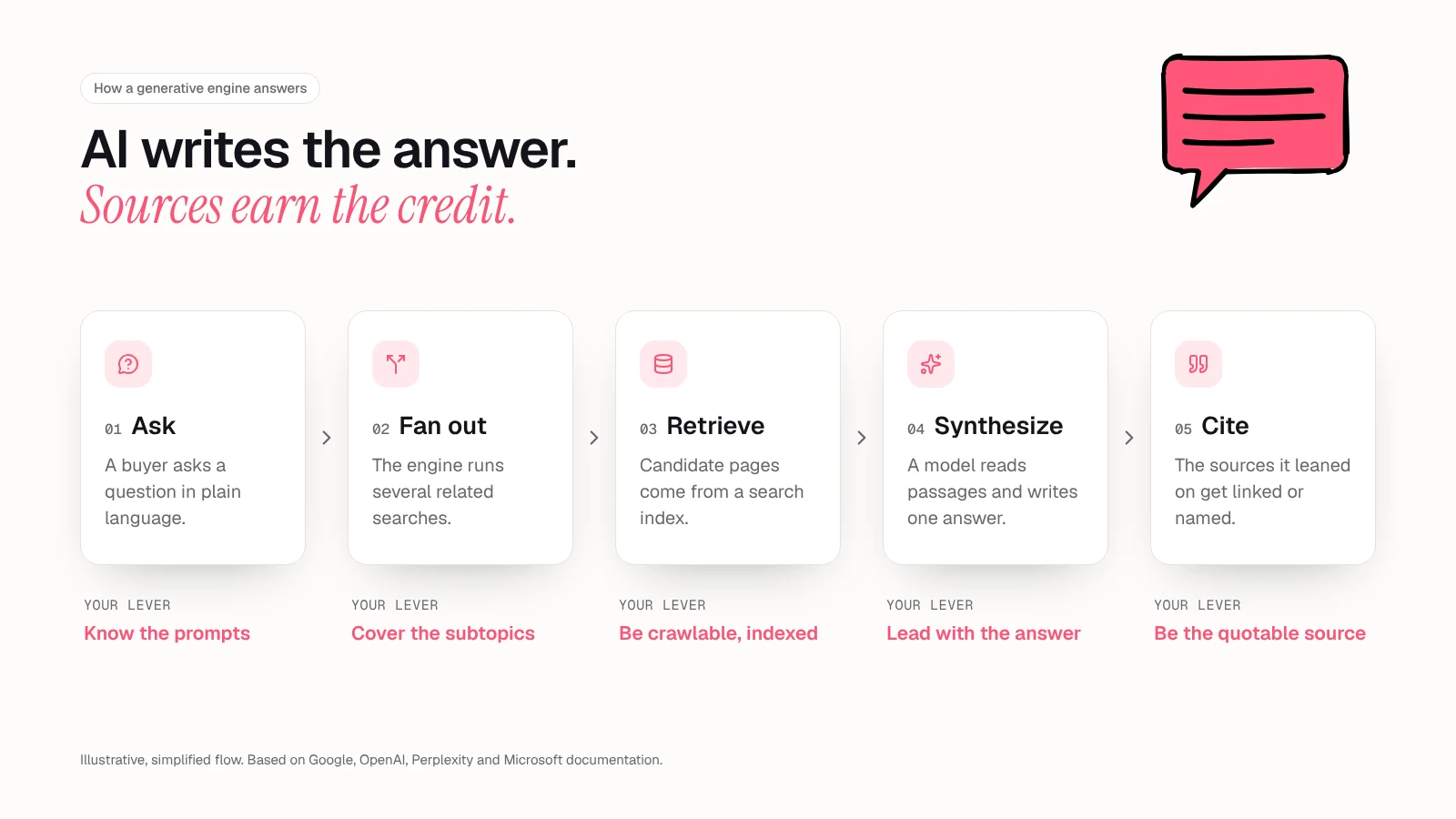
The vendors say more about eligibility than about ranking.
Google AI Overviews and AI Mode
Google's documentation on AI features says AI Overviews and AI Mode may use a "query fan-out" technique, issuing multiple related searches across subtopics and data sources to build a response. To be eligible as a supporting link, a page must be indexed and eligible to show a snippet in Google Search. Google states there are no additional technical requirements, no special schema and no AI text files needed. We go deeper on this in how to get cited in Google AI Overviews.
ChatGPT search
OpenAI says ChatGPT search draws on third-party search providers and content from partners. Its crawler documentation separates three bots: OAI-SearchBot surfaces sites in ChatGPT search, GPTBot collects data for model training, and ChatGPT-User fetches pages when a user asks. Sites that block OAI-SearchBot will not be shown in ChatGPT search answers, though they can still appear as navigational links. For the full playbook, read how to rank in ChatGPT.
Perplexity
Perplexity searches the web for each question and adds numbered citations to every answer. Its bot documentation recommends allowing PerplexityBot in robots.txt if you want to appear in results, and notes that PerplexityBot is not used to train foundation models.
Microsoft Copilot
Copilot and Bing's AI summaries cite web pages too. In February 2026 Microsoft added an AI Performance report to Bing Webmaster Tools (in public preview) that shows how often your pages are cited in Copilot, Bing's AI summaries and select partner integrations, plus the "grounding queries" used to retrieve your content.
The common thread: the retrieval step is still search. If you are not in the index the engine uses, the model never sees you.
What actually moves citations
No engine publishes a ranking formula, so the honest answer combines research, vendor guidance and large studies. Six levers show up consistently.
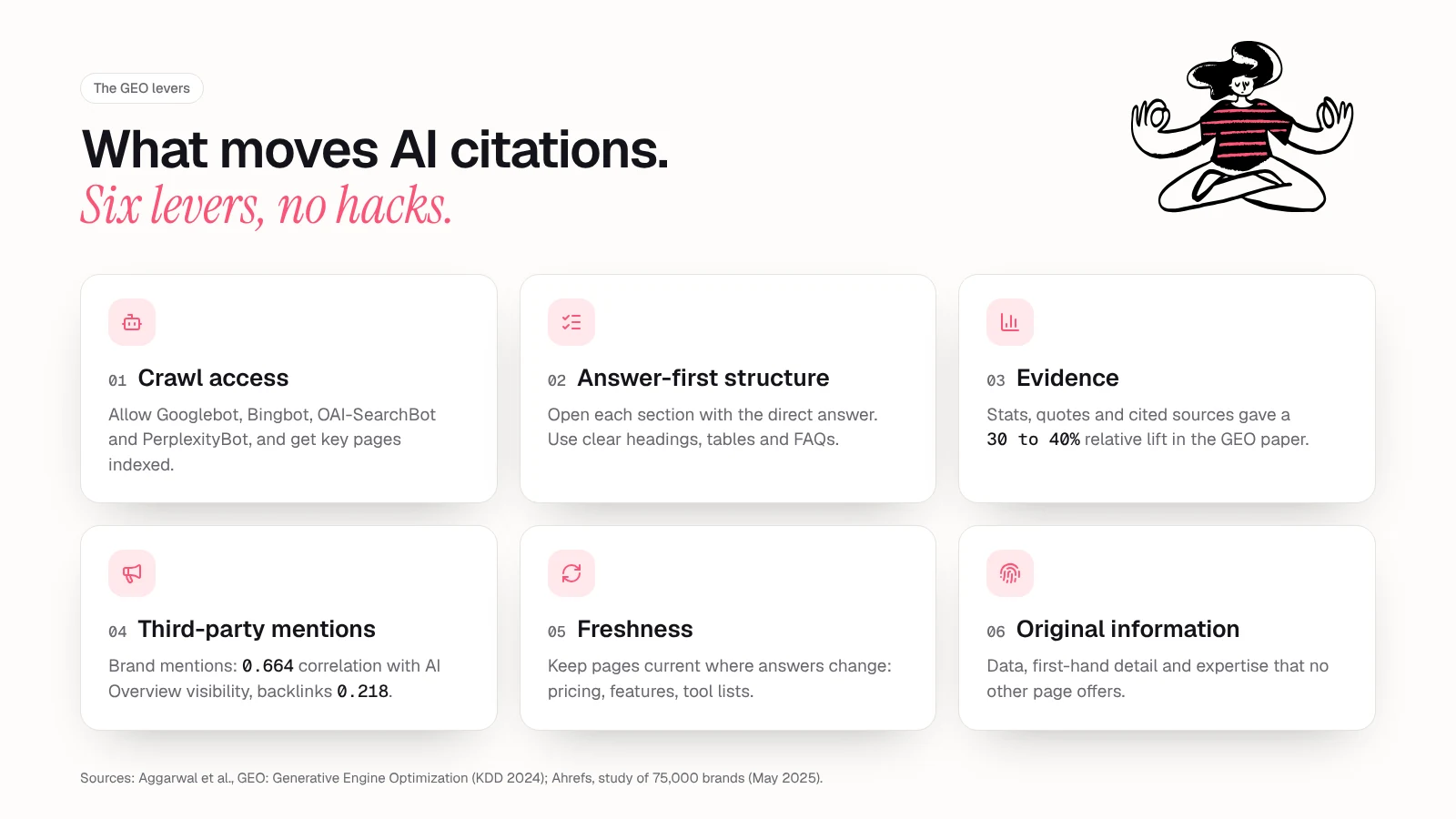
1. Crawl access and indexing
This is the gate. Google requires pages to be indexed and snippet-eligible. OpenAI and Perplexity each depend on their search crawlers being allowed.
2. Answer-first structure
Engines lift passages, not whole pages. A section that opens with a direct answer is easier to quote than one that builds up to the point. Microsoft's guidance for improving citations specifically names clear headings, tables and FAQ sections. The GEO paper found readability changes alone lifted visibility by 15 to 30%.
3. Evidence on the page
Statistics, quotations and citations to credible sources were the strongest on-page methods in the GEO paper. Microsoft also recommends supporting claims with examples and data. For most startups this is the cheapest lever.
4. Third-party mentions
What others say about you matters more than what you say about yourself. An Ahrefs study of 75,000 brands found branded web mentions had the strongest correlation with visibility in Google AI Overviews (0.664), well ahead of backlinks (0.218). Ahrefs notes that correlation is not causation. Pew's data points the same way: Wikipedia, YouTube and Reddit were the three most cited domains in Google's AI summaries.
5. Freshness
Microsoft lists keeping content current through regular updates as one of its recommendations. Many buyer questions have answers that change: prices, features, "best tools" lists. A stale page is easy to skip.
6. Original information
If your page says what fifty others say, the engine has no reason to cite you in particular. Original data, first-hand detail and named expertise give a model something it cannot get elsewhere. Microsoft's guidance puts depth and domain expertise first.
What does not move citations: keyword stuffing, persuasive or "authoritative" tone on its own, and special machine-readable files for Google, which Google says it does not need.
Generative engine optimization strategies: a step-by-step plan for startups
A startup does not need a GEO team. It needs a short list of questions that matter and a monthly loop.
- Build a prompt set. Write down 20 to 50 questions your buyers actually ask before they buy: "what is the best X for Y", "X vs Y", "how do I solve Z". Pull them from sales calls, support tickets, Search Console queries and community threads.
- Baseline your visibility. Run every prompt in ChatGPT, Perplexity, Google AI Mode and Copilot. Record whether you are mentioned, whether you are cited, how you are described and who appears instead. Run each more than once, since answers vary.
- Fix access. Check robots.txt for Googlebot, Bingbot, OAI-SearchBot and PerplexityBot. Confirm your key pages are indexed in Google and Bing, and that important text is in the HTML, not hidden behind scripts or logins.
- Rewrite your top pages answer-first. For each prompt, pick the page that should win. Open it with a two or three sentence direct answer, use descriptive headings, and add a comparison table or FAQ where it fits.
- Add evidence. Replace adjectives with numbers, cite primary sources, add quotes from customers or experts, and put a visible date on content that changes.
- Publish what is missing. The usual gaps are comparison pages, alternatives pages, use-case pages, pricing explainers and original data.
- Earn third-party mentions. Get listed in the reviews, directories, communities, podcasts and partner pages your buyers trust. This is distribution work as much as search work, which is why we argue distribution is the new moat.
- Re-measure monthly. Rerun the prompt set, compare against your baseline, and refresh the pages that lost ground.
Steps 1 to 5 are mostly a one-time sprint. Steps 6 to 8 are the ongoing loop.
How to measure generative engine optimization
There is no single rank to track, so you combine a few signals.
| Signal | Where to get it | What it tells you |
|---|---|---|
| Mention and citation rate | Your prompt set, run on a schedule | How often you appear, and for which questions |
| Share of voice | The same prompt set | How you compare with named competitors |
| AI citations and grounding queries | Bing Webmaster Tools AI Performance | Which pages Copilot cites and for what queries |
| Search performance | Google Search Console | AI Overviews and AI Mode traffic, counted inside the Web search type |
| AI referral traffic | Your analytics | Visits from ChatGPT, tagged utm_source=chatgpt.com, and other assistants |
| Branded search | Search Console, keyword tools | Whether AI exposure is creating demand |
Google reports traffic from AI features inside the standard Performance report, not as a separate line. OpenAI says ChatGPT adds utm_source=chatgpt.com to referral links, which makes that channel easy to segment.
The prompt set is the core metric. We explain how to build a full visibility scorecard in AI visibility.
Generative engine optimization tools: the main categories
Rather than rank vendors, here is what each category of GEO tool does.
- AI visibility trackers. Run your prompt set across engines on a schedule and report mentions, citations, competitors and sentiment.
- Webmaster tools. Google Search Console and Bing Webmaster Tools are free and first-party. Start here.
- Web analytics. Segment referral traffic from AI assistants and see what those visitors do.
- Crawl and log analyzers. Show whether AI crawlers can reach your pages and how often they visit.
- SEO platforms. Keyword research, technical audits and backlink and mention data still feed the retrieval layer.
For an early-stage startup, the free first-party tools plus a spreadsheet of prompts cover most of the need.
Common GEO mistakes
- Treating GEO as separate from SEO. If the page is not indexed, no amount of rewriting helps.
- Blocking the wrong bot. Blocking GPTBot stops training use. Blocking OAI-SearchBot removes you from ChatGPT search. They are different decisions.
- Keyword stuffing. The GEO paper found it did not help and often hurt.
- Chasing hacks. Google says no special AI files are needed, and the GEO paper found style tricks like an authoritative tone did little.
- Only talking about yourself. Engines lean on third-party sources. A perfect product page with no outside mentions is easy to overlook.
- Measuring one prompt once. Answers vary between runs and users. Track a set of prompts over time.
- Judging GEO by clicks alone. Many AI answers resolve the question without a click. Mentions and branded demand count too.
FAQ
What is generative engine optimization in simple terms?
It is the work of getting your brand mentioned and your pages cited when people ask AI tools like ChatGPT, Perplexity or Google's AI Mode a question. In practice it means being crawlable, writing clear answers backed by evidence, and being talked about on sites the engines trust.
Is generative engine optimization replacing SEO?
No. Generative engines retrieve from search indexes before they write an answer, so SEO is still the foundation. GEO adds a new goal on top: being quoted and cited inside the answer, not just ranked in a list.
What is the difference between GEO and AEO?
The terms overlap heavily. AEO came from optimizing for featured snippets and voice assistants and focuses on formatting direct answers. GEO comes from the 2023 research paper on generative engines and also covers citations, evidence and third-party mentions.
Do I need llms.txt or special schema for GEO?
Not for Google. Google states that no special schema, AI text files or markup are needed to appear in AI Overviews or AI Mode. Standard structured data that matches your visible content is still good practice.
How long does generative engine optimization take to work?
It depends on how quickly engines recrawl your pages and how fast you earn outside mentions. Access fixes can apply quickly; OpenAI says robots.txt changes take about 24 hours to register. Content and reputation changes take longer, which is why a monthly measurement loop works better than a one-off check.
Can a small startup get cited over big brands?
Yes, and the research is encouraging. In the GEO paper, adding citations raised visibility by 115.1% for pages ranked fifth in search results. Specific, evidence-backed answers on narrow questions are where smaller sites have the best chance.
Sources
- arXiv: GEO: Generative Engine Optimization (Aggarwal et al., KDD 2024) (June 2024)
- arXiv: GEO: Generative Engine Optimization, full text v3 (June 2024)
- Pew Research Center: Google users are less likely to click on links when an AI summary appears in the results (July 2025)
- Google Search Central: AI features and your website (December 2025)
- OpenAI: Introducing ChatGPT search (October 2024)
- OpenAI: Overview of OpenAI crawlers (accessed October 2026)
- OpenAI Help Center: Publishers and developers FAQ (accessed October 2026)
- Perplexity Help Center: How does Perplexity work? (accessed October 2026)
- Perplexity: Perplexity crawlers (accessed October 2026)
- Microsoft Bing Webmaster Blog: Introducing AI Performance in Bing Webmaster Tools public preview (February 2026)
- Ahrefs: Brand mentions and AI Overview visibility, a study of 75,000 brands (May 2025)