AEO vs SEO vs GEO: What to Do Differently for Each
AEO vs SEO vs GEO compared in one table: what each one optimizes for, how to measure it, and the work a small team should do differently for each.


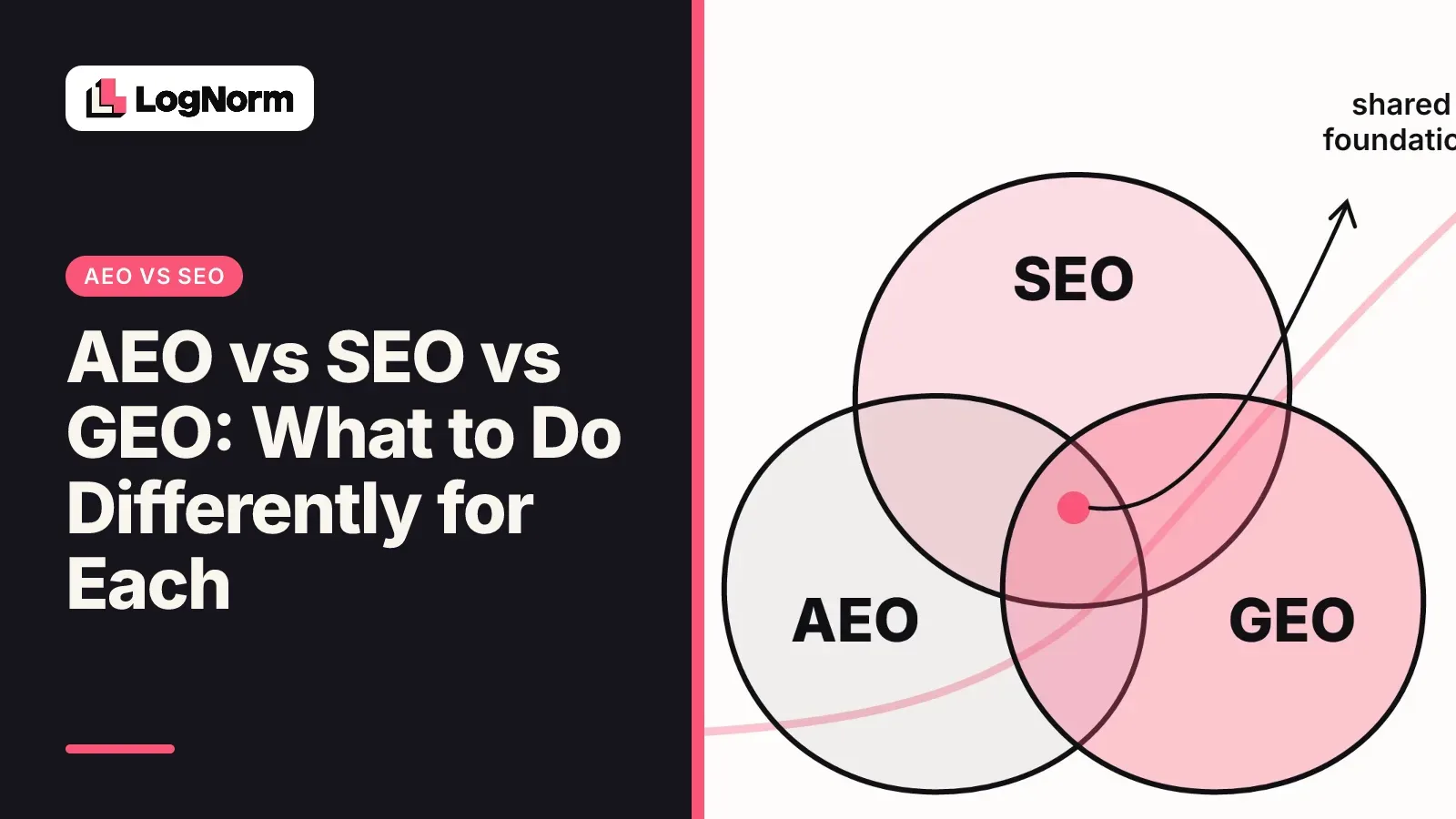
SEO, AEO and GEO are three scoreboards for one body of work. SEO (search engine optimization) gets a page ranked in a list of links. AEO (answer engine optimization) gets your text lifted as the direct answer to a question, in a featured snippet, an AI Overview or a voice reply. GEO (generative engine optimization) gets your brand named and your pages cited inside answers that ChatGPT, Gemini, Perplexity or Google's AI features write from many sources.
Most of the work is shared. The differences sit in where you show up, what counts as a win and a handful of extra habits on top of good SEO. This article is the three-way comparison and the practical list of what to do differently for each. If you want the full background on one discipline, read our guide to answer engine optimization or the two-way GEO vs SEO breakdown.
AEO vs SEO vs GEO at a glance
SEO earns a position, AEO earns the answer box, and GEO earns a mention or citation in a generated answer. The table puts the three side by side.
| SEO | AEO | GEO | |
|---|---|---|---|
| Goal | Rank a page in search results | Be the text shown as the direct answer | Be named or cited inside an AI-written answer |
| Where it shows up | Google and Bing results pages | Featured snippets, Google AI Overviews, voice assistants, People Also Ask | ChatGPT, Gemini, Perplexity, Google AI Overviews and AI Mode |
| Unit of success | A position and a click | Holding the answer for a specific question | A brand mention, a citation, or being recommended |
| Typical query | "aeo tools" | "what is answer engine optimization" | "which AEO tool should a seed-stage startup use" |
| Main levers | Crawlability, keyword targeting, internal links, backlinks | Question headings, short direct answers, lists and tables | Clear entity description, specific claims, presence on the sources engines cite |
| Depends on other sites | Yes, through links | A little | A lot, through what reviews, lists and forums say about you |
| How to measure | Search Console positions, clicks, CTR | Which target questions you hold the snippet or AI Overview citation for | Mention rate and citation rate across a fixed set of prompts |
The verdict: do SEO first, because the other two are built on it. Then add the AEO formatting habits to pages that answer questions, and the GEO habits to the pages and third-party mentions that decide whether AI assistants recommend you.
AEO vs SEO: the difference is the unit of success
AEO and SEO work on the same pages and the same crawl; they differ in what counts as a win. SEO wins when your page ranks and someone clicks it. AEO wins when your words become the answer the person reads, whether they click or not.
That changes how you write a page more than which pages you write. An SEO page can bury its answer under an introduction and still rank. An AEO page puts a quotable answer of a sentence or two directly under a heading phrased as the question, so an engine can lift it cleanly. The AEO guide covers the formatting in detail.
It also changes how you judge results. Pew Research tracked real browsing and found that Google users who saw an AI summary clicked a traditional result in 8% of visits, against 15% for users who did not see one. Clicks on links inside the summary itself happened in just 1% of visits. If you win the answer, expect fewer clicks for that query, and measure AEO by whether you hold the answer.
AEO vs GEO: is there really a difference?
Yes, but it is small, and many vendors use the two terms interchangeably. AEO aims at one extracted answer to one question. GEO aims at being named and cited in an answer the model writes by combining several sources, often for a question that has no single right answer, such as "best tool for X".
The practical gap is where the evidence comes from. For AEO, your own page does most of the work: if it answers the question cleanly, it can be the snippet. For GEO, the model also weighs what other sites say about you. A comparison article, a review site or a forum thread that names your competitors and not you can keep you out of a recommendation even if your own pages are excellent.
| AEO | GEO | |
|---|---|---|
| Typical question | Has one right answer ("what is X", "how do I Y") | Has many acceptable answers ("best X for Y", "X vs Z") |
| Output | One quoted passage, usually with a source link | A synthesized answer naming several brands, with a list of sources |
| What decides it | How cleanly your page answers the question | Your pages plus what third-party pages say about you |
| Biggest lever | Answer-first formatting under question headings | Getting onto the pages the engines already cite |
| Where to start | Your top informational pages | The prompts your buyers ask when choosing a product |
A simple way to hold it: GEO is AEO plus off-site reputation. If you only have time for one, do AEO on pages that answer questions and GEO on the buying questions where a recommendation turns into a customer. How to rank in ChatGPT and Perplexity goes deeper on the GEO side.
What all three share
All three need pages that machines can reach, that answer a real question with specifics, from a company they can identify. If any of those is missing, no amount of formatting or outreach fixes it.
The shared foundation, in the order to check it:
- Search engines and AI crawlers can fetch the page. Check that robots.txt does not block the crawlers you want, and that the content is in the HTML rather than loaded only by scripts.
- The page is indexed and has a clear title and description.
- The page answers its question with something specific: a number, a step, a named trade-off, an example.
- Your company is described the same way everywhere: home page, about page, docs, social profiles and directories.
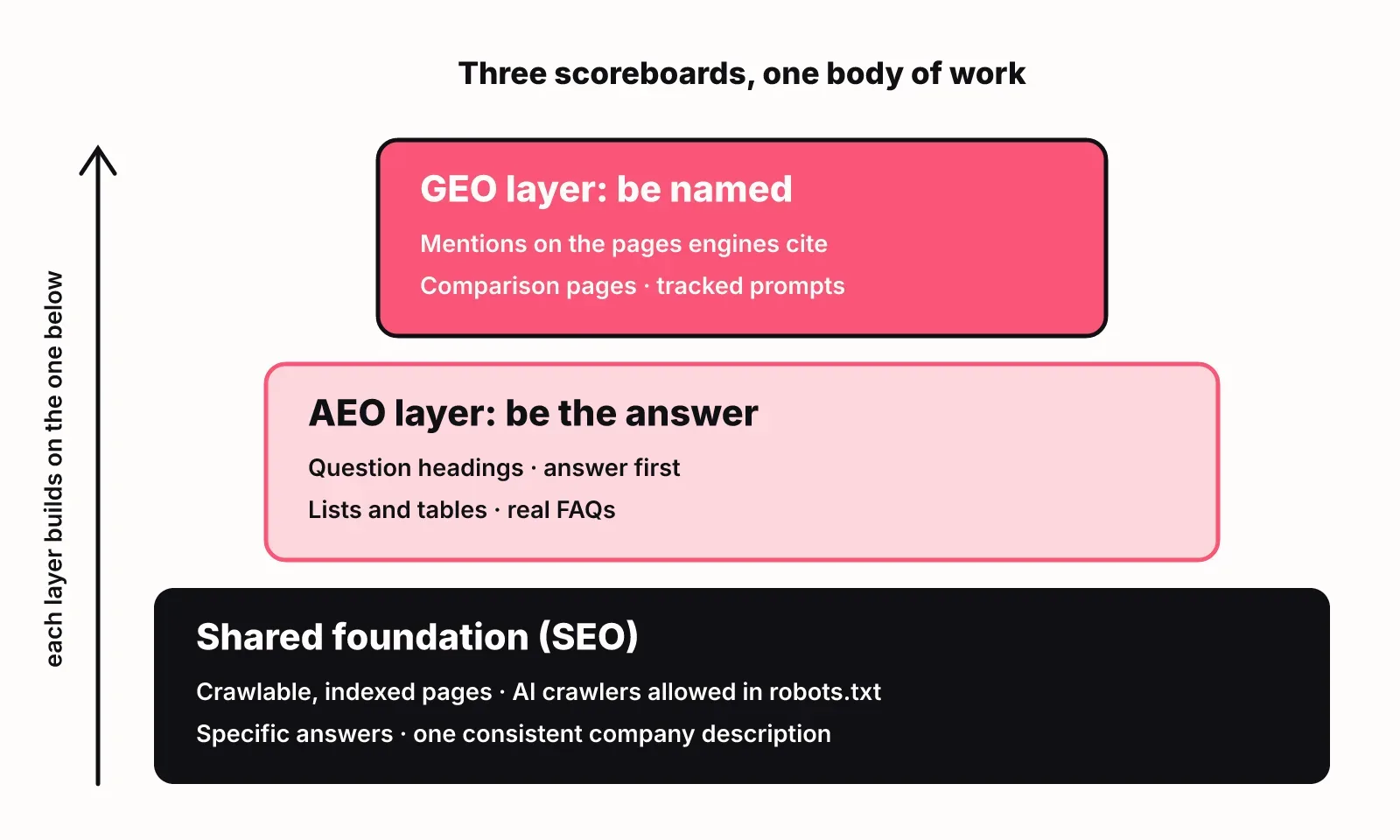
This is why we argue against running three separate programs. One audit that checks SEO issues and AI readiness together, like LogNorm's SEO and GEO audit, catches the foundation problems for all three at once.
What to do differently for each
Once the foundation is in place, each discipline adds a short list of its own habits. Keep these lists separate in your backlog so you know which scoreboard each task is meant to move.
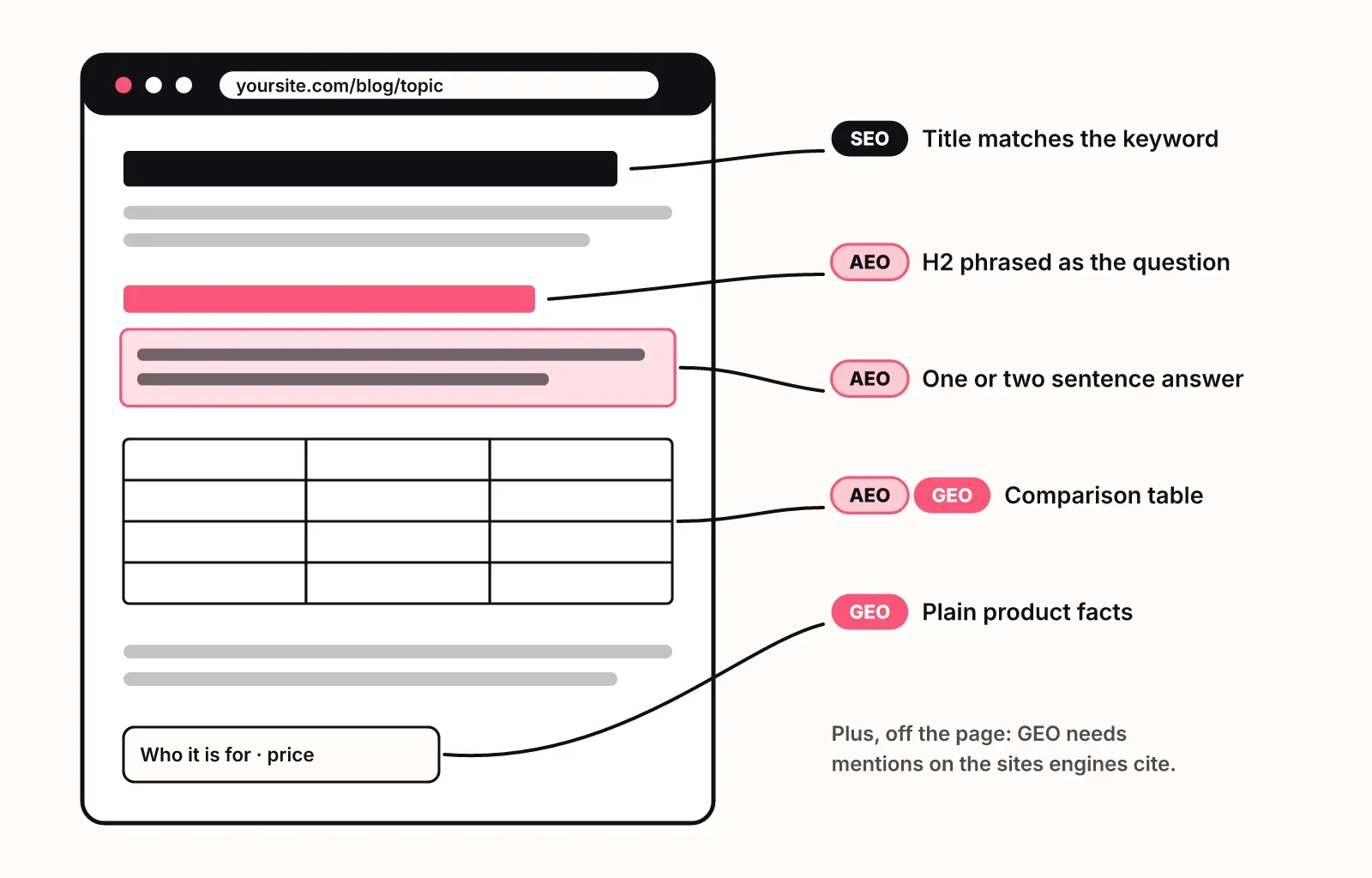
For SEO, keep doing the work that earns positions:
- Pick one target keyword per page and match the format Google already ranks for it.
- Link to new pages from related pages you already have, so they get crawled and inherit authority.
- Refresh pages whose clicks are falling before you write new ones.
- Earn links from sites your audience reads.
For AEO, change how question pages are written:
- Phrase H2s as the questions people search, using their words.
- Put a one or two sentence answer directly under each question heading, before any context.
- Use a numbered list for steps and a table for comparisons, so the answer can be lifted as a unit.
- Add a short FAQ for the real follow-up questions, not invented ones.
For GEO, work on what models read about you:
- Write down the prompts your buyers ask when choosing a product in your category, and track them.
- Find the pages the engines cite for those prompts, and get your product onto the ones that are open to it: lists, reviews, comparisons, community answers.
- Publish your own comparison and alternatives pages with honest, specific claims.
- State facts about your product plainly (who it is for, what it does, what it costs) on pages the crawlers can read.
Here is how the main tasks map to the three scoreboards and what each costs a small team.
| Task | SEO | AEO | GEO | Effort |
|---|---|---|---|---|
| Fix crawl, index and robots.txt issues | Yes | Yes | Yes | Low |
| Keyword-targeted page per topic | Yes | Partly | Partly | Medium |
| Question headings with answer-first paragraphs | Partly | Yes | Yes | Low |
| Tables and lists for comparisons and steps | Partly | Yes | Yes | Low |
| Backlinks from relevant sites | Yes | Partly | Partly | High |
| Comparison and alternatives pages | Yes | Partly | Yes | Medium |
| Getting listed on third-party roundups and reviews | Partly | No | Yes | High |
| Consistent company description across sites | Partly | Partly | Yes | Low |
The low-effort rows that score "Yes" in two or three columns are where a small team should start.
Which one is your problem? A diagnostic
Start from the symptom, not the acronym. Each symptom below points to the discipline that is failing and the first fix to try.
| Symptom | What is failing | First fix |
|---|---|---|
| The page is not in Google's top 20 for its keyword | SEO | Check indexing, match the ranking format, add internal links |
| You rank on page one but another site holds the snippet or AI Overview | AEO | Rewrite the section as a question heading with a short direct answer |
| You hold the AI Overview but clicks dropped | Nothing; this is the trade | Measure presence for that query, not clicks |
| ChatGPT or Gemini never names you for "best X" prompts | GEO | Find the sources they cite and get onto them |
| AI assistants name you but describe you wrongly | GEO | Fix the company description on your own pages and profiles |
| AI crawlers get blocked or see an empty page | All three | Fix robots.txt and server-rendered content first |
Most early-stage sites have the first and fourth problems at the same time. Fix the SEO one first, because an unindexed site cannot be cited either. If you have no SEO person, SEO for startups is a sensible order of operations.
How to measure each without fooling yourself
Measure each discipline on its own scoreboard, because a win in one can look like a loss in another. A page that starts holding the AI Overview may lose clicks while reaching more people.
- SEO: positions, impressions and clicks in Google Search Console, per page and per query. Our SEO KPIs post covers which ones predict growth.
- AEO: a list of your target questions and, for each, whether your page holds the featured snippet or is cited in the AI Overview. Check it on a schedule, since both change.
- GEO: a fixed set of buyer prompts asked in each assistant, with two separate numbers: how often the answer mentions you, and how often it cites one of your pages.
The audience for AI answers is already large. Pew found that 65% of U.S. adults at least sometimes come across AI summaries in search results, including 45% who see them often, and a 2026 survey found that six in ten U.S. adults say they read AI search engine summaries. Those readers often never reach your site, which is exactly why clicks alone undercount AEO and GEO.
Keep mentions and citations apart. An answer can recommend you without linking you, or link your page while recommending a competitor. LogNorm's AI visibility tracking asks ChatGPT, Gemini and Google AI Overviews your prompts from your market's country and records mention and citation as separate facts, then ties shipped work to before and after rates. A spreadsheet and a weekly manual check also works when you track a dozen prompts.
FAQ
Does AEO replace SEO?
No. AEO is built on SEO: an engine can only quote a page it has crawled, indexed and trusts. What changes is how you write question pages and how you measure them, since winning the answer can mean fewer clicks.
Is AEO the same as GEO?
They overlap heavily, and many people use the terms interchangeably. The useful distinction is that AEO targets a single extracted answer to a question, while GEO targets being named and cited in a synthesized answer, which depends more on what other sites say about you.
Is structured data necessary for AEO or GEO?
It helps engines understand a page, but it is not a substitute for a clear answer in the visible text. Fix crawl access, headings and answer-first paragraphs before you spend time on markup. Our GEO audit docs list the AI readiness checks we run.
Are LLM referrals worth measuring?
Yes, but as a small part of the picture. Pew found that people who see an AI summary rarely click the links in it, so referral traffic from AI answers understates their reach. Track mention and citation rates alongside referrals.
Do ChatGPT, Gemini and Google AI Overviews cite sources the same way?
No. Each picks and shows sources differently, and the same prompt can produce different brands and links in each. Track your prompts in every assistant your buyers use rather than assuming one stands in for the others.
Do AI Overviews always reduce clicks?
Not always, but on average they do. In Pew's data, visits with an AI summary led to a click on a traditional result about half as often as visits without one. Expect fewer clicks on queries where an overview appears, and judge those pages by whether you are in the answer.