SEO for startups: a playbook for teams without an SEO hire
A practical SEO playbook for seed and Series A startups: when SEO is worth it, keywords a new domain can win, technical basics, AI search and a 90-day plan.


SEO for startups is the practice of earning traffic from Google and AI answer engines with a small team, a young domain and no specialist. It comes down to four things: fix the technical basics that block indexing, target narrow, high-intent keywords a new site can win, publish in clusters around one topic, and earn mentions on other sites. Expect early signals within weeks and meaningful traffic in months.
Most startup SEO advice assumes an SEO lead, a content team and a domain that has collected links for a decade. You have a founder or one marketer and a few hours a week. That is enough if you spend it on the right things. This playbook tells you what to do, what to skip and in what order, so search becomes one reliable part of your growth engine.
When SEO is worth it for a startup, and when it is not
SEO captures demand that already exists. It does not create it. When people already search for the problem you solve, a page that ranks keeps working long after you stop touching it.
Use this test before you commit time:
| Signal | Start SEO now | Park it for later |
|---|---|---|
| Search demand | Buyers search for the problem, category or alternatives to an incumbent | You are creating a category nobody searches for yet |
| Sales cycle | Buyers research and compare before talking to sales | Deals close through warm intros in days |
| Runway to results | You can wait several months for a channel to mature | You need pipeline in the next 60 days |
| Positioning | Your ideal customer and core use case are stable | You are still pivoting every quarter |
| Expertise | You have first-hand knowledge to write about | You would be rewriting what already ranks |
B2B SaaS is usually a good fit. Software buyers compare tools and search for specific jobs to be done, which gives a small site many narrow entry points. That is most of what "SaaS SEO" means in practice: pages matched to the problems, use cases, integrations and comparisons buyers search for during evaluation.
Do you need to hire for it? Not yet. Google's guidance on whether you need an SEO says that if you run a small local business, "you can probably do much of the work yourself," starting with its SEO starter guide. It names a site redesign or a new site launch as a good time to bring in a professional. For a seed-stage team, that means one short consultation at launch, then doing the work in-house.
Choosing keywords a low-authority domain can win
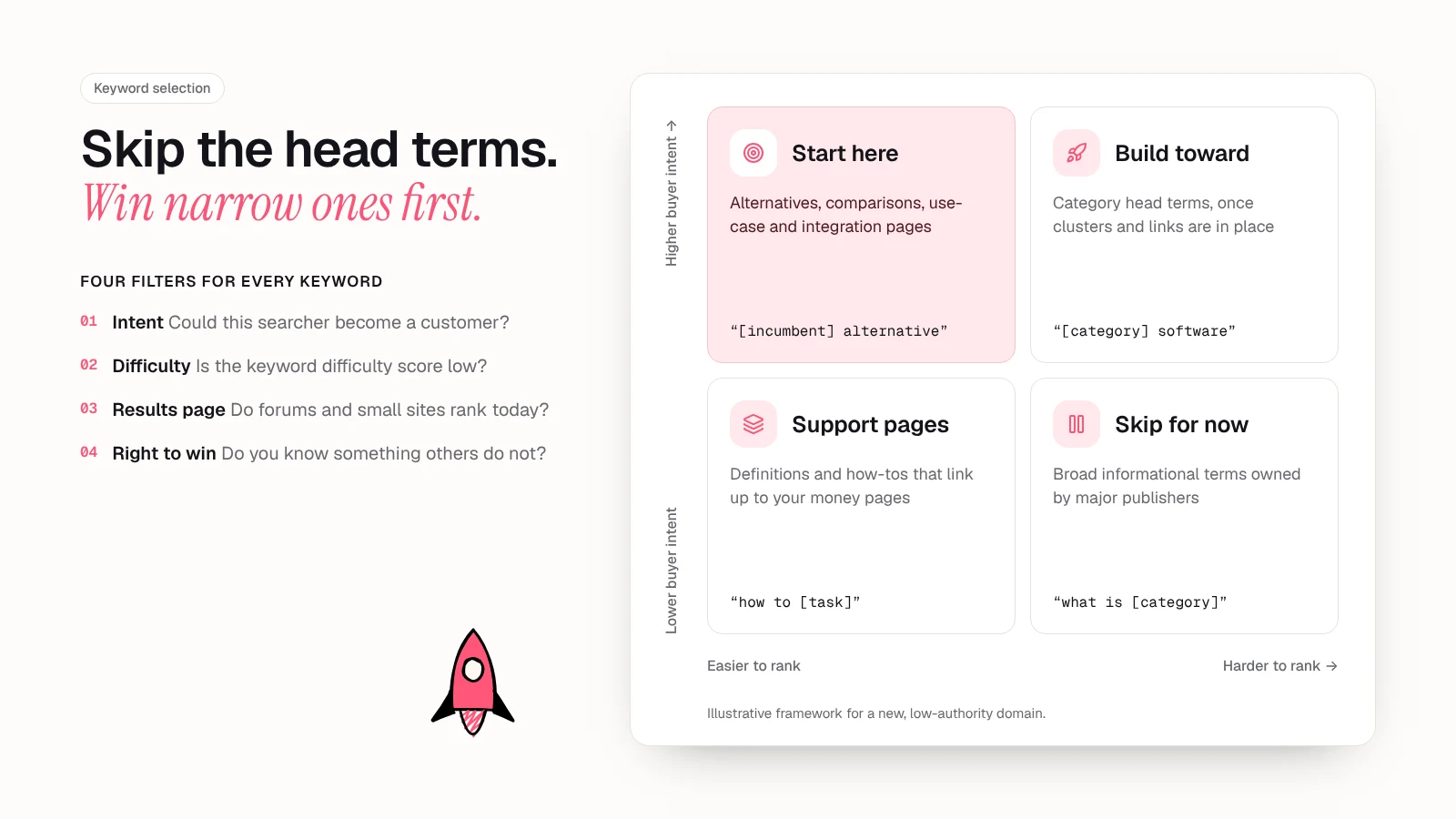
A new domain cannot win "project management software." It can win "project management for architecture firms." Keyword choice is the biggest lever a startup controls, and most teams get it wrong by chasing volume.
Filter every keyword on four questions, in this order:
- Intent. Would this searcher plausibly become a customer? "Best Mixpanel alternative for B2B" beats "what is product analytics," even at a tenth of the volume.
- Difficulty. Keyword difficulty scores from your SEO tool estimate how hard the first page is to reach. They are rough, but a useful first cut.
- The live results page. Search the phrase yourself. Forum threads, thin listicles and small sites mean you can compete. A page of category leaders and major publishers means move on.
- Your right to win. Do you have product data, customer stories or expertise nobody else has? If your page would be the tenth version of the same advice, skip it.
In B2B, 50 searches a month from the right buyers can be worth more than 5,000 from students. Low-volume, high-intent phrases are also where a young site faces the least competition.
The keyword types that tend to work early:
- Alternatives and comparisons: "[incumbent] alternative", "[tool A] vs [tool B]".
- Use case and industry pages: "[category] for [industry or role]".
- Integration pages: "[your category] + [popular tool]".
- Problem-aware questions: the exact phrases customers use in sales calls and support tickets.
One keyword tool plus Google Search Console is enough to start. We compare options in our guide to search engine optimization tools.
Technical basics that matter, and what to ignore
Startup sites built on modern frameworks are usually technically fine. Do a short pass to rule out blockers, then stop.
Google's technical requirements for indexing eligibility are short: Googlebot is not blocked, the page returns an HTTP 200 (success) status code, and the page has indexable content. Even then, Google notes, "indexing isn't guaranteed."
The week-one checklist:
- Check you are indexed. The SEO Starter Guide suggests searching Google with the
site:operator for your domain. - Set up Google Search Console and use its URL Inspection tool to check how Google sees your key pages.
- Submit a sitemap. Google's sitemap documentation says you may need one when "your site is new and has few external links to it." That describes almost every startup.
- Use descriptive URLs, such as
/blog/seo-for-startupsrather than/p?id=4821. - Write a unique title and meta description for every page.
- Keep staging and preview environments out of the index, and make sure production is not blocking crawlers by mistake.
Then ignore the noise. The same starter guide says Google Search does not use the keywords meta tag, that "there's no magical word count target," and that duplicate content across URLs is "inefficient" but will not cause a manual action. Those three myths alone eat weeks of startup time.
Build topic clusters, not a pile of posts
A cluster is one pillar page on a broad topic, linked to narrower pages that each answer one specific question, all linking back up. You cannot win on domain strength yet, so you win on depth in a narrow area. Ten connected pages on one problem beat fifty unrelated posts.
Google's guidance on helpful, people-first content makes the same point from the other side. One of its warning signs: "Are you producing lots of content on many different topics in hopes that some of it might perform well?"
Start with the one problem your product solves best. Write the pillar, list the 6 to 10 sub-questions buyers ask on the way, and give each its own page linked to and from the pillar. We go deeper on mapping keywords to clusters, writing briefs and planning refreshes in our guide to SEO content strategy.
A content cadence a small team can keep
Consistency beats volume. Two strong pages a month for a year will do more than twenty rushed pages followed by silence.
- Two to four new pages a month, each targeting one keyword from your list.
- One refresh a month of a page sitting on page two. Pages close to the top often move faster than new ones.
- One founder-led piece a quarter with real data or a strong opinion. These are the pages that earn links.
Use AI for research, outlines and first drafts, then add what only you know. Google's spam policies name "using generative AI tools or other similar tools to generate many pages without adding value for users" as scaled content abuse. The problem is not the tool. It is publishing pages that add nothing.
Links and mentions without buying them
Links still matter. The starter guide notes that most new pages Google finds are discovered through links, and calls word of mouth "one of the most effective and lasting ways" to promote a site.
Do not buy them. Google's spam policies define link spam as "creating links to or from a site primarily for the purpose of manipulating search rankings," including buying links and excessive link exchanges.
What works for startups instead:
- Integration and partner listings in the marketplaces of tools you connect to.
- Original data from your product, which writers cite when they need a number.
- Founder appearances on podcasts and newsletters.
- Customer stories published on the customer's site as well as yours.
- Real answers in the communities where your buyers ask questions.
Unlinked mentions count for more than they used to, because AI answer engines learn which brands go with which problems from what the web says. That is the part of SEO that changed most.
AI search is part of SEO now
Buyers now get answers from Google's AI Overviews, ChatGPT and other assistants, often without clicking. That changes what "ranking" means, but less than the hype suggests.
Google's page on AI features and your website states: "There are no additional requirements to appear in AI Overviews or AI Mode, nor other special optimizations necessary." A page must be indexed and eligible to show with a snippet, "all existing SEO fundamentals continue to be worthwhile," and this traffic appears in the Search Console Performance report under the "Web" search type.
The click is what changes. A Pew Research Center study of 68,879 Google searches by 900 US adults in March 2025 found that 18% produced an AI summary. Users who saw one clicked a traditional result on 8% of visits, against 15% for those who did not.
Three practical moves follow:
- Do not block AI search crawlers by accident. OpenAI's crawler documentation says sites that opt out of OAI-SearchBot "will not be shown in ChatGPT search answers." Check robots.txt and your CDN's bot rules.
- Write pages that are easy to quote. Lead with a direct answer, use clear headings and specific facts. The GEO paper by Aggarwal and colleagues found that optimizing for generative engines "can boost visibility by up to 40%" in their experiments.
- Earn mentions on the sites AI tools read: reviews, comparisons, forums and partner pages.
We cover how AI changes the day-to-day work of SEO, from research to showing up in answers, in our guide to AI SEO. For the full framework on getting cited, read what generative engine optimization is and how to apply it.
A 90-day SEO plan for a team without an SEO hire
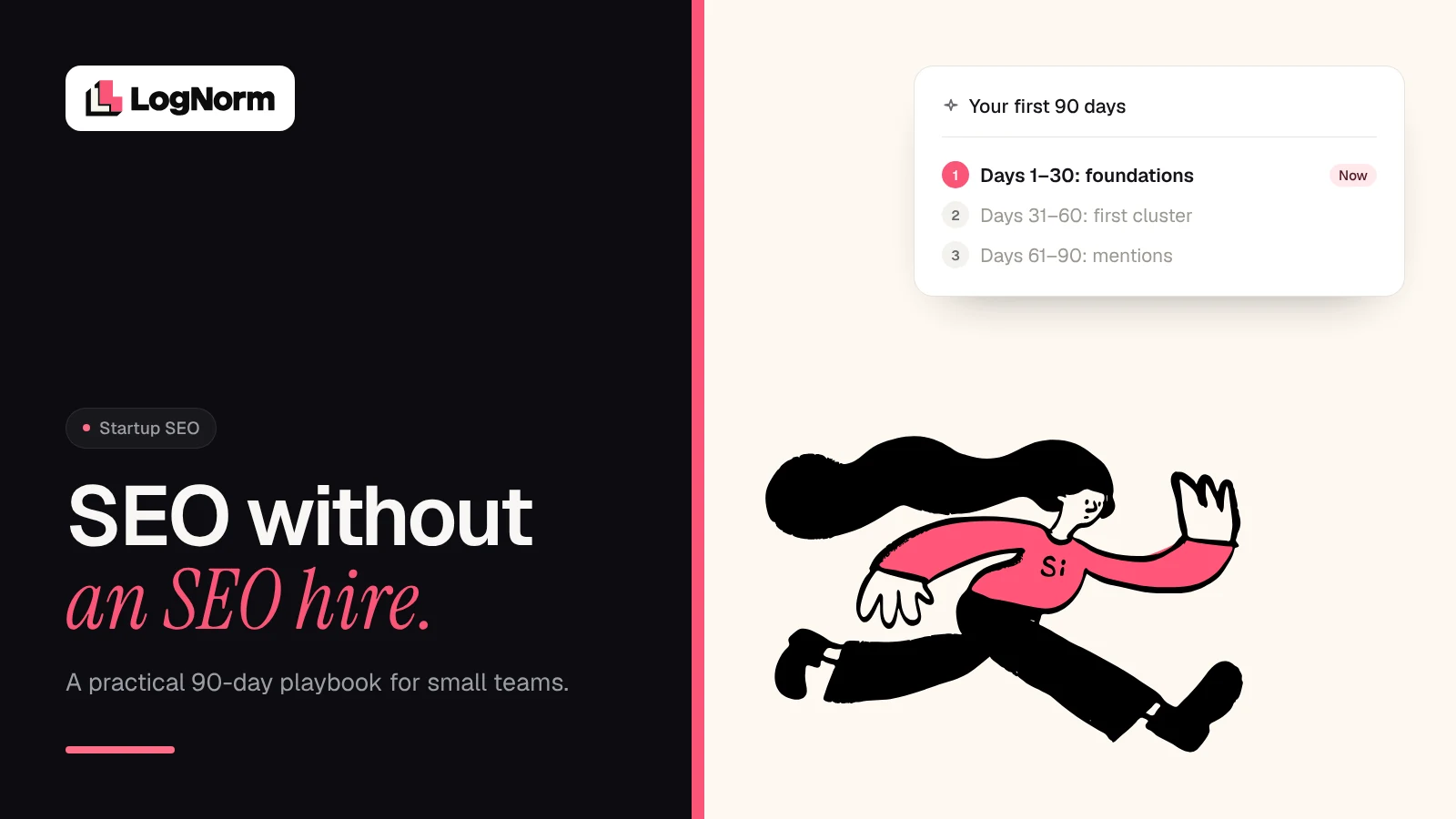
This is the plan we would hand a seed or Series A team: one owner, about half a day a week plus writing time.
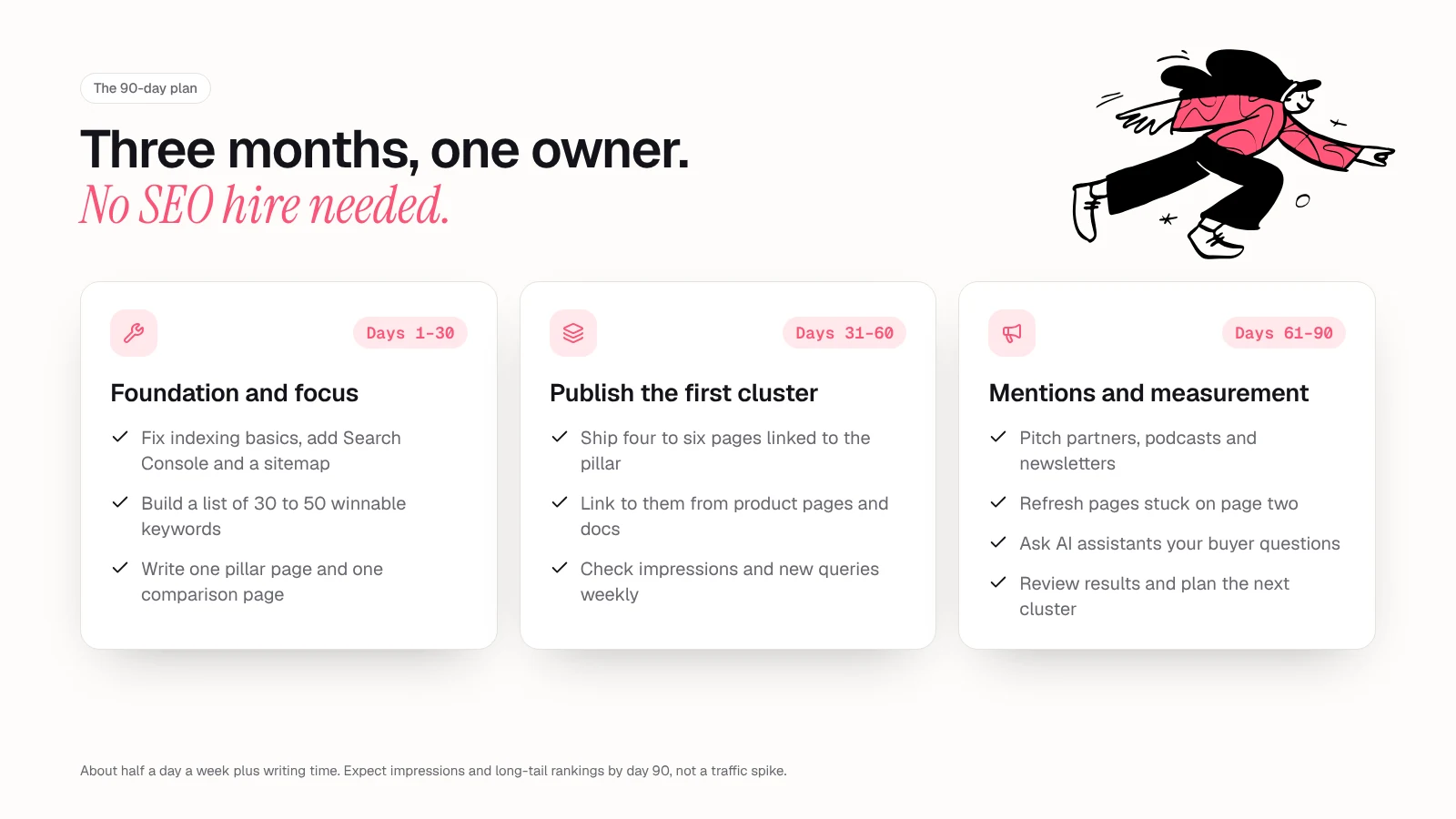
Days 1 to 30: foundation and focus
- Run the technical checklist, set up Search Console and submit a sitemap.
- Build a list of 30 to 50 keywords using the four filters.
- Pick one cluster topic, write its pillar and ship your first comparison page.
Days 31 to 60: publish the first cluster
- Publish four to six cluster pages, linked to and from the pillar.
- Link to them from your homepage, product pages and docs.
- Check Search Console weekly for impressions and new queries.
Days 61 to 90: mentions, refreshes and measurement
- Pitch two or three integration partners, podcasts or newsletters.
- Refresh pages getting impressions but stuck on page two.
- Ask ChatGPT, Gemini and Perplexity your top buyer questions and note who gets named.
- Review what worked and plan the next cluster.
By day 90, do not expect a traffic spike. Expect indexed pages, a growing set of queries with impressions and a few long-tail rankings on page one. That is a healthy start.
How long does SEO take for a startup?
Longer than you want, shorter than you fear. Google's SEO Starter Guide says: "Some changes might take effect in a few hours, others could take several months." It suggests waiting "a few weeks" before judging whether a change worked.
Third-party data points the same way. An Ahrefs study published in 2017, tracking 2 million pages across 2 million random keywords, found that only 5.7% of pages reached the top 10 within a year. Most of those took roughly 61 to 182 days. The study is old and covers all sites, but the lesson holds: plan in quarters.
Two habits keep you honest while you wait:
- Track leading indicators. Indexed pages, impressions and query count move before clicks and signups. We list which metrics to watch at each stage in our guide to SEO KPIs.
- Distrust guarantees. Google's hiring guidance is blunt: "No one can guarantee a #1 ranking on Google." It suggests asking any SEO, "What kind of results do you expect to see, and in what timeframe?" Ask yourself the same question.
FAQ
Is SEO worth it for an early-stage startup?
Yes, when buyers already search for your problem, category or competitors and you can wait a few months for results. If you are creating a new category or need pipeline in weeks, start with outbound or communities and add SEO once demand exists.
How long does SEO take to work for a new website?
Google says some changes take effect in hours and others take several months. For a new domain, expect impressions within the first month or two and meaningful traffic over several months, sooner for narrow long-tail keywords.
What is the difference between SaaS SEO and regular SEO?
The fundamentals are the same. B2B SaaS SEO leans on high-intent pages such as comparisons, alternatives, integrations and use cases, and measures success in signups and pipeline rather than pageviews, because volumes are smaller and each buyer is worth more.
Should a startup hire an SEO agency or do SEO in-house?
Most seed-stage teams can do the basics in-house. A short consultation is most useful at a site launch or redesign. Hire full-time once search is a proven channel and the work outgrows one owner.
Does SEO still matter with AI search?
Yes. Google says there are no special requirements to appear in AI Overviews or AI Mode, and pages must still be indexed and snippet-eligible. What changes is that fewer searches end in a click, so being named in the answer matters more.
Sources
- Google Search Central: Do you need an SEO? (June 2026)
- Google Search Central: SEO Starter Guide (December 2025)
- Google Search Central: Google Search technical requirements (December 2025)
- Google Search Central: Learn about sitemaps (December 2025)
- Google Search Central: Creating helpful, reliable, people-first content (October 2026)
- Google Search Central: Spam policies for Google web search (August 2026)
- Google Search Central: AI features and your website (December 2025)
- Pew Research Center: Google users are less likely to click on links when an AI summary appears in the results (July 2025)
- OpenAI: Overview of OpenAI crawlers (2026)
- arXiv: GEO: Generative Engine Optimization (Aggarwal et al.) (November 2023)
- Ahrefs: How long does it take to rank in Google? (February 2017, updated October 2021)