What is a Growth Engine? A System for Decisions, Not Dashboards
A growth engine isn't another dashboard. Learn what a true growth engine is, how it works, and why it's the key to turning data into a ranked plan.



What is a Growth Engine? A System for Decisions, Not Dashboards
You have the data: search console performance, site audit reports, competitor keyword lists, and what AI assistants say about your category. Yet, you start each week debating what to work on. A growth engine is a system that ends this debate.
It connects all your growth signals and turns them into a single, ranked backlog of work. For example, it might make the call that publishing an "Acme vs. Globex" comparison page is this week's top priority because a competitor ranks for it and you do not. It then measures the results of everything you ship, so the next decision is even smarter.
What is a Growth Engine? (And Why It's Not Another Dashboard)
A growth engine is a system that turns signals into prioritized, actionable work and measures the results. It connects data from your site audit, Google Search Console, competitor rankings, and AI answers, then turns them into a ranked backlog of specific jobs.
This makes it different from a typical dashboard. A dashboard might show you a chart of falling clicks on a key page, but it leaves you to decide what to do about it. A growth engine makes the decision for you, turning that signal into a concrete task like "Refresh /blog/pricing-guide" and telling you exactly where it fits in your priorities.
The output is not more data to analyze, but a simple plan for what to do next.
The Problem: Drowning in Data, Starving for Action

Startups often have more data than they can use. You might have a site audit with hundreds of "issues," a massive keyword export from a research tool, and multiple competitor reports. Each one presents a different version of what might be important.
This leads to analysis paralysis. Teams spend more time in meetings debating the priority of tasks than actually shipping work. Should you fix the meta descriptions, write a new blog post, or build a new landing page? Without a system to process and rank these signals, good opportunities are missed and effort is wasted on low-impact tasks.
A growth engine solves this by creating a single, ranked backlog from all available signals. It takes the guesswork out of prioritization so you can focus on execution.
The Components of a Modern Growth Engine
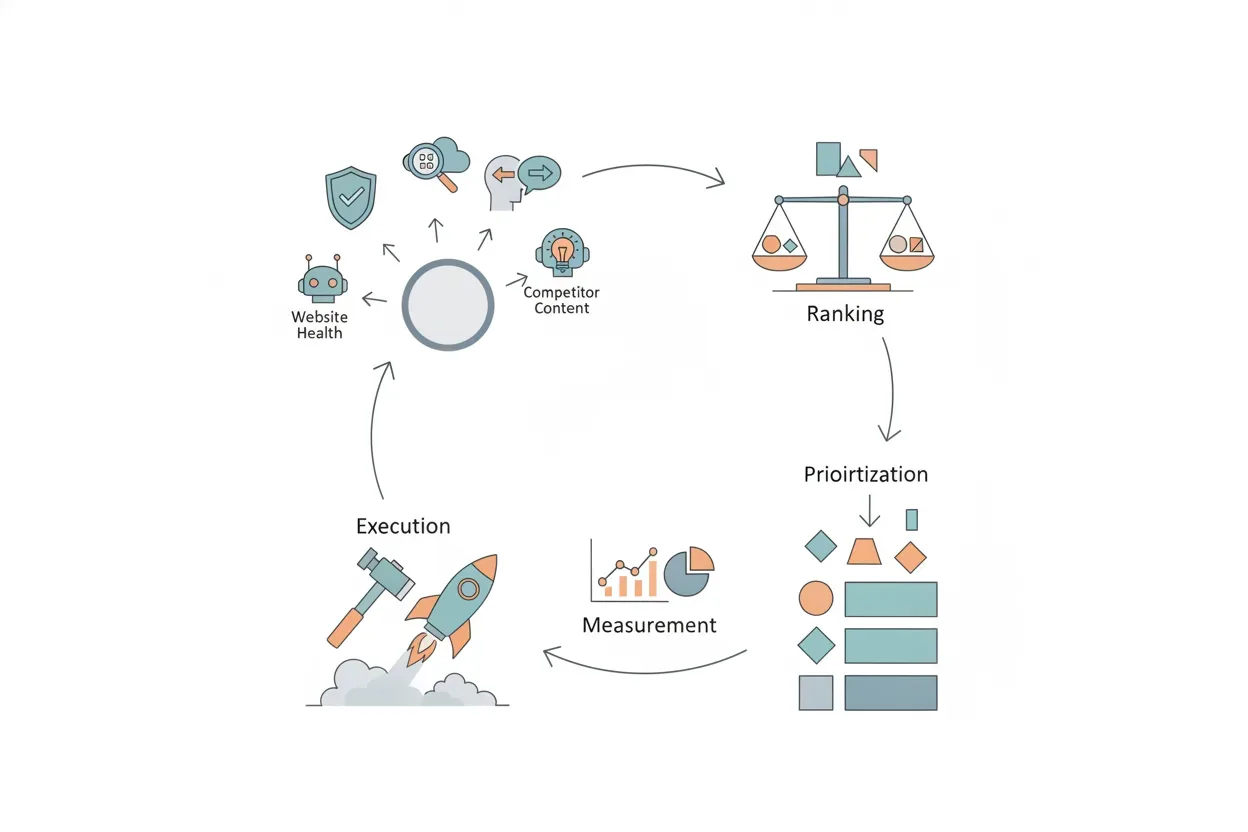
A complete growth engine operates as a continuous five-stage loop.
- The loop begins with discovery, continuously scanning for opportunities from signals like your website's technical health, search data, your competitors' content, and your visibility in AI assistant answers.
- Next, the engine ranks every potential task, which Lognorm calls a Move, by comparing them head-to-head to determine which action will have the most impact.
- From this ranked list, the system helps you build a weekly work plan sized to your team's capacity, ensuring a consistent pace.
- The plan then moves to creation and publishing, using integrated tools to generate content briefs, write drafts, and publish the finished work directly to your CMS.
- Finally, the engine measures the performance of every shipped move. Lognorm tracks results at 28 and 90 days, providing clear feedback that informs the next cycle of the loop.
How a Growth Engine Decides What to Do Next
A growth engine doesn't just find issues; it weighs them against each other. A missing meta description on a low-traffic page is not equal to a competitor ranking for a high-intent keyword you don't. The engine's job is to make that distinction for you.
A key function is translating your business goals into its ranking logic. It understands which keywords fit your business, which competitors are real threats, and which pages are most important. This is different from a simple scoring system that treats every issue in isolation.
It also helps you articulate and prove your unique value proposition (UVP). A 2026 report on association resilience found that 67 percent of organizations with an approved UVP reported membership growth, compared to just 33 percent of those without one. A growth engine helps you identify and win the topics that prove your value. This systematic prioritization is what separates an engine from a simple checklist.
The Impact: Why a Systematic Approach Wins
Organizations that implement a formal, structured operating system for growth consistently outperform those that do not. This isn't a small difference. According to research from the Chicago Booth Review, companies with formal systems can see a growth-rate difference of nearly 300 percent.
This structure also makes companies more investable. The same Chicago Booth Review analysis found that companies with a formal operating system scored 118 points higher on a composite investability index than those without one. A system demonstrates a predictable, scalable process for growth.
By turning growth from a series of disconnected projects into a repeatable process, an engine creates compounding returns. Each week's work builds on the last, informed by real performance data.
How to Get Your Growth Engine Running
You can build a growth engine manually. This involves stitching together multiple tools for audits, keyword research, and analytics, then enforcing a rigorous process for prioritization and review. This approach can work, but it requires significant discipline and operational overhead.
The alternative is to adopt a platform designed to be a growth engine from the start. Lognorm connects all the necessary components—from discovery and ranking to creation and measurement—in a single, continuous loop.
It analyzes your site, competitors, and search data to produce a ranked weekly Growth Plan. Instead of a list of data points, you get a prioritized list of specific moves to make. This allows your team to skip the debate and focus entirely on execution.
Frequently asked questions
What is another term for a growth engine?
A growth engine is often described as a "growth system" or a "growth loop." These terms emphasize that it's a repeatable, self-reinforcing process, not a one-off campaign or a simple tool. The key idea is that the outputs of one cycle become the inputs for the next.
What is the core concept of growth?
The core concept of growth is creating a sustainable, repeatable system for acquiring and retaining customers. It's about moving beyond random tactics and building a predictable process. This involves understanding your customers, finding effective channels, and continuously optimizing your approach based on data.
What is the primary engine of economic growth?
In macroeconomics, the primary engines of economic growth are typically considered to be technological innovation, increases in capital stock, and a more productive labor force. For a business, the engine is a system that reliably finds and converts new customers.
Why shouldn't you start building a growth system from scratch?
Building a growth system from scratch requires immense discipline and overhead. You have to select, integrate, and manage multiple tools for data collection, then build a manual process for analysis, prioritization, and measurement. An integrated platform handles this complexity for you, letting you focus on the work itself.