AI SEO: how startups should use AI for search in 2026
AI SEO means two things: using AI to do SEO work faster, and getting found in AI search. Here is where AI helps, where it hurts and what Google allows.


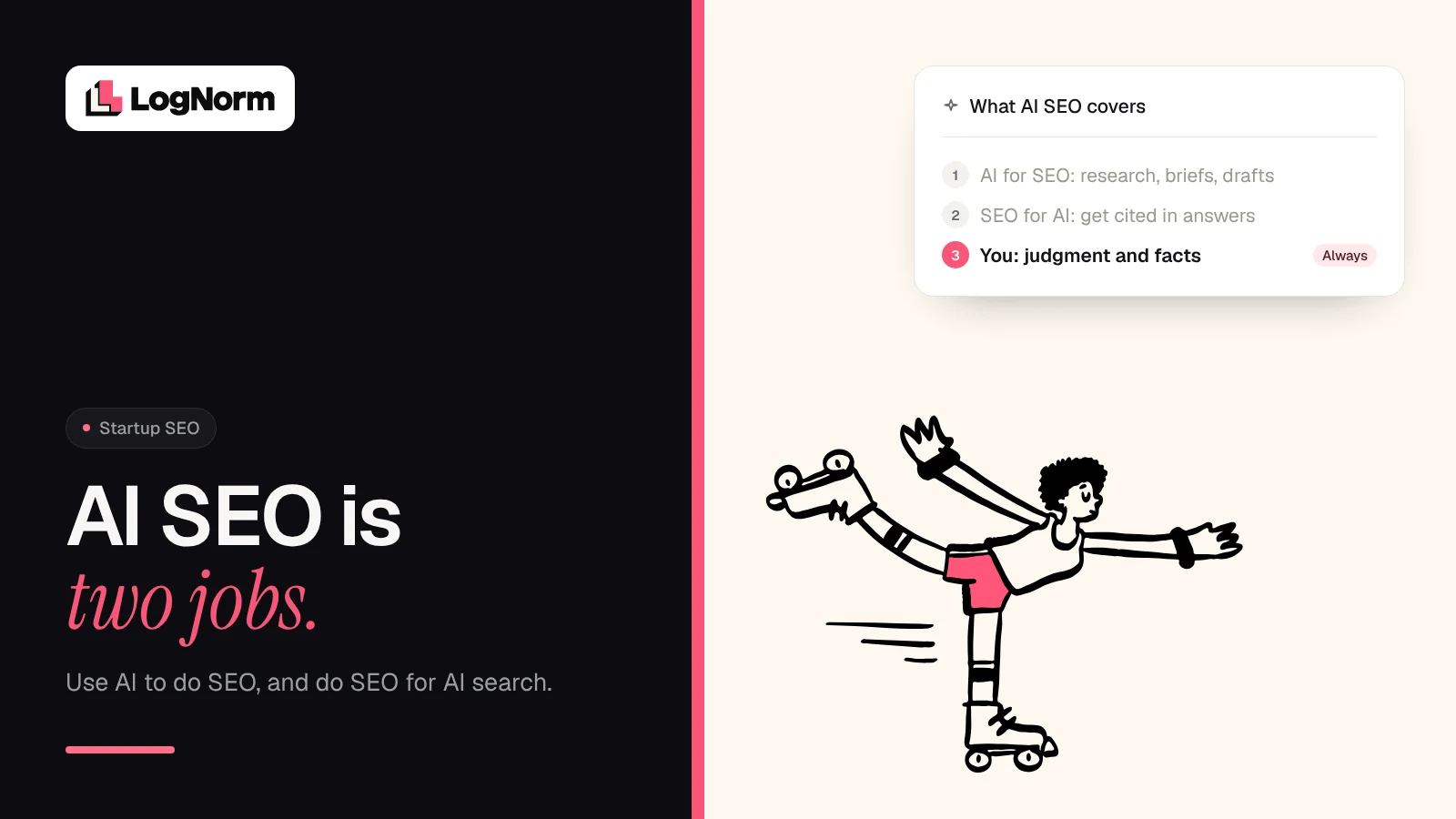
AI SEO means two different things. It is using AI tools to do SEO work faster, such as keyword research, briefs, drafts, internal links and technical audits. It is also optimising your site so AI-powered search, like Google's AI Overviews, ChatGPT search and Perplexity, can find, understand and cite you.
Most confusion comes from mixing the two up. Both matter, but they need different decisions. This guide covers using AI inside your SEO process first: where it saves time, where it does damage and what Google says about AI-generated content. Then a short primer on AI search. If you are still setting up the basics, start with our SEO playbook for startups without an SEO hire and come back here.
The two meanings of AI SEO
AI for SEO answers "how do we do this work with a small team?" It covers using AI to research keywords, write briefs, draft content, suggest internal links and triage technical issues. The output is the same as classic SEO: pages that rank and convert. AI changes the cost and speed of producing them.
SEO for AI answers "how do we show up when people ask an AI instead of searching?" It covers getting your pages crawled, indexed and cited by AI answer engines. The output is different: a mention or a source link inside a generated answer, not a blue link on page one.
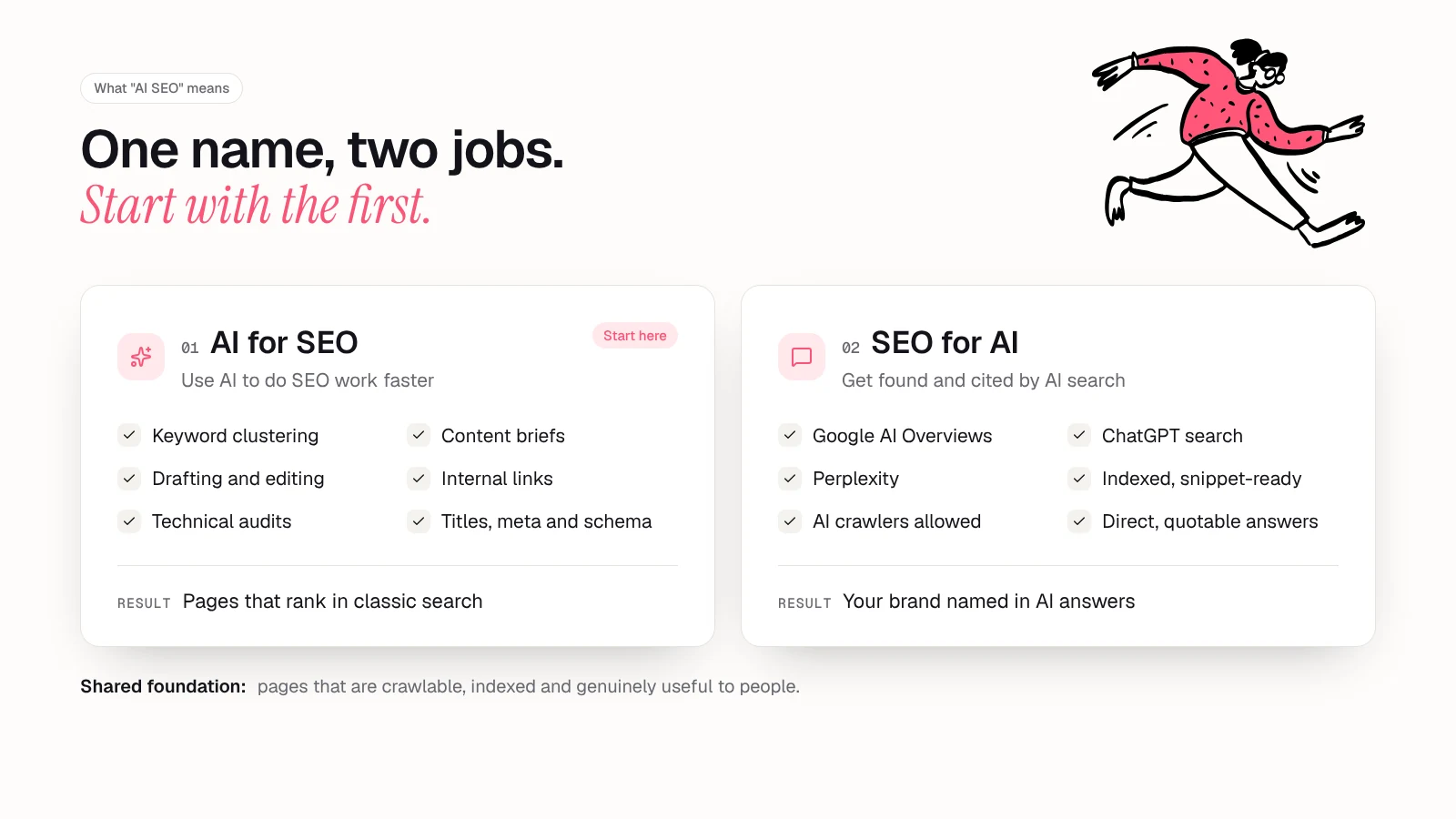
For a startup, the order matters. AI for SEO is the lever you can pull this week, and it makes everything else cheaper. SEO for AI mostly rests on the same foundations as ranking in Google, so it gets easier once the first part is working.
What Google actually says about AI-generated content
Google does not penalise content for being written with AI. It penalises content made to manipulate rankings, however it was produced. That distinction decides how far you can lean on AI.
The clearest statement is Google Search Central's February 2023 post, Google Search's guidance about AI-generated content. It says Google's ranking systems aim to reward "original, high-quality content" that shows E-E-A-T (experience, expertise, authoritativeness and trustworthiness), and that its focus is "on the quality of content, rather than how content is produced." The same post draws the line: using automation, including AI, to generate content with the primary purpose of manipulating search rankings is a violation of Google's spam policies. Its FAQ is blunter: "Using AI doesn't give content any special gains. It's just content."
Scaled content abuse is the policy to know
The rule most likely to catch an AI-heavy content program is scaled content abuse. Google's spam policies define it as "when many pages are generated for the primary purpose of manipulating search rankings and not helping users." The first example listed is "using generative AI tools or other similar tools to generate many pages without adding value for users."
When Google introduced this policy in its March 2024 core update announcement, it said the policy applies "no matter whether content is produced through automation, human efforts, or some combination of human and automated processes." So hiring cheap writers to churn out the same thin pages is no safer than using a model. The test is value to the reader, not the tool.
What Google asks you to do with AI content
Google's page on using generative AI content on your website adds practical rules:
- Focus on "accuracy, quality, and relevance, especially when automatically generating the content."
- Generative AI "may contain inaccuracies (also known as hallucinations)," so you should fact-check and review AI content before publishing.
- That review covers metadata too: title elements, meta descriptions, structured data and image alt text, because they can appear in search results.
On disclosure, Google's people-first content guidance asks you to think about Who, How and Why. If automation substantially generated a page, consider whether that is clear to readers, and say how and why AI was used where someone might reasonably ask "How was this created?" The "why" is the part Google calls "perhaps the most important": content should exist to help people, not mainly to attract search visits.
The practical reading for a startup: use AI as much as you like in the process, keep a named human accountable for every page, and never publish pages you would not be proud to show a customer.
Where AI helps in SEO work
AI is strongest where the work is structured, repetitive and easy to check. Here is where it earns its place on a small team.
Keyword research and clustering
Give AI a few hundred keywords from your SEO tool and it can group them by intent, suggest which belong on the same page and flag gaps. It cannot tell you search volume or difficulty, so pull those numbers from a real data source. We compare options in our guide to SEO tools.
Content briefs
A brief is mostly synthesis: what the searcher wants and which questions to answer. AI can draft one from your notes and the top-ranking pages in minutes. A human should then add the parts only you know, such as your product's angle, customer quotes and the opinion you want to take.
Drafting and editing
AI can produce a first draft quickly, and it is an even better editor: tightening sentences, catching gaps, rewriting for clarity and checking a draft against its brief. The draft is the start, not the finish. The value Google rewards (first-hand experience, original data, a clear point of view) has to come from you.
Internal linking
Internal linking is tedious, so it gets skipped. Give AI a list of your URLs and titles plus a new draft, and it can suggest where to link and with what anchor text. This fits naturally with a planned topic cluster, which we cover in our guide to building an SEO content strategy.
Technical audits
AI will not crawl your site, but it is useful once you have crawl data. Paste in a list of errors and it can explain each issue, group them by cause and draft the fix: a redirect map, a robots.txt rule or a schema snippet. Always test the fix before shipping it.
Metadata and schema
Title tags, meta descriptions, alt text and FAQ or Article schema are short, rule-bound and repetitive, which suits AI well. Google's guidance is explicit that this metadata needs the same accuracy review as body content, so check every line.
Where AI hurts
AI hurts when it replaces judgment instead of saving time. These are the common failure modes.
- Publishing at scale without adding value. Generating hundreds of near-identical pages is the exact pattern Google's scaled content abuse policy describes.
- Confident errors. Models invent statistics, product features, sources and quotes. Google names hallucinations directly. One wrong number on a pricing or compliance page costs more trust than the page will ever earn.
- Commodity content. A model trained on the web tends to produce the average of the web. Google's May 2025 guidance on succeeding in AI search tells site owners to focus on "unique, non-commodity content." A draft that says what every other page says has no reason to rank above them.
- Losing your voice. Readers notice when every post sounds like the same assistant. Edit AI drafts until they sound like your team.
- Skipping the strategy. AI makes it cheap to produce pages, which makes it tempting to skip deciding which pages deserve to exist. A focused cluster of 20 strong pages beats 200 thin ones.
The pattern behind all five: AI lowers the cost of producing content, so the scarce input becomes judgment about what to produce and whether it is true.
An AI SEO workflow for a small team
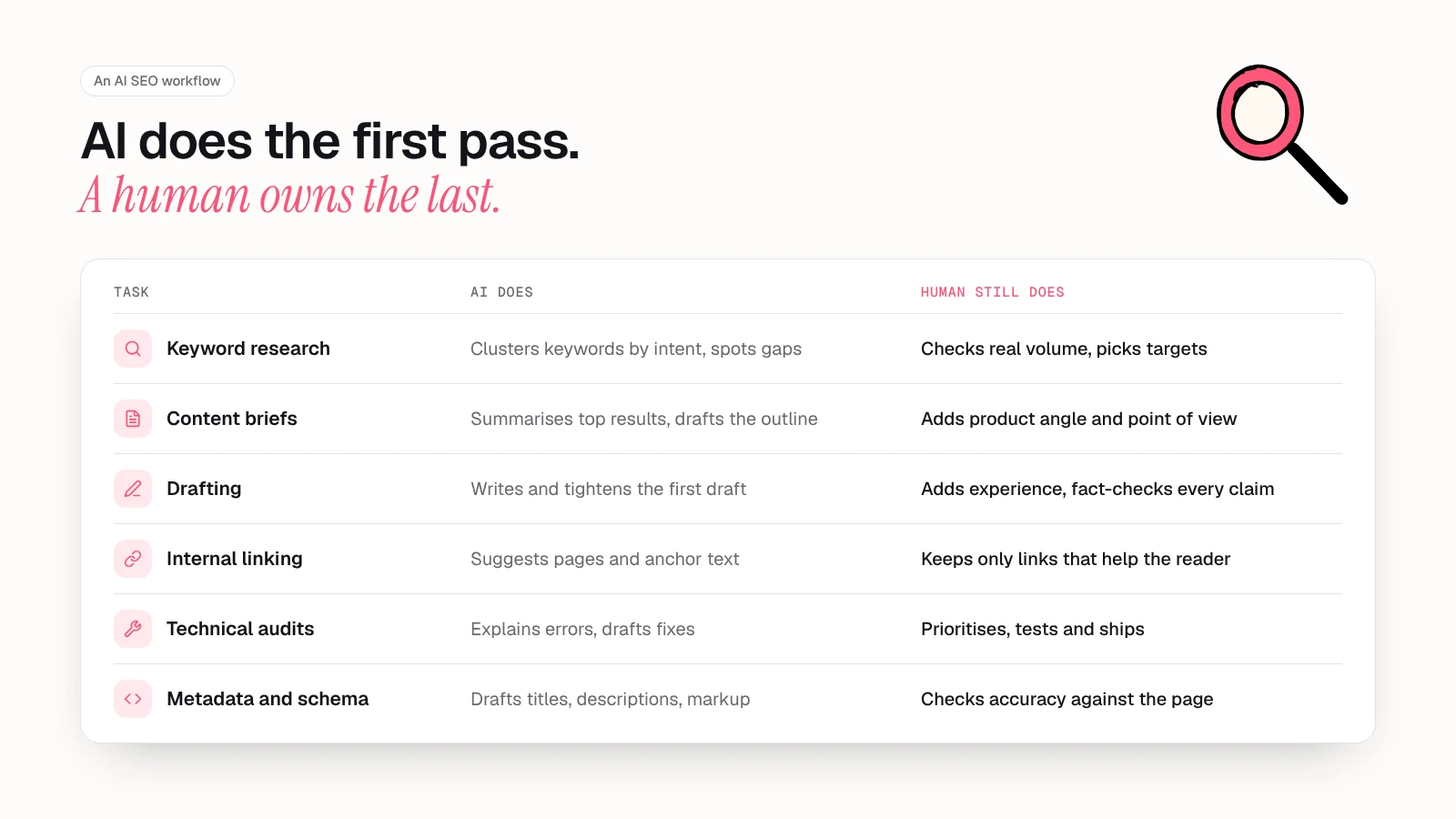
The simplest rule is to let AI do the first pass and let a human own the last one. This table shows how that splits across the main SEO tasks.
| Task | How AI helps | What a human must still do |
|---|---|---|
| Keyword research | Clusters exported keywords by intent, suggests page groupings, spots gaps | Pull real volume and difficulty data, pick targets that fit the product and buyer |
| Content briefs | Summarises top results, lists questions and subtopics, drafts an outline | Add the product angle, customer insight and the point of view the piece will argue |
| Drafting | Writes a first draft from the brief, rewrites sections, tightens copy | Add first-hand experience and examples, fact-check every claim, edit for voice |
| Internal linking | Suggests relevant pages and anchor text from your URL list | Confirm each link helps the reader, keep the cluster structure intentional |
| Technical audits | Explains crawl errors, groups issues, drafts redirects, robots rules and schema | Prioritise by business impact, test fixes on staging, ship and verify |
| Metadata and schema | Drafts titles, descriptions, alt text and structured data at scale | Check accuracy against the page, make sure markup matches visible content |
| Reporting | Summarises Search Console exports, flags pages that dropped | Decide what to fix, refresh or cut, and why |
In practice, a weekly loop for one person might look like this:
- Pick the next page from your plan and its target query. This is a human call.
- Generate the brief with AI, then add your angle, data and examples.
- Draft with AI, then rewrite. Budget more time for editing than drafting.
- Fact-check every number, name and claim against a source you opened yourself.
- Run AI over the finished draft for internal link suggestions, a title, a meta description and schema. Review each one.
- Publish, then review results monthly. Use AI to summarise performance data, and decide yourself what to refresh.
This keeps people accountable where Google and readers look for it. Our startup SEO playbook shows where this loop fits alongside technical setup and link building.
Optimising for AI-powered search
The second meaning of AI SEO is getting your pages used as sources in AI answers. For most startups it starts with the same fundamentals. A few facts worth knowing:
- Google says there is no special trick. Its documentation on AI features and your website states: "There are no additional requirements to appear in AI Overviews or AI Mode, nor other special optimizations necessary." To be shown as a supporting link, a page "must be indexed and eligible to be shown in Google Search with a snippet."
- Other AI search engines use their own crawlers. OpenAI's crawler documentation recommends allowing OAI-SearchBot in robots.txt for your site to appear in ChatGPT search, and says this is separate from GPTBot, which relates to model training. Perplexity's crawler documentation says PerplexityBot "is designed to surface and link websites in search results on Perplexity" and is not used for training foundation models. Check that your robots.txt or CDN is not blocking these by accident.
- Clicks behave differently. A Pew Research Center study of 68,879 Google searches by 900 US adults in March 2025 found users clicked a traditional result on 8% of visits when an AI summary appeared, versus 15% without one, and clicked a link inside the summary on 1% of visits.
- Content choices can change citation rates. The GEO research paper (November 2023) found optimisation methods could boost a source's visibility in generative engine responses by up to 40% in its tests.
We cover the full method, including how to structure pages for citation and how to track mentions, in our guide to generative engine optimization. The short version: be crawlable, answer questions directly near the top of the page, include specifics others do not have, and earn mentions on sites AI engines already trust.
How to tell if your AI SEO is working
Measure AI-assisted content the way you measure any content: by what it does, not how fast you made it. Track rankings, clicks and conversions per page in Search Console and your analytics, and compare pages produced with the new workflow against older ones. For AI search, run a fixed set of buyer questions through ChatGPT, Perplexity and Google every month and record whether you are cited. We explain which numbers to watch, and which to ignore, in our guide to SEO KPIs.
If output went up and results did not, the workflow is producing volume, not value. Cut back and put the saved time into editing and original input.
FAQ
What is AI SEO?
AI SEO covers two things: using AI tools to research, write and audit faster, and optimising your content so AI-powered search engines like Google AI Overviews, ChatGPT search and Perplexity can find and cite it.
Does Google penalize AI-generated content?
No, not for being AI-generated. Google says it rewards quality "rather than how content is produced," but using automation mainly to manipulate rankings breaks its spam policies. Mass-producing pages that add no value can count as scaled content abuse, whether a model or a person wrote them.
How do I use AI for SEO?
Use AI for the structured, repetitive parts: clustering keywords, drafting briefs and first drafts, suggesting internal links, writing metadata and explaining technical audit results. Keep a human responsible for strategy, fact-checking, first-hand experience and final edits.
Is SEO for AI different from regular SEO?
Mostly no. Google says there are no special optimisations needed for AI Overviews or AI Mode beyond being indexed and eligible for a snippet. The differences are at the edges: allowing AI search crawlers like OAI-SearchBot and PerplexityBot, and writing direct, specific answers that are easy to quote.
Should I disclose that content was written with AI?
Google suggests disclosures where readers would reasonably ask "How was this created?", such as content substantially generated by automation. It also says listing AI as the author is probably not the best approach. A human byline plus an honest note on process is the safer pattern.
Will AI replace SEO?
No. AI changes how SEO work gets done and where answers appear, but the job stays: understand what people search for and publish the best answer. AI makes average content cheap, which makes original, accurate content more valuable.
Sources
- Google Search Central: Google Search's guidance about AI-generated content (February 2023)
- Google Search Central: Spam policies for Google web search (August 2026)
- Google Search Central: What web creators should know about our March 2024 core update and new spam policies (March 2024)
- Google Search Central: Google Search's guidance on generative AI content on your website (October 2026)
- Google Search Central: Creating helpful, reliable, people-first content (October 2026)
- Google Search Central: Top ways to ensure your content performs well in Google's AI experiences on Search (May 2025)
- Google Search Central: AI features and your website (December 2025)
- OpenAI: Overview of OpenAI crawlers (October 2026)
- Perplexity: Perplexity crawlers (October 2026)
- Pew Research Center: Google users are less likely to click on links when an AI summary appears in the results (July 2025)
- arXiv: GEO: Generative Engine Optimization (November 2023)