SEO content strategy: from keyword list to ranked backlog
A content strategy in SEO turns a raw keyword list into a ranked backlog. Map intent, cluster topics, pick pillars, score pages and publish on a cadence.


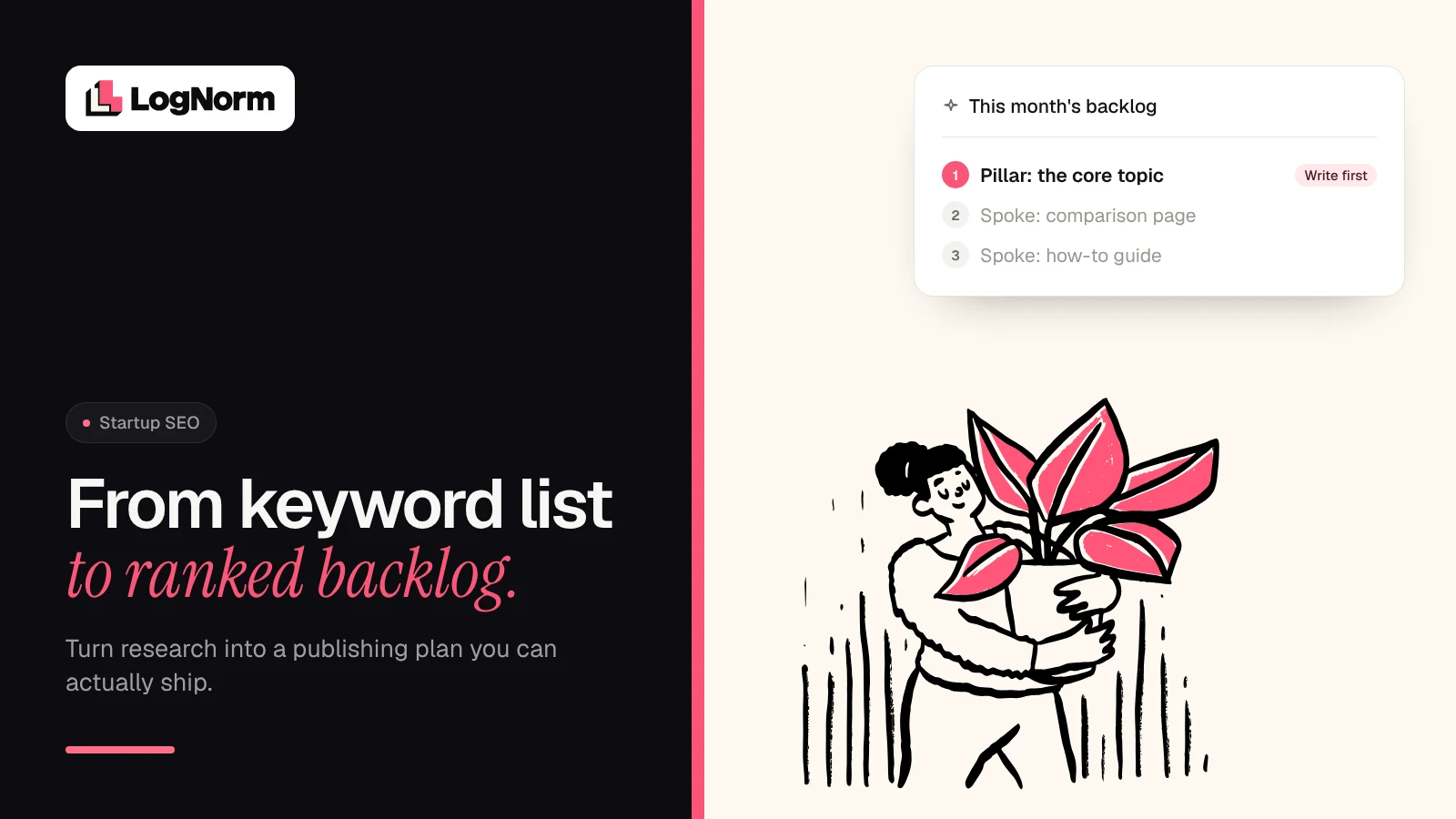
A content strategy in SEO is the plan that decides which pages you publish, in what order, and how they link together, so each page answers a real search and strengthens the others. In practice, it turns a raw keyword list into a ranked backlog: keywords grouped by intent into topics, topics arranged into pillars and spokes, and every planned page scored so the team always knows what to write next.
Most startups have the keyword list. Very few have the backlog. This guide closes that gap step by step. It is one part of our SEO playbook for teams without an SEO hire, and it assumes you already have a list of keywords from a tool, a spreadsheet or your own customer calls.
Why a keyword list is not a strategy
A keyword list tells you what people search for. It does not tell you which page to build, which keywords belong on the same page, or what to do first.
Left unprocessed, it produces three predictable problems:
- Duplicate pages. Five keywords that mean the same thing become five thin posts that compete with each other.
- Random order. The team writes whatever feels interesting this week, so the pages that would bring buyers wait behind the ones that bring nobody.
- Orphan content. Posts go live with no links from related pages, so neither readers nor crawlers find a path to them.
Google is direct about the risk of publishing without a plan. Its guidance on helpful, people-first content lists, as a warning sign, "producing lots of content on many different topics in hopes that some of it might perform well in search results." A strategy is the opposite of that: fewer pages, chosen on purpose, built to support each other.
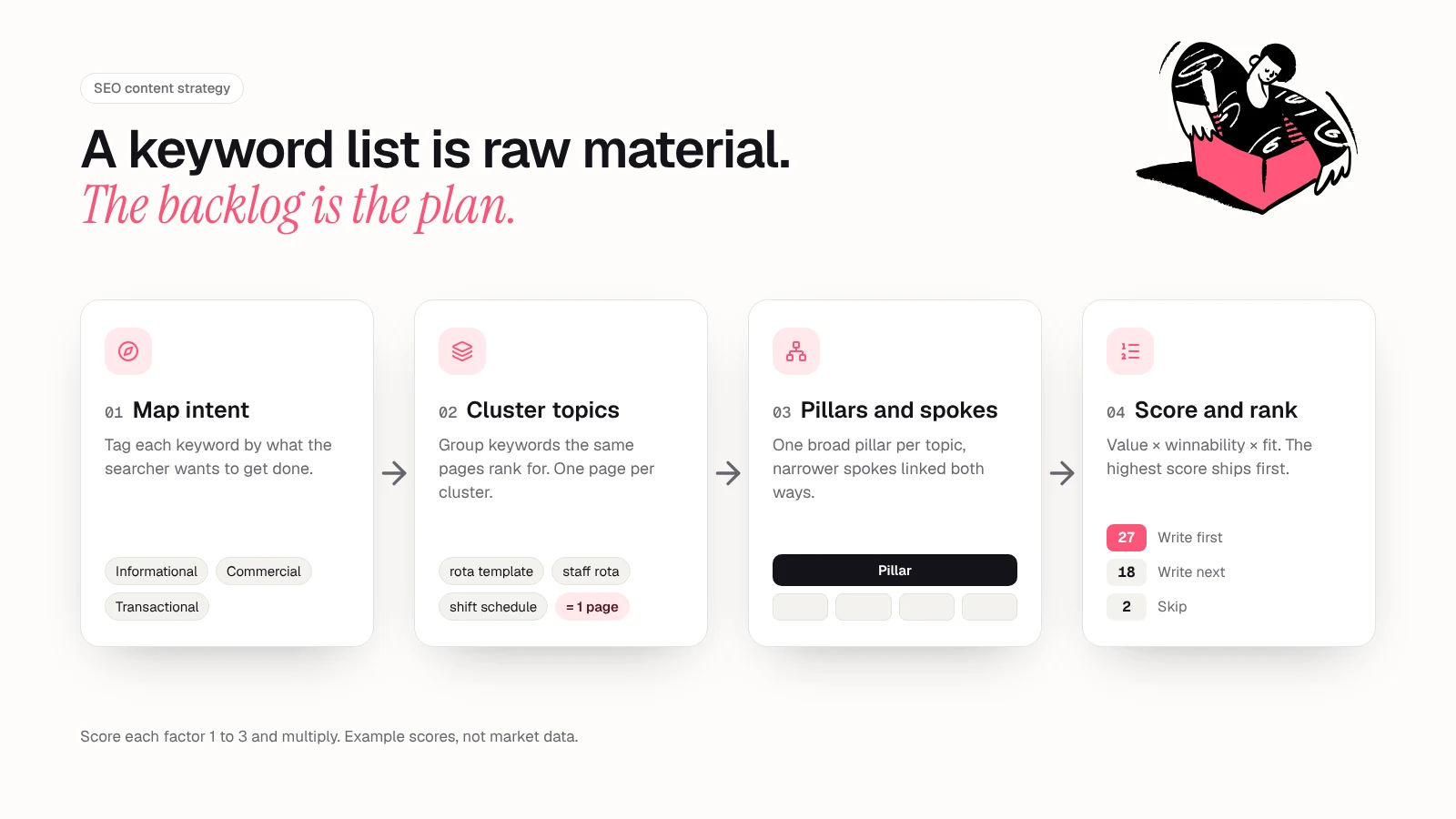
The core process has four stages: map intent, cluster keywords into topics, arrange topics into pillars and spokes, then score every page into one ranked list.
Step 1: map every keyword to search intent
Intent is what the searcher is trying to get done. It decides the page type, so map it before anything else.
Google's own Search Quality Rater Guidelines describe query intent in terms of Know queries (seeking information), Do queries (trying "to accomplish a goal or engage in an activity", such as to download or buy), Website queries and Visit-in-person queries. The guidelines also note that the line between Know and Do "is sometimes blurry". Most marketers use a simpler three-way split that maps onto those categories well enough for planning:
| Intent | What the searcher wants | Page type that fits | Example query (illustrative) |
|---|---|---|---|
| Informational | To understand something or solve a problem | Guide, explainer, how-to, template | "how to write a shift schedule" |
| Commercial | To compare options before choosing | Comparison, alternatives page, "best X" list | "shift scheduling software for restaurants" |
| Transactional | To act now: sign up, buy, download | Product page, pricing page, free tool | "shift scheduling app free trial" |
The fastest way to confirm intent is to search the keyword and look at what already ranks. If the first page is all how-to guides, a product page will struggle there, however well it is written. Match the format the results show, then do it better. Tag every keyword with one intent; if it carries two, tag the stronger.
Step 2: cluster keywords into topics
The rule is one page per intent, not one page per keyword. Clustering is how you apply it.
A cluster is a set of keywords a single page can satisfy. "How to make a staff rota", "staff rota template" and "how to schedule employee shifts" may look like three posts. If the same pages rank for all three, searchers clearly accept one answer for them, so you should write one page.
To cluster without special tools:
- Sort the sheet by intent, so you only compare like with like.
- Search each keyword and note the top few ranking URLs.
- Group keywords whose results share several of the same URLs.
- Name each group after its clearest phrase. That becomes the target keyword; the rest become secondary keywords and subheadings.
Clustering also prevents cannibalisation, where two of your own pages compete for the same query. If you already have near-duplicates, pick one to keep and merge the other into it. Google's guide to consolidating duplicate URLs calls a redirect "a strong signal that the target of the redirect should become canonical", so a 301 from the weaker page is usually the cleanest fix.
Step 3: choose pillars and spokes
Some clusters are broad enough to anchor a topic; most are narrower questions that sit under one.
HubSpot describes topic clusters as "a group of related content pieces (cluster pages) around one central pillar page." The pillar "covers a broad subject at a high level", and each cluster page addresses "a specific subtopic, long-tail question, or use case within that subject."
Here is how to choose:
- A pillar targets the broadest keyword in a topic and answers it fully at a summary level. It links down to every spoke.
- A spoke targets one narrower cluster and goes deep on it. It links up to the pillar and across to closely related spokes.
- A topic is worth a pillar only if you can name at least four or five distinct spokes under it. If you cannot, it is a spoke of something bigger.
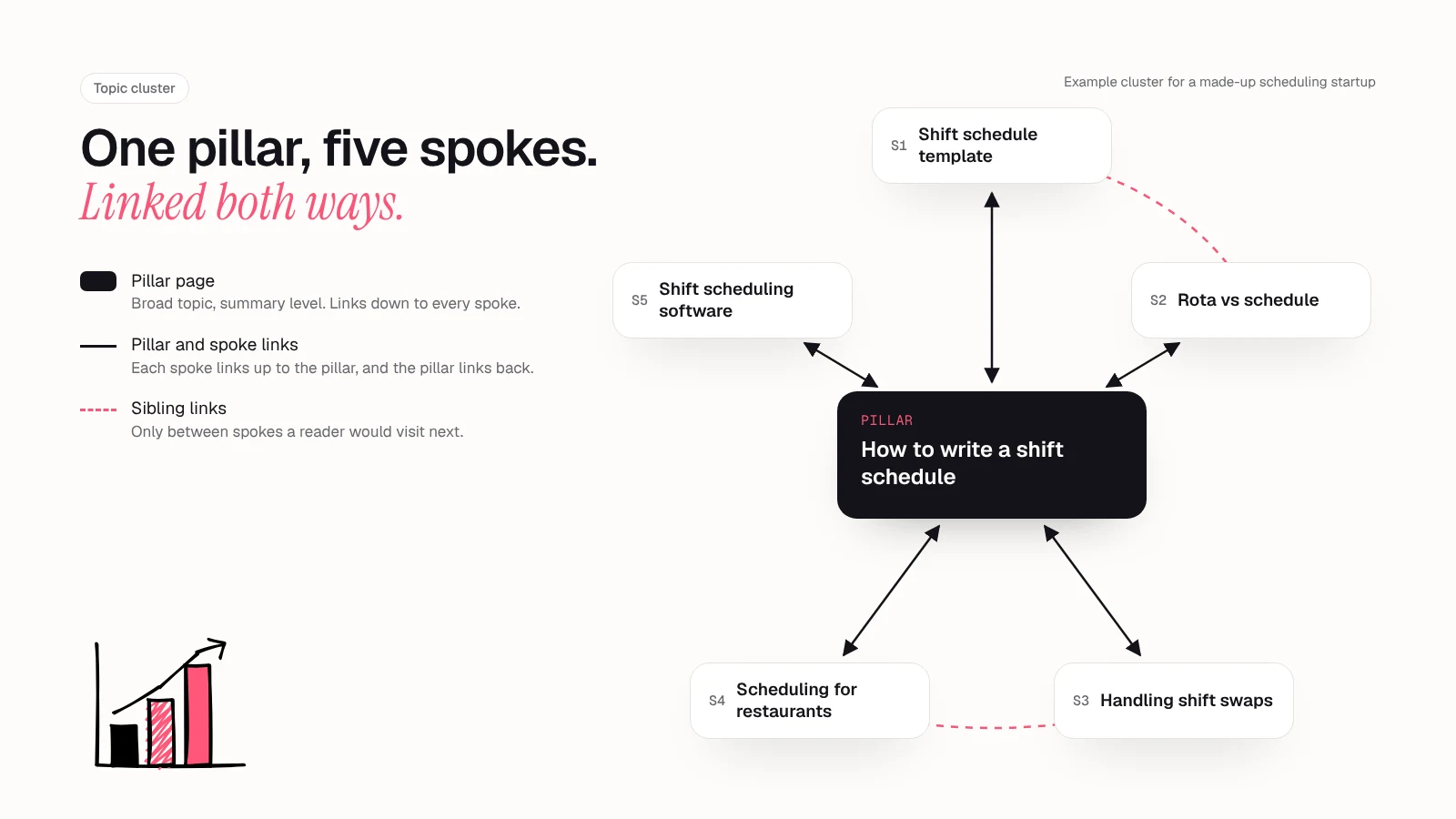
This blog uses the same structure. Our startup SEO playbook is the pillar; this post and our guides to SEO KPIs and AI SEO are spokes under it.
Start with one pillar per buyer problem your product solves. Two or three well-built clusters will do more for a young site than ten half-finished ones.
Step 4: score every page by value, winnability and fit
Now you have a list of planned pages. To set the order, we score each page on three factors and multiply them.
- Value: how much a ranking page is worth to the business. A searcher close to buying, or a topic your best customers search, scores high. A broad topic with no link to your product scores low.
- Winnability: how realistic it is to reach page one in the next few months. Look at who ranks today. Big, well-linked sites on every result mean low winnability; forums, thin posts and small blogs mean high.
- Fit: how credibly you can write it. Do you have first-hand experience, product data or customer stories that the ranking pages lack?
Keyword difficulty scores help with winnability, but read them carefully. Ahrefs, for example, says its Keyword Difficulty metric is based on how many websites link to the top 10 ranking pages, and that the score "doesn't account for your specific website's authority." Treat it as one input, then check the results page yourself.
Score each factor 1 to 3 and multiply, for a range of 1 to 27. Multiplying, rather than adding, means a page that is weak on any one factor sinks.
Example scoring table
The table below is an example for a made-up startup selling shift-scheduling software. The keywords and scores are illustrative, not market data.
| Example page (target keyword) | Intent | Value | Winnability | Fit | Score | Decision |
|---|---|---|---|---|---|---|
| "[product] vs [main competitor]" | Commercial | 3 | 3 | 3 | 27 | Write first |
| "how to write a shift schedule" | Informational | 2 | 3 | 3 | 18 | Write next (pillar) |
| "restaurant shift schedule template" | Informational | 2 | 3 | 2 | 12 | Queue |
| "best shift scheduling software" | Commercial | 3 | 1 | 3 | 9 | Later, once the cluster has support |
| "rota vs schedule" | Informational | 1 | 3 | 2 | 6 | Fold into the pillar as a section |
| "labour laws on scheduling by state" | Informational | 1 | 2 | 1 | 2 | Skip |
The comparison page wins because the buyer is close to a decision and few strong pages cover a niche pair of products. The "best software" list has top value but low winnability, so it waits until supporting pages exist.
Sort by score, and the sheet becomes your backlog. Review it every month as rankings, products and priorities shift. A ranked backlog that everyone works from is the core of any growth engine: the system decides what ships next, not whoever has the loudest idea that week.
Step 5: write a brief for every page
A brief turns a backlog row into a page a writer can finish without guessing. Keep it to one screen, covering:
- Target keyword and secondary keywords from the cluster.
- Intent and page type, with the format the current results reward.
- The direct answer in two or three sentences, which becomes the opening.
- Outline of H2s and H3s, built from the questions searchers ask around the topic.
- What we add that others do not: first-hand experience, product data, examples, screenshots.
- Internal links: which pillar to link up to, which spokes to link across to.
- Sources to check before any number goes in.
Item 5 matters most. Google's helpful content guidance asks whether content provides "original information, reporting, research, or analysis" and whether it is "the sort of page you'd want to bookmark, share with a friend, or recommend." A brief that only lists keywords produces a page that only repeats them. Our guide to AI SEO covers where AI tools help with briefs and drafts and where they need a human pass.
Do not set word counts as targets. The same guidance asks, "Are you writing to a particular word count because you've heard or read that Google has a preferred word count? (No, we don't.)" Length should follow from what the question needs.
Step 6: publish on a cadence you can keep
Consistency beats bursts. Pick a cadence you can sustain for months, whether one page a week or two a month, then protect it. Work the backlog from the top, one cluster at a time, so each pillar gains spokes quickly instead of every topic getting one page.
Be careful with volume shortcuts. Google's spam policies define scaled content abuse as "when many pages are generated for the primary purpose of manipulating search rankings and not helping users," and list "using generative AI tools or other similar tools to generate many pages without adding value for users" as an example.
Expect results to take time. Google's SEO Starter Guide says some changes "could take several months" and that "you likely want to wait a few weeks to assess whether your work had beneficial effects." Judge a cluster on a quarter, not a week. Our startup SEO playbook covers how this content work fits alongside the technical basics and link building.
Step 7: set internal linking rules once
Internal links are what make a set of pages a cluster.
Google's link best practices say "every page you care about should have a link from at least one other page on your site," that links should be standard <a href> elements, and that anchor text should be descriptive, concise and relevant, avoiding generic phrases like "click here."
Write rules once and put them in every brief:
- Every spoke links to its pillar early in the body, and once more later if it reads naturally.
- Every pillar links to every spoke, in the section where that subtopic comes up, with a summary rather than the spoke's full content.
- Spokes link across to one or two siblings only when the reader would genuinely want to go there next.
- Anchor text describes the destination, using the target page's topic, not "read more."
- New pages get links from old ones. When a spoke goes live, add a link to it from the pillar and from any older page that mentions the topic.
Step 8: refresh old content on a schedule
A backlog is not only new pages. Updating what already ranks is often the cheapest win you have.
Google's SEO Starter Guide advises you to "check in on previously published content and update it as needed, or even delete it if it's not relevant anymore." Put refreshes in the same backlog, scored the same way.
Signals that a page needs attention:
- It ranks on page two for its target keyword. Small improvements there can move it onto page one.
- Facts, screenshots, prices or product details are out of date.
- A newer page of yours now covers the same ground. Merge them and redirect the weaker one.
A refresh should change substance, not just the date. To choose which numbers to watch for each page, see our guide to SEO KPIs.
FAQ
What is content strategy in SEO?
It is the plan for which pages to create, in what order, and how they link together so they rank and support each other. It starts from what people search for, groups those searches by intent into topics, and ends in a prioritised list of pages to publish and update.
How do topic clusters help SEO?
A topic cluster groups one broad pillar page with several narrower spoke pages, all linked together. That structure helps readers move between related answers, helps crawlers find every page, and stops your own pages from competing for the same query.
What is the difference between a pillar page and a blog post?
A pillar page covers a broad topic at a summary level and links out to deeper pages on each subtopic. A regular blog post, or spoke, goes deep on one narrow question and links back up to the pillar.
How do I prioritise which SEO content to write first?
Score each planned page on business value, how winnable the ranking is, and how credibly you can write it, then multiply the scores. Pages close to a buying decision that few strong sites cover usually rise to the top.
How do I do keyword clustering without a tool?
Search each keyword and note the top ranking URLs. Keywords whose results share several of the same pages can usually be served by one page of yours, so group them and target the clearest phrase as the main keyword.
Sources
- Google Search Central: Creating helpful, reliable, people-first content (October 2026)
- Google Search Central: SEO link best practices for Google (December 2025)
- Google Search Central: SEO Starter Guide (December 2025)
- Google Search Central: Spam policies for Google web search (August 2026)
- Google Search Central: How to specify a canonical URL with rel="canonical" and other methods (July 2026)
- Google: Search Quality Rater Guidelines (September 2025)
- Ahrefs: Keyword difficulty: how to estimate your chances to rank (December 2025)
- HubSpot: Topic clusters, the next evolution of SEO (June 2026)