How to rank in ChatGPT and Perplexity
ChatGPT SEO, step by step: which crawlers to allow, how ChatGPT search and Perplexity pick sources, and the content and mentions that get you cited.


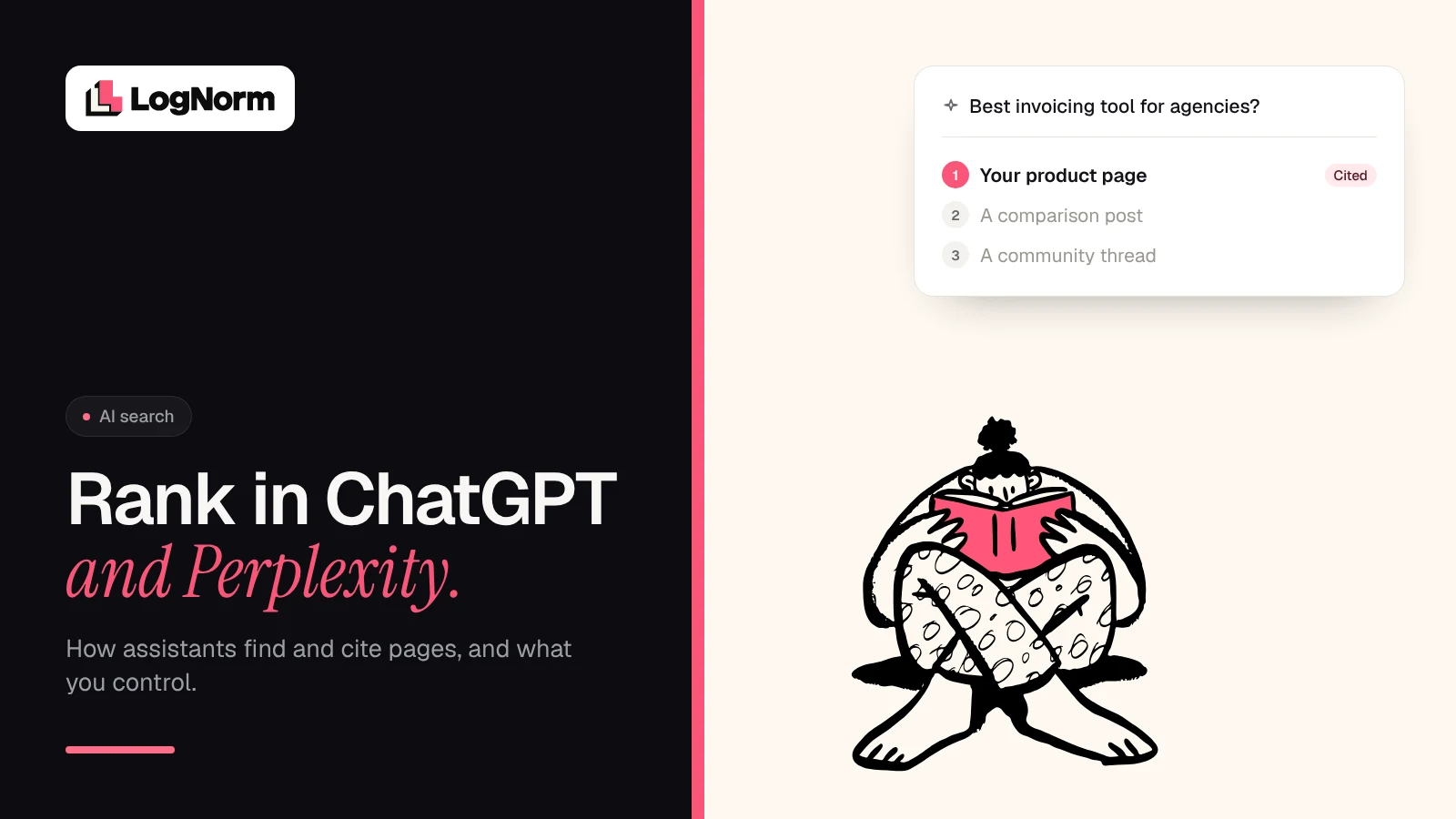
To rank in ChatGPT and Perplexity, first let their search crawlers (OAI-SearchBot and PerplexityBot) reach your site, then publish pages that answer specific buyer questions directly, and earn mentions on the third-party sites these assistants lean on. There is no guaranteed position: answers are generated fresh each time, so the goal is to be cited often, not to hold a fixed rank.
ChatGPT SEO is less new than it sounds. The technical part is a few lines of robots.txt and an indexable site. The harder part is the work that has always built search visibility: useful pages and a reputation other sites talk about. What changes is how few names make it into the answer.
This is the hands-on companion to our generative engine optimization guide: how each assistant finds pages, which bots to allow, and a six-step plan you can run without an SEO hire.
How ChatGPT search finds and cites pages
ChatGPT does not search the web on every prompt. OpenAI's help article on searching the web with ChatGPT says it "may search the web automatically when your question would benefit from current information," and users can also trigger a search by hand.
When it does search, OpenAI says ChatGPT "typically rewrites your query into one or more targeted queries," and that "ChatGPT search sometimes partners with other search providers." The same article points readers to the privacy policies of Microsoft and Shopify for how those providers process queries. OpenAI does not publish a ranking formula, so treat more specific claims as guesses.
Answers that use the web can include citations, and a Sources button lists the cited pages plus other relevant links. OpenAI is also candid that "search results and citations can be incomplete, outdated, or incorrect."
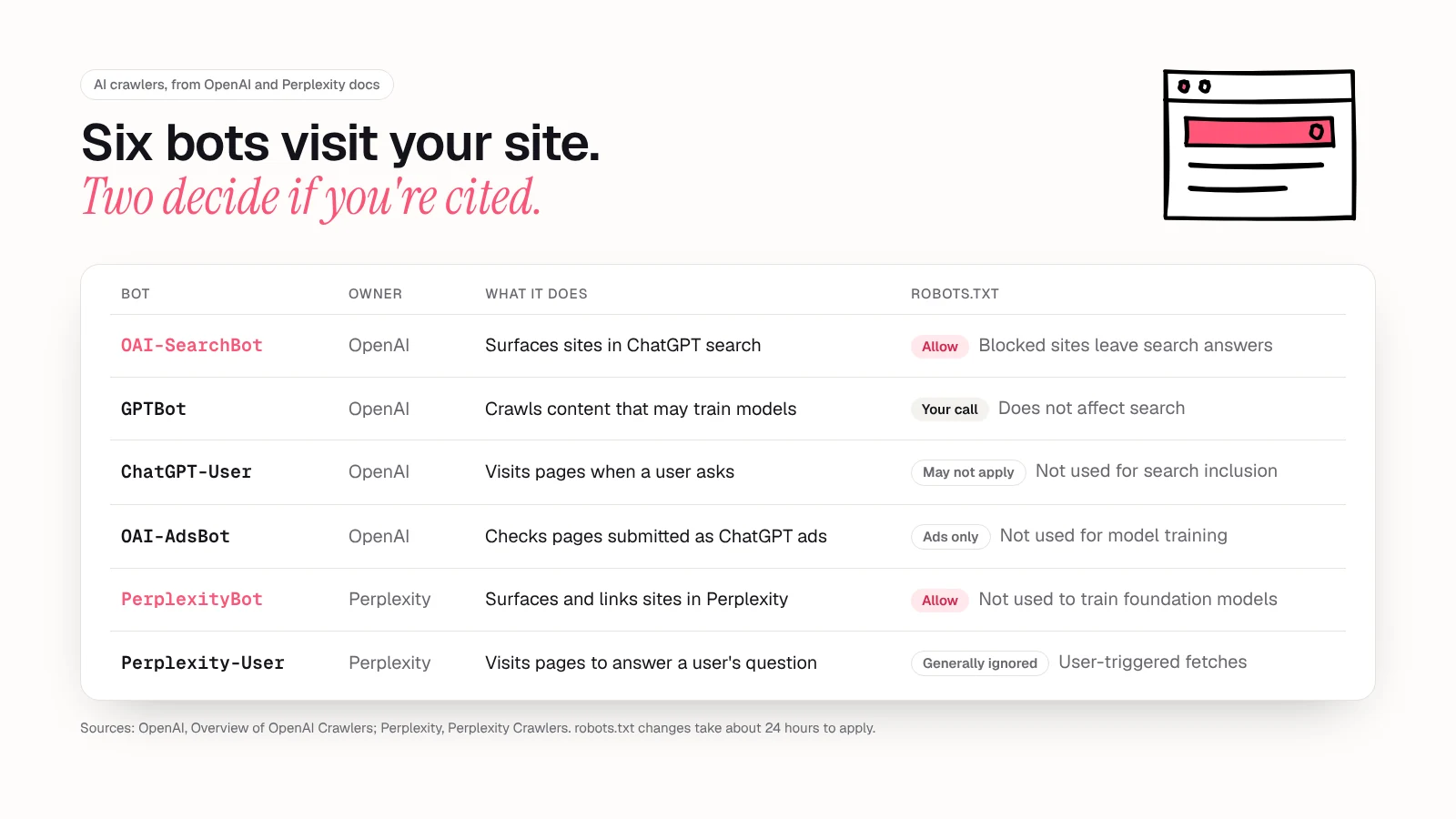
For publishers, the part that matters is the crawler. OpenAI's overview of its crawlers lists four user agents, and they do different jobs:
- OAI-SearchBot is "used to surface websites in search results in ChatGPT's search features." This is the one that decides whether you can be shown in ChatGPT search answers.
- GPTBot crawls content "that may be used in training our generative AI foundation models." Blocking it is a training opt-out, not a search opt-out.
- ChatGPT-User handles actions a user starts, such as asking ChatGPT to open a page. OpenAI says it "is not used for crawling the web in an automatic fashion," that robots.txt rules "may not apply," and that it "is not used to determine whether content may appear in Search."
- OAI-AdsBot only visits pages submitted as ads on ChatGPT, to check their safety.
OpenAI states that "each setting is independent of the others." You can allow OAI-SearchBot to appear in search while disallowing GPTBot.
How Perplexity finds and cites pages
Perplexity is search-first by design. Its help article on how Perplexity works says it searches the internet in real time and that "each answer includes numbered citations linking to the original sources." Like OpenAI, it does not publish how it ranks or selects those sources.
Perplexity's crawler documentation names two agents:
- PerplexityBot is "designed to surface and link websites in search results on Perplexity." Perplexity says it "is not used to crawl content for AI foundation models." Allow it if you want to appear in Perplexity answers.
- Perplexity-User "supports user actions within Perplexity." When someone asks a question, it may visit a page to answer it and link to that page. Perplexity says this fetcher "generally ignores robots.txt rules," because a user triggered the request.
So "Perplexity SEO" has a simple technical floor: PerplexityBot has to be able to reach the page. Everything above that floor is content and reputation.
Which bots to allow: a quick reference
Here is every documented bot from both companies, side by side. The advice column assumes you want to be cited.
| Bot | Owner | What it does | robots.txt advice |
|---|---|---|---|
| OAI-SearchBot | OpenAI | Surfaces sites in ChatGPT search | Allow. Blocking keeps you out of search answers |
| GPTBot | OpenAI | Crawls content that may train foundation models | Your choice. Does not affect search |
| ChatGPT-User | OpenAI | Visits pages when a user asks | Robots.txt may not apply. Not used for search inclusion |
| OAI-AdsBot | OpenAI | Checks pages submitted as ChatGPT ads | Only relevant if you run ads |
| PerplexityBot | Perplexity | Surfaces and links sites in Perplexity search | Allow |
| Perplexity-User | Perplexity | Visits pages to answer a user's question | Generally ignores robots.txt |
A minimal robots.txt for a startup that wants to be cited but keep content out of OpenAI's model training looks like this:
User-agent: OAI-SearchBot
Allow: /

User-agent: PerplexityBot
Allow: /

User-agent: GPTBot
Disallow: /
If you are happy for GPTBot to crawl, drop the last block. Both companies say robots.txt changes are not instant: OpenAI says it "can take ~24 hours" for search, and Perplexity says changes "may take up to 24 hours" to reflect.
Two edge cases are worth knowing. First, blocking is not the same as disappearing. OpenAI says sites opted out of OAI-SearchBot "can still appear as navigational links," and its publishers and developers FAQ adds that it may surface "just the link and page title" of a disallowed page if it finds the URL elsewhere. Use a noindex meta tag if you want a page kept out entirely. Second, robots.txt is not the only gate. On 1 July 2025, Cloudflare announced that every new domain signing up would be asked whether to allow AI crawlers, with access blocked by default. OpenAI also asks site owners to confirm their host or CDN allows traffic from its published search bot IP addresses. If your robots.txt says yes but your firewall says no, the firewall wins.
Six steps to rank in ChatGPT and Perplexity
The first two steps are a one-afternoon technical check. The rest is ongoing work.
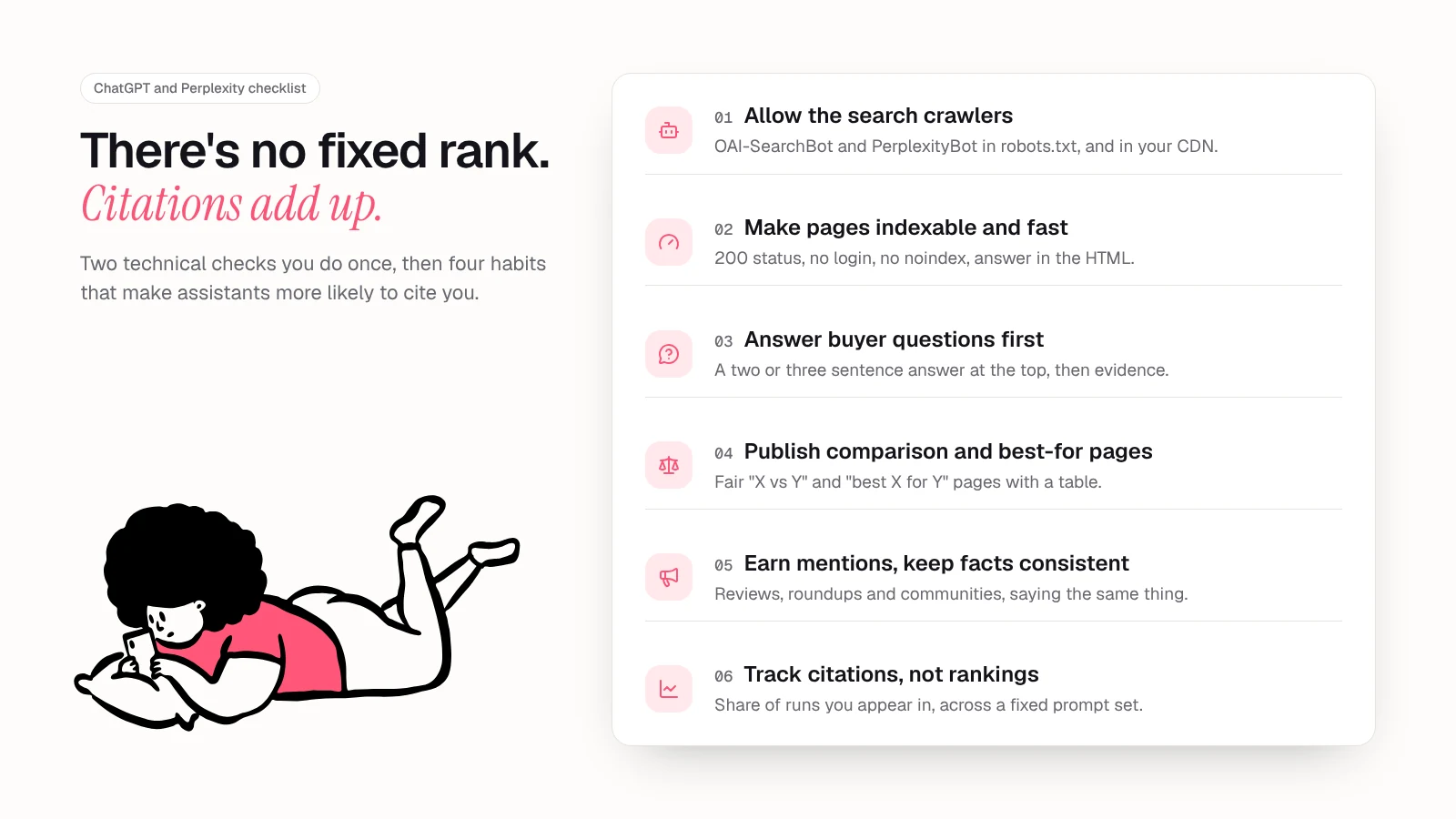
1. Allow the search crawlers, and check your CDN
Open yourdomain.com/robots.txt and confirm OAI-SearchBot and PerplexityBot are not disallowed, either by name or by a blanket User-agent: * rule. Then check your CDN or firewall settings for AI crawler blocking. Decide on GPTBot separately, based on how you feel about training, since it does not change search visibility.
2. Make pages indexable, fast and easy to read
An assistant cannot cite a page its crawler cannot load. Make sure the pages you want cited return a normal 200 status, are not behind a login, are not marked noindex, and are linked from your sitemap and navigation. Keep the main answer in the page's HTML rather than in tabs, images or scripts that load late. Fast, clean pages are also what traditional search rewards, and OpenAI says ChatGPT search draws on third-party search providers, so classic indexability still matters.
Google's AI features are a separate system with their own rules. We cover them in how to get cited in Google AI Overviews.
3. Answer specific buyer questions first
Assistants are answering questions, so give them a clean answer to lift. Pick the questions a buyer types when they are close to a decision: "what is the best X for a team of five," "does X integrate with Y," "how much does X cost." Write one page or section per question, and put a two or three sentence answer at the top, before any background.
Then back the answer with evidence. The GEO paper tested rewrites of web content on a benchmark of queries and found visibility in generative engine responses could rise "by up to 40%." In the paper's results, adding statistics, quotations and source citations were among the best methods, while keyword stuffing performed worse than doing nothing. Specifics beat repetition.
4. Publish comparison and "best X for Y" pages
A large share of buyer prompts are comparisons: "X vs Y," "alternatives to X," "best tool for Y." If you do not publish a clear, fair page on that question, the assistant will build its answer from someone else's.
Good comparison pages are honest about where a competitor fits better, use a table for features and pricing, and name the use case each option suits. A page that says plainly "best for seed-stage teams with no SEO hire" gives the assistant a sentence it can reuse.
5. Earn third-party mentions and keep your facts consistent
Your own site is only part of the picture. A September 2025 study, Generative Engine Optimization: How to Dominate AI Search, found AI search shows "a systematic and overwhelming bias towards Earned media (third-party, authoritative sources) over Brand-owned and Social content," while Google keeps a more balanced mix. The authors also flag a "big brand bias" that smaller players have to work around.
For a startup, that means:
- Get listed and reviewed on the directories and review sites your buyers use.
- Show up in the "best tools for" articles and roundups that already rank for your category.
- Answer questions in the communities where your buyers ask them, as a named person, without spam.
- Pitch data, guest posts and podcast appearances that put your name next to the problem you solve.
Keep your basic facts identical everywhere: what the product does, who it is for, pricing tiers, integrations. When your site says one thing and a two-year-old review says another, the assistant has to pick. Update old listings and profiles whenever something changes.
6. Track citations, not rankings
You cannot track a "position" in ChatGPT the way you track one in Google, because there is no stable list. SparkToro's study of AI recommendation consistency, published in January 2026, had 600 volunteers run 12 prompts 2,961 times across ChatGPT, Claude and Google's AI Overviews. It found less than a 1 in 100 chance of getting the same list of brands twice, and closer to 1 in 1,000 for the same order. Its conclusion: visibility measured as a percentage across many prompts and runs is a reasonable metric, while a single "ranking position in AI" is not.
So build a prompt set of 20 to 50 real buyer questions, run each several times on each assistant, and record how often you are cited and who appears instead. Watch the trend monthly, not the result of any single run. For referral traffic, OpenAI says ChatGPT adds utm_source=chatgpt.com to referral URLs, so you can filter it in your analytics. Our guide to measuring AI visibility covers prompt sets, metrics and reporting in more depth.
What you cannot control
- There is no guaranteed ranking. Neither OpenAI nor Perplexity publishes a ranking formula or documents a way to buy placement in organic answers. Anyone promising a fixed spot is guessing.
- Answers vary by run and by person. The same prompt can return different brands minutes apart, as the SparkToro data shows. How a question is phrased, and the context around it, shifts the result.
- Not every prompt triggers a search. ChatGPT searches when it judges that current information would help. When it answers from the model alone, there may be no citation to win.
- Earned media takes time. Reviews, roundups and community reputation build over months, which is also why starting early pays.
None of this is a reason to wait, since the same steps also help classic search. For how ChatGPT and Perplexity fit alongside classic search and Google's AI features, start from our guide to generative engine optimization.
FAQ
How do I get my website to show up in ChatGPT search?
Allow OAI-SearchBot in your robots.txt and make sure your host or CDN does not block OpenAI's published search bot IP addresses. OpenAI says any public website can appear in ChatGPT search. Whether you get cited for a given question then depends on how well your page, and what others say about you, answers it.
Does blocking GPTBot remove my site from ChatGPT?
No. GPTBot is OpenAI's training crawler, and OpenAI says each crawler setting is independent. Blocking GPTBot opts your content out of potential model training, while OAI-SearchBot controls whether you can appear in ChatGPT search answers.
Can I pay to rank in ChatGPT or Perplexity?
Neither company documents a way to buy organic placement in answers. OpenAI does run a separate bot, OAI-AdsBot, to check pages submitted as ads on ChatGPT, but that concerns ads, not cited sources. Organic citations come from crawl access, content and reputation.
How is Perplexity SEO different from Google SEO?
The foundations overlap: crawlable pages, clear answers and authority. The differences are the crawler (PerplexityBot must be allowed), the format (an answer with numbered citations instead of a page of links) and the measurement, since you track how often you are cited rather than a fixed position.
How long does it take to start getting cited by ChatGPT?
Robots.txt changes take about 24 hours to reach OpenAI's and Perplexity's systems, according to both companies. Getting cited regularly takes longer, because it depends on content quality and third-party mentions that build over months. There is no published timeline for either.
Sources
- OpenAI: Overview of OpenAI Crawlers (October 2026)
- OpenAI Help Center: Searching the web with ChatGPT (September 2026)
- OpenAI Help Center: Publishers and Developers FAQ (September 2026)
- Perplexity: Perplexity Crawlers (October 2026)
- Perplexity Help Center: How does Perplexity work? (October 2026)
- Cloudflare: Cloudflare just changed how AI crawlers scrape the Internet-at-large (July 2025)
- arXiv: GEO: Generative Engine Optimization (Aggarwal et al.) (June 2024)
- arXiv: Generative Engine Optimization: How to Dominate AI Search (Chen et al.) (September 2025)
- SparkToro: AIs are highly inconsistent when recommending brands or products (January 2026)