What is AI visibility, and how do you measure it?
AI visibility is how often AI assistants mention, recommend and cite your brand. Learn the five metrics that matter and a simple way to track AI mentions.


AI visibility is how often, and how favourably, AI assistants such as ChatGPT, Perplexity and Google's AI Overviews mention, recommend and cite your brand when people ask the questions your buyers ask. You measure it by running a fixed set of buyer prompts across assistants on a schedule and recording five things: mention rate, position in the answer, citations of your URLs, sentiment and accuracy, and share of voice against competitors.
AI answers give a buyer a shortlist of a few names, written fresh every time. If you are not on it, you were not considered, and no rank tracker will tell you.
This guide explains why AI visibility does not behave like a ranking and gives you a measurement method a small team can run with a spreadsheet. It is part of our series on generative engine optimization, which covers the full practice of earning a place in AI answers.
What AI visibility actually means
AI visibility is the share of relevant AI answers in which your brand shows up, and the quality of how it shows up. It has four parts:
- Mentioned. The assistant names your brand in its answer.
- Recommended. It suggests you as an option, not just in passing.
- Cited. It links to a page on your site as a source.
- Described well. What it says about you is accurate and positive.
These are different outcomes. An assistant can mention you without citing you, cite your pricing page while recommending a competitor, or recommend you for a feature you dropped last year. Track each part separately, and only for the questions your buyers ask, such as "best invoicing tool for freelancers" or "alternatives to [competitor]".
Why AI visibility is not a ranking
A search ranking is a position on a mostly stable page. AI visibility is a probability. The same question asked twice can produce a different answer, and that changes how you measure it.
Answers change from run to run
In late 2025, SparkToro and Gumshoe.ai had 600 volunteers run 12 prompts through ChatGPT, Claude and Google's AI a combined 2,961 times. They found less than a 1 in 100 chance that ChatGPT or Google's AI would give the same list of brands in any two of 100 responses, and roughly 1 in 1,000 odds of seeing two lists in the same order.
Their conclusion: visibility percentage across many prompts run many times is a reasonable metric, but a "ranking position in AI" is not.
There are many engines, not one
Google says plainly that AI Mode and AI Overviews may use different models and techniques, so the responses and links they show will vary. Both may use "query fan-out", issuing several related searches across subtopics before writing an answer. When ChatGPT searches the web with partners, it typically rewrites your question into one or more targeted queries. Each assistant builds its answer its own way, so measure each one separately.
Answers are personalised
ChatGPT can use saved memories and past conversations to personalise responses. Your test account will never see exactly what a customer sees.
Buyers phrase questions very differently
The same SparkToro study asked volunteers to write their own prompts for the same need. The average semantic similarity between pairs of those prompts was 0.081, meaning people rarely ask the same thing the same way. A tracker built on five hand-picked prompts is measuring your prompts, not your market.
| Search rankings | AI visibility | |
|---|---|---|
| Unit of measure | Position for a keyword | Share of answers that include you |
| Stability | Fairly stable day to day | Changes from one run to the next |
| Query | A short keyword you can list | A long, varied question people phrase their own way |
| Personalisation | Limited | Memory and chat history can shape answers |
| Where it is reported | Search Console, rank trackers | Mostly your own testing, plus partial platform data |
| Success looks like | Top three positions | Named, cited and described accurately in most runs |
We go deeper on how the two disciplines overlap in GEO vs SEO.
The five AI visibility metrics
Track these five numbers. Together they tell you whether you show up, how prominently, whether you get credit, whether the story is right, and how you compare.
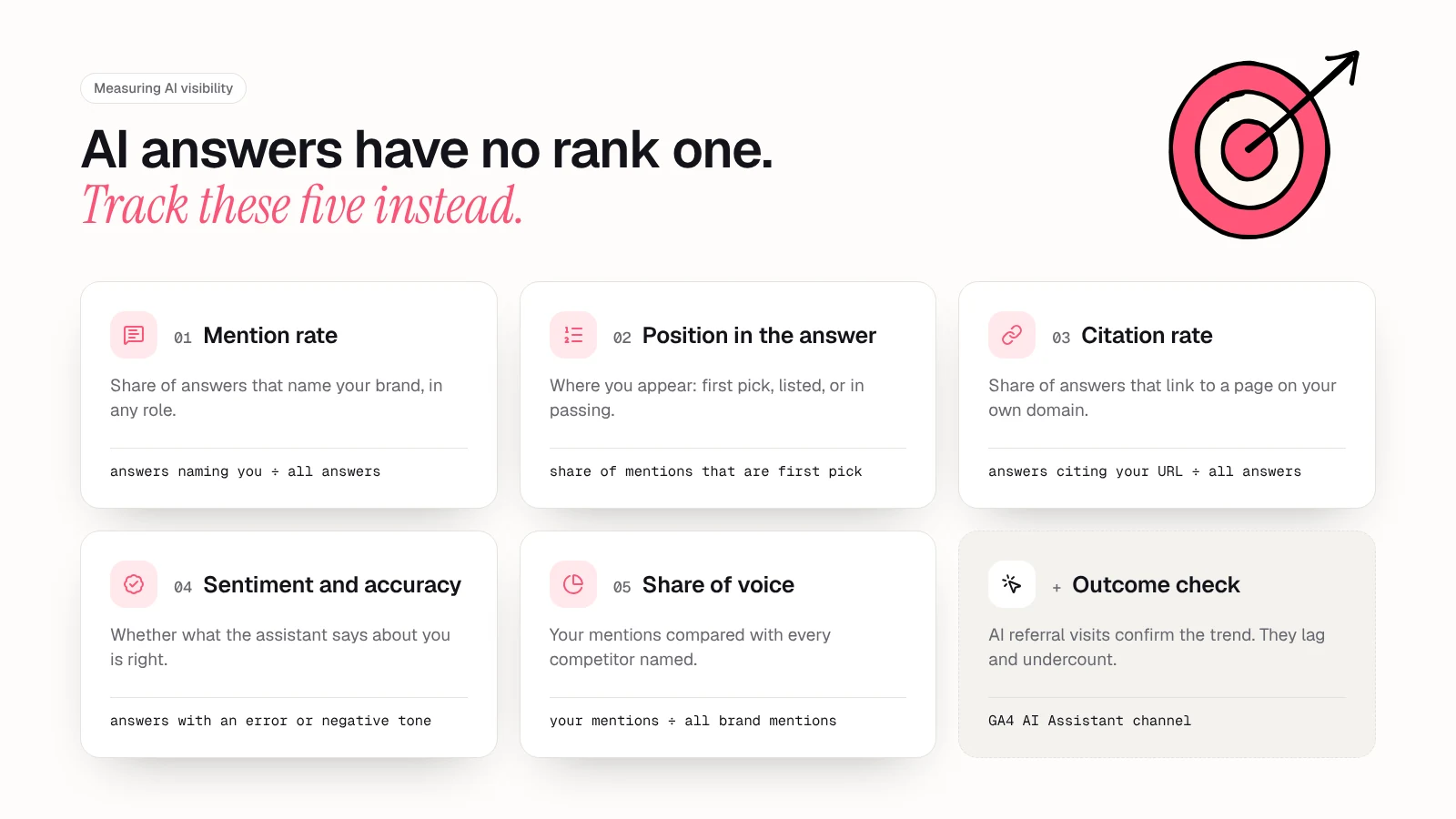
- Mention rate. The percentage of answers that name your brand. If you ran 40 prompts three times each and appeared in 30 of the 120 answers, your mention rate is 25%. This is your headline number.
- Position in the answer. Where you appear when you do appear. Because order is close to random from run to run, do not record a rank. Use three buckets instead: first recommendation, listed among options, or mentioned in passing. Then report the share of mentions that land in the first bucket.
- Citation rate. The percentage of answers that link to a URL on your domain. Record which page was cited. It is the metric most directly tied to traffic.
- Sentiment and accuracy. Is the description positive, neutral or negative, and is it correct? Check pricing, core features, who the product is for, and anything you have changed recently. One wrong fact repeated across hundreds of answers costs more than a missing mention.
- Share of voice. Your mentions divided by all brand mentions in the same answers. If competitors were named 90 times and you were named 30, your share of voice is 25%. It shows whether you are gaining ground or just riding a growing category.
A sixth number sits outside the answers: referral traffic from AI. It is the outcome you care about, but it lags and undercounts, so treat it as confirmation rather than the main gauge. We cover where to find it below.
How to measure AI visibility yourself
You do not need a paid tool to start. A spreadsheet and a consistent method will give you a reliable trend. Paid trackers automate the same steps.
- Build a prompt set from real buyer questions. Pull them from sales calls, support tickets, demo request forms, community threads and your Search Console queries. Aim for 30 to 60 prompts across three groups: problem questions ("how do I reduce invoice chasing"), category questions ("best invoicing tool for agencies") and comparison questions ("[competitor] alternatives"). Write two or three phrasings of the most important ones, because buyers will.
- Pick the assistants your buyers use. For most startups that means ChatGPT, Google (AI Overviews and AI Mode), Perplexity, and one or two of Gemini, Claude or Copilot. Ask a few customers which they use before deciding.
- Control the test conditions. Use a clean account or a logged-out session where possible, turn off memory, and note the date, assistant, mode and location for each run. You cannot remove variation, but you can stop adding your own.
- Run each prompt several times on a schedule. Three runs per prompt per assistant, once a month, is a sensible floor for a small team. Run on roughly the same days each month so the numbers are comparable.
- Log each answer the same way. For every run, record: mentioned (yes or no), position bucket, cited URL if any, sentiment, any factual errors, and every competitor named. Save the raw answer text so you can recheck later.
- Calculate the five metrics and track the trend. Compute each metric per assistant and in total. Look at month-over-month direction, not single readings. With this much variation, a five-point move in one month may be noise. A steady climb over a quarter is a signal.
Here is what a small slice of the log might look like:
| Prompt | Assistant | Run | Mentioned | Position | Cited URL | Notes |
|---|---|---|---|---|---|---|
| Best invoicing tool for small agencies | ChatGPT | 1 | Yes | First | /pricing | Accurate |
| Best invoicing tool for small agencies | ChatGPT | 2 | Yes | Listed | None | Listed old price |
| Best invoicing tool for small agencies | Perplexity | 1 | No | None | None | Three competitors named |
| [Competitor] alternatives | ChatGPT | 1 | Yes | Listed | /compare/competitor | Accurate |
| [Competitor] alternatives | Google AI Mode | 1 | Yes | Passing | None | Called it "enterprise only" |
| How to stop chasing late invoices | Perplexity | 1 | No | None | /blog/late-invoices | Cited, not named |
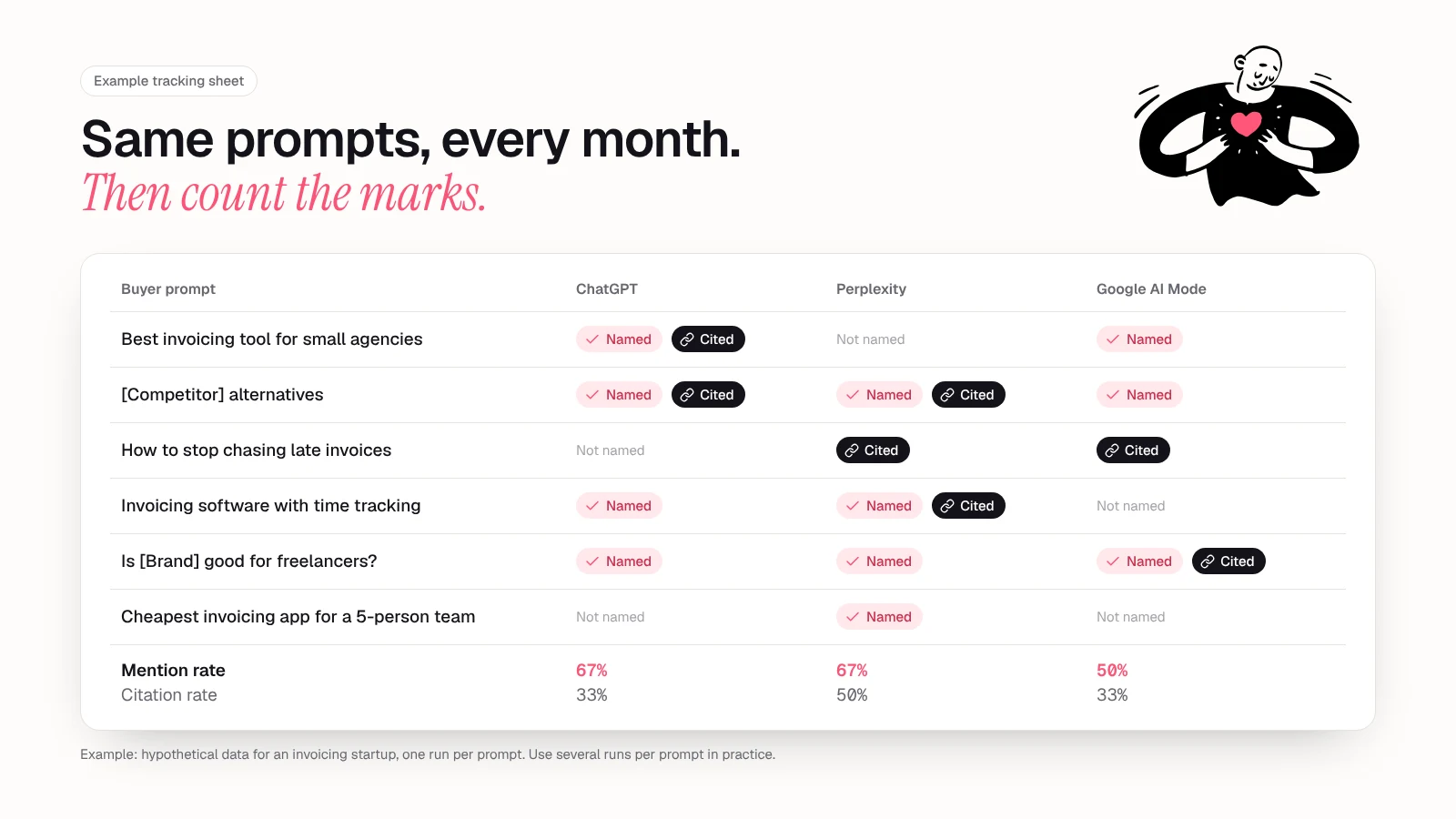
Notice the last row: a citation without a mention. The page answered the question well but did not connect the answer to the product.
Connecting AI visibility to traffic
Your prompt tests measure presence. Analytics and Search Console show what that presence is worth, and each sees a different slice.
| Source | What it shows | What it misses |
|---|---|---|
| GA4 default channel groups | An AI Assistant channel for visits from sources like ChatGPT, Gemini, Deepseek, Copilot or Grok | Google's AI Overviews and AI Mode, which GA4 counts as Organic Search |
| ChatGPT referral tags | ChatGPT adds utm_source=chatgpt.com to referral URLs, so its clicks are easy to isolate | Anyone who reads the answer and later searches your brand or types your URL |
| Search Console generative AI report | Impressions in AI Overviews and AI Mode, by page, country, device and date | Queries, clicks and position; it reports impressions only |
| Search Console performance report | AI feature traffic included in overall Web search data | A way to separate AI clicks from classic result clicks |
Google announced the generative AI performance reports in June 2026 and says they rolled out to all websites worldwide as of 31 August 2026. They show which of your pages appear in Google's AI answers, but not which questions triggered them, so your prompt set is still the only view of that.
In GA4, check the AI Assistant channel, then the session source to see which assistants send visits. Also watch branded search in Search Console: people who read an AI answer often look you up on Google later, and that shows up as brand demand, not as an AI referral.
For a wider view of which numbers belong on a growth dashboard, see our guide to SEO KPIs.
How to improve your AI visibility numbers
The tracking log tells you where to look. The fixes fall into four groups.
- Make sure assistants can reach you. OpenAI says sites that block OAI-SearchBot will not be shown in ChatGPT search answers, apart from navigational links. Perplexity uses PerplexityBot to surface and link websites in its results. For Google, a page must be indexed and eligible to show with a snippet, and Google says there are no additional requirements or special optimizations for AI features.
- Answer the questions in your prompt set directly. For every prompt where you are missing, ask which page on your site should answer it. If none does, write it. Clear headings, a direct answer up top and specific facts make a page easier to quote. In the GEO research paper accepted to KDD 2024, the best-performing changes (citing sources, adding quotations and adding statistics) improved visibility in generative engine responses by 30 to 40% on the authors' main metric, while classic keyword stuffing did not help.
- Earn mentions where assistants look. If competitors are named from review sites and forums where you are absent, the gap is off your site. Reviews, comparison articles and community answers all feed the answers.
- Fix wrong facts at the source. When an assistant repeats an old price or a wrong positioning line, find where it comes from. Update your own pages first, then ask third-party sites to correct theirs.
Our generative engine optimization guide covers each of these in depth, and how to rank in ChatGPT walks through the ChatGPT-specific steps.
FAQ
How do I track AI mentions of my brand?
Build a list of 30 to 60 questions your buyers ask, run each one several times a month in ChatGPT, Perplexity, Google AI Mode and any other assistant your buyers use, and log whether your brand is named, cited and described correctly. Calculate mention rate and share of voice from that log. Paid AI visibility tools automate the same process.
What is a good AI visibility score?
There is no standard benchmark, because every tool builds its score from a different prompt set. Compare yourself with your direct competitors on the same prompts, and judge success by the trend over a quarter rather than a single month's number.
Does Google Search Console show AI Overviews data?
Yes, in part. Google's generative AI performance report shows impressions in AI Overviews and AI Mode by page, country, device and date. It does not show queries, clicks or position.
How can I see traffic from ChatGPT in Google Analytics?
Use the AI Assistant channel in GA4's default channel groups, or filter for utm_source=chatgpt.com, which ChatGPT adds to its links. Clicks from Google's AI Overviews and AI Mode are counted as Organic Search.
Is AI visibility the same as AI search visibility?
The terms are used interchangeably. Some people use "AI search visibility" for assistants that browse the web, such as ChatGPT search, Perplexity and Google AI Mode, and "AI visibility" more broadly to include answers drawn from what a model already knows. The measurement method is the same.
How often should I check my AI visibility?
Monthly is enough for most startups, with each prompt run several times per check. Answers vary so much from run to run that weekly single checks mostly pick up noise.
Sources
- SparkToro: AIs are highly inconsistent when recommending brands or products; marketers should take care when tracking AI visibility (January 2026)
- Google Search Central: AI features and your website (December 2025)
- Google Search Central Blog: Introducing Search generative AI performance reports in Search Console (June 2026)
- Search Console Help: Generative AI performance report (Search) (October 2026)
- Analytics Help: Default channel group (October 2026)
- OpenAI Help Center: Searching the web with ChatGPT (September 2026)
- OpenAI Help Center: Publishers and developers FAQ (September 2026)
- OpenAI Help Center: Memory FAQ (October 2026)
- OpenAI: Overview of OpenAI crawlers (October 2026)
- Perplexity: Perplexity crawlers (October 2026)
- arXiv: GEO: Generative Engine Optimization (Aggarwal et al., KDD 2024) (November 2023)