GEO vs SEO: what changes and what stays the same
GEO vs SEO explained: how goals, signals, content format and measurement differ, what overlaps, and how a small team should split effort between the two.


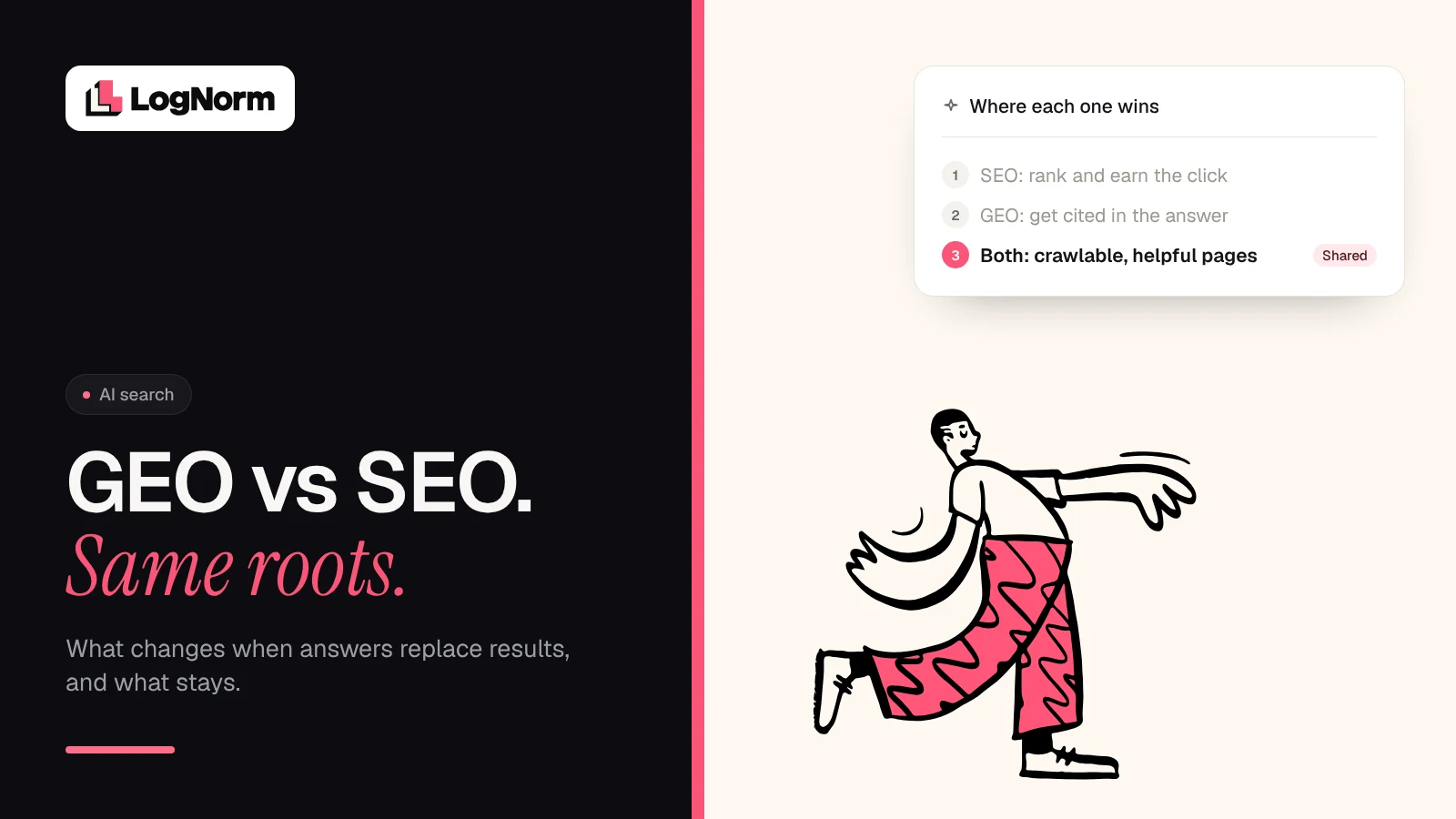
GEO (generative engine optimization) is the work of getting your content cited in AI-generated answers, while SEO (search engine optimization) is the work of ranking in search results. The two overlap heavily: GEO builds on SEO's foundations of crawlable, indexed, genuinely useful pages, then adds a layer focused on being quoted and named inside the answer itself.
So the honest answer to "GEO vs SEO" is not either/or. It is SEO first, with a set of GEO habits on top. If you want the full background on the newer discipline, start with our practical guide to generative engine optimization. This post is the side-by-side: what each one is trying to do, where the work is identical, where it splits, and how to divide a small team's time between them.
GEO vs SEO at a glance
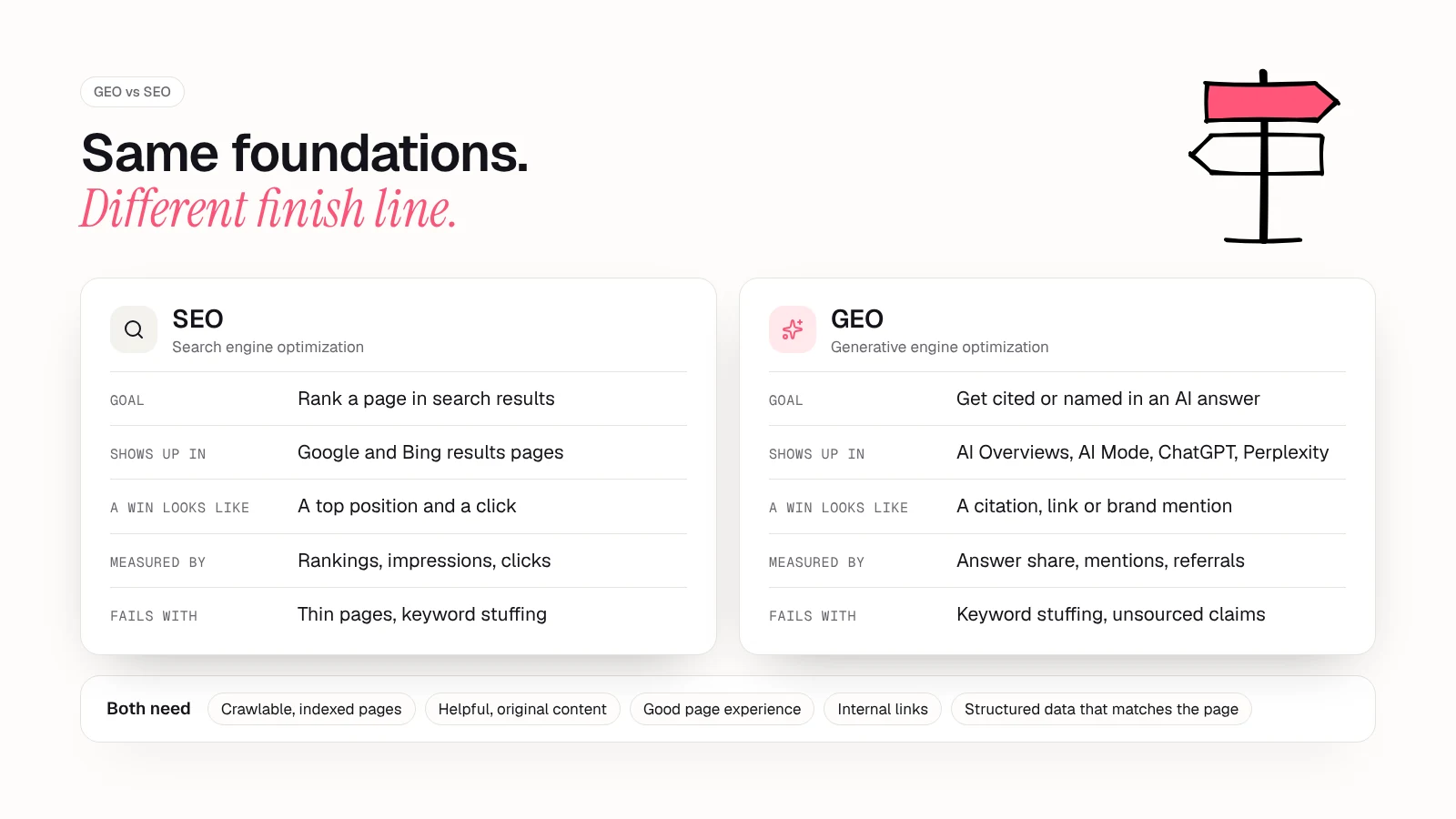
The short version: the inputs mostly match, the outputs differ. SEO is judged on positions and clicks. GEO is judged on whether an AI system uses your page and names you.
| SEO | GEO | |
|---|---|---|
| Goal | Rank a page in search results | Get cited or named inside an AI answer |
| Where results show up | Google and Bing results pages | Google AI Overviews and AI Mode, ChatGPT search, Perplexity and other assistants |
| Unit of success | A position and a click | A citation, a link or a brand mention in the answer |
| How it is measured | Rankings, impressions, clicks, conversions | Share of answers you appear in, how you are described, referral visits, conversions |
| Main signals | Relevance, content quality, links, technical health, page experience | Same foundations, plus extractable facts, sources, statistics and clear structure |
| Content format | A page built to satisfy one query | Sections that can be lifted out and quoted on their own |
| Technical basis | Crawlable, indexable, fast pages | The same, plus allowing AI search crawlers such as OAI-SearchBot and PerplexityBot |
| Tactics that fail | Thin content, keyword stuffing | Keyword stuffing, which tested worse than doing nothing |
What stays the same
Most of the work you already do for search carries straight over. That is not our opinion. It is what Google says.
Crawlability and indexing
An AI system can only cite a page it can reach. Google is explicit about this for its own AI features: to be eligible as a supporting link in AI Overviews or AI Mode, a page must be indexed and eligible to be shown in Google Search with a snippet, and "there are no additional technical requirements."
The same page lists the fundamentals it still expects: crawling allowed in robots.txt and by your CDN or host, content findable through internal links, important content available as text, and structured data that matches the visible page. It also says you do not need to create "new machine readable files, AI text files, or markup" to appear in these features, and that there is no special schema to add.
Helpful, original content
In May 2025, Google's John Mueller wrote that the underpinnings of what Google has long advised carries across to its AI search experiences. His first recommendation was to focus on "unique, non-commodity content" that visitors find helpful and satisfying, and he noted that the same quality bar applies to classic blue-link results.
The page that ranks because it answers the question best is the page most worth citing. Rewriting what already ranks helps with neither.
Page experience
Google's guidance asks for pages that display well across devices, load quickly and make the main content easy to find, for visitors arriving "either from classic or AI search results." A citation that lands on a cluttered page wastes the click.
What changes
The goal: a ranking versus a citation
SEO aims for a position on a results page. GEO aims for a place inside a generated answer, either as a cited source or as a name the assistant recommends.
That changes the unit you compete for. A results page has ten organic slots. An AI answer may cite a handful of pages and name one or two products. Being the fourth-best source may still get you a link in an AI Overview, while being the fourth-best product often means not being mentioned at all.
Where results show up
SEO results live on search engine results pages. GEO results live in several places at once: Google's AI Overviews and AI Mode, ChatGPT's search features, Perplexity, and other assistants. Each has its own retrieval system.
Google says both of its AI features may use a "query fan-out" technique, issuing multiple related searches across subtopics to build one response. One question from a user can pull in pages that rank for quite different queries. That is a reason to cover a topic's subquestions well, not just its head term.
How success is measured
SEO has mature measurement: rankings, impressions, clicks and conversions. GEO measurement is less tidy.
- Google AI features: Google reports traffic from AI Overviews and AI Mode inside the regular Search Console Performance report, under the "Web" search type, as part of your overall search traffic.
- Click quality: Google says clicks from results pages with AI Overviews are "higher quality", meaning users are more likely to spend more time on the site, and suggests tracking conversions rather than clicks alone.
- Assistants: for ChatGPT, Perplexity and others, the practical method is to run the questions your buyers ask on a regular schedule and record whether you appear, how you are described and who appears instead.
We go deeper on tracking that last part in our guide to measuring AI visibility.
Signals: what earns a rank versus a citation
Search rankings weigh relevance, quality, links and technical health. AI answers sit on top of retrieval, so many of the same signals decide whether your page is even in the pool. What changes is what happens next: a model reads the retrieved pages and decides which ones to use and quote.
The best public evidence on that second step is the paper that coined the term. GEO: Generative Engine Optimization, by researchers at Princeton University and IIT Delhi among others, was accepted at KDD 2024. The authors built a benchmark of 10,000 queries, GEO-bench, and tested nine ways of rewriting source content. Their findings, from the full paper:
- Citations, quotations and statistics worked best. Adding relevant sources, quotes from credible sources and quantitative statistics gave a relative visibility improvement of 30 to 40% on their main metric.
- Keyword stuffing did not work. The classic SEO tactic performed below the unoptimized baseline, and about 10% worse than baseline when tested on Perplexity.
- Lower-ranked pages gained the most. The Cite Sources method raised visibility by 115.1% for pages ranked fifth in search results, while the top-ranked page's visibility fell by 30.3% on average.
- Results vary by topic. Authoritative phrasing did best on debate and history queries, while statistics did best on law and government queries.
Treat this as a lab result, not a ranking factor list. Most experiments ran on the authors' own generative engine built on GPT-3.5, with a smaller check on Perplexity. But the direction is consistent: models favour content that carries checkable facts and attributes them.
Content format
A ranking page needs to satisfy a query as a whole. A cited page needs parts that make sense on their own, because a model will lift a sentence or a paragraph, not the whole article.
That favours a few habits:
- Put a direct, two or three sentence answer at the top of the page and at the top of each section.
- Write headings as the questions people actually ask.
- State specific facts with numbers, dates and named sources, and link the source at the claim.
- Use tables for comparisons, since attributes in rows are easy to extract accurately.
None of this hurts SEO. It is also the core of answer engine optimization, which we treat as the bridge between the two.
The overlap is bigger than the difference
If you map the work, most of it sits in the middle. A small set of tasks is SEO-only, a small set is GEO-only, and the shared base is where most of your hours should go.
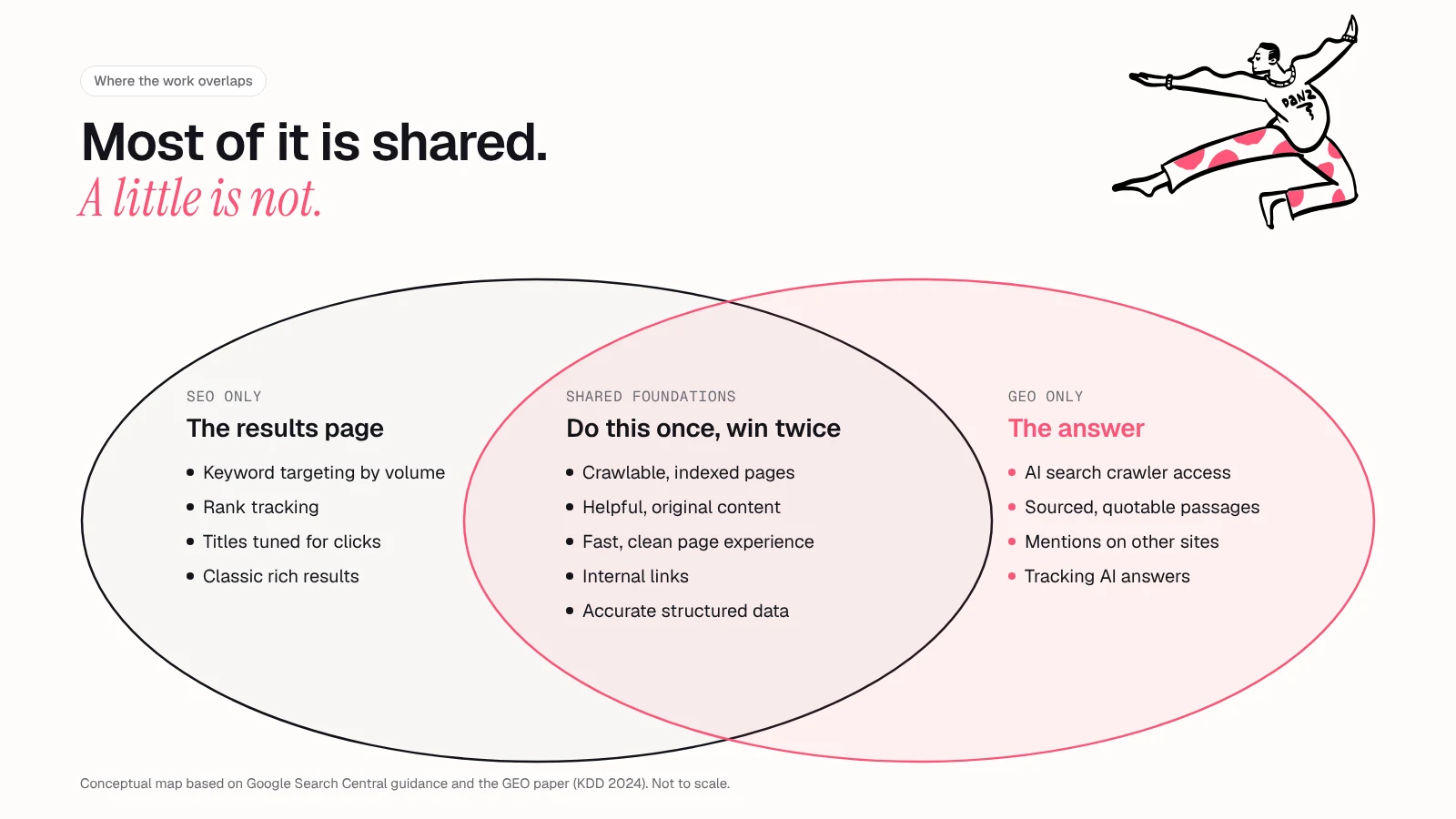
The SEO-only work is mostly about the results page itself: keyword targeting, rank tracking and tuning titles for clicks. The GEO-only work is about the answer: AI crawler access, self-contained passages with sourced facts, mentions on other sites and tracking whether assistants name you.
Is GEO replacing SEO?
No. GEO depends on SEO more than it competes with it.
Google's position is that the best practices for SEO remain relevant for AI Overviews and AI Mode, and that no special optimization is required. Assistants that search the web also need to find, fetch and trust your page first. What is changing is where the visit happens and what counts as winning. A page can now do its job by being quoted in an answer, even when the click goes elsewhere or does not come at all.
What to keep doing
Keep the parts of SEO that make your pages findable and worth citing:
- Technical health. Make sure search crawlers are not blocked, pages return a 200 status and key pages are indexed.
- Topic coverage with internal links. Build hub and supporting pages around the problems your buyers search for, and link them together. Query fan-out pulls from pages that answer the follow-up questions too.
- Original substance. Publish what only you can say: product data, customer patterns, real examples, clear opinions.
- Earning links and mentions. They still drive rankings, and they are how a brand gets known beyond its own site.
If you are setting this up from scratch, our SEO playbook for startups covers the foundations step by step.
What to add for GEO
These are the additions that are specific to AI answers.
- Allow the AI search crawlers. OpenAI says sites that opt out of OAI-SearchBot will not be shown in ChatGPT search answers, and recommends allowing it in robots.txt. Its GPTBot crawler is separate and covers model training, so you can allow search while blocking training. Perplexity likewise recommends allowing PerplexityBot, which it says is used to surface and link websites in its search results and not to train foundation models.
- Know which Google control does what. Google says robots.txt rules for Googlebot are the control for Search, including its AI features. The
nosnippet,data-nosnippet,max-snippetandnoindexcontrols limit what is shown. Google-Extended covers AI training and grounding in some of Google's other systems. - Write citable passages. Lead each section with a direct answer, add specific numbers and dates, and link the source at the claim.
- Build presence beyond your site. AI answers synthesize several sources, so reviews, comparisons, community threads and press that describe you are inputs too, not just your own pages.
- Track answers, not just rankings. Keep a fixed list of buyer questions and check the main assistants monthly. Record mentions, citations, the description used and the competitors named.
How a small team should split the effort
With one or two people on growth, you cannot run two separate programs, and you do not need to. Our rule of thumb is to spend most of your time on the shared foundations, because that work pays off in both places, and to treat GEO as a set of habits added to work you already do rather than a separate project.
- Week one: fix access. Confirm indexing in Search Console, check robots.txt for Googlebot, Bingbot, OAI-SearchBot and PerplexityBot, and make sure your CDN is not blocking them.
- Every new page: write it for both. Answer first, question-style headings, sourced numbers, a comparison table where it fits. This adds minutes, not days.
- Every quarter: refresh your top pages. Update facts and dates, add sources and tighten the opening answer on the pages that already earn traffic.
- Every month: run your answer check. A fixed set of 20 to 30 buyer questions across Google AI Mode, ChatGPT and Perplexity is a workable start.
- Ongoing: earn mentions. Comparison listings, guest posts, podcasts and honest participation in communities where your buyers ask for recommendations.
Our full framework for the GEO side, including how to prioritize pages and prompts, is in the generative engine optimization guide.
FAQ
What is the difference between GEO and SEO?
SEO aims to rank pages in search results and is measured by positions, clicks and conversions. GEO aims to get your content cited or your brand named inside AI answers from Google AI Overviews, ChatGPT, Perplexity and others, on top of the same foundations.
Is GEO replacing SEO?
No. Google says SEO best practices remain relevant for its AI features and that no special optimization is needed to appear in them. Assistants still need to find and trust a page before citing it.
Do I need separate content for GEO and SEO?
No. One well-structured page can serve both: a direct answer up top, question-style headings, sourced facts, and a crawlable, indexed URL.
Does keyword stuffing help with GEO?
No. In the original GEO study, keyword stuffing performed worse than leaving content unchanged. Adding citations, quotations and statistics performed best.
Do I need an llms.txt file or special schema for AI search?
Not for Google. Its guidance says you do not need new machine-readable files, AI text files or special schema.org markup to appear in AI Overviews or AI Mode. Structured data should still match what is visible on the page.
How do I measure GEO results?
Google counts AI Overviews and AI Mode traffic in the Search Console Performance report under the "Web" search type. For assistants, check a fixed set of buyer questions on a schedule, record whether you are cited or named, and track conversions from referral visits.
Sources
- Google Search Central: AI features and your website (December 2025)
- Google Search Central Blog: Top ways to ensure your content performs well in Google's AI experiences on Search (May 2025)
- arXiv: GEO: Generative Engine Optimization (Aggarwal et al., KDD 2024) (June 2024)
- arXiv: GEO: Generative Engine Optimization, full paper (HTML, v3) (June 2024)
- OpenAI: Overview of OpenAI crawlers (accessed October 2026)
- Perplexity: Perplexity crawlers (January 2026)