What is answer engine optimization, and how is it different from SEO?
Answer engine optimization (AEO) means shaping content so search and AI assistants quote it as the answer. How it differs from SEO and GEO, plus a checklist.


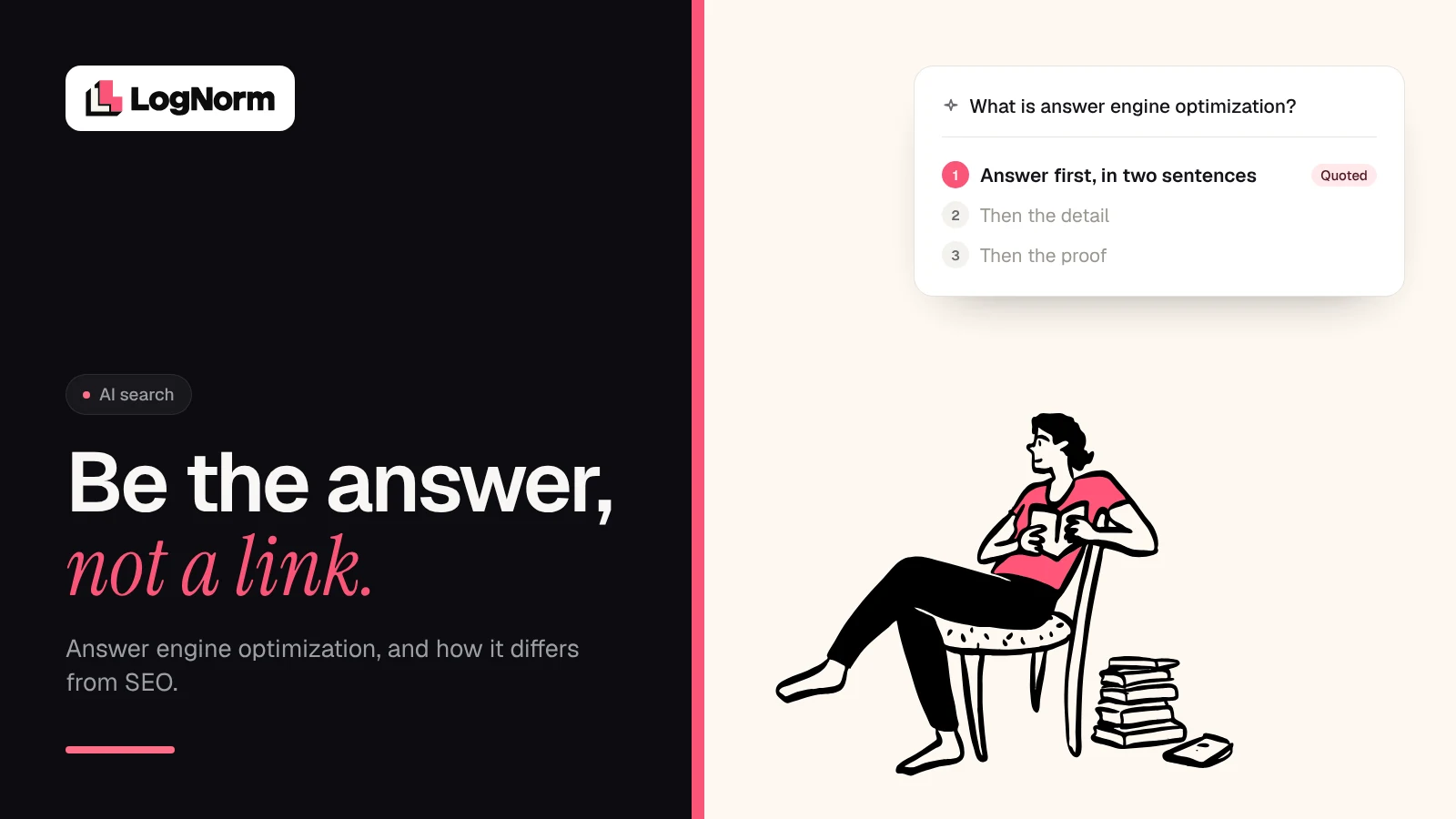
Answer engine optimization (AEO) is the practice of shaping your content so that answer engines, such as Google's featured snippets and AI Overviews, voice assistants, ChatGPT and Perplexity, can lift it as the direct answer to a question. SEO works to rank a page in a list of links; AEO works to make your page the text the person reads, and the source that gets named. The two overlap heavily, and Google itself counts AEO as part of SEO.
That last point matters more than most AEO guides admit. You do not need a separate team, a new file format or a bag of tricks. You need pages that answer real questions clearly, on a site machines can read, from a company they can identify. This post explains where the term came from, how it relates to SEO and GEO, and what a startup should actually do.
Where the term "answer engine" came from
The idea of an answer engine is older than ChatGPT. It grew in three waves, and each one changed what "being the answer" meant.
Wave one: featured snippets. Google describes featured snippets as "special boxes where the format of a regular search result is reversed, showing the descriptive snippet first". For the first time, a search result could answer the question on the results page itself. Marketers started optimizing to win that box, not just a position.
Wave two: voice assistants. When Danny Sullivan explained featured snippets on Google's blog in January 2018, he noted they are "especially helpful for those on mobile or searching by voice", and that for spoken results Google cites the source page and links to it in the Google Home app. A voice answer has no page two. There is one answer, read aloud, with one source.
Wave three: AI assistants. Perplexity calls itself an answer engine and defines one as "a tool designed to give you direct, detailed answers to your questions", instead of a list of links you sift through. ChatGPT search, Google's AI Overviews and AI Mode work the same way: they write an answer and cite a handful of sources.
So "answer engine optimization" has always meant the same goal, with a growing list of surfaces. If you want the wider picture of how AI assistants pick sources, start with our practical guide to generative engine optimization.
AEO vs SEO vs GEO: what is actually different
Short version: SEO is the umbrella, AEO focuses on being the extracted answer, and GEO focuses on being cited inside AI-generated responses. In everyday use, AEO and GEO are often used as synonyms, and that is fine.
There is no official canon here, so it helps to be precise about what each label points to.
- SEO covers everything that helps a page get crawled, indexed, ranked and clicked in search.
- AEO took hold in the featured snippet and voice era. Its unit of success is a single extracted answer: the snippet, the spoken reply, the quoted line.
- GEO has a clear origin. The term was introduced in a 2023 research paper by Aggarwal and colleagues, accepted to KDD 2024, which described generative engines as systems that answer queries by synthesizing information from multiple sources and summarizing it with large language models. Its unit of success is visibility inside a generated answer.
Google's view is blunt. Its guide to generative AI search says AEO and GEO are terms used for work focused on AI search visibility, and adds: "From Google Search's perspective, optimizing for generative AI search is optimizing for the search experience, and thus still SEO."
| SEO | AEO | GEO | |
|---|---|---|---|
| Main surface | Ranked results pages | Featured snippets, voice answers, AI answers | AI-generated answers (ChatGPT, Perplexity, AI Overviews) |
| What counts as a win | A high ranking and a click | Your text used as the answer | Your brand or page cited in the response |
| Where the term came from | Search marketing practice | Snippet and voice era | 2023 academic paper |
| What the content needs | Relevance, quality, links, technical health | A clear question and a direct, quotable answer | Specific, credible, well-sourced content an LLM can synthesize |
| How you measure it | Rankings, clicks, conversions | Snippet ownership, answer appearances | Citations and mentions in AI answers, AI feature impressions |
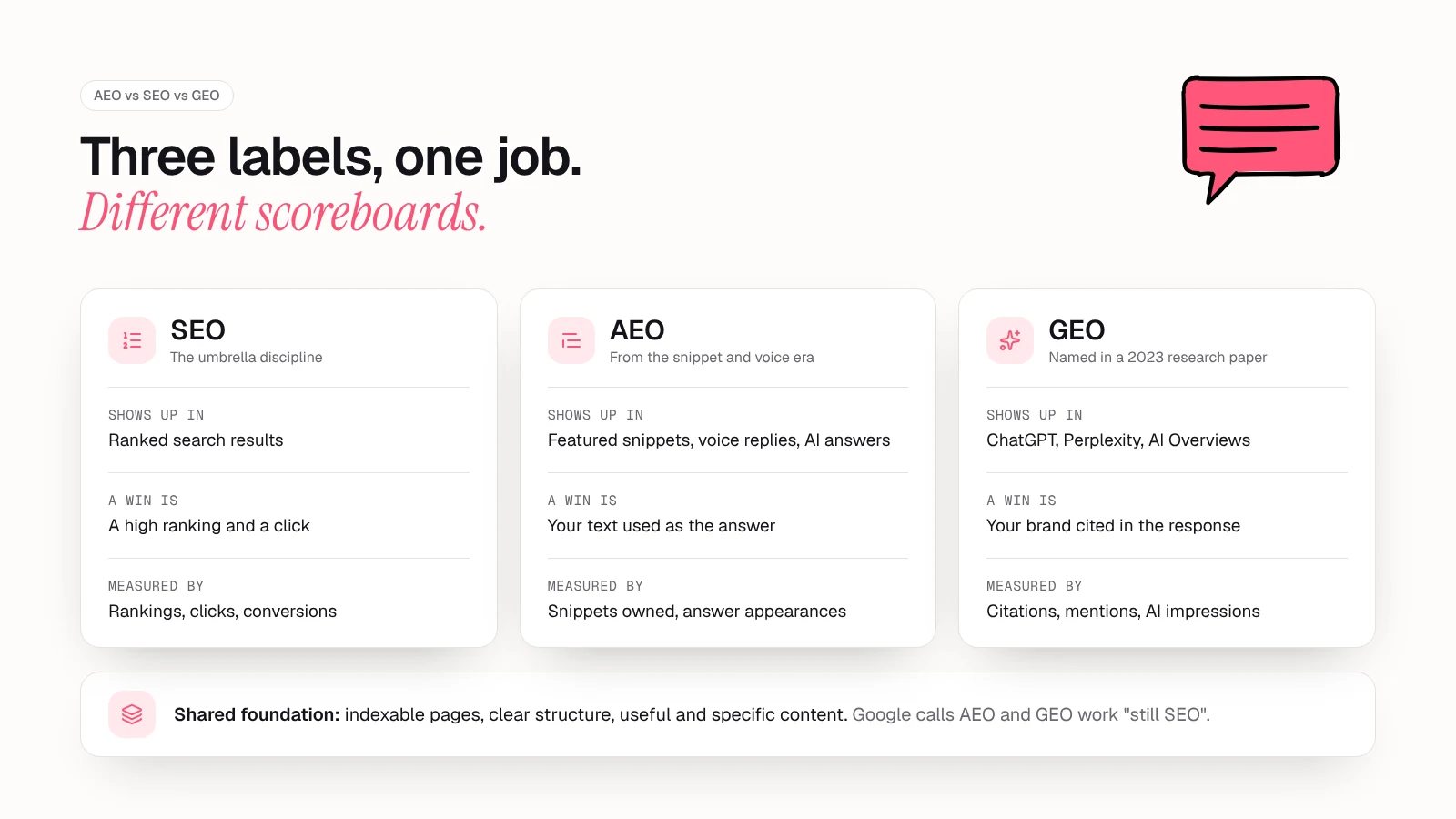
The honest takeaway: these are three lenses on one job. A page that is technically sound, clearly structured and genuinely useful tends to do well on all three. We break down the ranking-versus-citation differences in more detail in GEO vs SEO.
What an answer engine needs before it can quote you
Before structure, there is eligibility. Most failed AEO efforts are technical, not editorial.
Google. Google says there are "no additional requirements to appear in AI Overviews or AI Mode, nor other special optimizations necessary". A page must be indexed, meet the Search technical requirements and be eligible to show with a snippet. For featured snippets, you cannot apply for the box at all. Google's own answer to "how do I mark my page as a featured snippet?" is "You can't." Its systems decide. Note that nosnippet and a low max-snippet setting can keep you out of those features.
ChatGPT. OpenAI says sites that block its search crawler "will not be shown in ChatGPT search answers", and it recommends allowing OAI-SearchBot in robots.txt. That crawler is separate from GPTBot, which relates to model training, so you can allow one and block the other.
Perplexity. Perplexity's docs say PerplexityBot is "designed to surface and link websites in search results on Perplexity" and recommend allowing it, including in your web application firewall.
Check these three before you rewrite a single heading. A security rule that blocks AI crawlers by default will undo every editorial improvement.
How to structure content so it becomes the answer
Answer engines pull passages, not whole pages. Your job is to make the right passage easy to find, easy to lift and worth trusting.
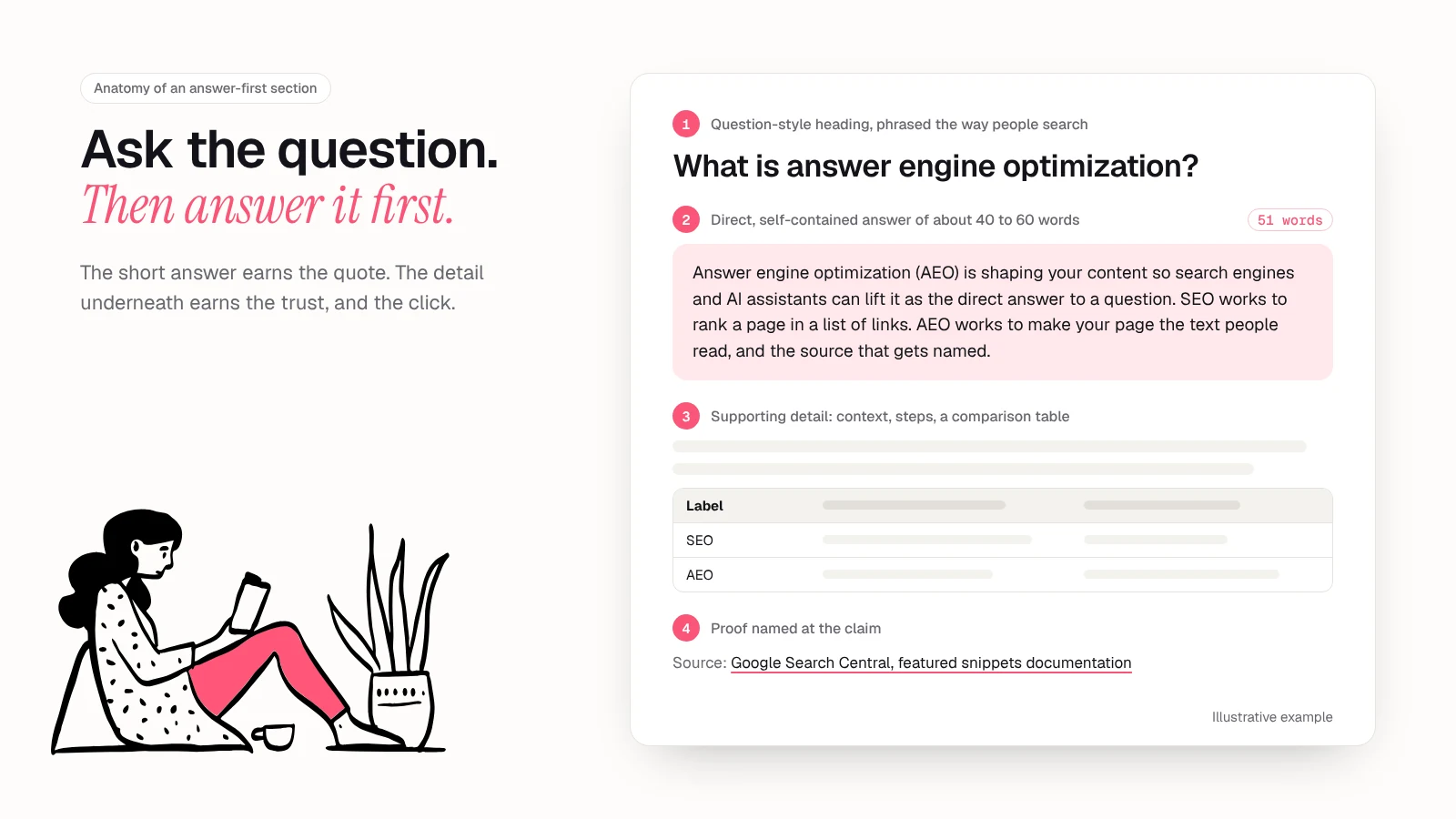
Use the question as the heading
Phrase H2s and H3s the way people ask: "How much does SOC 2 cost for a startup?" beats "Pricing considerations." The heading tells both the reader and the machine exactly what the next paragraph answers. Use your keyword research and sales calls to find the real wording.
Answer first, in about 40 to 60 words
Put a direct, self-contained answer in the first paragraph under the heading. Lead with the claim, then one sentence of context. Many SEO teams use 40 to 60 words as a working rule for snippet-sized answers. Treat that as a habit, not a Google requirement.
Then add the supporting detail: steps, a table, exceptions, an example. The short answer earns the quote; the detail earns the trust and the click.
A fair caveat: Google says there is "no requirement to break your content into tiny pieces" and that you do not need to rewrite content just for AI. We agree. Answer-first is not about chopping pages into fragments. It is a writing discipline that helps skimming humans first, and it happens to give any extraction system a clean passage to use.
Add the specifics that make you worth citing
Generic answers are interchangeable, so an engine can quote anyone. In the GEO paper, the strongest methods were adding citations, quotations and statistics, which improved one visibility metric by 30 to 40% relative to the baseline, while classic keyword stuffing did not perform well. Those results come from a research benchmark, not a live product, but the direction matches Google's advice to create "non-commodity content" with a unique point of view and first-hand experience.
For a startup, that means your own numbers, your customer patterns, real screenshots and named sources. Things a model cannot produce from the rest of the web.
Make your company an unambiguous entity
Answer engines need to know who is speaking. Use one consistent company name, a clear one-line description of what you do, an about page that states it plainly, and author names on articles. Google's Organization structured data can help it "disambiguate your organization in search results", and its sameAs property lets you point to your profiles on other sites.
Use structured data where it still earns something
Structured data is useful, but its role in AEO is often overstated. Three facts worth knowing:
- It is not required for AI features. Google says structured data "isn't required for generative AI search, and there's no special schema.org markup you need to add", though it is still worth using for rich results.
- FAQ rich results are gone. In August 2023 Google limited FAQ rich results to "well-known, authoritative government and health websites". Its changelog then recorded that the feature would no longer appear in Google Search from May 7, 2026, and the documentation was removed in June 2026. Write FAQ sections for readers, not for a rich result.
- Markup does not guarantee display. Google recommends JSON-LD and notes that complete, accurate markup makes a page eligible for enhanced results, not entitled to them.
Voice has its own markup, speakable, but Google lists it as beta and limited to US users with English-language Google Home devices. For most startups, it is not a priority.
What AEO does not require
A lot of AEO advice is folklore. Google's guide lists things you can ignore for Google Search, and it is worth reading in full. The headline items:
- llms.txt and "AI files". Google Search does not use them. Keeping one for other systems is fine; it will neither help nor hurt you on Google.
- Chunking content. No need to split pages into tiny blocks.
- Rewriting for AI. AI systems understand synonyms, so you do not need every long-tail variant.
- Inauthentic mentions. Planting mentions across the web is not the shortcut it looks like.
- Pages for every query variation. Google warns that creating content mainly to manipulate AI responses can violate its scaled content abuse policy.
If an AEO vendor's plan leans on these, be skeptical.
A practical AEO checklist for a startup
You do not need an AEO program. You need a short list you apply to every important page.
- Confirm eligibility. Pages are indexed, snippets are not blocked, and robots.txt and your firewall allow
Googlebot,OAI-SearchBotandPerplexityBot. - List the questions buyers ask. Pull them from sales calls, support tickets, community threads and keyword data. Prioritize questions close to a buying decision.
- Give each question a home. One clear page or section per question, with the question as the heading. Avoid near-duplicate pages for tiny variations.
- Write answer-first. A 40 to 60 word direct answer, then the detail.
- Add proof. Original numbers, examples, screenshots and links to primary sources. Name your sources at the claim.
- Use tables for comparisons. Pricing tiers, feature differences and "X vs Y" questions read better, and extract more cleanly, as tables.
- Clarify the entity. Consistent company name, a plain about page, author bylines, and Organization structured data on the home or about page.
- Keep pages current. Update dates, numbers and screenshots when they change. A stale answer is a weak answer.
- Measure. Google's Search Console now has a Generative AI performance report, rolled out to all websites as of August 31, 2026, showing impressions and pages that appeared in AI features. Pair it with a monthly manual check of your key questions in ChatGPT and Perplexity.
Google's AI Overviews deserve their own playbook, and we cover it in how to get cited in Google AI Overviews. For the broader strategy across every assistant, our generative engine optimization guide ties AEO, GEO and SEO into one plan.
FAQ
What is answer engine optimization in simple terms?
Answer engine optimization is making your content easy for search engines and AI assistants to use as the direct answer to a question. That means question-style headings, short answer-first paragraphs, specific supporting detail and a site that crawlers can access.
What is the difference between AEO and SEO?
SEO aims to rank pages and earn clicks from a list of results. AEO aims to have your text used as the answer itself, in a featured snippet, a voice reply or an AI-generated response. Google treats AEO as part of SEO, so the two share the same foundation.
Is AEO the same as GEO?
Many people use them interchangeably. Where a distinction is drawn, AEO comes from the featured snippet and voice era and focuses on being the extracted answer, while GEO comes from a 2023 research paper and focuses on visibility inside AI-generated responses. The practical work overlaps almost completely.
Does FAQ schema still help with AEO?
Not for Google's FAQ rich results, which no longer appear in Google Search as of May 2026. FAQ sections can still help readers and give answer engines clear question-and-answer pairs, so write them for people rather than for markup.
Do I need an llms.txt file for AEO?
Not for Google. Google says its Search features, including AI Overviews and AI Mode, do not use llms.txt, and having one neither helps nor hurts. It is fine to keep one if another service you care about uses it.
Sources
- Google Search Central: Featured snippets and your website (December 2025)
- Google: A reintroduction to Google's featured snippets (January 2018)
- Perplexity Help Center: What is an answer engine, and how does Perplexity work as one? (accessed October 2026)
- arXiv: GEO: Generative Engine Optimization (November 2023, revised June 2024)
- arXiv: GEO: Generative Engine Optimization, full paper (v3) (June 2024)
- Google Search Central: Optimizing your website for generative AI features on Google Search (May 2026)
- Google Search Central: AI features and your website (December 2025)
- OpenAI: Overview of OpenAI crawlers (accessed October 2026)
- Perplexity: Perplexity crawlers (accessed October 2026)
- Google Search Central: Organization structured data (September 2026)
- Google Search Central: Introduction to structured data markup in Google Search (December 2025)
- Google Search Central Blog: Changes to HowTo and FAQ rich results (August 2023)
- Google Search Central: Latest Google Search documentation updates (May and June 2026 entries)
- Google Search Central: Speakable structured data (September 2026)
- Google Search Central Blog: Introducing Search Generative AI performance reports in Search Console (June 2026)