AI Citations: Why Some Pages Get Cited by ChatGPT and Gemini
AI citations are the pages ChatGPT, Gemini and AI Overviews list as sources. Learn mention vs citation, how to read your sources and what to change.


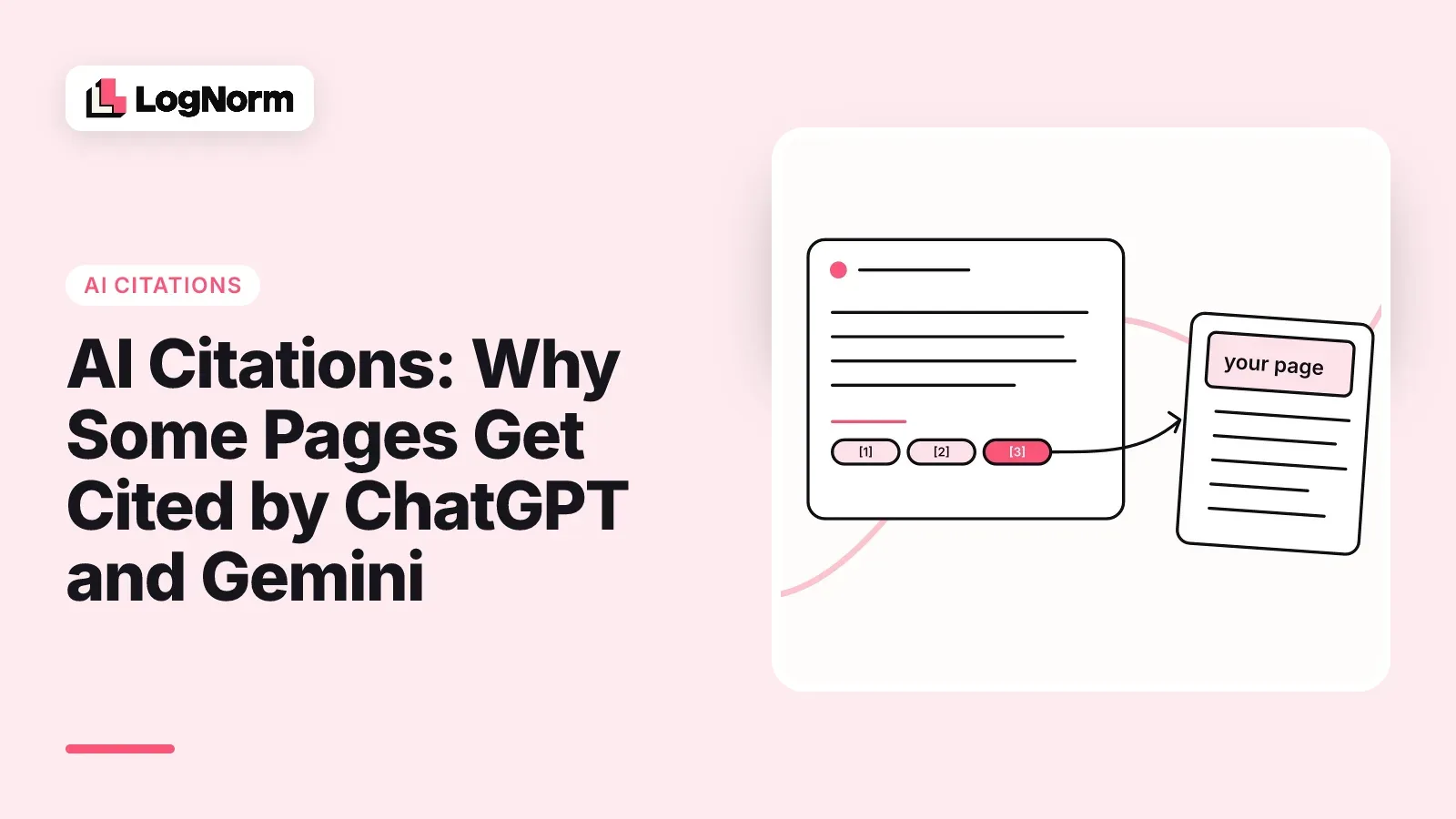
An AI citation is a page that an AI engine such as ChatGPT, Gemini or Google AI Overviews lists as a source for its answer. Engines cite pages they found while searching the web and used to write a part of the answer. Being cited is a separate outcome from being named: an answer can recommend your brand while citing other sites, or cite your page without ever saying your name.
Most advice on why some pages get cited quotes statistics that are hard to trace back to a study. We went looking for verified research on what makes a page citable and found nothing solid enough to repeat. So this guide does not give you percentages. It gives you a way to get your own evidence: what to record, how to read it, and what to change in each situation.
What an AI citation is
An AI citation is a source link attached to a generated answer. When an assistant answers with web search on, it retrieves pages, writes the answer, and lists some of those pages as its sources. That list is what "cited" means.
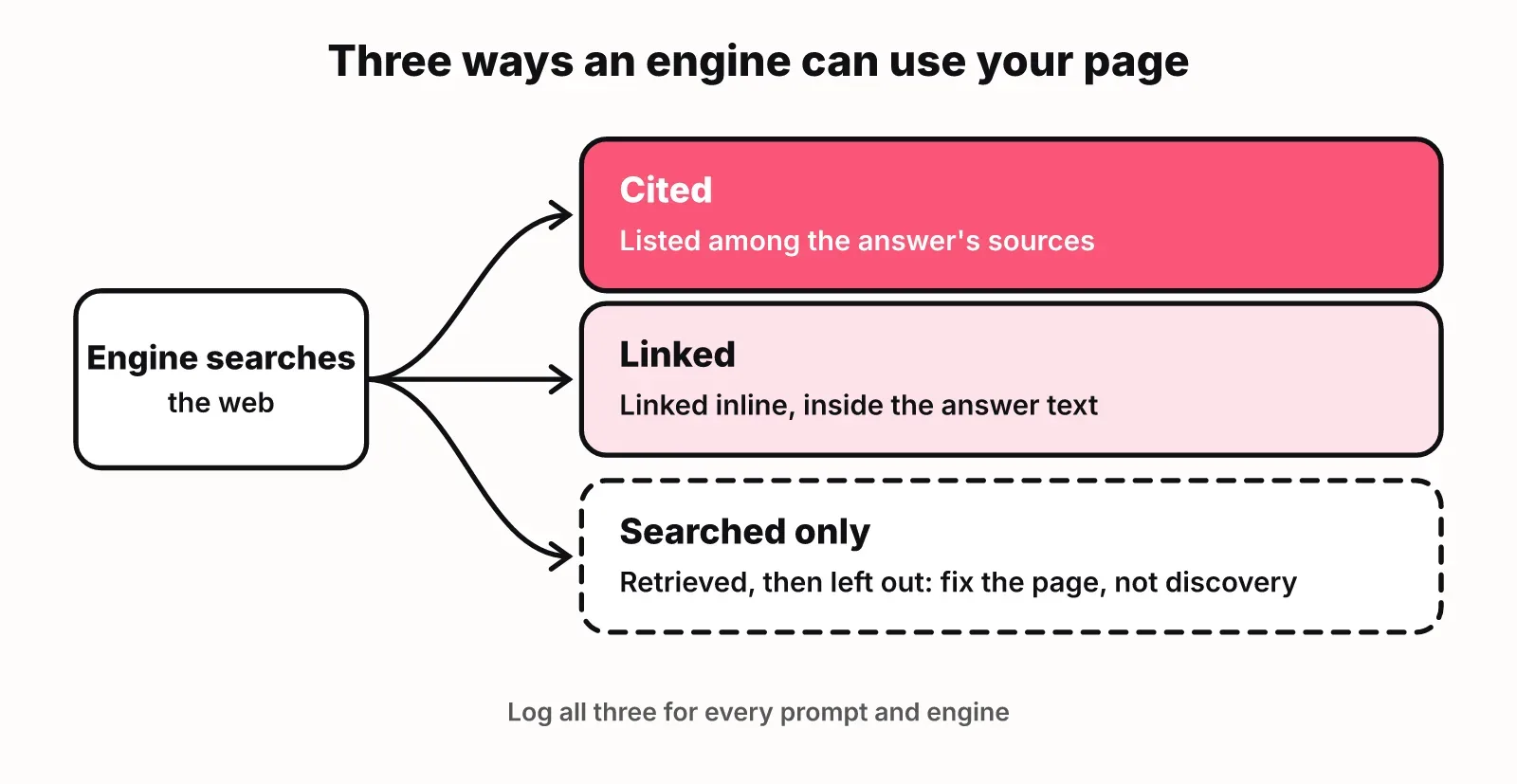
There are three ways an engine can use your page, and they mean different things:
- Cited: your page is listed among the answer's sources.
- Linked: your page is linked inline, inside the answer text.
- Searched only: the engine retrieved your page while researching, then left it out of the answer.
Searched only is the one most people never see, and it is the most useful signal. It means the engine found you and chose another page. That is a content problem you can fix, not a discovery problem.
One more thing to clear up. If you searched "ai citations" because you need to cite ChatGPT in an essay, you want a style guide, such as APA's or your university library's page on citing generative AI. Google's own AI Overview for this search answers that academic question. This article is about the other meaning: getting your pages cited by AI engines.
Mention vs citation: the four cases
A mention means the answer names your brand in its text. A citation means one of your pages is among the answer's sources. The two are independent, so every answer lands in one of four cases, and each case needs a different response.
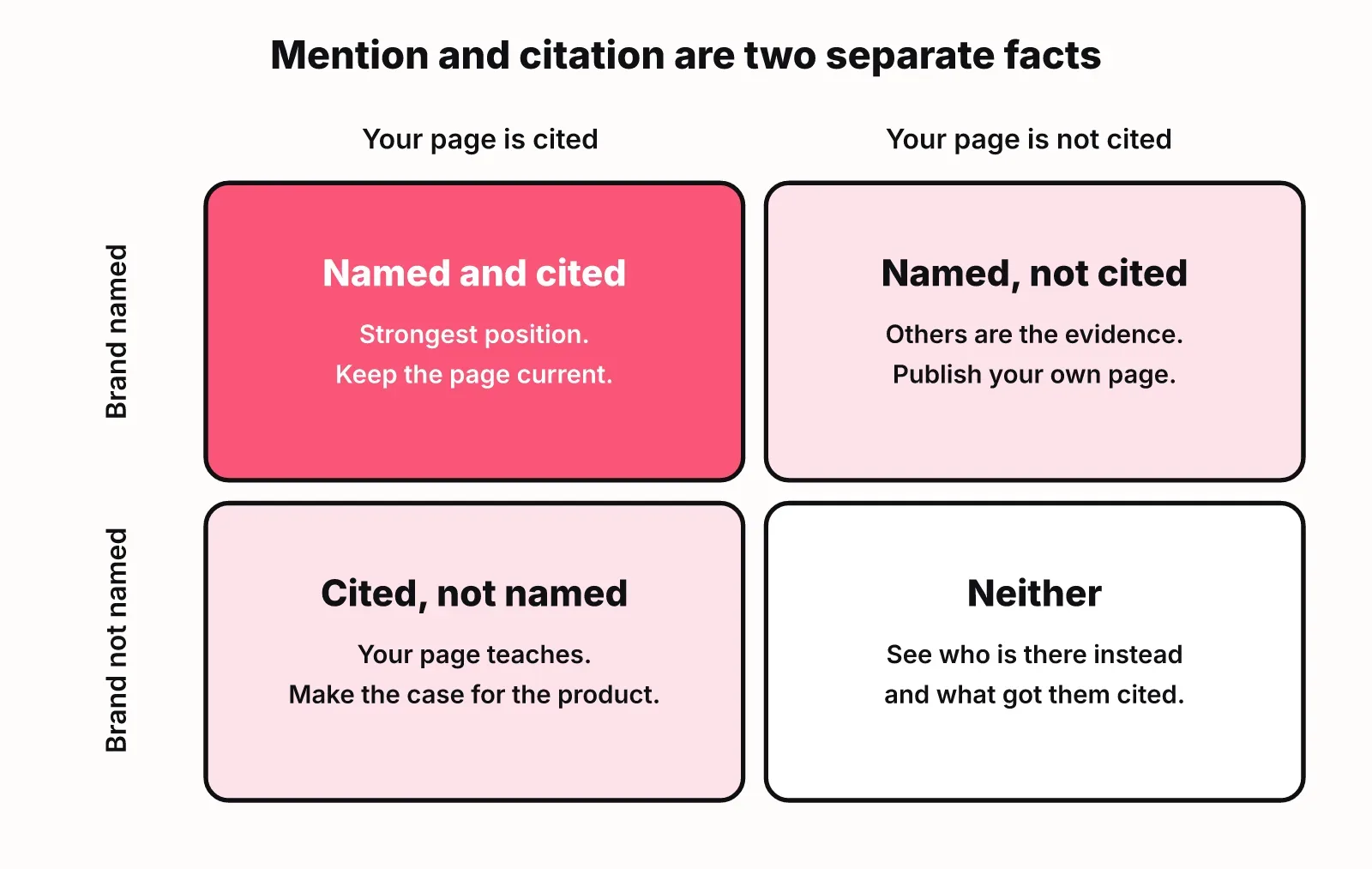
| Case | What happens in the answer | What it tells you |
|---|---|---|
| Named and cited | The answer names you and uses your page as a source | The strongest position. Keep that page current. |
| Named, not cited | The answer names you, but its sources are other sites | The engine knows you from third parties. What it says about you is out of your hands. |
| Cited, not named | Your page is a source, but the answer never names you | Your page teaches without making the case for your product. |
| Neither | You are not named and none of your pages are sources | Look at who is there instead and what the engine cited for them. |
Merging these into one "AI visibility score" hides the fix. A brand that is named but never cited needs its own evidence page. A brand that is cited but never named needs to rewrite a page it already has. Those are different jobs. We cover the wider set of metrics, including mention rate and share of voice, in how to measure AI visibility.
What the evidence says about which pages get cited
The honest answer: there is no verified, public study we can point you to that explains why one page gets cited over another. Engines don't publish their source selection rules, and answers change from run to run. Treat any precise "X% of citations go to Y" claim with care until you can see the method behind it.
What you can see is what engines cite for your own prompts. Here is one real example from LogNorm's tracking. On 8 October 2026 we asked ChatGPT, Gemini and Google AI Overviews the same buyer question: "best affordable Profound alternatives for tracking brand visibility across AI search engines".
| Engine | Sources cited | Kinds of pages cited |
|---|---|---|
| ChatGPT | 4 | Three vendors' pricing pages and one comparison article |
| Gemini | 4 | Four "best alternatives" and "best tools" articles on blogs and publishers |
| Google AI Overviews | 6 | Listicles on publisher and vendor blogs, a Medium post and a Reddit thread |
Three things stand out, and none of them needs a statistic to be useful.
First, the engines barely agreed. Each cited a different set of pages for the same question, so "getting cited by AI" is really three separate goals.
Second, the page kind matched the question. A question about affordable alternatives pulled in pricing pages and comparison lists, because those pages hold the answer in a form that is easy to lift.
Third, the brands named in the answers were not the same as the sites cited. Several brands were recommended on the strength of third-party lists. That is the "named, not cited" case at scale, and it is why a vendor's own pricing page earning a ChatGPT citation is worth noting.
One prompt on one day proves nothing on its own. It is a method, not a conclusion. Run the same read across your full prompt set and several runs, and the patterns for your category become clear.
How to read which sources engines cite for your prompts
You read AI citations by asking the engines your buyers' questions, then logging every source they used and what kind of page it is. Do it the same way every time so runs are comparable.
- Write buyer prompts without your brand name in them. Mix category questions ("best X for Y"), alternatives, comparisons and how-to questions.
- Ask the real consumer products with web search on, from your market's country. The developer APIs search and choose sources differently from the apps your buyers use.
- For each answer, record whether you are named, how you are treated (top pick, one of several, passing mention, alternative, criticised) and whether your page is cited.
- Log every source: cited, linked or searched only, plus the page kind (listicle, comparison, review, forum thread, docs, product page, news).
- For each third-party source, note whether it names you and which competitors it names.
- Compare across engines and across runs. A single answer is noise; the same page cited in most runs is a pattern.
Step 5 gives you the most direct to-do list. A cited comparison page that names three competitors and not you is a specific site to approach, with a specific gap to fill.
What to change in each case
The change depends on which of the four cases you are in, plus how your page was used. Start with the case that covers your most valuable prompts.
| Situation | What to change |
|---|---|
| Named, not cited | Publish the page that should be the evidence: a clear pricing page, an honest comparison page, docs that answer the question directly. Engines can only cite your page if one exists for that question. |
| Cited, not named | Edit the page that already earns citations. Add a short section that connects the answer to your product: who it is for, what it does for this problem, what it costs. |
| Neither | Get onto the third-party pages engines already cite for the prompt (listicles, reviews, forum threads), and build your own version of the page kinds they cite. |
| Searched only | Your page was found and passed over. Move the specific answer to the top of the page and of each section, with the numbers, names and steps written as text. |
| Named and cited | Keep the page accurate. Check prices, features and claims each time you ship a change. |
Two rules apply in every case. Write answer-first: the first sentence under each heading should answer that heading on its own, so an engine can lift it. And add something other pages don't have: your own data, a test you ran, or a comparison with the criteria shown. A page that repeats ten others gives an engine no reason to pick it. Our guide to AI SEO covers how to use AI in that writing without producing commodity pages.
How to get cited by ChatGPT
To get cited by ChatGPT, your page has to be reachable by its search, match the kind of page ChatGPT cites for the question, and state the answer plainly near the top.
- Check that crawlers can reach the page. A robots.txt rule or a CDN setting that blocks AI crawlers stops the page from being retrieved at all. A GEO audit checks AI crawler access and how answerable each page is.
- Look at what ChatGPT cites today for your prompt. In our example it cited vendors' pricing pages. If your pricing is hidden behind "contact sales", there is nothing for it to cite.
- Put the answer in the first lines of the page, as text, with the specifics: price, plan names, who it is for, limits.
- Keep the page current. An answer built from an outdated page will repeat the outdated fact.
Google works differently from ChatGPT, and its own rules for AI Overviews are documented. We cover them in getting cited in Google AI Overviews. Our upcoming guides on AI visibility tracking and LLM SEO go further on tracking and on the other engines.
Check whether the change worked
You know a change worked when the same prompts, rerun on a schedule, show your page cited more often than before. Compare the runs before you shipped with the runs after, and look for the shipped page itself among the sources.
Give it time. Engines take days to weeks to pick up a new or changed page, so a check the day after you publish tells you little. Run the same prompts on the same schedule, and judge the trend over several runs rather than one.
This is the loop LogNorm's AI visibility tracking runs for you: it asks ChatGPT, Gemini and Google AI Overviews your buyer prompts from your country, records mention and citation as separate facts, keeps every cited, linked and searched-only source with its page kind, and turns gaps like "a cited page names your competitors and not you" into ranked work. After you ship, it compares the prompts' rates before and after and shows which answers now cite the new page. The AI visibility docs explain each number.
FAQ
What are AI citations?
AI citations are the pages an AI engine lists as sources for a generated answer. ChatGPT, Gemini and Google AI Overviews show them as source links when they search the web to answer a question. A citation is different from a mention, which is the engine naming a brand in the answer text.
What is the difference between an AI mention and an AI citation?
A mention is the answer naming your brand. A citation is the answer using one of your pages as a source. They are independent: you can be recommended while other sites are cited, or be cited while the answer recommends someone else.
How do I get cited by ChatGPT?
Make sure your page can be crawled, check which kinds of pages ChatGPT cites for your buyers' questions, and publish that kind of page with the answer stated plainly at the top. Then rerun the same questions over several weeks to see whether your page appears among the sources.
Do I need to be on Reddit or forums to get cited?
Not always. It depends on what the engines cite for your prompts. In our example, Google AI Overviews cited a Reddit thread while ChatGPT cited pricing pages. Log the sources for your own prompts and go where the citations are.
How long does it take for AI engines to cite a new page?
Expect days to weeks before engines pick up a new or changed page. Measure over several scheduled runs, not the day after publishing, because answers vary from run to run.
How do I cite ChatGPT in APA style?
That is a different meaning of "AI citation". Use APA Style's guidance on citing generative AI or your library's citation guide. This article covers getting your website cited by AI engines.