Startup Marketing: Channels That Work Before Product-Market Fit
Startup marketing before product-market fit: which channels to run, how to pick one or two, and what to measure while you still learn who your buyer is.


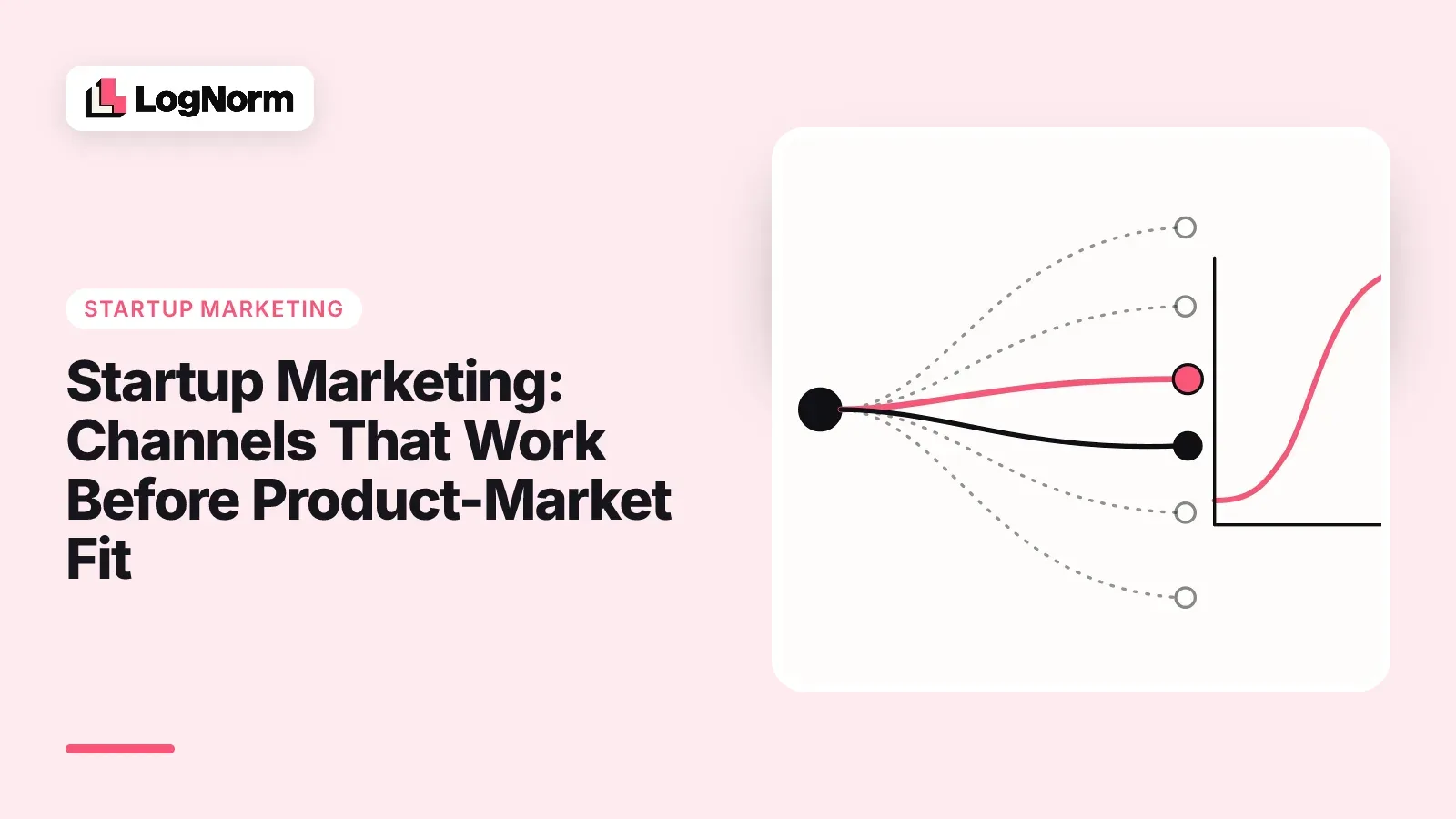
Startup marketing before product-market fit has one job: put you in front of the few buyers who need your product most, and teach you why they buy. Reach comes later. This guide covers the channels a small team can actually run at this stage, how to pick one or two of them, and what to measure while you are still learning who your buyer is.
What startup marketing means before product-market fit
Startup marketing before product-market fit is a learning system: each channel you run should tell you something new about your buyer, your message or your product every week. If a channel only produces impressions, it is not doing the job yet.
That is the main difference from marketing after fit. Once people pull the product out of your hands, the work becomes finding more of them at a cost you can afford, which is what a growth marketing playbook is for. Before that point, optimising a funnel is premature. You do not yet know which message works, so there is nothing stable to optimise.
In practice this means three habits:
- Talk to buyers directly and often, even when it does not scale.
- Treat every post, page and ad as a test of a specific message.
- Keep a written log of what you learned, so channel choices rest on evidence rather than mood.
Distribution also matters more than it used to. Building software has become cheaper and faster, so the products you compete with ship quickly too. We made that case in Distribution Is the New Moat. The practical conclusion for a pre-PMF team is to start building distribution early, in small, deliberate steps.
The channels a pre-PMF startup can realistically run
A pre-PMF startup can realistically run founder-led sales, founder-led content, communities, small paid tests, comparison pages, AI-answer visibility and early SEO. Most teams should run only one or two of them at once. Here is what each one involves at this stage.
Founder-led sales
Founder-led sales means the founder personally finds, contacts and sells to the first customers. It is the fastest feedback channel you have. A single call can tell you more about objections, budget and wording than a month of traffic data.
Start with a list of people you can name who match your best-guess buyer. Write to them about their problem, not your product. Record the exact phrases they use, because those phrases become your headlines, page titles and ad copy later.
Founder-led content
Founder-led content is the founder writing in public about the problems they hear in sales calls. It works because buyers trust a person more than a logo, and because each post tests a message in front of the right audience.
Keep it close to your calls. If three prospects described the same pain this week, that is your next post. We are not going to cover content formats in depth here, since that deserves its own guide. The point for channel selection is simpler: founder content is cheap, fast to test and it compounds if you keep it up.
Communities
Communities are the forums, Slack and Discord groups, subreddits and professional groups where your buyers already ask for help. They work pre-PMF because the questions people post there are free customer research.
The rule is to help first. Answer questions in detail, share what you learned, and mention your product only when it genuinely solves the problem asked about. Communities punish drive-by promotion quickly, and they remember.
SEO, started early and judged late
SEO is the practice of earning traffic from search results, and its main trait for a startup is a long lead time: pages often take months to rank. That is why you start it early and judge it late.
Before fit, aim for a small base: a technically clean site, a handful of pages on problems your buyers search for, and the commercial pages covered below. Do not judge SEO in month two, and do not make it your only channel. Our SEO for startups playbook covers the full setup, and the SaaS SEO strategy guide covers how to plan it without an SEO hire.
Comparison and alternatives pages
Comparison pages ("you vs a known competitor") and alternatives pages ("alternatives to a known tool") target buyers who are already choosing a product. Search volume is usually small, but intent is high, so a few visitors can turn into real conversations.
They also force useful clarity. To write an honest comparison you must state who your product is for, where it is weaker and why someone would switch. That is positioning work you need anyway.
AI answers
AI answers are the responses ChatGPT, Gemini and Google AI Overviews give when a buyer asks something like "what's the best tool for X". Buyers now ask these questions before they search, and the assistants often name a short list of products.
For a young startup, the first step is to look. Ask the assistants the questions your buyers ask and note who gets named and which pages get cited. Those cited pages show you what content earns a mention. Our guide on AI for marketing covers how AI changes the rest of the marketing work.
Small paid tests
Small paid tests are short, capped ad campaigns used to compare messages or audiences, not to acquire customers at scale. Before fit, paid is a fast way to learn which headline gets a click from the right people.
Set a fixed budget and a fixed end date before you start. If you find yourself raising the budget to "see if it works", stop. Paid spend that grows before you have message fit usually buys expensive, poorly retained users.
Pre-PMF channel comparison
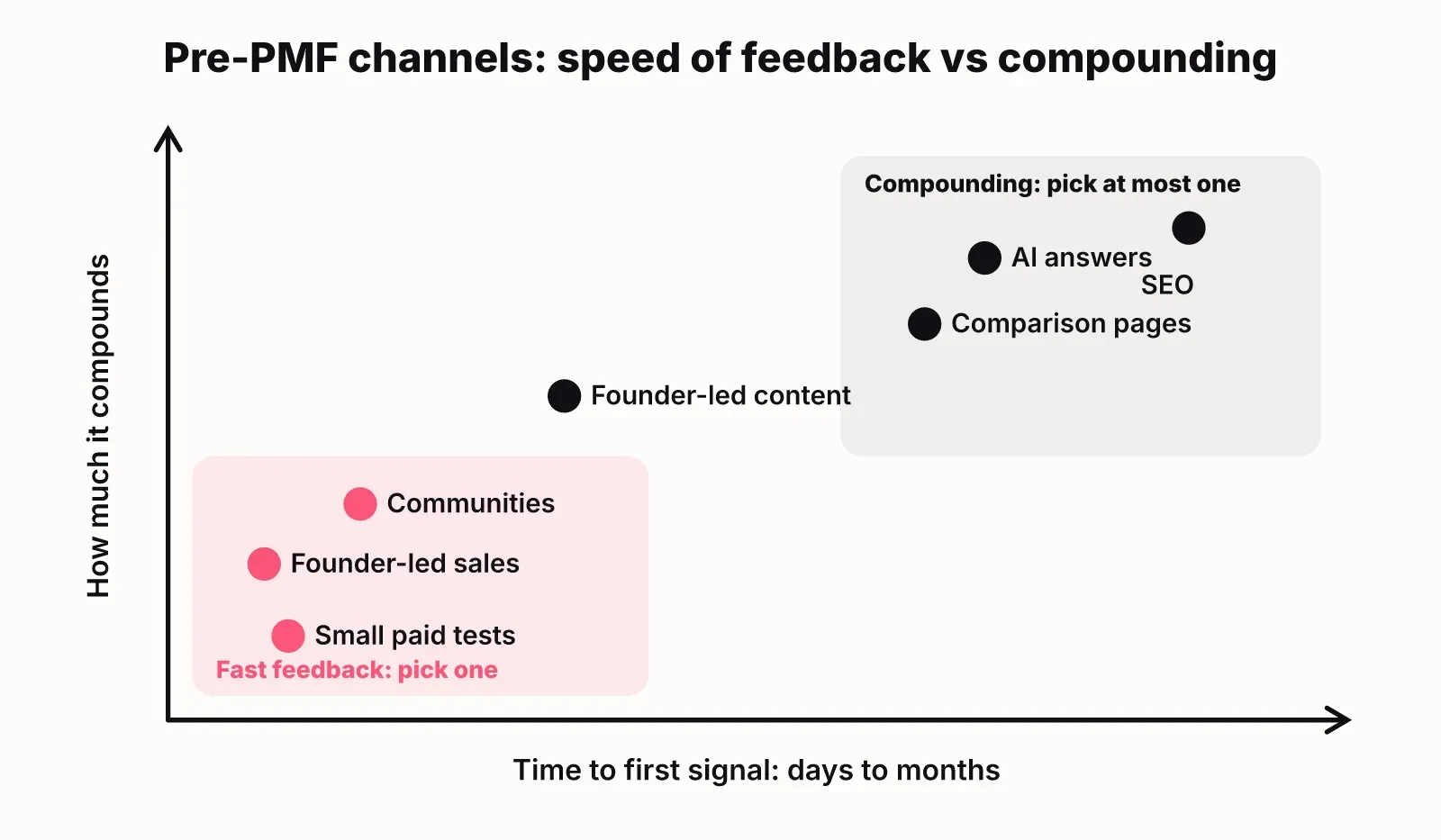
The best pre-PMF channels give a signal within days or weeks and teach you something about the buyer; slower channels are worth starting only if they compound. The table below compares them on those terms.
| Channel | Time to first signal | Cash cost | Founder time | What it teaches you | Fits best when |
|---|---|---|---|---|---|
| Founder-led sales | Days | Low | High | Objections, budget, buyer language | Buyers are reachable by name (most B2B) |
| Founder-led content | Weeks | Low | Medium | Which problems and messages resonate | The founder has a point of view and writes or records easily |
| Communities | Days to weeks | Low | Medium | Unfiltered questions and alternatives buyers use | Buyers gather in a few known places |
| SEO | Months | Low to medium | Medium | What buyers search for and how they phrase it | You can commit for a year and the category has search demand |
| Comparison pages | Weeks to months | Low | Low to medium | Who you win against and why | Buyers already evaluate known competitors |
| AI answers | Weeks to months | Low | Low to medium | How assistants describe your category and who they name | Buyers ask assistants for recommendations |
| Small paid tests | Days | Medium | Low | Which message gets a click from the right audience | You have specific messages to compare |
Founder-led sales and communities are the fast-feedback channels. SEO, comparison pages and AI answers compound slowly. Content and paid tests sit between them.
How to pick one or two channels
Pick one fast-feedback channel and, at most, one compounding channel. The fast channel keeps you learning every week, and the compounding one means you are not starting from zero once you find fit.
Work through these questions in order:
- Where do your buyers already look for a solution today? Search, assistants, communities, peers or vendors' sales teams.
- Can you reach a few dozen of them by hand this month? If yes, founder-led sales is almost always the fast channel.
- What does the founder do well? A founder who writes clearly should pair sales with content. A founder who hates writing should not force it.
- Is there a known competitor buyers compare you with? If yes, comparison pages are a strong first compounding channel.
- Does the category have search or assistant demand? If yes, start SEO and AI-answer work now, with low expectations for the first months.
Then set kill criteria before you start. Write down what signal you expect from each channel and by when, for example a number of booked calls in six weeks. When the deadline passes, keep, change or drop the channel based on what you wrote, not on how busy it felt.
If you are tempted to add a third channel, check whether the first two are getting full effort. Spreading a two-person team across six channels is a common way early marketing fails.
What to measure before product-market fit
Before product-market fit, measure learning signals: replies, booked calls, activation, early retention and the reasons people give for choosing you. These tell you whether you are getting closer to fit. Traffic and follower counts mostly do not.
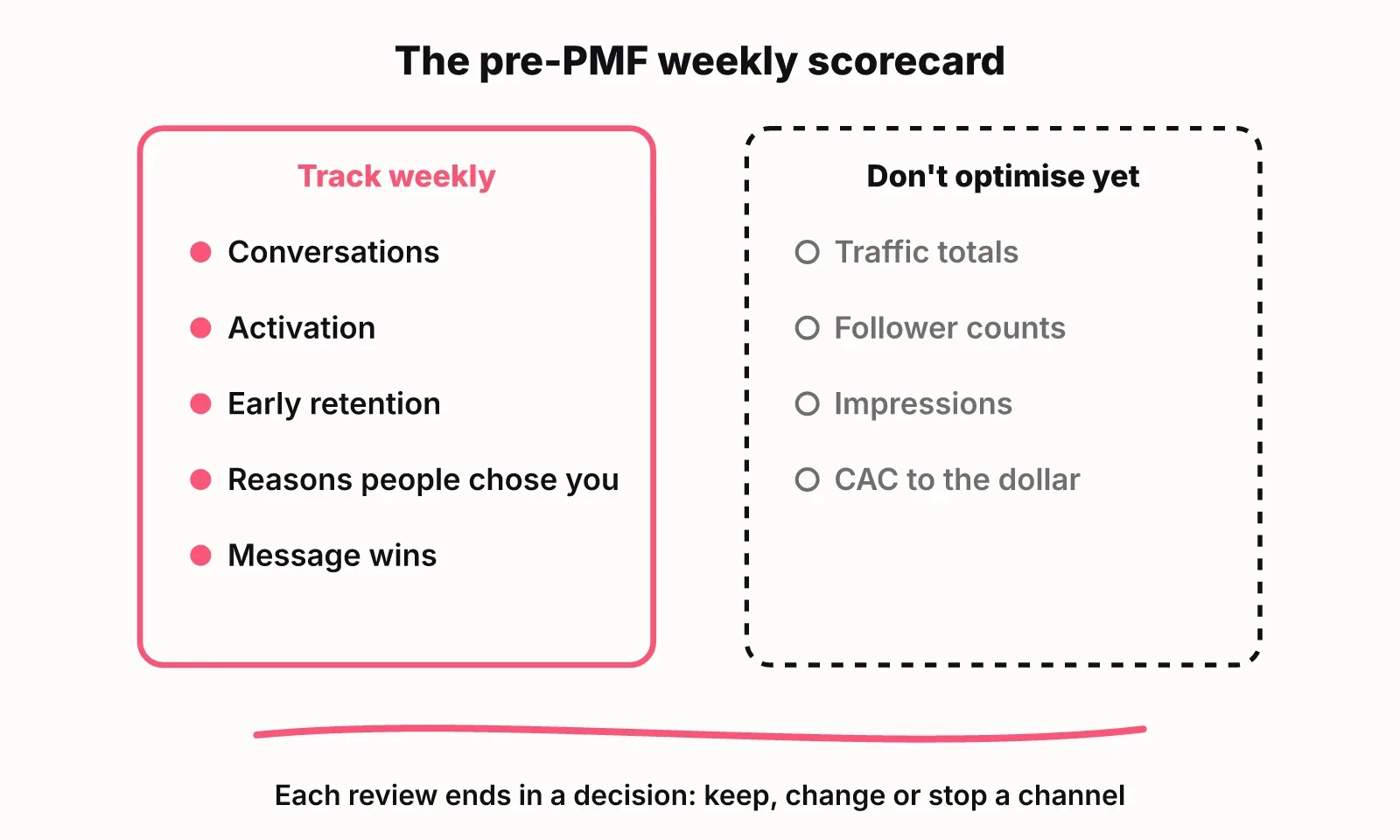
A simple weekly scorecard:
- Conversations: replies to outreach, community threads that turned into calls, demo requests.
- Activation: how many new signups reach the first moment of real value in the product.
- Retention: whether last month's users are still active.
- Reasons: why people chose you, in their words, and why lost deals did not.
- Message wins: which headline or post brought in the best-fit people, not the most people.
Notice what is missing. Customer acquisition cost matters, but optimising it pre-PMF is premature because your numbers are too small and your message keeps changing. Track it roughly so you know the order of magnitude, and read our customer acquisition cost guide for when and how to tighten it.
Review the scorecard weekly with whoever runs marketing and sales. The output of the review should be a decision: what to keep, what to change and what to stop. Teams that later build growth loops or move to product-led growth usually find the inputs for those in this early log.
Where search and AI answers fit early
Search and AI answers fit early as the compounding channel you start small and let grow while the fast channels do the learning. Because results take months, the cheapest time to start is before you need them.
A sensible pre-PMF order:
- Fix the technical basics so search engines and assistants can read your site.
- Publish comparison or alternatives pages for the competitors buyers mention in calls.
- Write a few pages on problems your buyers describe, using their own words from sales notes.
- Check monthly how ChatGPT, Gemini and Google AI Overviews answer your buyers' questions, and which pages they cite.
- Keep a ranked list of what to do next, and check whether each shipped page moved anything.
The hard part for a small team is step five: deciding what comes first and checking later whether it worked. This is the job we built LogNorm for. It reads your site audit, Search Console, keywords, competitors and how ChatGPT, Gemini and Google AI Overviews answer your buyers, turns each opportunity into a ranked move, and measures shipped moves at 28 and 90 days. You can read how LogNorm works if that fits your stage. If it does not yet, the five steps above work with a spreadsheet.
Mistakes that waste the first months
The most expensive early mistakes come from running too many channels, scaling before the message works, or judging slow channels too soon.
- Running six channels at once. Each gets a fraction of the effort and none produces a clear signal.
- Scaling paid spend before you know which message converts the right buyer.
- Judging SEO or AI answers after a few weeks, then abandoning them right before they would have started to work.
- Writing content nobody in your sales calls asked about.
- Copying the playbook of a company that already has fit, a brand and a budget you do not have.
- Hiring a channel specialist before you know which channel matters.
FAQ
What is startup marketing?
Startup marketing is the work of finding, reaching and winning a startup's first customers with a small team and budget. Before product-market fit, its main goal is learning which buyer and message work. After fit, it shifts to scaling the channels that proved themselves.
Which marketing channel should a startup start with?
Most B2B startups should start with founder-led sales, because it gives the fastest and most detailed feedback. Pair it with one compounding channel, such as comparison pages or early SEO, if your buyers search for solutions.
When should a startup start SEO?
Start SEO early, ideally once you know your buyer roughly, because pages often take months to rank. Keep the scope small before product-market fit and judge it on a timeline of months, not weeks.
Should a pre-PMF startup run paid ads?
Yes, but only as small, capped tests to compare messages or audiences. Set the budget and end date in advance. Scaling paid acquisition before you have message fit tends to buy users who do not stay.
How do you measure marketing before product-market fit?
Measure conversations, activation, early retention and the reasons customers give for choosing you. Review them weekly and turn each review into a decision to keep, change or stop a channel.
When should a startup hire its first marketer?
Hire your first marketer once at least one channel works and needs more hands than the founders have. Hiring earlier usually means asking one person to find fit across many channels at once.