What is growth marketing? A playbook for startups
Growth marketing is full-funnel, experiment-driven marketing. Learn how it differs from traditional marketing and how a 1 to 3 person team can run it weekly.


Growth marketing is a full-funnel, experiment-driven way of growing a company. Instead of stopping at awareness and leads, it owns the whole customer journey (acquisition, activation, retention, referral and revenue) and improves it through a steady cycle of small, measured tests. The goal is not a successful campaign. It is a repeatable system that keeps finding the next thing that moves your core metric.
For a startup, that difference matters more than the label. With little budget and no brand to lean on, you cannot spend a quarter on a campaign and hope. You need to know, every week, what you are testing and what you learned.
What is growth marketing?
Growth marketing is marketing that is accountable for growth across the whole funnel, not just the top of it. A growth marketer cares as much about whether a new signup reaches the product's core value in their first session as about where that signup came from.
The idea grew out of "growth hacking." In July 2010, Sean Ellis wrote that a growth hacker is "a person whose true north is growth", someone who is creative about finding ways to grow, disciplined enough to follow a testing process, and analytical about which ideas to keep. Growth marketing keeps that discipline and drops the implication that growth comes from clever tricks.
Our guide to growth hacking and how it differs from growth marketing covers where the term came from, which tactics still hold up, and why most startups are better served by a system than a list of hacks.
Three traits define growth marketing:
- Full funnel. It covers acquisition, activation, retention, referral and revenue, not only traffic and leads.
- Experiment-driven. Ideas are hypotheses. They get prioritised, tested, measured and either scaled or dropped.
- Metric-anchored. One metric that reflects customer value decides what counts as progress, so the team does not optimise for vanity numbers.
Growth marketing vs traditional marketing
Traditional marketing and growth marketing are not opposites. They answer different questions. Traditional (or brand) marketing asks: how do we get the right people to know and trust us? Growth marketing asks: which change, anywhere in the customer journey, will move our core metric most this week?
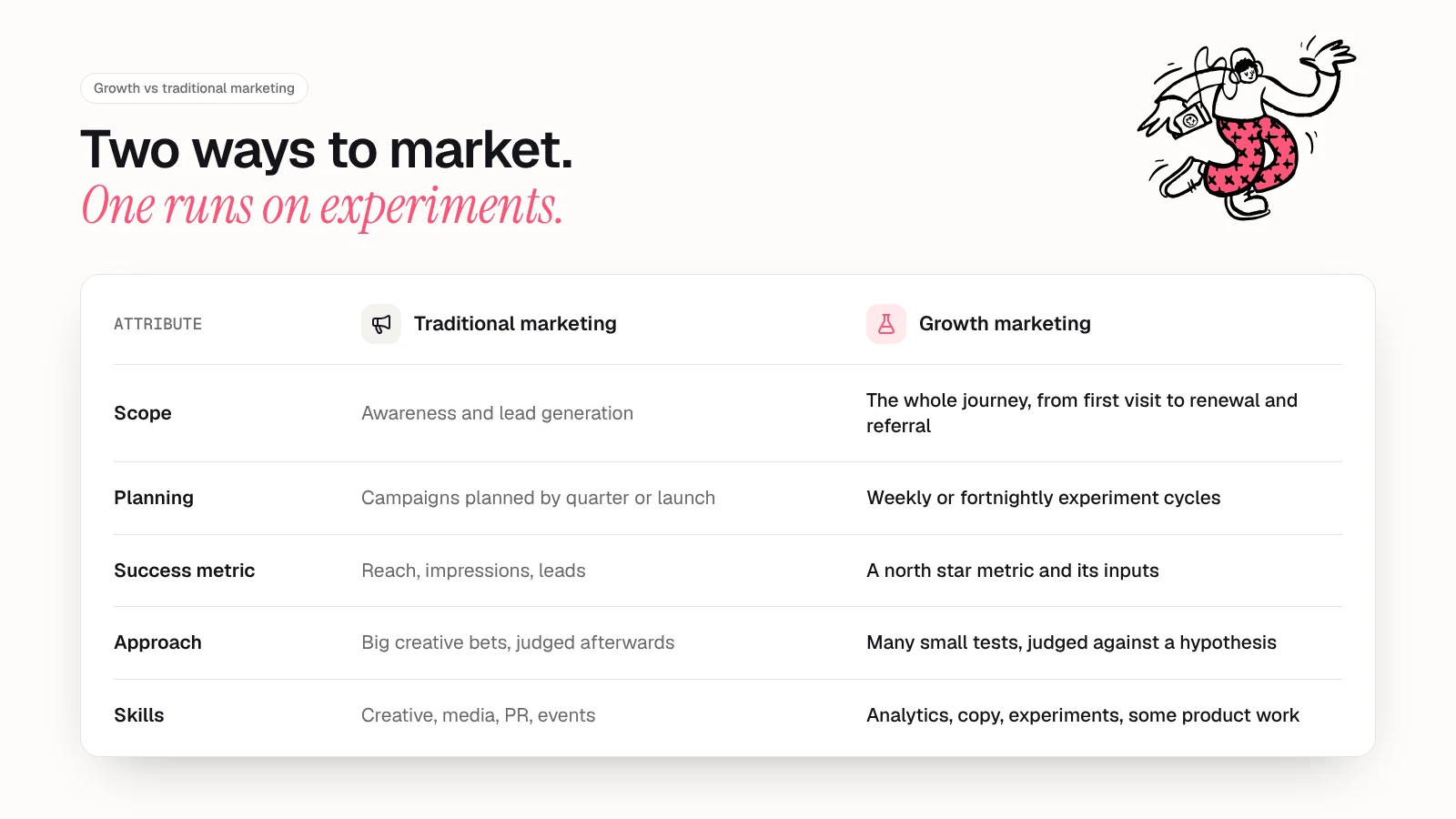
| Attribute | Traditional marketing | Growth marketing |
|---|---|---|
| Scope | Awareness and lead generation | The whole journey, from first visit to renewal and referral |
| Planning | Campaigns planned by quarter or launch | Weekly or fortnightly experiment cycles |
| Success metric | Reach, impressions, leads, share of voice | A north star metric plus the inputs that drive it |
| Approach | Big creative bets, judged after the fact | Many small tests, judged against a hypothesis |
| Skills | Creative, media, PR, events | Analytics, copy, experimentation, some product and data work |
Brand still matters: when buyers compare similar products, a known name shortens the decision. But a startup has no brand yet, and brand work is slow to measure. Growth marketing gives you a feedback loop while the brand builds.
The building blocks of a growth marketing strategy
A growth marketing strategy has five parts. You need a metric to aim at, a model of how users flow through your business, a short list of channels, an experiment process, and a plan for keeping the users you win.
1. A north star metric
A north star metric is the single number that best captures the value customers get from your product. Amplitude describes it as the metric that "defines the relationship between the customer problems your product team is trying to solve and the revenue you aim to generate". Its guidance lists three tests: the metric reflects value customers actually receive, it expresses your product strategy, and it is a leading indicator of revenue rather than a lagging one.
Amplitude's examples make this concrete: "number of mobile orders delivered" for a retailer, or "trial accounts with >3 users active in week 1" for a SaaS subscription business. Sean Ellis adds that a good north star should be actionable, not a ratio, and able to scale over time.
Every experiment should name which input to the north star it expects to move. Our guide to choosing a north star metric walks through how to pick one for your business model, how to break it into input metrics a small team can influence, and the common traps, such as picking revenue or signups.
2. Funnels and loops
The classic model of a growth business is a funnel. Dave McClure's AARRR framework, first presented in his 2007 talk "Startup Metrics for Pirates", splits the journey into acquisition, activation, retention, referral and revenue. It is still the simplest way to find where users drop off. Some teams reorder it as RARRA, putting retention first, on the argument that acquisition gets more expensive as markets get more competitive.
Funnels have a blind spot. In 2018, Brian Balfour and co-authors at Reforge argued that "funnels operate in one direction": you put more in at the top and get more out at the bottom, with no way to reinvest the output. A growth loop is a closed system where the output of one cycle becomes input for the next. A user creates content, that content gets found in search, new users arrive and create more content. Their conclusion: "The fastest-growing products are better represented as a system of loops, not funnels."
Use both: the funnel shows where you leak, loops show how growth can compound. Our guide to growth loops explains the common loop types, how to map the one hiding in your product, and how to measure whether it actually compounds.
The most powerful loops often sit inside the product itself. When the product is the main way people discover, try and buy, you are running product-led growth. That guide covers when a free plan or trial makes sense, which activation moments to design for, and how marketing's job changes when the product does most of the selling.
3. Channel selection
Most early startups spread across too many channels. A useful corrective is the Bullseye framework from the book Traction by Gabriel Weinberg and Justin Mares. In Weinberg's own description on the SaaS Club podcast, the process is to brainstorm all 19 traction channels, rank them, prioritise the top candidates, run cheap parallel tests and focus on the winner. He notes that in startups that took off, one channel usually dominated, and teams could not predict in advance which one it would be.
Two rules make channel selection work for a small team:
- Test cheaply before you commit. A channel test should cost days and a small budget, not a quarter.
- Judge channels on unit economics, not volume. A channel that brings fewer, better-retained customers often beats one that brings a flood of signups who never activate.
That second rule depends on knowing your customer acquisition cost. Our guide to customer acquisition cost shows how to calculate CAC by channel, why blended CAC hides problems, and how to judge it against payback period and lifetime value instead of borrowing someone else's benchmark.
4. The experiment cycle
Experiments are the engine of growth marketing. A good cycle has five steps:
- Hypothesis. Write it as "If we change X for audience Y, metric Z will move, because of evidence W." The "because" forces you to point at evidence.
- Prioritise. Score every idea the same way so the backlog is ranked by expected value, not by who argued loudest.
- Test. Ship the smallest version that can answer the question. Set the success metric and the run time before you start.
- Learn. Record the result, including null results. A test that changed nothing still tells you where not to look.
- Decide. Scale it, iterate on it or kill it, then feed what you learned into the next hypothesis.
Two scoring models dominate the prioritise step. ICE, developed by Sean Ellis, rates each idea from 1 to 10 on impact, confidence and ease. PIE, designed by Chris Goward for A/B testing, scores potential, importance and ease, where importance asks how valuable the traffic to a page is.
| Model | Scores | Best for |
|---|---|---|
| ICE | Impact, confidence, ease | A mixed backlog across channels, onboarding and content |
| PIE | Potential, importance, ease | Page-level conversion tests where traffic value differs a lot |
Neither model is precise. Their value is consistency: scoring the same way every week gives you a backlog you can trust.
5. Activation and retention
Acquisition gets the attention, but retention decides whether growth compounds. Research by Frederick Reichheld of Bain & Company, cited in Harvard Business Review, found that acquiring a new customer is five to 25 times more expensive than retaining an existing one, and that increasing retention rates by 5% increases profits by 25% to 95%. Those figures come from Bain's research across industries, not a startup sample, but the direction holds: every user you keep makes every channel cheaper.
Retention starts with activation, the moment a new user first gets real value. If users do not activate, nothing downstream works. Ellis's advice on low activation is direct: find the root cause, and the simplest way is to ask users. Pair those answers with cohort data: what share of each weekly signup cohort is still active after one, four and twelve weeks? If the curve flattens, you have a base to grow on. If it heads to zero, fix that before you spend more on acquisition.
A weekly growth operating rhythm for a team of 1 to 3
Frameworks are easy. Running them every week with one to three people is the hard part. A fixed rhythm keeps experiments shipping even in busy weeks.
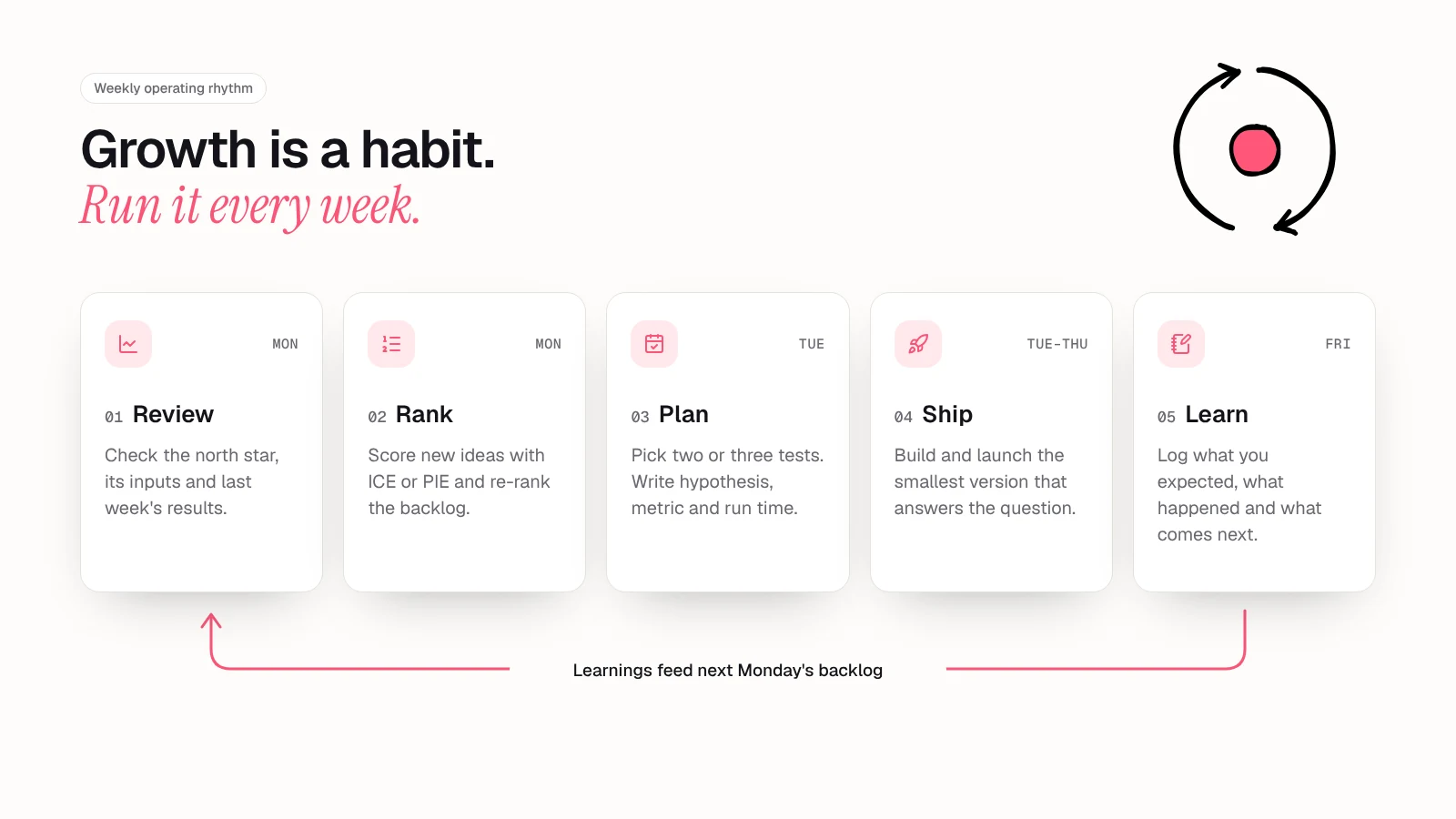
- Monday: review. Look at the north star, its input metrics and the results of anything that finished last week. Thirty minutes, the same dashboard every time.
- Monday: rank. Add new ideas to the backlog, score them with ICE or PIE, and re-score anything whose evidence changed.
- Tuesday: plan. Pick the top two or three experiments the team can actually finish. Write the hypothesis, success metric and run time for each.
- Tuesday to Thursday: ship. Build and launch. For a solo marketer that may be one landing page test, one onboarding email change and one new piece of content.
- Friday: learn. Write a few lines per finished test in a shared log: what you expected, what happened, what you will do next.
The ranking step is where small teams most often slip. Ideas pile up in docs, Slack threads and audit reports, and the week gets planned from whatever feels urgent. Tools like LogNorm pull signals such as site audits, Search Console data, keywords, competitors and AI answers into one ranked weekly backlog, so the plan starts from the highest-value move rather than the loudest one.
Two habits keep the rhythm honest. Cap work in progress, because two finished tests beat five half-built ones. And for slow channels such as SEO, log a check date when you publish rather than calling the test early.
If you want to see how this rhythm fits into a larger system that compounds over time, our explainer on what a growth engine is shows how the weekly loop connects to your channels and content.
Where AI speeds things up
AI does not decide your strategy, but it removes much of the slow work inside each step of the cycle.
- Research and hypotheses. Summarise customer interviews, support tickets and reviews to find patterns worth testing.
- Analysis. Draft queries, clean exports and explain a cohort table in plain language, so the Monday review takes minutes.
- Variants and content. Produce several versions of a headline, email or ad for a test, and first drafts of articles, with a human checking facts.
- Learning logs. Turn rough test notes into a searchable record the next hypothesis can draw on.
The rule is to use AI to speed up the work, not to skip the judgement. A faster cycle only helps if the hypotheses are still grounded in evidence. For a fuller view of where AI fits across marketing, see our hub on how startups use AI for marketing.
Common growth marketing mistakes
- Optimising for signups. Signups are easy to move and often do not predict revenue. Tie every test to an input of your north star.
- Testing without a hypothesis. Without a stated expectation, you cannot learn from the result, so decide the metric and run time before launch.
- Pouring acquisition into a leaky product. If retention cohorts trend to zero, more traffic only makes the leak bigger.
- Not writing anything down. A team without a learning log repeats failed tests and forgets why winners worked.
FAQ
What does a growth marketer do?
A growth marketer owns a metric rather than a channel. They find where users drop off across the funnel, write hypotheses to fix it, prioritise and run experiments, and scale what works. The work spans acquisition, onboarding, retention and referral, so it often overlaps with product and data.
Is growth marketing the same as growth hacking?
Not quite. Growth hacking, a term Sean Ellis defined in a 2010 post, emphasised fast, creative and often unconventional tactics. Growth marketing keeps the testing discipline but treats growth as a long-term system across the whole funnel, including brand, content and retention.
What is a growth marketing strategy?
A growth marketing strategy is a plan that names one north star metric, maps how users move through your funnel and loops, picks a small set of channels to test, and sets a regular experiment cycle. It answers what you are trying to move, where the biggest constraint is, and how you will test your way to improving it.
Do startups need a growth team?
Early on, no. One person, or a founder, can run a growth rhythm with a ranked backlog, two or three experiments a week and a written learning log. A dedicated team makes sense once you have a working channel and enough traffic for tests to reach clear results quickly.
What metrics should a growth marketer track?
Start with a north star metric and the three to five inputs that drive it, such as activation rate, week-four retention and new customers by channel. Add customer acquisition cost and payback period by channel once you spend money on acquisition. Keep everything else as diagnostics you check only when an input moves.
Sources
- Startup Marketing (Sean Ellis): Find a growth hacker for your startup (July 2010)
- Amplitude: Every product needs a North Star Metric: here's how to find yours (August 2024)
- Lenny's Newsletter: The original growth hacker reveals his secrets (Sean Ellis) (September 2024)
- Mind the Product: AARRR vs RARRA, pirate metrics explained (October 2020)
- Reforge: Growth loops are the new funnels (July 2018)
- SaaS Club: The Bullseye Framework for startup traction (Gabriel Weinberg) (accessed October 2026)
- Conversion: PIE prioritization framework (accessed October 2026)
- Harvard Business Review: The value of keeping the right customers (October 2014)