Customer acquisition cost: formula, examples and how to lower it
What customer acquisition cost is, how to calculate blended and paid CAC with a worked example, how to judge payback and LTV:CAC, and 8 ways to lower it.


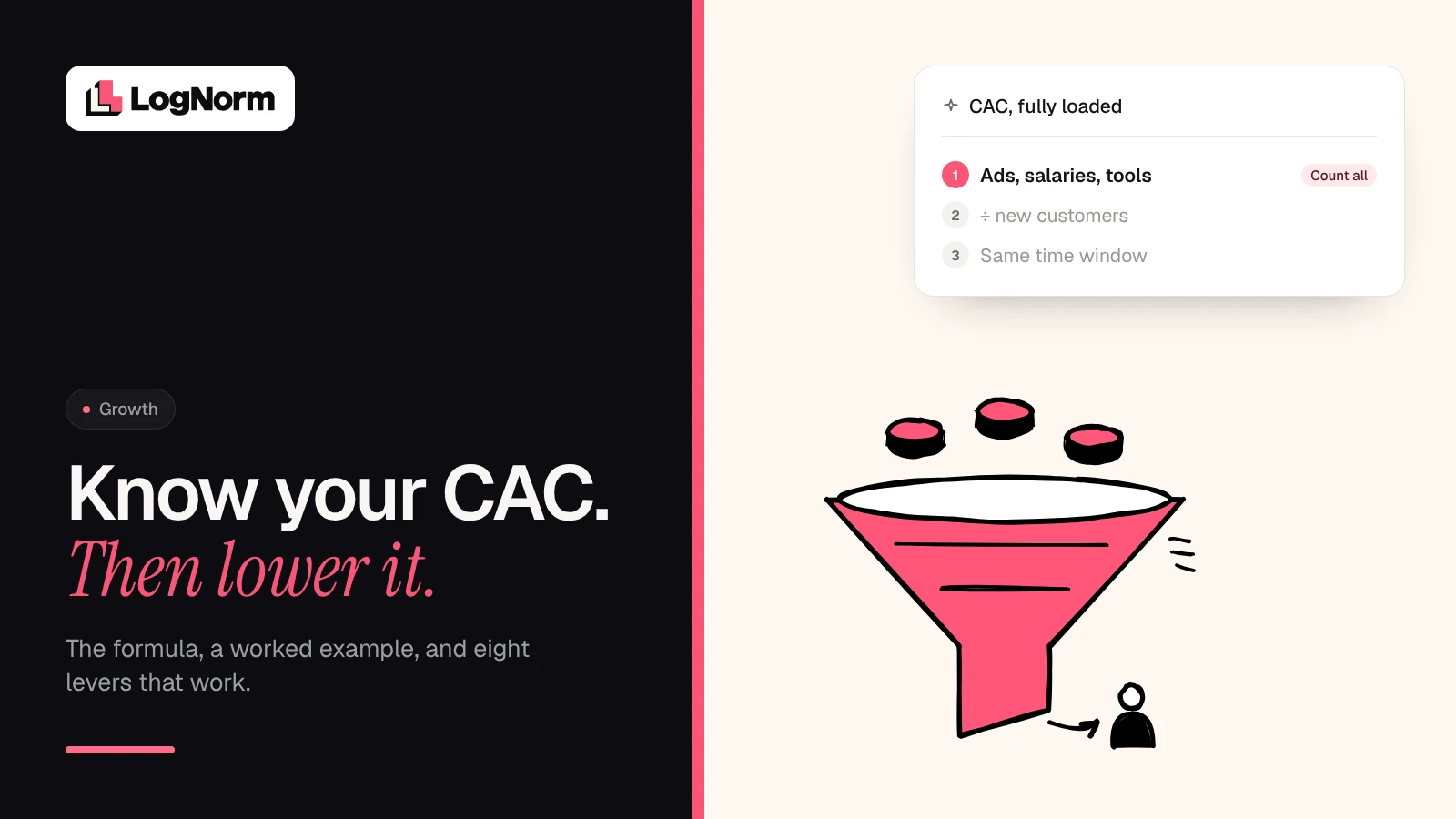
Customer acquisition cost (CAC) is the total amount you spend on sales and marketing to win one new customer. The formula is simple: divide your sales and marketing costs for a period by the number of new customers you won in that period. The hard part is deciding which costs and which customers belong in the sum.
Get those choices wrong and CAC flatters you. In the example below, ad spend divided by new customers comes to $120, while the fully loaded cost of a customer from paid channels is $875. This guide covers the formula, a worked example, the two ratios that tell you whether a CAC is good, the mistakes that distort it, and eight ways to bring it down.
CAC is one of the core numbers in any growth marketing playbook for startups. It does not tell you what to do on its own, but it tells you how expensive each growth bet really is.
What customer acquisition cost measures
CAC answers one question: what does it cost to turn a stranger into a paying customer? It is a unit cost, and it only means something next to what that customer is worth.
A $2,000 CAC is excellent for a product that earns $50,000 a year per account. A $200 CAC can sink a $10 a month app. That is why founders and investors read CAC alongside payback period and lifetime value.
CAC is a cost of growth, not of running the business. Engineering, hosting and support for existing customers stay out. Everything you spend to find, convince and close new customers goes in.
The customer acquisition cost formula
CAC = total sales and marketing costs in a period ÷ new customers acquired in that period
David Skok defines it the same way in his For Entrepreneurs SaaS metrics guide: sales and marketing expenses divided by new customers acquired. The real work is defining the two inputs honestly.
Fully loaded CAC: what goes in the numerator
A fully loaded CAC counts every cost of acquisition, not only media spend:
- Paid media: search, social, sponsorships, paid newsletter placements.
- People: salaries, benefits and commissions for marketing and sales, including founder time spent selling.
- Tools: CRM, marketing automation, analytics, SEO and outreach software.
- Contractors and agencies: writers, designers, ad agencies, outsourced SDRs.
- Incentives: Andreessen Horowitz calls out failing to include costs such as referral fees, credits or discounts as a common CAC problem.
Bessemer Venture Partners says the costs in its CAC payback metric usually include sales, marketing and customer success expenses, at least the part of customer success tied to renewals and upsells. Whatever you include, write it down and keep it the same every month, or trends become meaningless.
Blended CAC vs paid CAC
Andreessen Horowitz separates two versions of CAC:
| Blended CAC | Paid CAC | |
|---|---|---|
| Formula (a16z) | Total acquisition cost ÷ all new customers | Total acquisition cost ÷ customers from paid marketing |
| Who it counts | Organic, referral, direct and paid customers | Only customers from paid channels |
| What it tells you | The average cost of growth | Whether paid acquisition is profitable and can scale |
| Main risk | Free organic customers hide expensive paid ones | Attribution errors decide who counts as paid |
The a16z authors say blended CAC is not wrong, but it "doesn't inform how well your paid campaigns are working and whether they're profitable." Investors care about paid CAC because it shows whether you can grow by spending more. Many teams also track channel CAC, one channel's cost over that channel's customers. Label each version and report them side by side.
A worked example
The numbers below are hypothetical, chosen to show the method. They are not benchmarks.
Example. A B2B SaaS startup looks at one month:
- Ad spend: $12,000
- Marketing and sales salaries: $18,000
- Tools: $2,000
- Contractors: $3,000
- Total acquisition cost: $35,000
- New paying customers: 100, of which 40 came from paid ads
Three ways to calculate CAC give three very different answers:
- Ads-only CAC: $12,000 ÷ 100 = $120. Easy to pull, and it leaves out two thirds of the cost.
- Fully loaded blended CAC: $35,000 ÷ 100 = $350. The honest average.
- Fully loaded paid CAC: $35,000 ÷ 40 = $875. The a16z definition, counting only customers paid acquisition brought in.
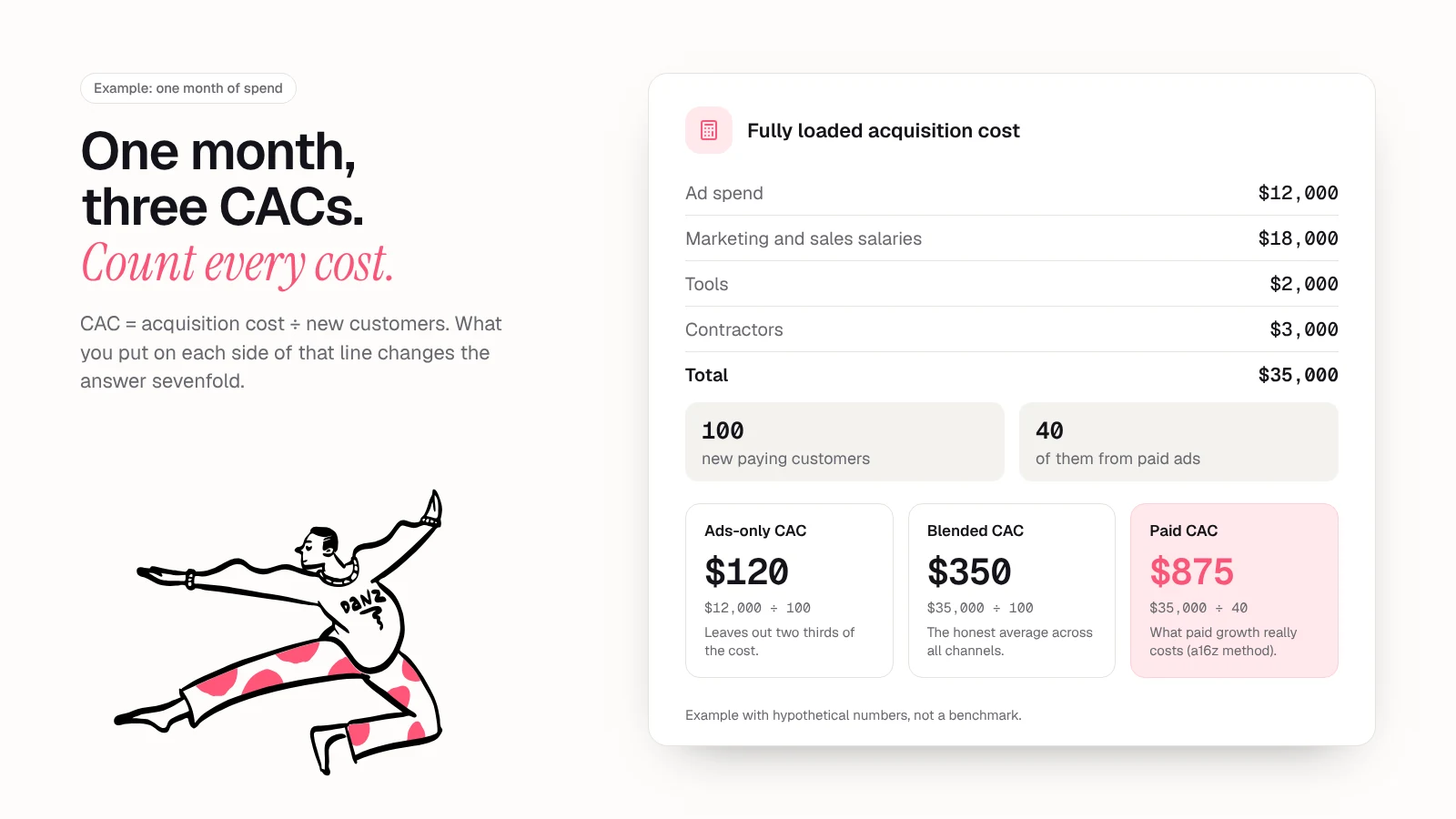
The same month produces a CAC between $120 and $875. None of these is the "real" CAC. Each answers a different question, and the mistake is quoting one while making decisions that need another.
CAC payback period and LTV:CAC
A CAC is only good or bad relative to what a customer pays you back. Two ratios do that job.
CAC payback period
Payback is how many months of gross profit it takes to earn back the cost of winning a customer.
CAC payback (months) = CAC ÷ (monthly revenue per customer × gross margin %)
Skok notes that to be accurate, payback should include a gross margin adjustment, and Bessemer measures CAC payback against gross-margin-adjusted revenue. Hosting and support costs do not repay acquisition.
Example (continued). Each customer pays $100 a month at an 80% gross margin, so contributes $80 a month. Blended payback is $350 ÷ $80 = about 4.4 months. Paid payback is $875 ÷ $80 = about 10.9 months.
There is no universal target, but there are reputable reference points. Bessemer's 2021 guidance for cloud companies is to target CAC payback under 12 months for SMB-focused companies, under 18 months for mid-market and under 24 months for enterprise. It also reports that average payback across its portfolio companies at $1 to $10 million ARR was 15 months, rising as companies mature. Skok's original guideline was under 12 months, though he notes that companies able to raise more capital can afford longer.
LTV:CAC ratio
Lifetime value (LTV) estimates the gross profit a customer generates over their whole relationship with you. A simple version for subscriptions:
LTV = (monthly revenue per customer × gross margin %) ÷ monthly churn rate
LTV:CAC = LTV ÷ CAC
Example (continued). With 3% monthly churn, LTV = $80 ÷ 0.03 = about $2,667. Against blended CAC that is roughly 7.6 to 1. Against paid CAC it is about 3 to 1.
The "3:1" figure is a commonly cited rule of thumb. One well-known source is Skok, whose guideline is that a successful SaaS business should have LTV:CAC higher than 3. Treat it as a sanity check, not a law. A healthy blended ratio can hide a paid ratio near the line, as the example shows.
LTV is also the shakiest number in the set, because early churn estimates rest on few customers and short histories. When in doubt, lean on payback, which uses numbers you already have.
Common CAC mistakes
Most bad CAC numbers come from a handful of errors.
Ignoring sales salaries and founder time
Ad spend is easy to export, so it often becomes the whole numerator. In a sales-led company, people are frequently the biggest acquisition cost. Leaving out account executives, SDRs and the founder who closes every deal makes CAC look like a marketing problem when it is mostly a sales-capacity one.
There is one fair adjustment. Skok points out that early teams may carry expensive people who will later handle far more customers, and suggests counting only a portion of those salaries early on. If you do, say so in the label.
Mixing organic and paid
Blended CAC credits you for customers from word of mouth, SEO or a launch spike, and hides a paid program that is losing money. Split by source before deciding where the next dollar goes. Watch the reverse too: paid campaigns can lift branded search, so some "organic" customers were really paid ones.
Using the wrong time window
Spend in March often produces customers in May, especially with longer sales cycles. Dividing March cost by March customers mismatches cause and effect. Use a trailing quarter, or a window that matches your typical time to close, and keep it consistent.
Treating CAC as the goal
CAC is a guardrail, not a target. The easiest way to cut it is to stop spending, which also stops growth. Pair it with a measure of the value customers get, such as your north star metric, so cost cuts do not quietly lower the quality of customers you win.
8 ways to lower customer acquisition cost
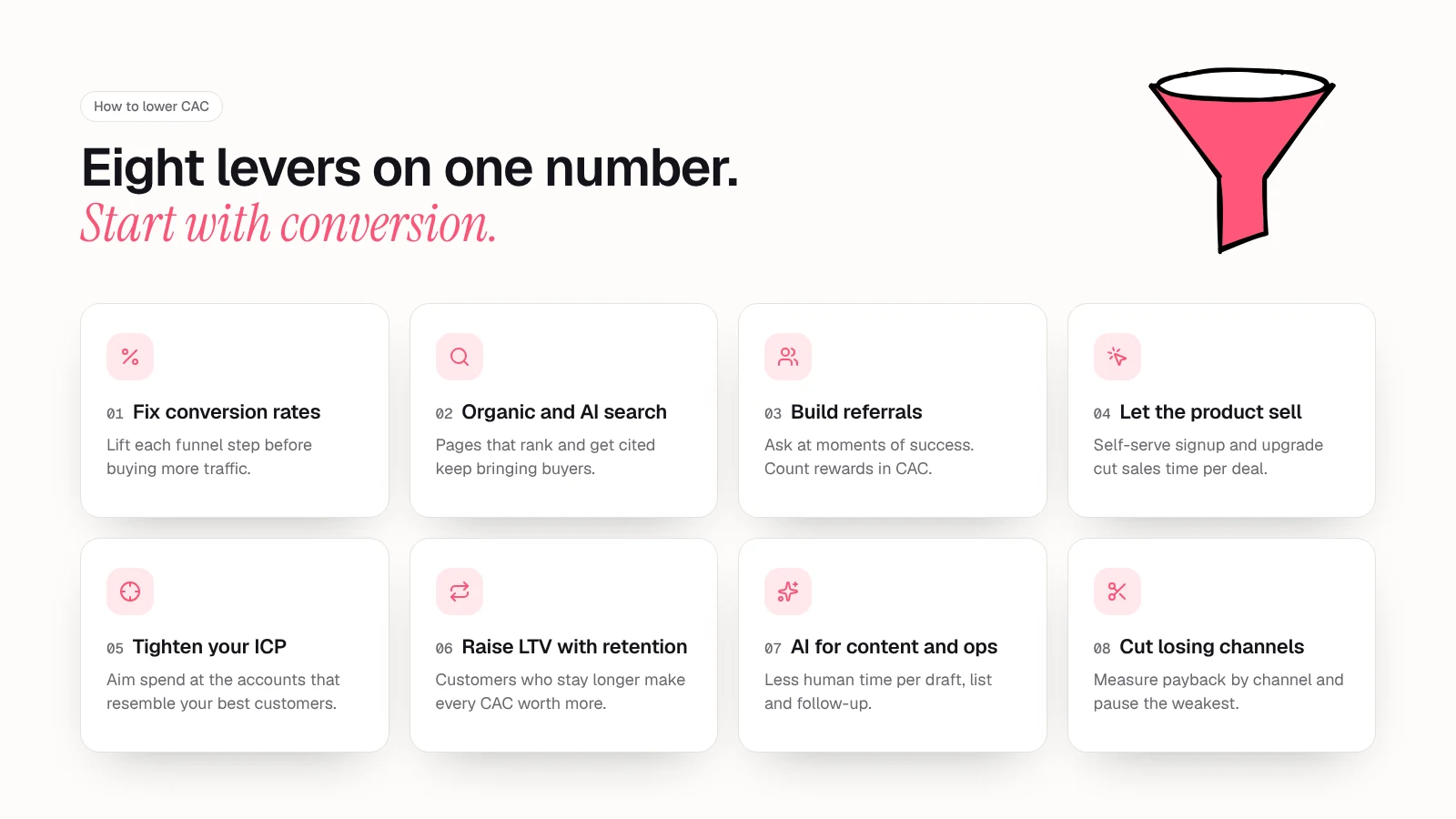
You can lower CAC two ways: spend less per customer, or convert more of the people you already reach. The levers below cover both, plus one that improves the ratio from the value side.
1. Fix conversion rates before buying more traffic
Every step from first visit to paid customer has a conversion rate, and each one divides into CAC. If 2% of visitors sign up and 10% of signups pay, raising either rate lowers CAC with no new spend. Start with the biggest drop, often the pricing page, signup form or first session, and measure on customers, not clicks.
2. Build organic search and AI answer visibility
Organic search turns a fixed content investment into customers you do not pay for one by one. A page that ranks keeps bringing in buyers long after it ships, which pulls blended CAC down over time. The same work feeds AI answers: Google says SEO best practices remain relevant for AI features in Search, with no additional requirements to appear in AI Overviews or AI Mode.
The catch is focus. Small teams rarely lack ideas; they lack a way to decide what to do next. Tools like LogNorm pull site audits, Search Console, keywords, competitors and AI answers together and turn each signal into a ranked Move, so the week's work is a short backlog instead of five dashboards. For a full plan, see our guide to SEO for startups without an SEO hire.
3. Turn happy customers into referrers
Referred customers can be worth more than others. In a Journal of Marketing study of about 10,000 customers at a German bank, the average referred customer was worth at least 16% more than a non-referred one, with a retention advantage that persisted over time. Ask at moments of success, make sharing one click, and count referral rewards in CAC.
4. Let the product do more of the selling
When users can sign up, get value and upgrade without a sales call, people time per deal falls, and CAC with it. Free plans, trials, templates and in-product invites move part of acquisition into the product. That is the core of product-led growth, and it works best when the product delivers value in the first session.
5. Tighten your ideal customer profile
Spend aimed at people who will never buy is a hidden cost in every CAC. Look at your best customers by retention and expansion, find what they share (company size, role, trigger event, tool stack), and narrow targeting, outbound lists and content to match. A tighter audience tends to convert better at every stage, and sales stops chasing deals that stall.
6. Raise LTV through retention
Strictly, retention does not lower CAC. It makes the CAC you pay worth more: a customer who stays twice as long roughly doubles LTV. Retained customers also refer, review and expand. If LTV:CAC is weak, check churn before cutting acquisition budgets.
7. Use AI for content and operations
AI lowers the people cost inside CAC: research, first drafts, ad variations, lead enrichment and routine follow-ups take less human time. Use it for better work, not more pages. Google says generative AI can be useful for researching a topic and adding structure to original content, but generating many pages without adding value may violate its spam policy on scaled content abuse. Keep a human on facts and final edits.
8. Cut channels that do not pay back
Calculate CAC and payback by channel, not just in total. Pause the weakest channel for a few weeks and see whether total new customers actually drop. If they do not, move that budget to what pays back inside your target window.
How to track CAC month to month
- Write down your definitions: which costs, which customers, which time window.
- Tag every new customer by source at signup or close.
- Report three numbers each month: fully loaded blended CAC, paid CAC and payback, on a trailing three-month basis.
- Review by channel each quarter and shift budget toward the shortest payback.
Used this way, CAC becomes a budget tool rather than a vanity number, one part of a growth marketing system where you test channels, measure what each customer costs and double down on what pays back.
FAQ
What is a good customer acquisition cost?
There is no single good CAC, because it depends on what a customer is worth. Judge it by payback and LTV:CAC instead. Bessemer's guidance targets payback under 12 months for SMB-focused companies, and David Skok's guideline is an LTV:CAC above 3.
How do you calculate customer acquisition cost?
Add up all sales and marketing costs for a period, including salaries, tools, ads, contractors and incentives, then divide by new paying customers won in that period. Calculate it both blended (all customers) and paid (customers from paid channels) so organic wins do not hide costly paid acquisition.
Should CAC include salaries?
Yes, for a fully loaded CAC. Marketing and sales salaries, commissions and benefits are often the largest acquisition cost, especially in sales-led businesses. Early teams can count a portion of senior salaries if those people will later handle many more customers, as long as they label the adjustment.
What is the difference between CAC and CPA?
CAC measures the cost of a new paying customer and usually includes all sales and marketing costs. Cost per acquisition (CPA) is typically an advertising metric for a specific action, such as a signup or lead, counting only media spend. A low CPA can still mean a high CAC if few of those signups pay.
Sources
- Andreessen Horowitz: 16 Startup Metrics (August 2015)
- For Entrepreneurs (David Skok): SaaS Metrics 2.0 - Detailed Definitions (December 2020)
- Bessemer Venture Partners: Scaling to $100 Million (September 2021)
- Journal of Marketing (Schmitt, Skiera and Van den Bulte): Referral Programs and Customer Value (January 2011)
- Google Search Central: AI features and your website (December 2025)
- Google Search Central: Guidance on using generative AI content on your website (October 2026)