What is product-led growth? A practical guide for startups
Product-led growth explained for startups: when PLG fits, free trial vs freemium vs reverse trial, activation, PQLs, and the metrics to track at each stage.


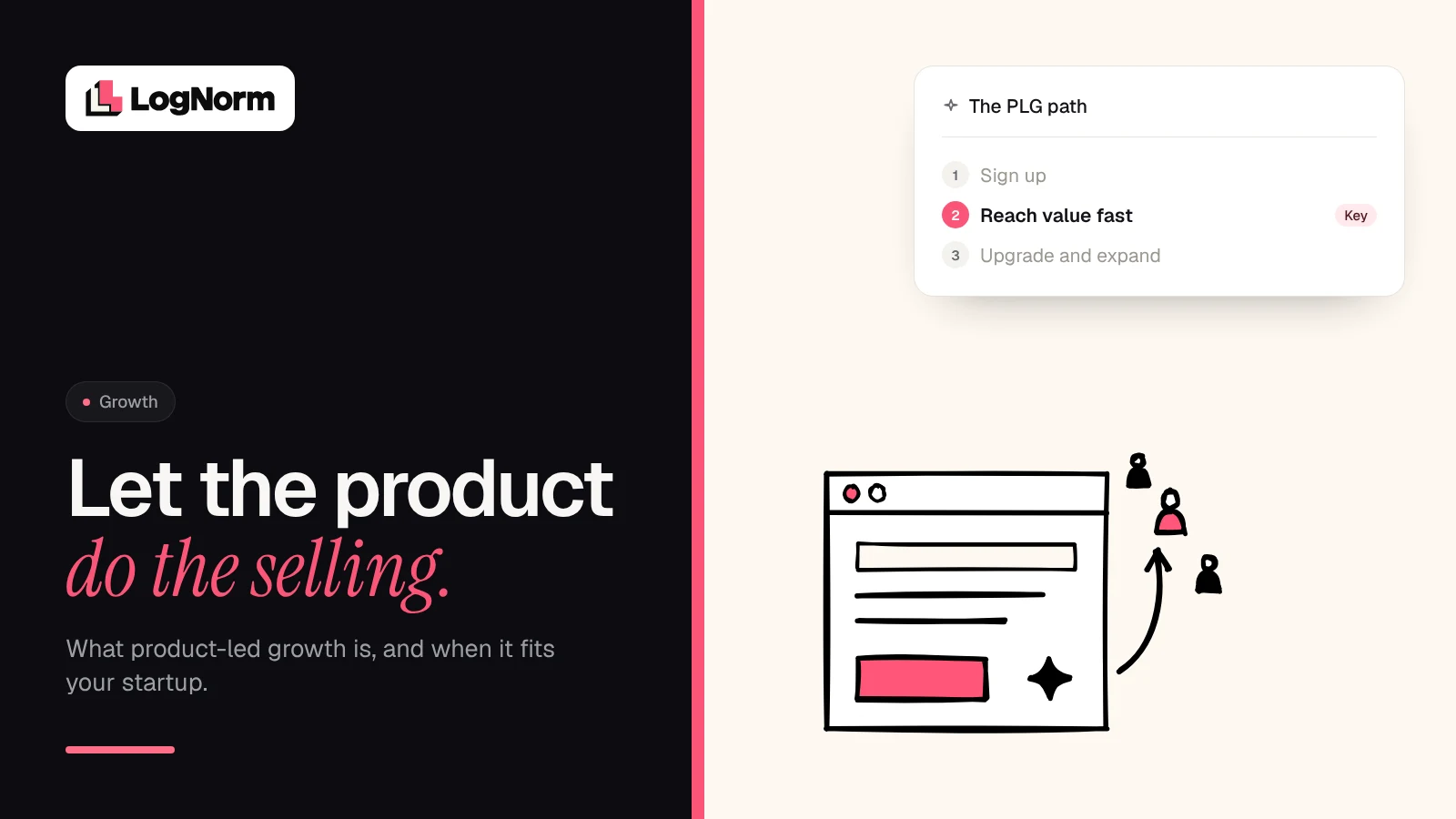
Product-led growth (PLG) is a go-to-market model where the product itself is the main driver of acquiring, converting and expanding customers. Instead of a sales call coming first, users sign up, reach value on their own, and pay when the product has earned it. Sales and marketing still exist, but they support the product rather than replace it.
The term was popularised by the venture firm OpenView. Its definition, written by partner Blake Bartlett, is still the cleanest one: PLG is "an end user-focused growth model that relies on the product itself as the primary driver of customer acquisition, conversion, and expansion." Bartlett is widely credited with coining the term, though he points out that companies like SurveyMonkey and Atlassian were working this way long before it had a name.
PLG is one model inside a wider growth marketing playbook for startups. This guide covers when it fits, the mechanics that make it work, the metrics to track and how AI is changing the first few minutes of a user's experience.
What product-led growth means in practice
In a product-led company, the product does work that sales and marketing teams used to do: it demonstrates value, qualifies buyers and spreads through sharing.
OpenView's original guide put two rules at the centre: "Deliver value before the paywall" and "Hire sales last". The examples it named are familiar: Slack, Atlassian, Zoom, Shopify, Twilio and Dropbox. In each case an individual could start using the product without asking IT or talking to a rep.
The shift behind PLG is simple: the person who uses a tool increasingly gets to pick it. If they succeed in the first session, they become your best salesperson inside their company.
PLG is not the same as "free". A free plan with a confusing product is just an expensive way to collect email addresses. The model works only when someone can reach a meaningful result quickly and without help.
PLG vs sales-led vs hybrid: which fits your startup
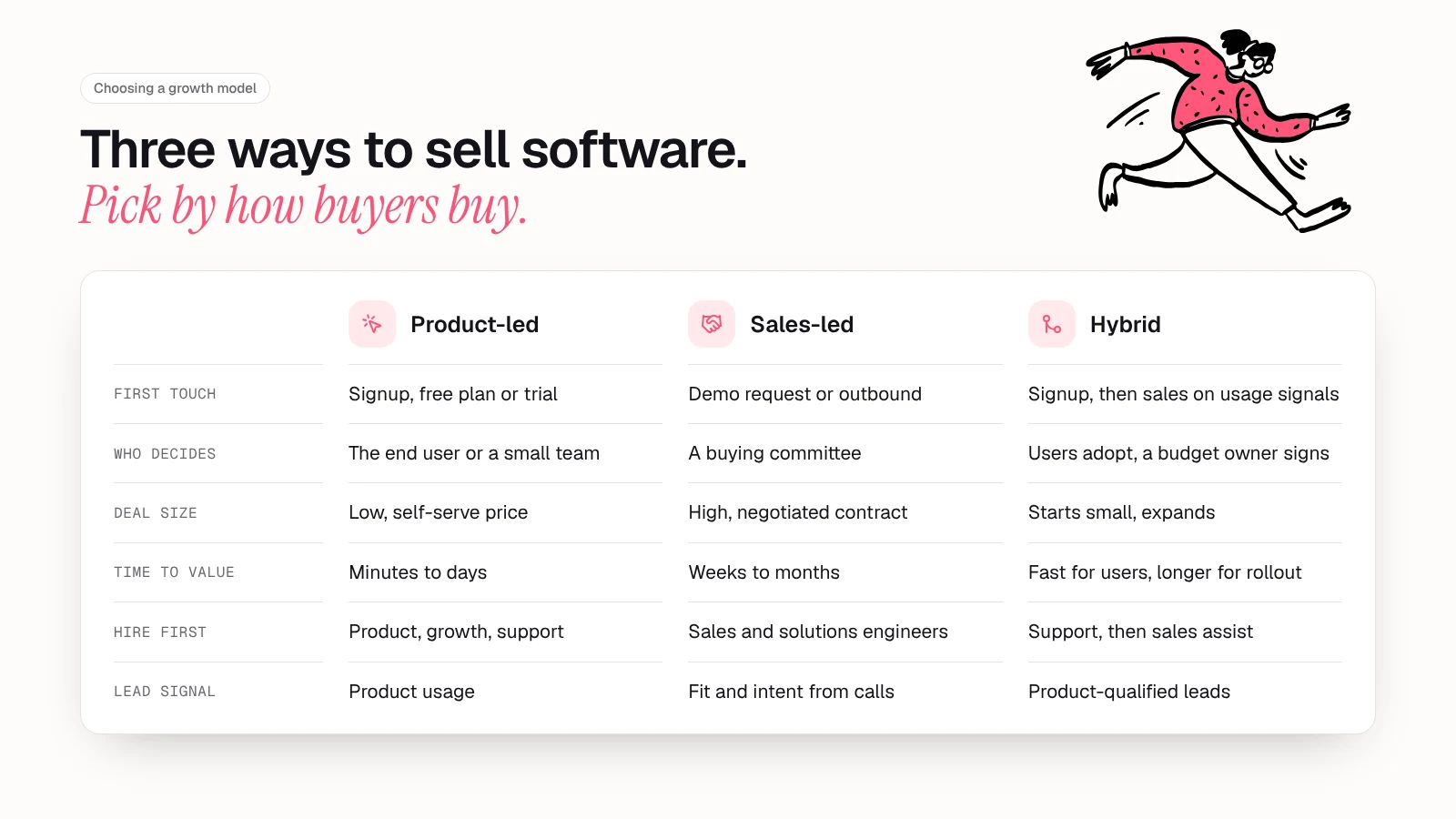
Most startups sit somewhere between fully product-led and fully sales-led. The right spot depends on how your buyers buy.
| Product-led | Sales-led | Hybrid (product-led sales) | |
|---|---|---|---|
| First touch | Signup, free plan or trial | Demo request or outbound | Signup, then sales on strong signals |
| Who decides | The end user or a small team | A buying committee | Users adopt, a budget owner signs |
| Deal size | Low, self-serve price points | High, negotiated contracts | Starts small, expands into larger deals |
| Time to value | Minutes to days | Weeks to months, often with setup | Fast for users, longer for rollout |
| First team to hire | Product, growth, support | Sales and solutions engineers | Support, then a sales-assist team |
| Main lead signal | Product usage | Fit and intent from conversations | Product-qualified leads |
Signs PLG fits
- One person can get value without a company-wide rollout.
- Setup takes minutes, not a project plan.
- The product gets more useful when more people join, so users invite colleagues.
- Your price is low enough that a user can pay on a card without procurement.
Signs sales-led or hybrid fits better
- The product needs data migration, integrations or security review before it does anything useful.
- The buyer and the user are different people with different goals.
- Contract values are high enough that a sales cycle pays for itself.
Pure PLG is rarer than it looks. In a January 2026 survey of 200 B2B software products run by Kyle Poyar with ChartMogul and ProductLed, 80% of free trial products had human touchpoints when an enterprise user entered the trial, and 70% of freemium products did the same. For most startups, the practical answer is hybrid: self-serve by default, with people stepping in when usage signals a bigger account.
The core mechanics of a product-led motion
Four mechanics do most of the work: how users get in, how quickly they reach value, how the product spreads, and how you spot buyers among users.
Free trial, freemium or reverse trial
Your entry model decides what a new user can do and for how long.
| Model | How it works | Main trade-off |
|---|---|---|
| Free trial | Full or paid-tier access for a fixed period, then pay or lose access | Creates urgency, but users who need longer to see value drop out |
| Freemium | A free plan with no time limit and paid upgrades | Builds habit and word of mouth, but many users never see what paid adds |
| Reverse trial | Paid features for a limited time, then the account drops to the free plan | Shows the full product while keeping the user if they do not pay |
Elena Verna, writing for Amplitude, describes a reverse trial as one that "puts customers in a freemium experience with a timed free trial with access to paid capabilities which reverts to a traditional freemium product after the free trial ends."
Free trials are the most common choice. In the Growth Unhinged 2026 report, 57% of products used a free trial as the main entry point, 26% used freemium and 7% used a reverse trial. The most common trial length was 14 days (62% of trial products), and trials that required a credit card upfront converted at 30%, more than five times the rate of trials that did not. Requiring a card also means fewer signups, so compare paying customers per visitor, not just the percentage.
Time to value and the activation moment
Time to value is how long it takes a new user to get the first real result from your product. The activation moment is the specific action that marks that result: the first report generated, the first message sent to a teammate, the first invoice paid.
To find your activation moment:
- List the actions a new user can take in their first week.
- Compare users who were still active a month later with those who left.
- Find the action, and the count of it, that the retained group did far more often.
- Make that action your activation event and design onboarding to get every user there sooner.
Everything before that moment is friction. Judge every form field and setup step by one question: does it get the user to activation faster?
In-product sharing and virality
The strongest PLG products spread because using them involves other people. A shared document, a meeting link or a public page puts the product in front of someone new.
Dropbox's referral program gives Basic users 500 MB of extra space for each friend they refer, up to 16 GB, and the friend has to install the app and log in for it to count. The reward is tied to active users, not just signups.
When sharing feeds new users who share again, you have a loop rather than a funnel. We cover how to design those in our guide to growth loops.
Product-qualified leads
A product-qualified lead (PQL) is a user who has shown buying intent through how they use the product. OpenView's Kyle Poyar defines PQLs as "users who signal their buying intent based on product usage rather than just traditional marketing or sales qualification."
His guide groups PQL signals into three types:
- Product usage: frequency, adoption of high-value features, week-on-week growth, completed activation steps.
- Fit: company size, job title, location.
- Hand-raising: requesting a demo, contacting support, viewing the pricing page without buying.
PQLs tell a hybrid team where sales time should go: to accounts where usage already shows the need.
PLG metrics and how to calculate them
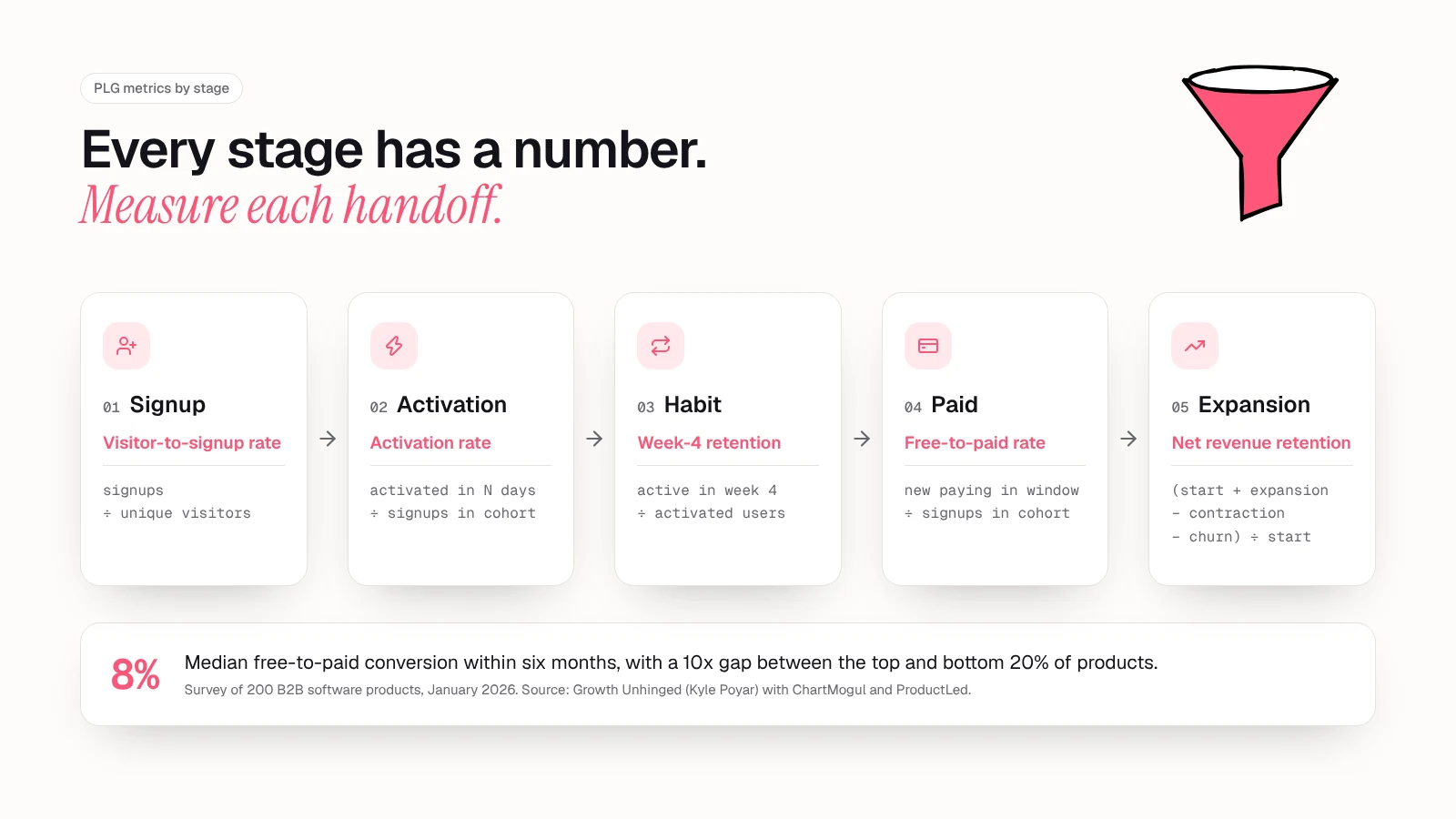
PLG metrics follow the user's path through the product. Measure each stage on a cohort basis, meaning everyone who signed up in the same week or month, so changes to onboarding show up clearly.
| Stage | Metric | How to calculate it |
|---|---|---|
| Signup | Visitor-to-signup rate | Signups ÷ unique visitors to signup pages, same period |
| Activation | Activation rate | Users who hit the activation event within N days ÷ signups in the cohort |
| Activation | Time to value | Median time from signup to the activation event |
| Habit | Week-4 retention | Users active in week 4 ÷ users who activated |
| Paid | Free-to-paid conversion | New paying customers from the cohort within a fixed window ÷ signups in the cohort |
| Expansion | Net revenue retention | (Starting recurring revenue + expansion − contraction − churn) ÷ starting recurring revenue |
Pick the window and stick to it. The Growth Unhinged survey, for example, defines free-to-paid conversion as the share of leads or free signups that become paying customers within six months. If you measure at 14 days and compare yourself to a six-month benchmark, you will draw the wrong conclusion.
On benchmarks, that January 2026 survey of 200 B2B products is one of the few recent datasets with a clear method. It found a median free-to-paid conversion rate of 8% across all products, with a 10x difference between the top 20% and the bottom 20%. Among free trial products, 20% converted below 2.5% and 23% converted above 25%. Among freemium products, 25% converted below 2.5%, and conversion above 15% was rare.
The spread is the lesson: an average tells you little, so set your baseline from your own cohorts. To connect these stage metrics to one number the whole team rallies around, see our guide to choosing a north star metric.
Marketing still matters in a product-led company
PLG changes what marketing is for, not whether you need it. The product converts and expands users, but someone has to bring them to the signup page in the first place.
In a product-led company, marketing owns acquisition into the product:
- Search and content that answers the problems your product solves, with a clear path to try it.
- Use-case and template pages that drop a visitor straight into a working example.
- AI answer visibility, so assistants mention your product when someone asks what to use.
- Onboarding emails that push users toward the activation event, not a feature tour.
Judge each channel on activated users and paying customers, not raw signups. Signups who never activate still cost support time and, with AI features, compute.
Growth tools work the same way: LogNorm, for example, has a free plan and runs a weekly loop that turns site, Search Console, keyword and competitor signals into a ranked backlog of Moves, so a new user sees what to do next rather than a dashboard. If search is one of your main acquisition channels, our guide to SEO for startups covers how to build it. For how acquisition, product and retention fit together, go back to the growth marketing guide.
How AI changes PLG onboarding
AI is reshaping the first session, which is where PLG products win or lose. Kyle Poyar's 2026 report notes that "self-serve funnels now include AI-driven onboarding and in-product copilots", and that supporting free users has become more expensive because AI token costs have stayed high.
The appetite for self-serve AI is large. Menlo Ventures' 2025 State of Generative AI in the Enterprise report, based on a survey of about 500 US enterprise decision-makers in November 2025, found that 27% of all AI application spend comes through PLG motions, nearly four times the rate in traditional software (7%). It also reports that "Cursor reached $200 million in revenue before hiring a single enterprise sales rep."
Three practical changes follow:
- Ask, then configure. Wes Bush of ProductLed argues that "AI onboarding makes activation instant. Ask users what they want to accomplish, AI configures the experience immediately." A setup wizard becomes a single question.
- Let people try before they sign up. The Growth Unhinged survey found that 38% of freemium products let users try the product before creating an account, as many AI app builders and assistants do.
- Redefine activation for agent products. Bush suggests the moment that matters is "the first time a user successfully delegates a complete task to an agent and trusts the output." If your product does work on the user's behalf, your activation event should reflect a completed, trusted task, not a click.
Watch the cost side too. Set usage limits on free plans, track cost per activated user alongside conversion, and use reverse trials or credits when unlimited free access does not pay.
FAQ
What is product-led growth in simple terms?
Product-led growth means your product does most of the selling. Users sign up, try it, get value on their own and then pay or upgrade, instead of going through a sales call first. Marketing and sales still help, but the product experience drives the decision.
What are some product-led growth examples?
OpenView's guide names Slack, Atlassian, Zoom, Shopify, Twilio and Dropbox as product-led companies. Each let individuals start for free or on a trial, then grew as those users brought in teammates.
What is the difference between product-led and sales-led growth?
In sales-led growth, a sales team qualifies buyers, runs demos and closes contracts before the customer uses the product. In product-led growth, the customer uses the product first and pays once it has proved its value. Many startups run a hybrid, where sales steps in for accounts that show strong usage.
Is freemium the same as product-led growth?
No. Freemium is one pricing model a product-led company can use, alongside free trials and reverse trials. PLG is the broader strategy of letting the product drive acquisition, conversion and expansion, and it can work with any of these entry models.
What is a good free-to-paid conversion rate?
It depends on your model and how you measure it. A January 2026 survey of 200 B2B products by Growth Unhinged, ChartMogul and ProductLed found a median of 8% within six months, with trials that required a credit card converting at 30%. Use these as context, and set targets from your own cohort data.
Sources
- OpenView: What is Product-Led Growth? How to Build a Software Company in the End User Era (June 2021)
- SaaS Club: Product-Led Growth Explained by the VC Who Coined It (October 2026)
- Growth Unhinged: The 2026 free-to-paid conversion report (February 2026)
- Amplitude: Trial or Freemium? Get the Best of Both with a Reverse Trial (June 2025)
- Dropbox Help: How much free referral space can I earn? (October 2026)
- OpenView: Your Guide to Product Qualified Leads (PQLs) (January 2022)
- Menlo Ventures: 2025: The State of Generative AI in the Enterprise (December 2025)
- ProductLed: PLG Predictions For 2026 (December 2025)