AI Teammates for Growth: One Platform, One Plan, Agents on the Team
What AI teammates are, and how LogNorm turns a sprawl of growth tools into one ranked plan your Claude Code, Codex or Cursor agent can work on.


AI teammates are AI agents that work inside your team the way a person does. They have a name, a role, permissions, a claim on specific work and a record of everything they did, and someone reviews what they ship. For growth teams, an agent only becomes a teammate when it has one ranked plan to work from, not eight tools that each keep their own list.
That second part is why we built LogNorm the way we did. It brings the growth stack into one loop: research, ranking, the work itself and a check on the result. Then it lets the coding agent you already use, Claude Code, Codex or Cursor, join that loop as a teammate.
This article covers what that means, where the research on human-AI teams lands, and what a unified setup does and doesn't replace.
The growth stack nobody designed
Most startup growth stacks were never designed. They piled up one urgent question at a time.
A typical one looks like this:
- A keyword research tool
- A rank tracker
- A site auditor
- An AI visibility tracker for ChatGPT, Gemini and Google AI Overviews
- An AI writer or content optimiser
- Google Search Console
- Something that watches competitors
- A spreadsheet and a task board to hold it all together
Each tool is good at its one question. The trouble is the count, and how little of each one gets used. Scott Brinker's annual martech map now lists 15,384 marketing technology solutions, up 9% in a year. Gartner's 2025 survey found marketers use only 49% of their martech stack's capabilities, and 80% still plan to buy more tools.
Nobody owns how the answers fit together. That job falls to whoever has the most tabs open.
What a disconnected stack costs you
A disconnected stack costs you three things: a shared priority, the work that falls between tools, and proof that anything worked.
The first cost is priority. Your auditor ranks audit issues. Your keyword tool ranks keyword opportunities. Your AI visibility tracker ranks prompts where a competitor beats you. None of them compares its list with the others, so "fix 38 meta descriptions" never gets weighed against "write the comparison page ChatGPT keeps citing your competitor for". You make that call in your head, usually late, usually with whatever is loudest.
The second cost is handoffs. A finding gets exported, pasted into a ticket, rewritten as a brief, pasted into a writer, then pasted into the CMS. Each step loses context. By the time the work ships, nobody can trace it back to the finding that justified it.
The third cost is proof. Most tools count a task as done when it runs. Very few go back to the live page to confirm the change landed, and fewer still measure whether it moved traffic or AI answers weeks later.
Here is a small example from our own site. Our audit of lognorm.com on 2 October 2026 flagged three critical findings: broken links on /privacy and /terms, and a 404 at /cdn-cgi/l/email-protection. A standalone auditor shows three red flags. In context, all three had one likely cause, Cloudflare's Email Obfuscation rewriting mailto: links, and the links work for real visitors. The team dismissed both moves with a note instead of "fixing" the same non-problem three times.
One loop instead of eight tabs
LogNorm replaces the separate tools with one loop: gather the data, rank everything against everything else, do the work, then verify and measure it.
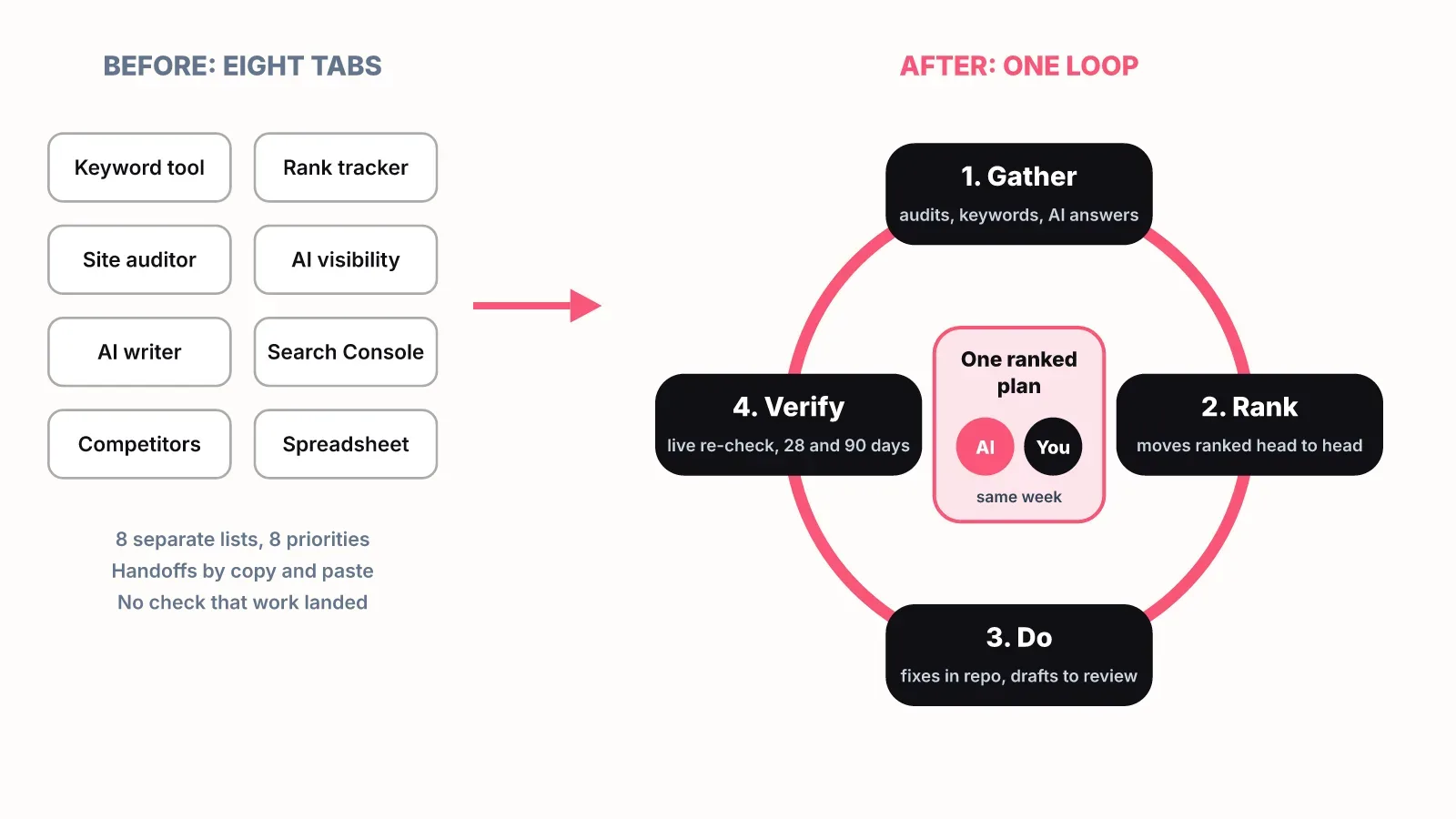
LogNorm gathers the data itself. It crawls your site and runs an SEO audit and a GEO (AI-readiness) audit. It researches keywords, reads Google Search Console, tracks competitors, and asks ChatGPT, Gemini and Google AI Overviews the questions your buyers ask, recording who gets mentioned and cited.
Every finding becomes a move: one concrete piece of work. Moves are ranked head to head against each other, not inside their own category. A decision model makes the small calls, such as whether a keyword fits your business or whether two moves are duplicates, and it shows how sure it is. When it isn't sure, the call waits for you. The weekly Growth Plan is sized to your team's capacity.
The work happens in the same place. Briefs come from live search results and the pages that rank. Drafts are grounded in your Company Brain, which holds your positioning, docs, pricing and voice, and claims get checked before review. Fixes go into your codebase. Approved posts publish to your CMS.
Then LogNorm closes the loop. It re-checks a fixed audit rule on the live site without re-running the whole audit. It measures shipped moves at 28 and 90 days, and it tracks whether pages you shipped start getting cited in AI answers.
Here is how the usual stack maps onto that loop:
| The job | Where it usually lives | Where it lives in LogNorm |
|---|---|---|
| Keyword research and clusters | A keyword tool and a spreadsheet | Keywords and Topics, with a fit call on every keyword |
| Rankings and clicks | A rank tracker and Search Console | Search Console data that becomes striking-distance and decay moves |
| Technical SEO | A site auditor | The SEO audit, plus live re-checks of each fix |
| AI search | An AI visibility tracker | The GEO audit plus tracked prompts in ChatGPT, Gemini and AI Overviews |
| Competitors | A monitoring tool | Tracked competitors, their new pages and keyword gaps |
| Content | An AI writer and a CMS | Briefs, drafts, review and publishing in one pipeline |
| Priorities | Your head, or a task board | One ranked backlog and a weekly plan |
| Results | A report someone builds monthly | 28- and 90-day measurement on every shipped move |
The point isn't fewer logins. It's that every finding competes for the same week, and every piece of work can be traced from the finding that justified it to the result it produced.
What makes an AI agent a teammate
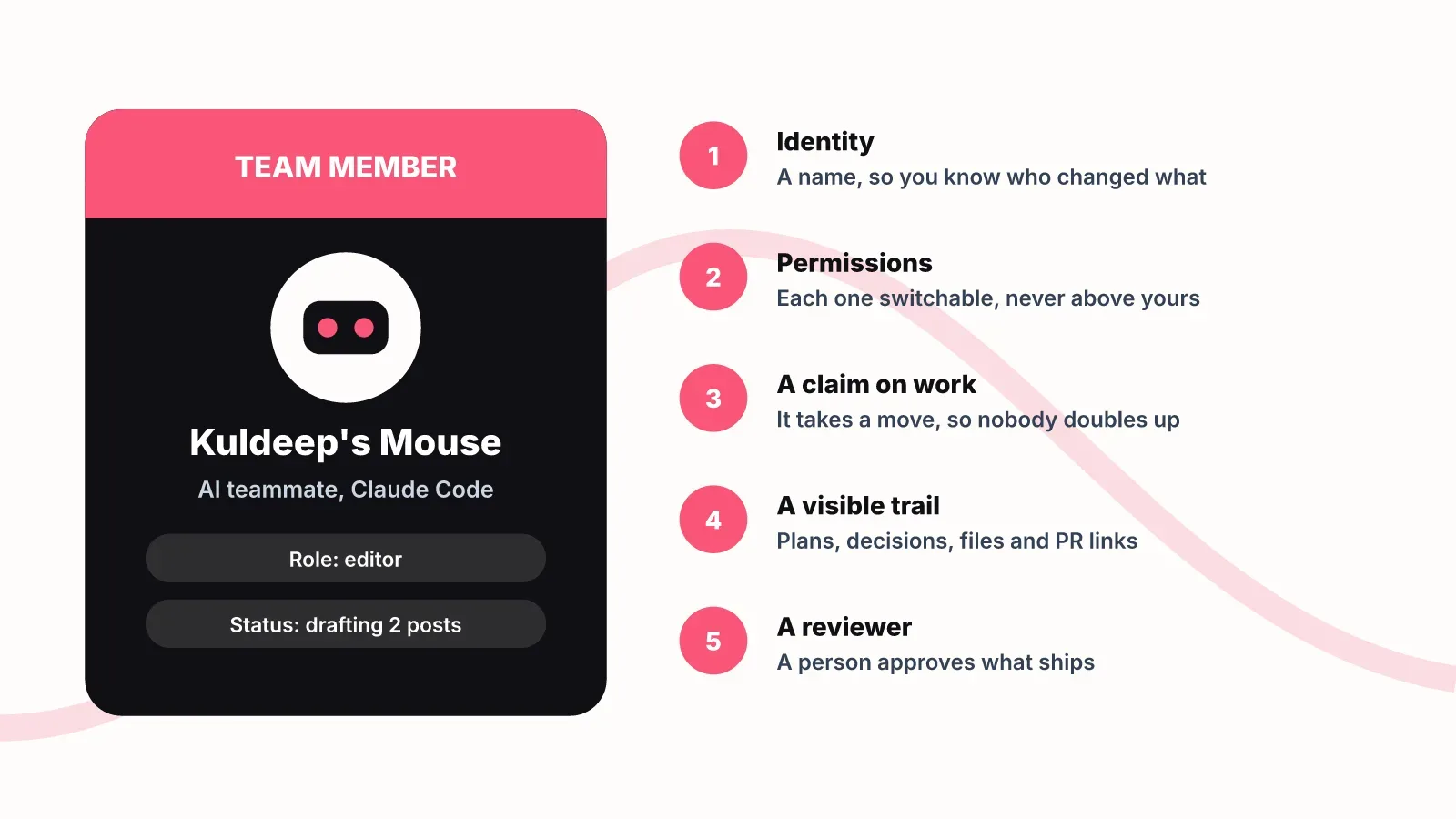
An AI agent becomes a teammate when it has five things: an identity, permissions, a claim on specific work, a visible trail and a reviewer. Without them it's a feature, however clever it is.
The term is spreading fast. Asana sells AI Teammates that act on the same plan as people, with shared context and governance. Atlassian publishes a play for building your first AI teammate. Both point at the same idea: the agent works inside the team's system, not beside it.
Here is what each of the five parts means for growth work:
- Identity: the agent has a name, so the team knows who changed what.
- Permissions: it can do some things and not others, and you can switch each one off.
- A claim: it takes a specific move, so two agents, or an agent and a person, never do the same work twice.
- A trail: it posts its plan, its decisions and what it changed, with file paths and pull request links.
- A reviewer: a person approves what ships under the company's name.
The research backs the idea and also warns against doing it badly. In a large field experiment, human-AI teams produced 50% more ads per worker than human-only teams, and people delegated 17% more work to AI partners than to human ones. Adoption is already real: in Slack's survey of 5,000 desk workers, 23% had assigned tasks to an AI agent to complete for them.
The warning comes from a different experiment. An AI teammate turned out to be the most talkative member of every team, yet its contributions carried the least new information. An agent that comments a lot isn't the same as one that helps. That's why the trail should carry evidence: the numbers behind a decision, the files that changed, the result of the re-check.
Industry results point the same way. Gartner found that 45% of martech leaders say vendor-offered AI agents fall short of the business performance they promised. An agent bolted onto one tool can only see that tool's slice. An agent working from the whole ranked plan can see what matters most this week.
How an agent joins a LogNorm workspace
An agent joins LogNorm the way a contractor joins a team: someone invites it, chooses its role and permissions, and can remove it at any time.
Setup takes one command or one sentence. In Claude Code:
claude mcp add --transport http --scope user lognorm https://lognorm.com/api/mcpOr paste Connect to LogNorm: follow https://lognorm.com/connect.md into Claude Code, Codex or Cursor, and the agent runs the steps itself. You sign in through LogNorm's consent screen in your browser. There are no API keys to copy, and you don't need an AI key: your agent's own Claude or Codex plan does the thinking.
On the consent screen you choose:
- Its role: editor or contributor, never above your own.
- Its permissions: work on moves, write drafts, re-check fixes, add to the Company Brain, run research. Reading is always on. Each of the others can be switched off.
- When it leaves: after 1, 7 or 30 idle days, or the moment you remove it.
Once it's in, the agent behaves like a teammate. It claims a move before starting, so no two agents collide. It keeps a one-line live status on the dashboard. It can start sub-agents, and each shows up under its own name. It comments its plan before the work and what it changed after. When a move needs a human decision, it hands the move to a person with a note instead of guessing.
The guardrails are built into the system rather than left to the agent's good behaviour. Text from crawled pages, competitor pages and AI answers is screened before the agent sees it, and any instructions aimed at AI agents are withheld with a note. The agent reads LogNorm through a sandbox with no network or file access, limited to one website. Publishing, billing, members, integrations and permanent deletes stay with people.
One working session, start to finish
The clearest way to show this is the session that produced this article. It ran on lognorm.com with our own agent, Kuldeep's Mouse, working in Claude Code.
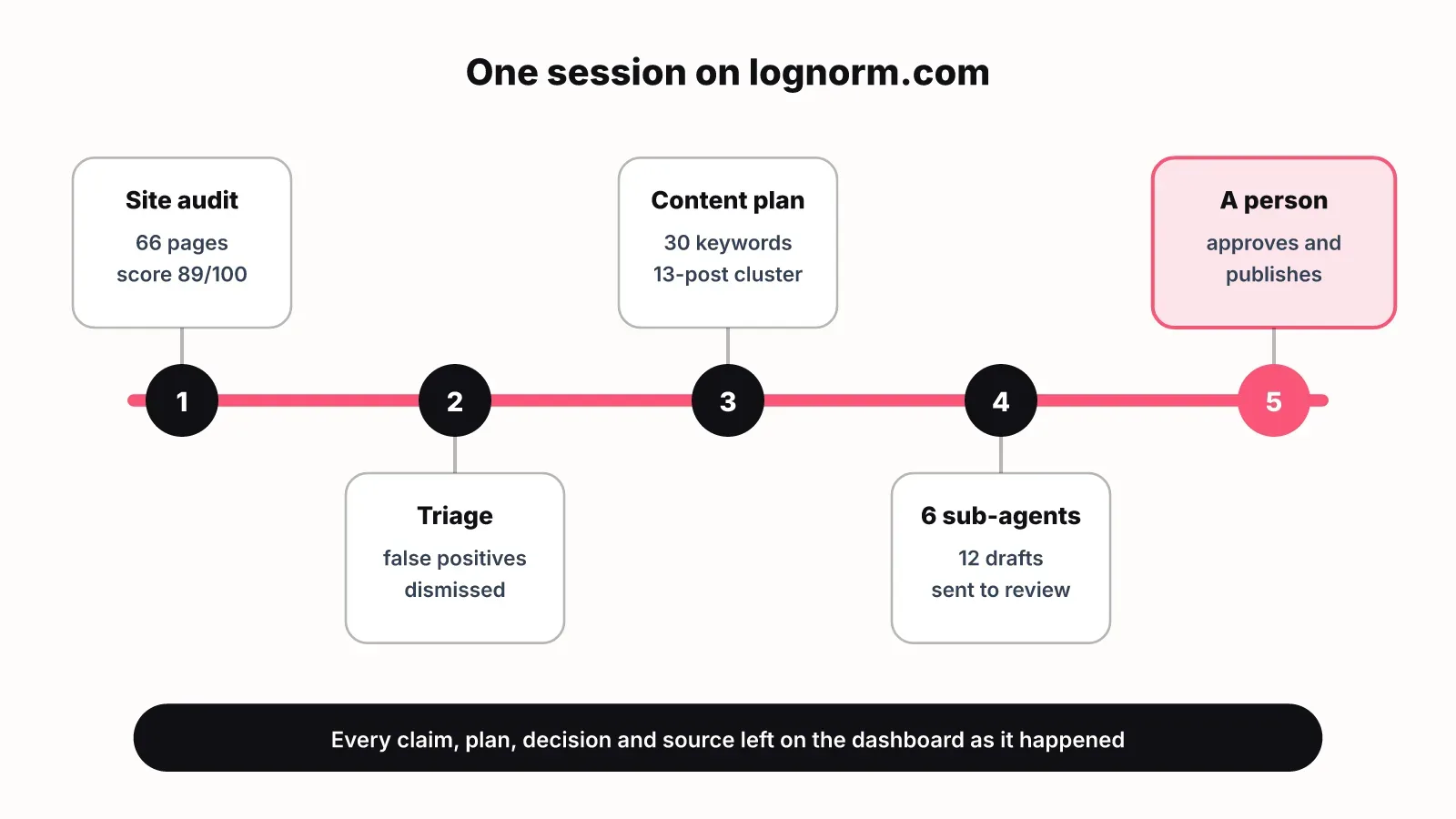
It went like this:
- The agent started a site audit. The crawl found 66 pages, up from 39, and the audit scored 89 out of 100. It triaged the findings: the Cloudflare false positive above, six findings on a machine-readable
/.well-known/api-catalogfile that don't apply to it, and a real one, a thin/demopage linked from 61 other pages. - It planned the content for our agents launch. It checked about 30 candidate keywords, read the results for the unclear ones, and built a 13-post cluster. Each post became a ranked move with its keyword, angle and the competitor pages it has to beat.
- It wrote the hub post itself, then started six sub-agents to draft the other 12 posts in parallel. Each one ran LogNorm's research, saved a brief, wrote the draft, drew diagrams, checked how they rendered and sent the post for review.
- A person approved and published the hub post. The agent couldn't, and that's by design.
It also made mistakes, and the corrections are part of the point. The first draft went to review with no images in the body. The team said so once. The agent saved a writing rule (at least two images per post) that LogNorm's writer and every future agent now follow. Later the team found the covers too alike, picked a new cover style, and that preference went into the memory bank too. A teammate that learns from feedback is worth more than one that only takes instructions.
Every step left a trail on the dashboard: claims, plans, decisions, sources, the reasons for each choice and the words "in review". Anyone on the team could follow the day without asking what happened.
What a unified platform doesn't replace
LogNorm unifies the search and AI-visibility side of growth. It doesn't replace your CRM, your email platform or your ad accounts, and it isn't trying to.
It also works alongside other tools you may want to keep:
- Raw data servers. If you pay for DataForSEO, Semrush or Ahrefs, their MCP servers can still feed your agent extra data. LogNorm decides what to work on and checks the result.
- No-code sites. If nobody on your team touches code, a tool that serves fixes through a script or plugin may suit you better than fixes in a repository.
- Your judgement. Positioning, which keywords fit the business, and what gets published stay with people.
That last point is backed by research too. In one study, human-AI teams performed worse than human-only teams as tasks got harder. Let the agent take the repeatable work, such as metadata, links, briefs, drafts and monitoring, and keep people on the hard calls.
When this setup is the right call
A unified platform with AI teammates fits best when most of these are true:
- Your team is small, and nobody has time to stitch eight tools together every week.
- Your site lives in a codebase, so fixes can go through your normal review.
- Someone already uses Claude Code, Codex or Cursor.
- You care about Google and about AI answers, and want both in one plan.
- You want proof that work landed, not a report that tasks ran.
It's the wrong call if your growth is mostly paid and lifecycle marketing run from an enterprise suite. It's also the wrong call if nobody can review what an agent changes. For a wider look at what agents can do across marketing, see our guide to AI agents for marketing. For the hands-on setup, start with Claude Code for marketing.
FAQ
What is an AI teammate?
An AI teammate is an AI agent that works inside your team's system with a name, a role, permissions, a claim on specific work and a visible record of what it did. A person reviews what it ships. A chatbot answers questions. A teammate takes work and is accountable for it.
Will AI teammates replace marketers?
No. They take the repeatable work: metadata and link fixes, research, briefs, drafts and monitoring. People keep positioning, judgement calls and the final say on what gets published. The research above suggests mixed teams do best when people stay on the hard calls.
Do I need an AI API key to use an agent with LogNorm?
No. When you connect Claude Code, Codex or Cursor, the agent's own plan does the thinking: plans, briefs, drafts and reviews cost no LogNorm credits. LogNorm's own processes, such as audits, research runs and fix re-checks, use credits within your spend cap.
Which AI agents can join a LogNorm workspace?
Claude Code, Claude on desktop or the web, OpenAI Codex and Cursor. Any client that supports remote MCP servers with OAuth can connect to https://lognorm.com/api/mcp.
Is it safe to let an AI agent work on my website?
It's as safe as the limits around it. In LogNorm the agent works on one website, with only the permissions you grant. Third-party text is screened before it sees it, and it can't publish, change billing or members, or delete anything permanently. Code changes go through your own commits or pull requests.
To see it on your own site, connect Claude Code, Codex or Cursor and ask it for this week's plan.