AI agents for marketing: what they can do today
What AI agents for marketing are, the tasks they handle well today, where they fail, and a safe way for a startup team to pilot one with human approval.


An AI agent for marketing is a system where a language model decides its own next steps and uses tools, such as search, analytics or your CMS, to finish a marketing task without a fixed script. Today, agents are useful for bounded work that a person can check: research briefs, competitor monitoring, content repurposing, SEO audits, reporting, lead enrichment and campaign QA. They are not yet safe to leave alone with anything that publishes, spends money or emails customers in your name.
The demos show an agent running a whole campaign. The reality is narrower and still worth having: an agent that does the slow first pass of a task, then hands you something to approve.
This post is part of our guide to how startups use AI for marketing. Here we cover what an agent is, what it can do today, where it breaks, and how to pilot one.
What an AI agent is, and what it is not
An agent chooses its own path to a goal. A chatbot answers, and a workflow follows steps you wrote.
The clearest primary definition comes from Anthropic's engineering team. In Building effective agents, they separate two kinds of systems: "Workflows are systems where LLMs and tools are orchestrated through predefined code paths. Agents, on the other hand, are systems where LLMs dynamically direct their own processes and tool usage, maintaining control over how they accomplish tasks."
OpenAI draws the same line from the other side. Its practical guide to building agents defines agents as "systems that independently accomplish tasks on your behalf," and is explicit that simple chatbots, single-turn LLMs and sentiment classifiers are not agents, because they integrate LLMs but "don't use them to control workflow execution."
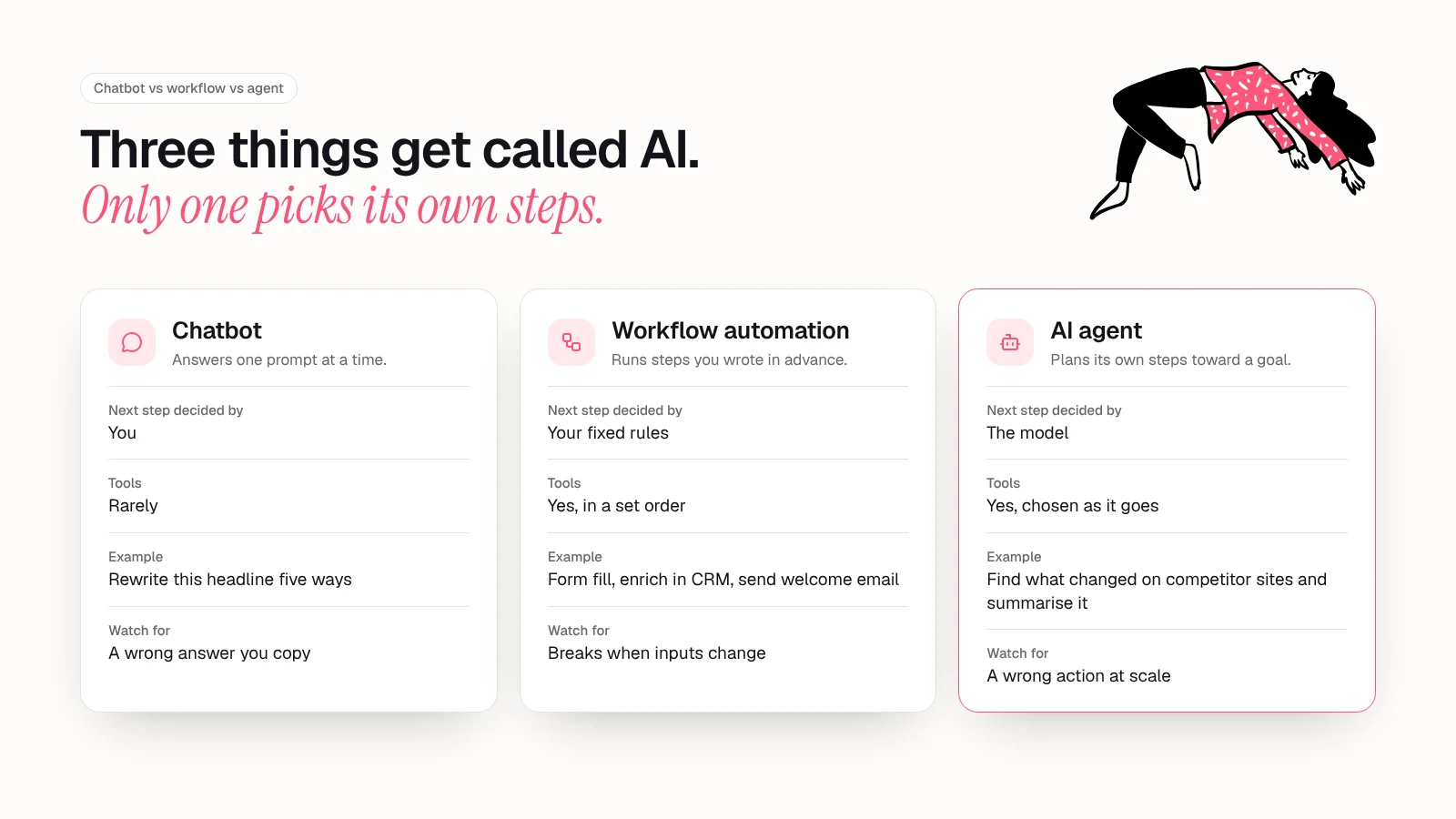
In marketing terms, the three look like this:
| Chatbot | Workflow automation | AI agent | |
|---|---|---|---|
| Who decides the next step | You, one prompt at a time | The steps you defined in advance | The model, based on what it finds |
| Uses tools | Rarely, or one at a time | Yes, in a fixed order | Yes, chosen as it goes |
| Marketing example | "Rewrite this headline five ways" | New form fill, enrich in CRM, send welcome email | "Find what changed on three competitor sites this week and summarise what matters" |
| Best for | One-off drafting and thinking | Repeatable tasks with known steps | Open-ended tasks where the steps vary |
| Main risk | Wrong answer you copy | Breaks when inputs change | Wrong action taken at scale |
The label is overused. Gartner warned in June 2025 about "agent washing," which it describes as "the rebranding of existing products, such as AI assistants, robotic process automation (RPA) and chatbots, without substantial agentic capabilities." It counted only about 130 genuine agentic AI vendors among the thousands making the claim.
Most marketing work does not need a true agent. If the steps are known, a plain workflow is cheaper and more predictable, which is the territory of AI marketing automation. Anthropic's own advice is to "start with simple prompts, optimize them with comprehensive evaluation, and add multi-step agentic systems only when simpler solutions fall short." Agents earn their place on open-ended problems where, in Anthropic's words, "it's difficult or impossible to predict the required number of steps."
What AI agents can do for marketing today
The good use cases share three traits: the input is messy, the steps vary, and a person can review the output before it matters. OpenAI's guide recommends agents for work with "complex decision-making," "difficult-to-maintain rules" or "heavy reliance on unstructured data." Marketing has plenty of all three.
Research briefs
Give an agent a topic, a target reader and a few seed sources. It searches, reads and returns a brief with the questions people ask, the angles competitors cover, and a link for every claim. Your job is to open the links. A brief without sources takes as long to check as doing the research yourself.
Competitor monitoring
This is close to an ideal agent task. The agent visits competitor pages (pricing, changelog, blog), compares them to last week, and writes up what changed. It is read-only by nature, and the output is a memo, not an action. The weak point is judgment: unless you say what counts, it will flag a reworded footer as loudly as a pricing change.
Content repurposing
Turning a webinar transcript into a blog draft, social posts and a newsletter section is tedious, and agents handle it well because the source material is already yours. The risk is publishing unreviewed. Google's guidance on using generative AI content says AI "can be particularly useful when researching a topic, and to add structure to original content," but also that "using generative AI tools or other similar tools to generate many pages without adding value for users may violate Google's spam policy on scaled content abuse." Repurposing your own expertise is fine. Spinning up hundreds of thin pages is not.
SEO audits
An agent can crawl a set of pages, check titles, internal links and indexability, cross-reference Search Console, and return a list of fixes. The useful part is the ranking: which fixes matter this week. This is also where a weekly loop beats a one-off audit. Tools like LogNorm pull site audits, Search Console, keywords, competitors and AI answers together and turn every signal into a Move ranked against the rest, so a person reviews a short backlog each week instead of a dashboard.
Reporting
An agent with read access to analytics and ad accounts can pull the numbers, compare them to last period and draft the commentary. It does not know that the spike in week three was a conference, not a channel. Have it draft, then add the context yourself.
Lead enrichment
For each new signup, an agent can look up the company, size, industry and likely use case, then write a one-line summary for sales. Have it fill a draft field that a person or a rule checks before routing changes, and limit its access to the fields it needs.
Campaign QA
Before a launch, an agent can click every link in an email, check UTM parameters against your naming convention, compare landing page copy to the ad, and flag mismatched offers. It is a checklist with judgment. The agent reports; it does not hit send.
The same list, for quick reference:
| Task | What the agent does | What a person checks | Risk if unchecked |
|---|---|---|---|
| Research brief | Finds sources, drafts outline | Every cited link | Wrong facts in print |
| Competitor monitoring | Diffs pages, writes memo | What actually matters | Noise, missed signal |
| Content repurposing | Drafts posts from your source | Accuracy, tone | Thin or off-brand content |
| SEO audit | Finds and ranks fixes | Priority order | Wasted sprint |
| Reporting | Pulls numbers, drafts notes | Context and causes | Wrong conclusions |
| Lead enrichment | Adds firmographics, summary | Routing changes | Bad data in CRM |
| Campaign QA | Checks links, UTMs, copy | Final send | Broken launch |
If you are choosing products for these jobs rather than building, our roundup of AI tools for marketing sorts them by task.
Where AI agents fail
Agents fail in four predictable ways. Plan for all of them before the first run.
Accuracy, and errors that compound
A chatbot gets one answer wrong. An agent can get step two wrong and then build steps three to ten on it. Anthropic names this directly: "The autonomous nature of agents means higher costs, and the potential for compounding errors." Google tells site owners to "focus on accuracy, quality, and relevance, especially when automatically generating the content." The fix is boring: require sources for every claim, and check them.
Brand risk
Your customers will not care that a bot said it. In Moffatt v. Air Canada, decided in February 2024, the airline's website chatbot told a customer he could claim a bereavement fare refund after travel, which contradicted the airline's policy. Air Canada argued the chatbot was a separate legal entity responsible for its own actions. The British Columbia Civil Resolution Tribunal disagreed, finding that "Air Canada still bore responsibility for all the information on its website, whether it came from a static page or a chatbot."
That was a support chatbot, not a marketing agent, but the lesson carries over: anything an agent publishes in your name is your statement. Pricing, results claims, competitor comparisons and anything legal need a person to read them first.
Permissions
The more an agent can touch, the more it can break. The OWASP Gen AI Security Project lists Excessive Agency (LLM06:2025) among the main risks for LLM applications, with three root causes: "excessive functionality," "excessive permissions" and "excessive autonomy." Its advice: "Limit the extensions that LLM agents are allowed to call to only the minimum necessary," and "Utilise human-in-the-loop control to require a human to approve high-impact actions before they are taken." OWASP even uses a marketing example: an app that creates social media content should include a user approval step in the operation that posts.
There is a quieter version. Agents read the open web, and OWASP describes indirect prompt injection, where an LLM "accepts input from external sources, such as websites or files" that "alters the behavior of the model in unintended or unexpected ways." A competitor monitoring agent reads pages you do not control. Do not give that same agent the power to post, send or spend.
Cost
Agents use far more compute than a single prompt. Anthropic reported in How we built our multi-agent research system that "agents typically use about 4× more tokens than chat interactions, and multi-agent systems use about 15× more tokens than chats." Its earlier post puts the trade plainly: "Agentic systems often trade latency and cost for better task performance, and you should consider when this tradeoff makes sense."
Cost also shows up as wasted projects. Gartner predicted in June 2025 that "over 40% of agentic AI projects will be canceled by the end of 2027, due to escalating costs, unclear business value or inadequate risk controls." For a startup, the smaller version is familiar: weeks spent wiring up an agent for a task that took an hour a week.
How to pilot an AI agent safely
A good pilot is small, observable and measured against how you work today. The question is narrow: does one agent save your team real time on one task without lowering quality?
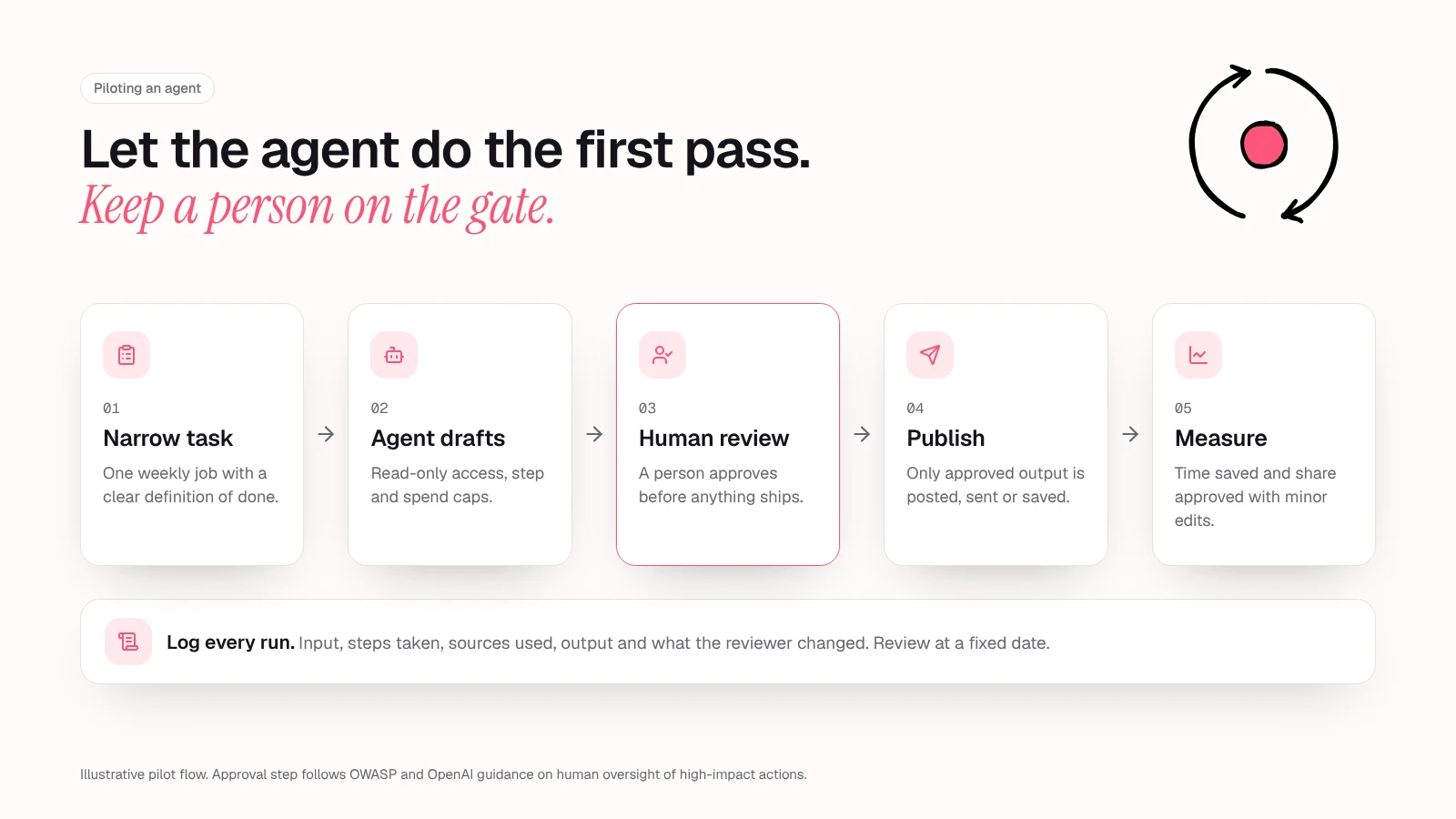
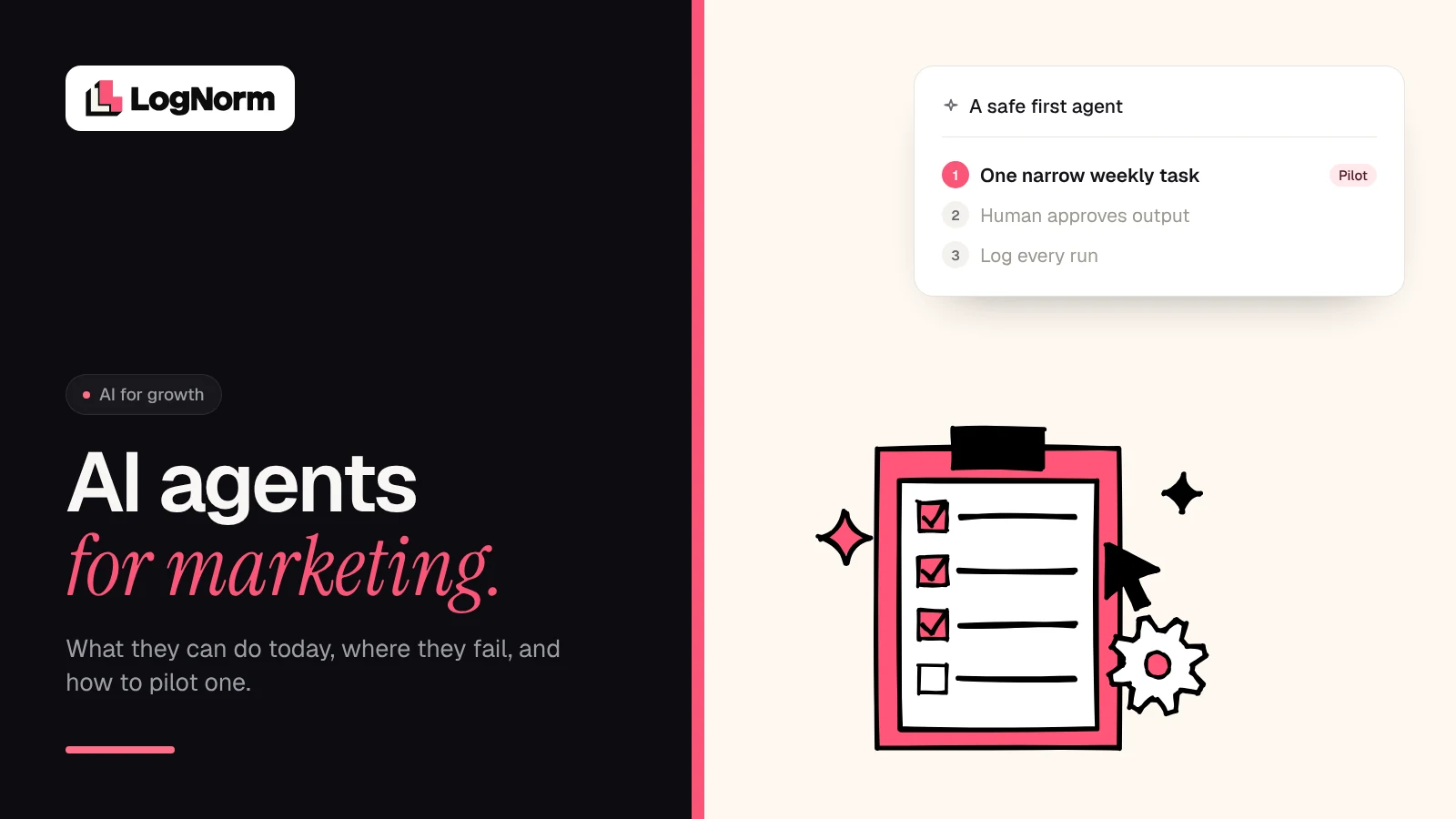
- Pick one narrow, frequent task. Choose something your team does at least weekly, with a clear output, such as the competitor memo or campaign QA. Avoid tasks where a mistake reaches customers directly.
- Write down what "done" looks like. List what a good output contains and what would make you reject it. This becomes your review checklist and the agent's instructions.
- Start read-only. Give the agent access to the data it needs and nothing it can change. Add write access later, one tool at a time, only if the read-only version proves useful.
- Put a human approval step before anything leaves the building. OpenAI's guide says "actions that are sensitive, irreversible, or have high stakes should trigger human oversight until confidence in the agent's reliability grows." In marketing, that means publishing, sending, spending and changing CRM records.
- Log every run. Keep the input, the steps the agent took, the sources it used, the output and what the reviewer changed. Without logs, you cannot tell whether a bad output came from bad data or bad instructions.
- Set stopping conditions. Anthropic recommends agents include "stopping conditions (such as a maximum number of iterations) to maintain control." Cap steps, run time and spend per run.
- Measure time saved and quality. Time the manual task a few times first. During the pilot, record agent run time plus review and fix time. Time saved is the difference, multiplied by how often the task runs. For quality, track the share of outputs approved with no or minor edits, and count errors your reviewer caught.
- Decide at a fixed date. Pick the review date before you start. If the agent saves time and quality holds, widen its scope slightly. If review time eats the savings, use a simpler workflow or drop it.
The review step is not a sign the agent failed. It is the design. An agent that drafts and a person who approves is the setup most teams can defend today, and the logs from that setup are what earn the agent more freedom later. For where agents sit next to tools and automation across the funnel, see our AI for marketing playbook for startups.
FAQ
What are AI agents for marketing?
They are AI systems that pursue a marketing goal by choosing their own steps and using tools such as search, analytics or a CMS. Unlike a chatbot, they complete multi-step tasks like a competitor review without a prompt for each step. The useful ones today draft and recommend, with a person approving.
What are the best AI agents for marketing?
The best agent is the one that fits a specific task you already do often. Judge options on whether they cite sources, whether they can run read-only, whether they log their steps and whether they support approval before any action.
How are AI agents different from marketing automation?
Marketing automation follows steps you define in advance, such as sending an email when a form is filled. An agent decides the steps itself based on what it finds. Use automation when the path is known and an agent when the path changes each time.
Can AI agents replace a marketing team?
Not today. Agents can take on research, monitoring, first drafts and checks, but they make compounding errors, and companies stay responsible for what their AI says, as the Air Canada chatbot ruling showed.
Are AI agents for marketing safe to use?
They are safe enough when scoped tightly. Give them the minimum access they need, require human approval for publishing, sending and spending, and keep logs of every run. OWASP lists excessive agency and prompt injection among the main risks to plan for.
Sources
- Anthropic: Building effective agents (December 2024)
- Anthropic: How we built our multi-agent research system (June 2025)
- OpenAI: A practical guide to building agents (accessed October 2026)
- Gartner: Gartner predicts over 40% of agentic AI projects will be canceled by end of 2027 (June 2025)
- OWASP Gen AI Security Project: LLM06:2025 Excessive Agency (2025)
- OWASP Gen AI Security Project: LLM01:2025 Prompt Injection (2025)
- Google Search Central: Google Search's guidance on using generative AI content on your website (updated October 2026)
- American Bar Association: BC Tribunal confirms companies remain liable for information provided by AI chatbot (February 2024)