AI for marketing: how startups use AI to grow
A practical guide to AI for marketing at startups: where AI drives growth, where it fails, an adoption plan by team size, guardrails and how to measure it.


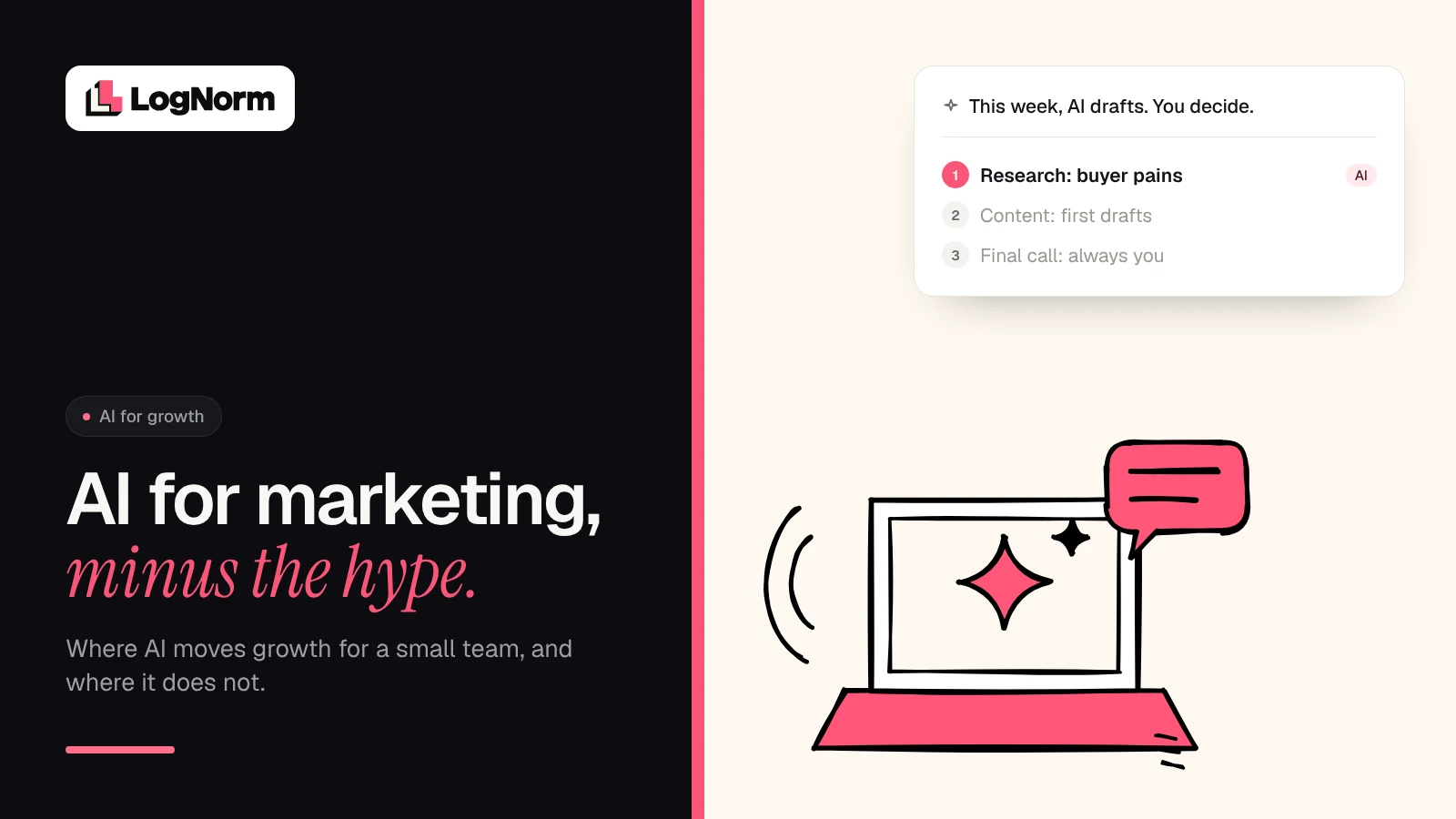
AI for marketing means using machine learning and generative AI to do marketing work: researching customers, producing content, personalising messages, testing ads, improving search visibility, reporting and assisting support and sales. For a startup, the payoff is not "more content". It is a small team doing the work of a larger one, with humans still owning strategy, judgement and the final say.
Almost every marketing team now uses AI somewhere. Far fewer get measurable growth from it. This guide covers where AI moves the numbers for a small team, where it does not, an adoption plan by team size, guardrails and how to measure the impact.
What AI in marketing looks like in 2026
Adoption is no longer the question. HubSpot's 2026 State of Marketing report, based on a survey of more than 1,500 global marketers and published in April 2026, found that 86.4% of marketing teams use AI in at least a few marketing areas, and only 1.7% neither use it nor plan to.
Impact is less even. In the same report, 26.5% of marketers said AI had significantly increased productivity, while 66.2% said it had increased productivity slightly or moderately. McKinsey's The state of AI in 2026, a survey of 1,719 respondents in 97 countries published in August 2026, shows the same gap. Nearly nine in ten respondents report regular use of AI in at least one business function, but only 37% attribute at least some EBIT impact to it. Revenue gains are most often attributed to AI in marketing and sales.
What separates the two groups is not the tools. McKinsey found that nearly three quarters of its "high performers" (just 6% of respondents) had fundamentally redesigned workflows, against about one quarter of everyone else. Bolting a chatbot onto the old process saves hours. Redesigning the process is where growth shows up.
That redesign needs a growth model to sit inside. If your acquisition, activation and retention levers are still unclear, start with our growth marketing playbook for startups, then come back and decide where AI fits.
Where AI genuinely moves growth
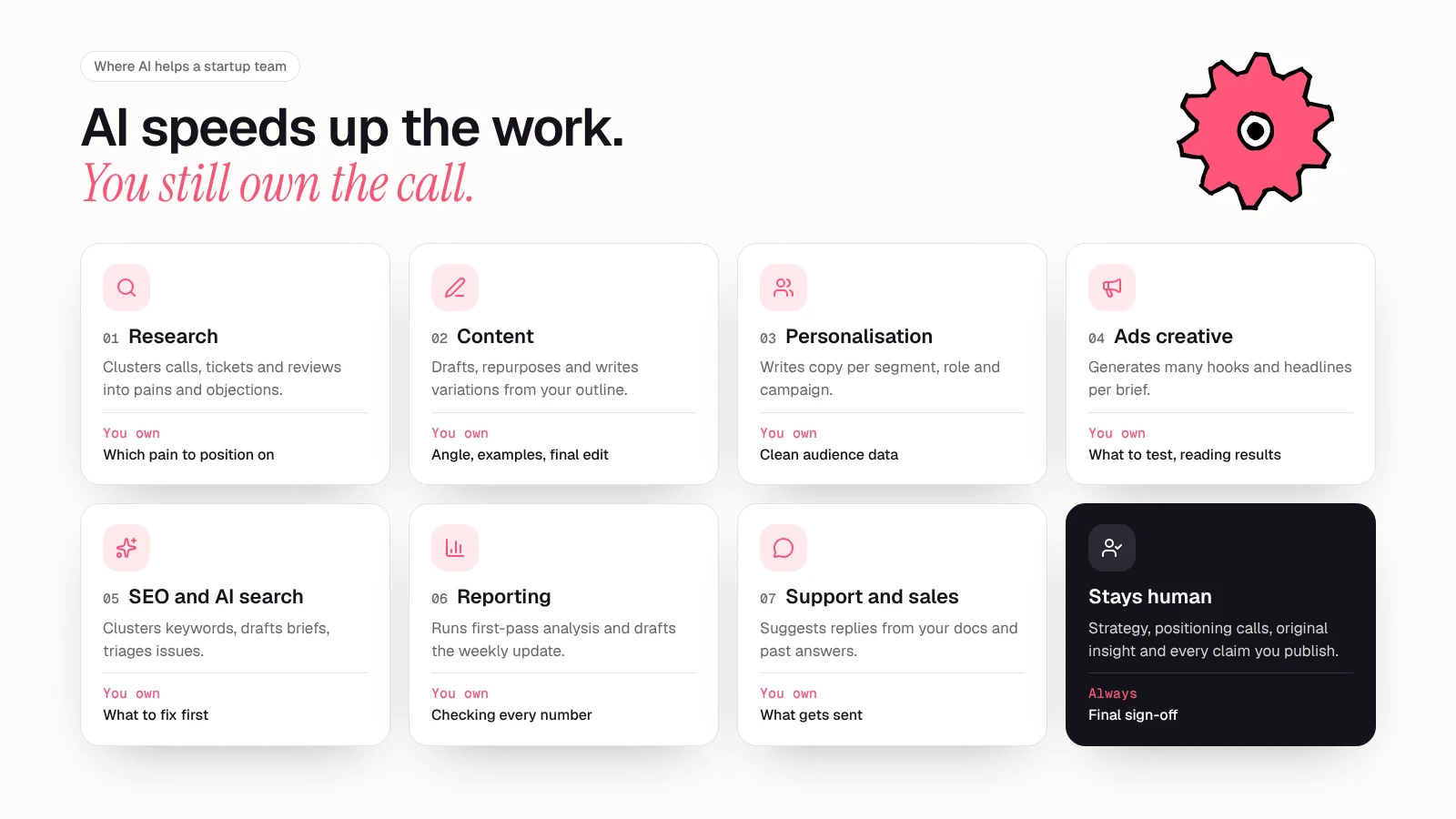
AI is most useful on work that is frequent, pattern-based and easy to check. It is least useful on work that needs new judgement. These are the seven areas where a small team usually sees real gains.
Research and positioning
AI is a fast research assistant. Feed it call transcripts, support tickets, competitor reviews and survey answers, and ask it to cluster the pains, objections and phrases customers repeat. You get a first draft of your positioning inputs in an afternoon.
The decision stays with you. AI can tell you that setup time is the complaint customers repeat most. It cannot tell you whether to build your positioning around it, because that depends on what you can defend against competitors.
Content production, with human review
Drafting is where most teams start. Use AI to turn an outline into a first draft, repurpose a webinar into a post and five social snippets, write variations of an email, or tighten a messy paragraph.
The rule that keeps quality up: a human who knows the subject plans the piece and edits the result. The plan holds the angle, the original examples and the claims you can stand behind. AI fills in the prose. Content that skips the plan reads like everyone else's, because it is built from the same training data as everyone else's.
Personalisation
AI makes segment-level personalisation cheap. A team that used to send one onboarding sequence can now write versions for each role, industry or use case, and adapt landing page copy to the campaign that sent the visitor.
Data is the limit, not writing. Only 65% of marketers in the HubSpot report say they have high-quality audience data. If your CRM fields are empty or wrong, AI personalises confidently in the wrong direction. Fix the data before you scale the copy.
Ads creative testing
AI can generate dozens of headline, hook and image concepts from one brief, so you test more angles per dollar.
Keep humans on two jobs: choosing which concepts are worth testing at all, and reading the results. A creative that wins clicks but attracts the wrong buyer looks good only in the ad account.
SEO and AI search visibility
AI speeds up keyword clustering, briefs, internal linking and technical triage. It also changes where buyers find you. Pew Research Center's study of 68,879 Google searches by 900 US adults in March 2025 found that users clicked a traditional result on 8% of visits when an AI summary appeared, against 15% without one. Ranking is no longer the whole job. You also want to be the source an AI answer cites.
Both sides are covered in our guide to AI SEO for startups and our explainer on generative engine optimization. The hard part for a small team is not knowing the tactics. It is deciding which of fifty possible fixes to do this week. Tools like LogNorm pull site audits, Search Console, keywords, competitors and AI answers together and turn them into a ranked weekly backlog of moves, so the team spends its hours on the highest-value work instead of reading dashboards.
Analytics and reporting
AI is good at the first pass of analysis: summarising a week of campaign data, flagging what changed, writing SQL for a question you would otherwise wait on, and drafting the weekly update.
Check any number it quotes against the source. Models occasionally invent a figure that looks right.
Customer support and sales assist
This is the area with the strongest evidence. In Generative AI at Work, an NBER working paper (April 2023, revised November 2023) studying 5,179 customer support agents, access to an AI assistant raised issues resolved per hour by 14% on average and by 34% for novice and low-skilled workers, with minimal impact on experienced staff. Customer sentiment and employee retention also improved.
The same pattern fits a first sales hire or a founder doing support: AI suggests answers from your docs and past replies, and the person decides what to send.
Where AI does not help (yet)
AI's strengths are uneven, and the edges are hard to see in advance. A preregistered experiment with 758 consultants, Navigating the Jagged Technological Frontier (September 2023), found that on 18 tasks within AI's capabilities, people using AI completed 12.2% more tasks and finished 25.1% more quickly, with better quality. On a complex task chosen to sit outside those capabilities, people using AI were 19% less likely to produce a correct solution than those without it.
That second number is the warning. AI fails confidently, often on the problems that matter most. In marketing, keep these with humans:
- Strategy and positioning calls. Which market to enter, which segment to ignore, what to say no to.
- Original insight. Your data, your customer stories, your point of view. AI can only remix what already exists.
- Claims and numbers. Anything a customer, journalist or regulator might check.
- Final sign-off. Someone with a name is accountable for everything that ships.
Tools, agents and automation: choosing your building blocks
Once you know which jobs to hand to AI, there are three ways to do it. Most teams adopt them in this order.
AI tools for marketing
Tools are the starting point: a chat assistant, a writing tool, an image generator, an SEO platform. Each speeds up a task a person still runs. Our guide to the best AI tools for marketing walks through the main categories and how to choose between them, so you buy for a workflow instead of collecting subscriptions.
AI marketing automation
Automation connects steps that happen the same way every time: a new lead is enriched, scored and routed, or a published post is cut into social snippets and queued. AI adds judgement to rules-based flows, such as classifying intent or drafting the first reply. Our guide to AI marketing automation covers which workflows are worth automating first and where a human approval step belongs.
AI agents for marketing
Agents go a step further: you give them a goal, and they plan and carry out several steps with tools, such as researching a competitor and drafting a brief. They are the most powerful option and the easiest to get wrong. Our explainer on AI agents for marketing covers what agents can reliably handle, where they still need supervision and how to scope a first one.
An AI adoption plan by team size
The right starting point depends on how many people you have. Start where the hours go.
| Team size | Start with | Add next | Who owns AI quality |
|---|---|---|---|
| Solo founder | One general assistant for research, drafting and reporting | SEO and AI visibility tracking, one automation for lead follow-up | The founder, with a written checklist |
| 2 to 5 people | Shared prompts and brand voice guide, AI-assisted content with a named editor | Ad creative testing, support reply suggestions | A named editor for content, an owner per workflow |
| 6 to 15 people | Redesign one full workflow end to end, such as content or lead handling | Agents for scoped research or ops tasks, AI in reporting | A workflow owner plus a simple review and audit log |
Whatever your size, roll it out in three phases.
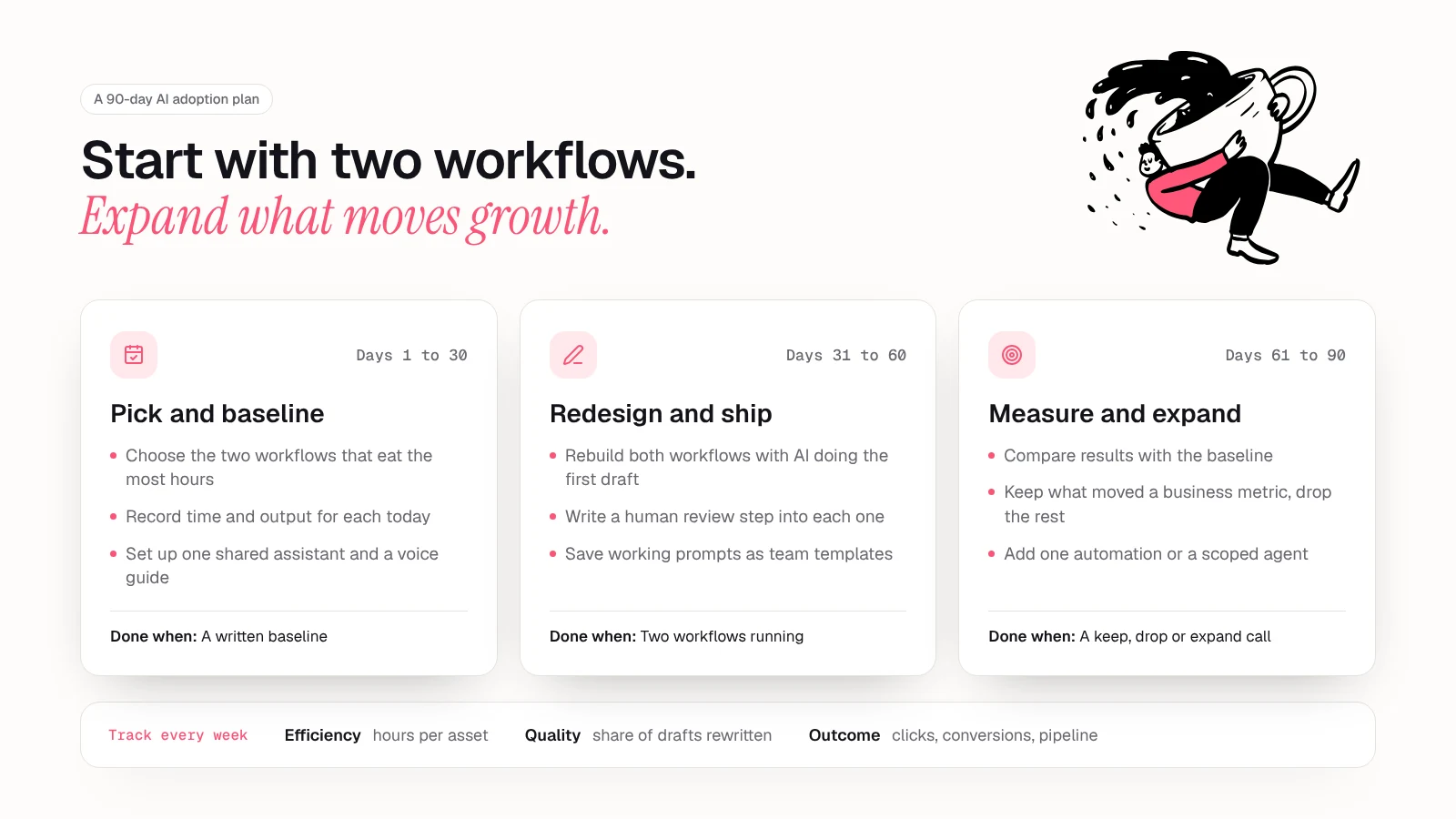
- Days 1 to 30: pick and baseline. Choose two workflows that eat the most hours. Write down how long each takes today and what it produces. Set up one shared assistant, a brand voice guide and a short list of what must always be human-reviewed.
- Days 31 to 60: redesign and ship. Rebuild those two workflows around AI, with a human review step written in. Save working prompts as team templates and track hours against your baseline weekly.
- Days 61 to 90: measure and expand. Keep what moved a business metric, drop what only felt fast, and add one automation or a scoped agent. Then pick the next workflow.
Guardrails: accuracy, brand voice, disclosure and privacy
Guardrails let a small team move fast without a cleanup project later. Four matter most.
Accuracy
Google's own guidance on generative AI content puts it plainly: generative models "don't retrieve facts, but predict a likely sequence of words," so outputs may contain inaccuracies. It calls it "critical to manually factcheck and review all AI-generated content for accuracy and trustworthiness before publishing," including titles, meta descriptions, structured data and image alt text. Apply the same standard to emails, ads and sales collateral.
Brand voice
AI drifts toward the average voice of the internet. Write a one-page voice guide with words you use, words you avoid and three example paragraphs, give it to every tool, and have one editor read for voice before anything ships.
Disclosure and search quality
Google does not penalise content for being made with AI. Its February 2023 guidance on AI-generated content says its focus is "on the quality of content, rather than how content is produced," and adds: "Using AI doesn't give content any special gains. It's just content." It suggests AI or automation disclosures where readers might reasonably ask "How was this created?"
The line you must not cross is volume for its own sake. Google's spam policies define scaled content abuse as "when many pages are generated for the primary purpose of manipulating search rankings and not helping users", whatever tool produced them.
Privacy
Know what your tools do with what you paste in. OpenAI's enterprise privacy page, for example, says it does not train its models on data from ChatGPT Business, ChatGPT Enterprise or its API platform by default. Check each tool's terms before customer data or CRM exports go into it, and keep personal data out of unapproved tools.
How to measure the impact of AI on marketing
Measure AI like any growth investment: against a baseline, on the metric the business cares about. HubSpot found 67.5% of marketers now say they know how to measure AI impact, up from 48% in 2025. The common mistake is stopping at time saved.
Track three layers, and only call a workflow a win when the third one moves.
| Layer | What to track | Example metric |
|---|---|---|
| Efficiency | Time and cost per unit of work | Hours per published post, days from brief to launch |
| Quality | Whether output holds up | Share of drafts needing major rewrites, errors caught in review |
| Outcome | Whether growth changed | Organic clicks and AI citations, conversion rate, qualified pipeline, cost per acquired customer |
Three rules keep the numbers honest:
- Record the baseline first. Without "before" numbers, every result looks like a win.
- Compare like with like. Measure AI-assisted pages or campaigns against similar ones made the old way, over the same period.
- Give it enough time. Ads show results in days. Check content and SEO work at about one and three months.
If time saved turns into more output but no outcome moves, you have made noise cheaper.
FAQ
How is AI used in marketing?
AI is used to research customers and competitors, draft and repurpose content, personalise emails and pages, generate ad variations, speed up SEO work, summarise performance data and suggest replies in support and sales. HubSpot's 2026 survey lists content creation first among the most popular uses.
How can a startup use AI for marketing with a small team?
Pick the two workflows that take the most hours, record how long they take today, and rebuild them with AI doing the first draft and a person doing the review. Measure against your baseline for 60 to 90 days before adding more tools or agents.
Will AI replace marketers?
Not on current evidence. In HubSpot's 2026 survey, 73.4% of marketers said they see AI working in conjunction with marketers, assisting with most of their duties. AI takes over repetitive production, which raises the value of strategy and judgement.
Is AI-generated content bad for SEO?
No, not by itself. Google says it rewards helpful, high-quality content however it is produced. What it penalises is generating many low-value pages mainly to manipulate rankings, which its spam policies call scaled content abuse.
How do I measure the ROI of AI in marketing?
Set a baseline for time, cost and results before you start. Then track efficiency, quality and business outcomes such as pipeline or acquisition cost, and only count the workflow as a win when the outcome metric moves.
Sources
- HubSpot: 2026 state of marketing: Data from 1,500+ global marketers (April 2026)
- McKinsey & Company: The state of AI in 2026: On the road to ROI (August 2026)
- Pew Research Center: Google users are less likely to click on links when an AI summary appears in the results (July 2025)
- NBER: Generative AI at Work (November 2023)
- SSRN: Navigating the Jagged Technological Frontier: Field Experimental Evidence of the Effects of AI on Knowledge Worker Productivity and Quality (September 2023)
- Google Search Central: Google Search's guidance on using generative AI content on your website (October 2026)
- Google Search Central: Google Search's guidance about AI-generated content (February 2023)
- Google Search Central: Spam policies for Google web search (August 2026)
- OpenAI: Enterprise privacy at OpenAI (January 2026)