Growth loops: how startups build growth that compounds
What a growth loop is, how it differs from a funnel, the five main loop types with real examples, and how to map, measure and speed up your own loop.


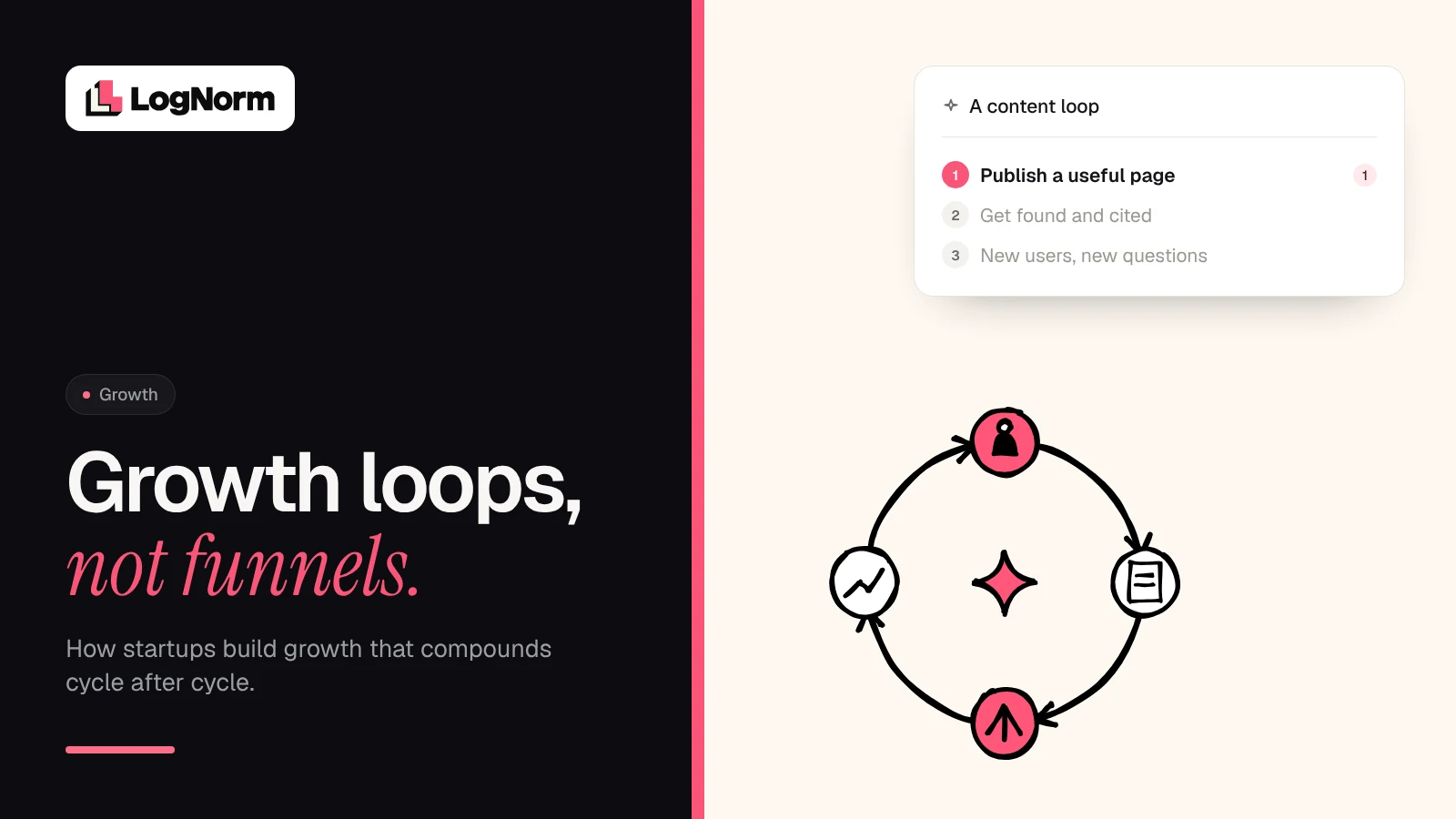
A growth loop is a system where the output of one cycle becomes the input of the next: new users create content, invites or revenue that bring in more new users. Unlike a funnel, which ends at the sale, a loop reinvests what comes out the bottom back into the top, so each cohort helps produce the next one. That is why loops compound and funnels do not.
Most startups still plan growth as a funnel: spend at the top, plug leaks in the middle, then refill the top with more spend. It works, but it never gets easier. A loop makes each new customer help bring in the next.
This post is part of our growth marketing playbook for startups. Here we cover the main loop types, real examples, and how to map and measure your own.
What is a growth loop?
The most cited definition comes from Reforge. In its 2018 essay Growth Loops are the New Funnels, Brian Balfour, Casey Winters, Kevin Kwok and Andrew Chen define loops as "closed systems where the inputs through some process generates more of an output that can be reinvested in the input."
Every loop has an input (a new user, a page, a dollar of revenue), a process (what that input does), and an output that feeds back in as the next input.
The useful question a loop forces, in Reforge's words, is "How does one cohort of users lead to another cohort of users?" If you cannot answer that, you do not have a loop. You have a funnel with a budget attached.
Growth loops vs funnels
Reforge lists three problems with running a company on funnels: they put product strategy and acquisition strategy in separate silos, they push marketing, product and sales to optimise against each other, and they run in one direction, with "no concept of how to reinvest what comes out at the bottom to get more at the top."
| Funnel | Growth loop | |
|---|---|---|
| Shape | Linear, top to bottom | Circular, output feeds input |
| Ends at | A conversion or sale | The next cycle's input |
| Growth per unit of effort | Flat: more output needs more input | Compounding: each cycle adds to the next |
| Who owns it | Split across marketing, product, sales | One system that crosses teams |
| Main question | Where are we leaking users? | How does this cohort produce the next one? |
| Main metrics | Stage conversion rates | Conversion per step and time per cycle |
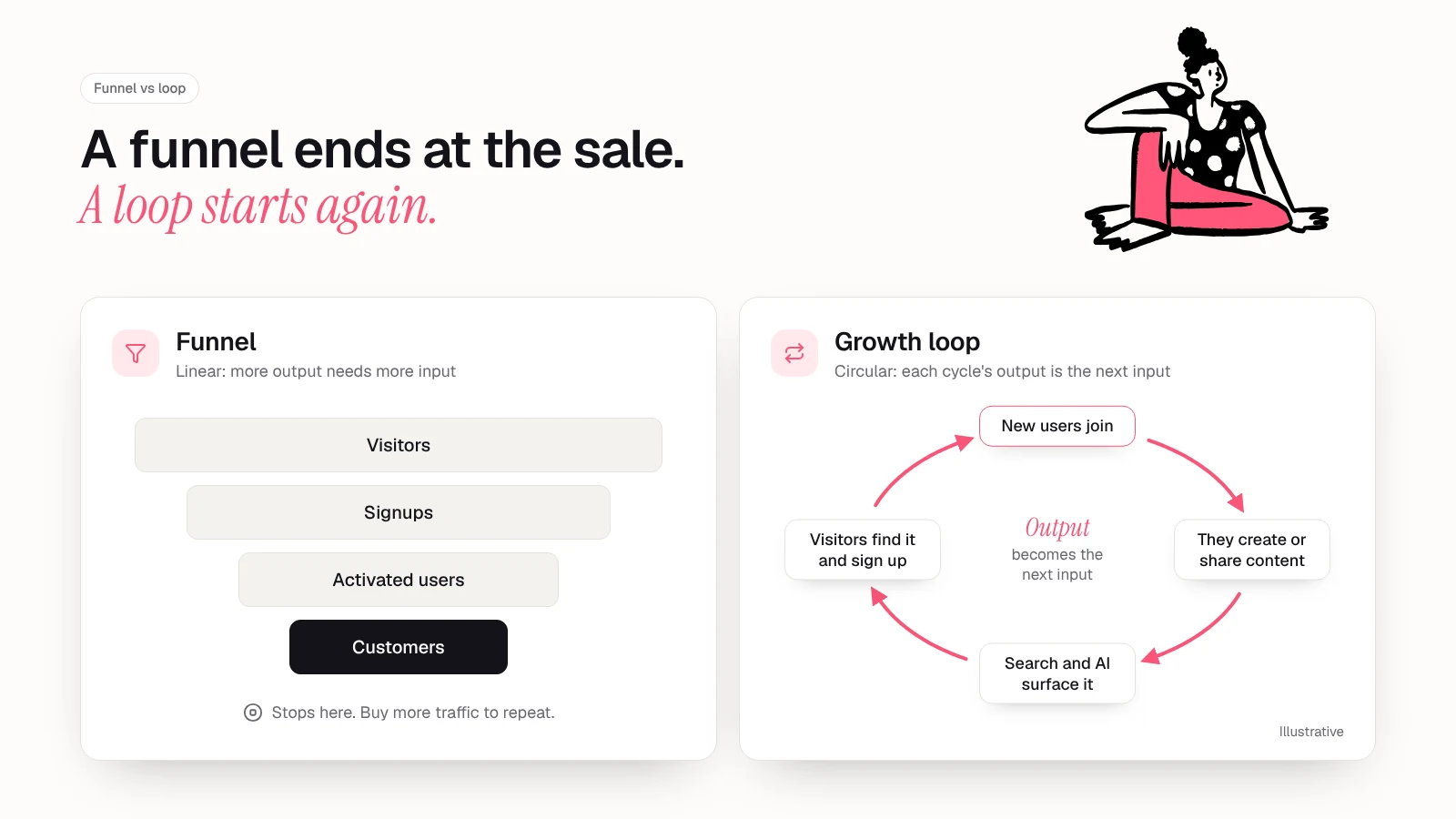
Funnels are not useless: each step of a loop still has a small funnel inside it. But Reforge's point is that "the fastest-growing products are better represented as a system of loops, not funnels."
Growth loops vs the marketing flywheel
HubSpot's flywheel model also replaces the funnel, with three stages (attract, engage, delight), arguing that "the funnel has one major flaw: it views customers as an afterthought, not a driving force." Treat the flywheel as the idea and a loop as the working mechanism: a loop names each step, its output and its metric.
The five main types of growth loops
Reforge describes loops for acquisition, retention, defensibility and efficiency. For a startup chasing new customers, five acquisition loops cover most cases.
1. Content and SEO loops
Your team publishes content, search engines and AI assistants surface it, readers sign up, and what you learn from them (plus the revenue they bring) funds the next round. Most B2B startups can start this loop now, because it needs no network effect and no ad budget. Its weakness is speed: indexing and ranking take time, so each cycle is slow. Our guide to SEO for startups covers the groundwork.
2. User-generated content loops
Here your users create the content. Reforge maps Pinterest's loop in five steps: a user signs up or returns, they find relevant content, they save or repin it (which gives Pinterest quality signals), Pinterest distributes that content to search engines, and a new user finds it through search and signs up or returns.
Casey Winters, who led growth at Pinterest and Grubhub, told First Round Review that "neither Pinterest nor Grubhub employees were primarily responsible for driving the content value or volume, as the demand and supply sides of their products took care of it." The same piece reports Pinterest had 40 million active users when Winters arrived and later passed 200 million. UGC loops scale beyond what any content team can write, but only when the product naturally produces something public and useful.
3. Viral and referral loops
A user invites or exposes someone else, who signs up and does the same. Referral loops add an incentive. Dropbox is the classic example: its help center states that Basic users earn 500 MB of space for each friend they refer, up to 16 GB, and that both the referrer and the friend receive bonus space.
The best viral loops are built into the product, which is why they sit at the heart of product-led growth: a shared doc or a public project shows the product to people who never saw an ad. Winters is blunt about the limits: "a viral loop is very hard to execute, because your product or your content has to be extremely gripping."
4. Paid loops funded by revenue
A paid loop turns revenue back into acquisition. Winters describes it this way: "When a business can quantify the revenue captured from a user signup and reinvest a certain amount back into the Google AdWords or Facebook ads, that can be an effective way to go after growth."
It holds only while each customer pays back more than they cost to acquire, fast enough for your cash to survive. Winters also warns that "unless there is a core network effect inside of a product, paid acquisition is a race to the bottom over time."
5. Sales loops
Sales loops are the B2B version of a paid loop. In Winters' description, "when a high-value contract is signed with a customer, the profit is reinvested into growing the sales team, with the idea being that as the sales team expands and learns how to sell more effectively, more contracts will come in." It only works when contracts are large enough to pay for the people who close them.
| Loop type | Input | Output that feeds back | Works best when | Main constraint |
|---|---|---|---|---|
| Content and SEO | Pages you publish | Readers, signups, search data | Buyers research before they buy | Slow cycle time |
| User-generated content | Content users create | Public pages that bring new users | The product produces shareable public output | Needs volume and quality control |
| Viral and referral | Active users | Invites and exposure to new users | Using the product involves other people | Hard to sustain alone |
| Paid | Revenue | Ad spend that buys new customers | Payback is fast and predictable | Rising ad costs |
| Sales | Contract profit | More sales capacity | Contract values are high | Hiring and ramp time |
You do not need all five. Reforge found that "the fastest growing products are typically powered by 1-2 major loops that transition over time." Pick the one that fits how buyers find tools like yours.
How to map your own growth loop
The goal is a diagram where every arrow has a number on it.
- Pick one loop. Start with the channel that already brings most new users. Reforge warns that "you'll be tempted to draw a ton of loops for your product."
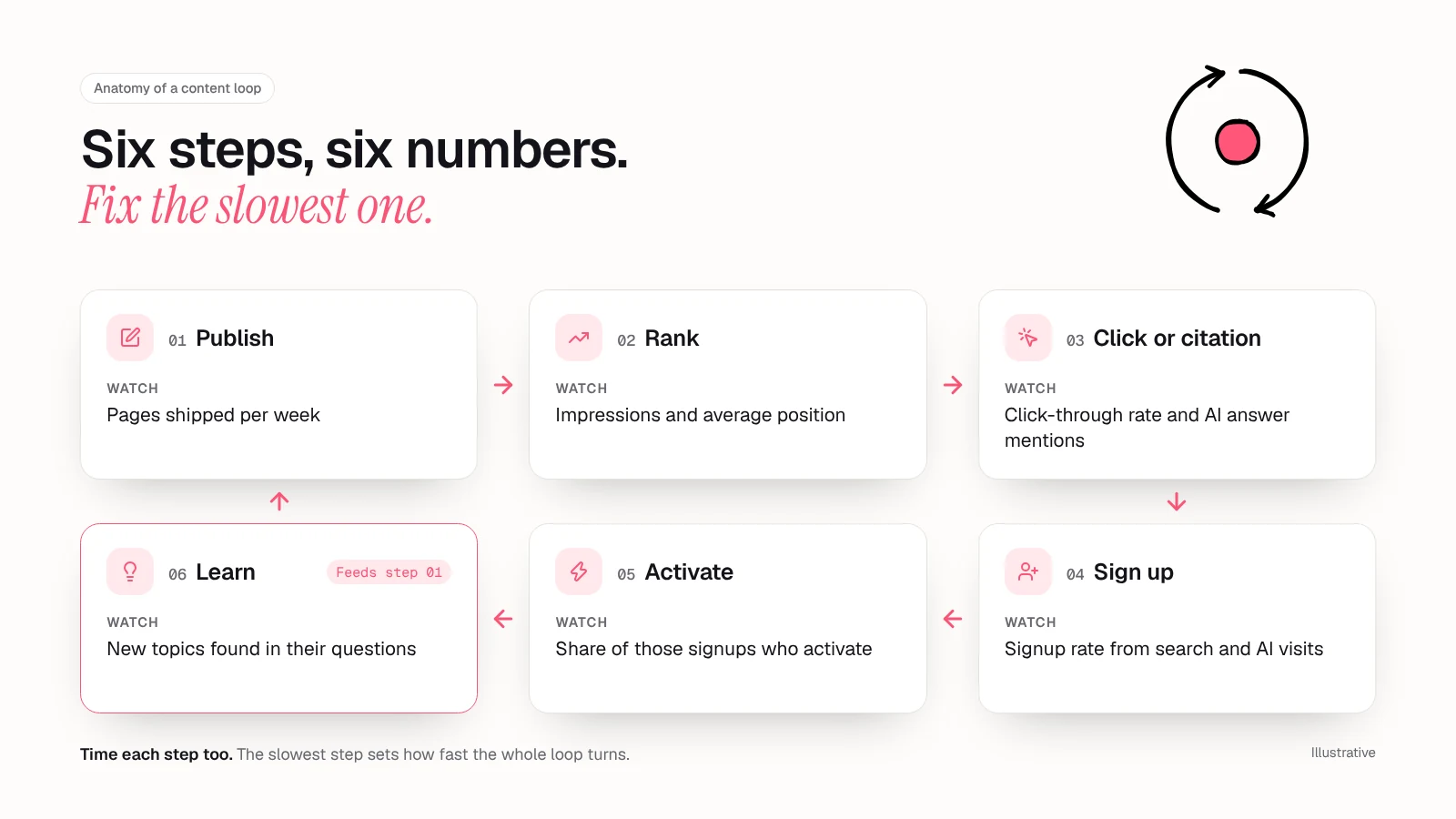
- Write each step as an action. For a content loop: publish, rank, get clicked or cited in an AI answer, sign up, activate, and surface new topics.
- Attach one metric to each step. Pages per week, impressions, click-through rate, signup rate, activation rate, new topics found.
- Mark where the output re-enters. For a content loop, it is new topics plus the revenue that pays for writing them. If nothing re-enters, it is a funnel.
- Find the bottleneck. The step with the weakest conversion or the longest delay caps the whole loop. Fix that one first.
- Tie it to one outcome. Judge the loop by the number the company steers by, your North Star metric, not pageviews.
How to measure loop speed and conversion
A loop has two dials: how much of the input survives each step (conversion) and how long one full cycle takes (cycle time). Most teams watch only the first.
Loop conversion. Multiply the conversion rates of every step. One weak step drags the whole product down, which is why the bottleneck matters more than the average. For viral loops, David Skok's viral marketing guide gives the classic version: the viral coefficient equals invitations sent per user multiplied by the conversion rate of those invitations.
Cycle time. Measure the median time from a new input entering the loop to its output re-entering. Skok argues that "the most important factor to increasing growth is not the Viral Coefficient, but the Viral Cycle Time (ct) which should be made as short as possible." His worked example shows why: with the same viral coefficient, a two-day cycle produces 20,470 users after 20 days, while a one-day cycle produces over 20 million.
There is no reliable public benchmark for a good content loop, so judge against yourself. Group users by signup week, count what each cohort generated, and time each step separately: for a content loop, time to index and first ranking usually dominate; for a referral loop, time from signup to first invite.
How AI search changes content loops
Content loops used to have a simple middle: rank, get the click. AI answers now sit in between and can absorb it.
In a Pew Research Center study of 68,879 Google searches by 900 US adults in March 2025, users who saw an AI summary clicked a traditional result on 8% of visits, against 15% when no summary appeared. They clicked a link inside the summary on 1% of visits. The click step leaks more than it used to, so a loop that only counts clicks can look broken while your content is still being read and cited.
Three changes keep a content loop working:
- Add a citation step to your map. Track whether your pages are named or linked in AI answers to your buyers' questions. A mention is exposure even without a click.
- Keep the basics. Google's guidance on AI features and your website says there are "no additional requirements to appear in AI Overviews or AI Mode", beyond a page being indexed and eligible to show with a snippet. Traffic from those features is counted in the Search Console Performance report under the Web search type.
- Write content worth citing. The GEO paper by Aggarwal and colleagues tested ways of optimising content for generative engines and found they can boost visibility "by up to 40%" in generative engine responses, with results that vary by domain.
As we argue in distribution is the new moat, being the name an assistant suggests is now part of distribution itself.
Run the content loop on a weekly cadence
A content loop compounds only if it turns on a fixed rhythm: find opportunities, rank them, plan, write, publish, check results. Tools like LogNorm run this as a weekly loop of Discover, Rank, Plan, Create, Publish and Measure, checking results at 28 and 90 days and tracking whether you are recommended in ChatGPT, Gemini and Google AI Overviews.
Whatever you use, the test is the same: does this cycle's output become next cycle's input? For the wider plan these loops sit inside, see our growth marketing playbook.
FAQ
What is a growth loop in marketing?
A growth loop is a closed system where the output of one cycle, such as new users, content or revenue, is reinvested as the input of the next cycle. Because each cohort helps produce the next, growth compounds instead of needing fresh spend every cycle.
What is the difference between growth loops and funnels?
A funnel is linear: it starts with traffic and ends at a conversion, and more output requires more input. A growth loop is circular: its output, like content or referrals, feeds back into the top.
What are some examples of growth loops?
Pinterest's user-generated content loop, where saved pins are distributed to search engines and bring in new users, is the example Reforge maps in detail. Dropbox's referral program, which gives both the referrer and the friend bonus storage, is a classic viral loop. Paid loops reinvest revenue in ads, and sales loops reinvest contract profit in more salespeople.
Is a marketing flywheel the same as a growth loop?
Not quite. HubSpot's flywheel is a company-wide model (attract, engage, delight) built on momentum from happy customers. A growth loop is narrower: it names each step, its metric and what feeds back.
How do you measure a growth loop?
Measure two things: conversion at each step and cycle time, the time for one full turn of the loop. Multiply the step conversion rates for overall loop conversion, find the weakest or slowest step, and compare cohorts against your own history.
Do growth loops work for B2B startups?
Yes. Content, sales and product-led viral loops all work in B2B. Many start with a content loop because it needs no network effect or large budget.
Sources
- Reforge: Growth Loops are the New Funnels (July 2018)
- First Round Review: Pinterest and Grubhub's Former Growth Lead on Building Content Loops (August 2018)
- For Entrepreneurs (David Skok): Lessons Learned, Viral Marketing (December 2009, updated February 2017)
- Dropbox Help: How much free referral space can I earn? (October 2026)
- HubSpot: The Flywheel Model (October 2026)
- Pew Research Center: Google users are less likely to click on links when an AI summary appears in the results (July 2025)
- Google Search Central: AI features and your website (December 2025)
- arXiv: GEO: Generative Engine Optimization (November 2023, revised June 2024)