Distribution is the new moat: how AI changed the rules
AI made building software cheap for everyone. Here is why distribution is now the moat that protects a business, and how to build one.


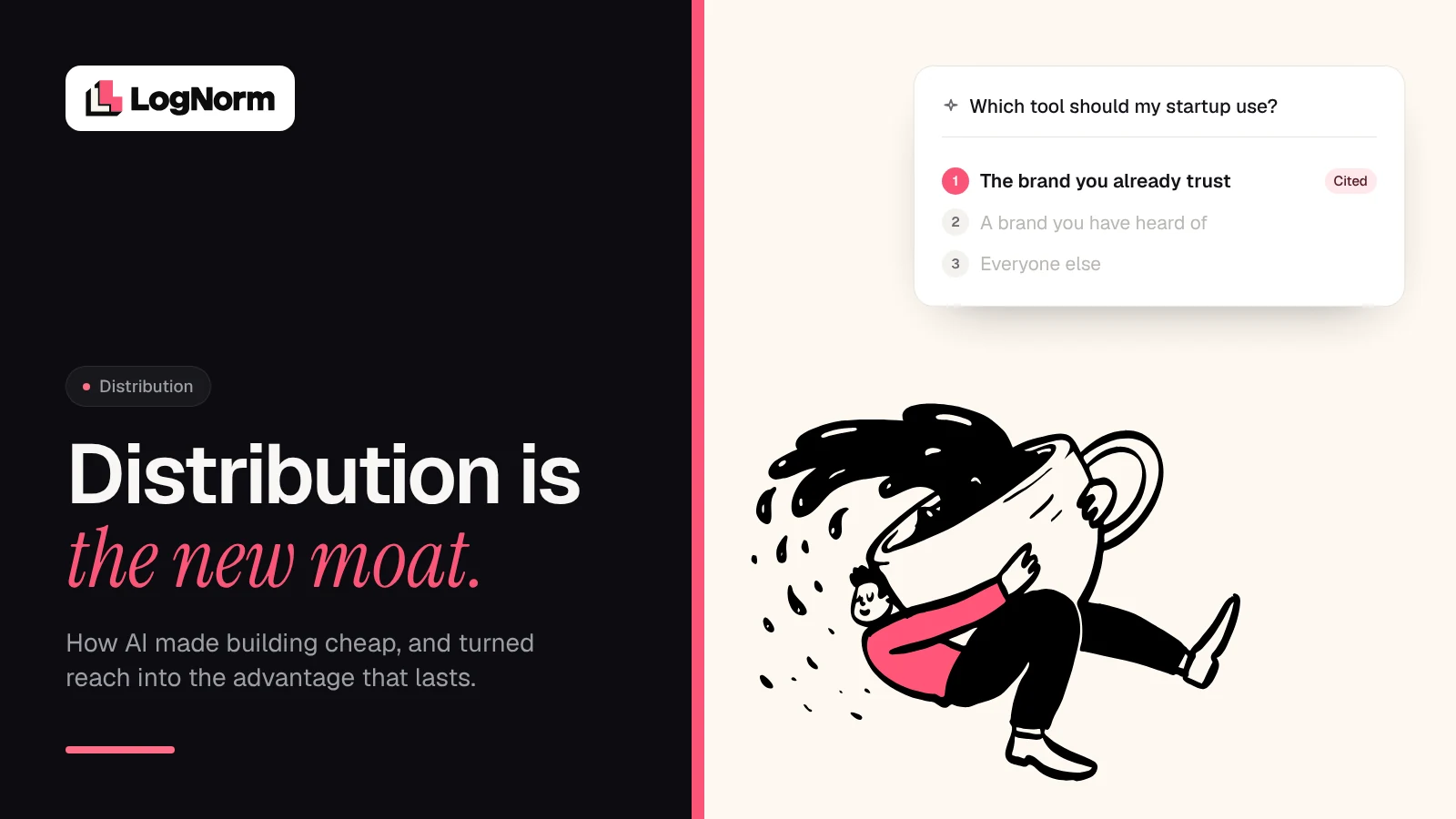
When anyone can build your product in a weekend, the only thing that protects you is who already listens to you.
For two decades, startup advice repeated a familiar line: build something people want, and the rest follows. Product was the hard part. Engineering talent was scarce, software took quarters to ship, and a well-built feature set could hold off competitors for years.
AI broke that equation. Coding agents, open-weight models and AI app builders have pushed the cost of shipping software toward zero. A two-person team can now clone the core of a funded SaaS product in days. When building is cheap and fast for everyone, building stops being a differentiator.
What stays scarce is attention: the trust of a buyer, a slot in their workflow, a spot in the answer when they ask an AI what to use. That is distribution. And in the AI era, it has become the moat.
The old moats are leaking
Most classic software moats depended on one assumption: building is slow and expensive. AI is removing that assumption, and the moats that rested on it are thinning.
| Classic moat | Why it worked | What AI changed |
|---|---|---|
| Proprietary code | Years of engineering were hard to copy | Coding agents reproduce standard features in days |
| Feature depth | A long roadmap kept rivals behind | Rivals ship the same features in weeks, often in parallel |
| Technical talent | Strong engineering teams were scarce | Small teams with AI tools match the output of large ones |
| Switching costs | Data and workflows were painful to move | AI handles migration, mapping and onboarding |
| UX polish | Good design took craft and time | AI design tools and component libraries close the gap fast |
The change is visible in how startups are built. In March 2025, Y Combinator CEO Garry Tan said that for about a quarter of the Winter 2025 batch, 95% or more of the code was written by AI. His takeaway for founders: you no longer need 50 or 100 engineers to build a product.
That is great news for builders and bad news for anyone whose defense was "it would take them too long to copy us." Some moats survive, such as network effects, regulatory licenses and truly proprietary data. But for most software products, the gap between "idea" and "working competitor" has collapsed.
The economics: supply exploded, attention did not
AI made software supply nearly unlimited, but buyer attention stayed fixed. That mismatch is the whole story.
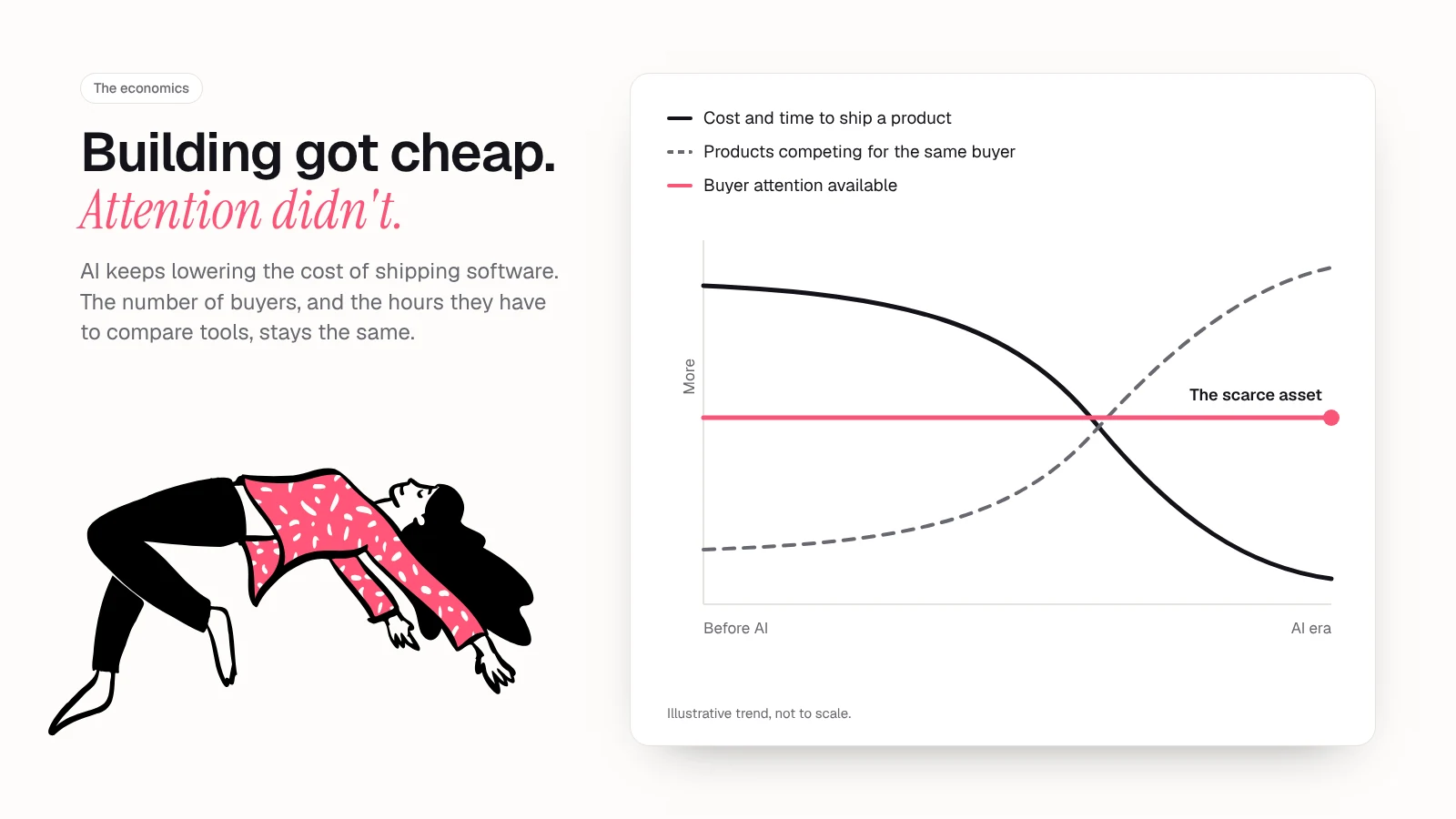
Think of any category on a buyer's shortlist: CRMs, note-taking apps, AI writing tools, analytics dashboards. Five years ago, a buyer might compare five credible options. Today there can be fifty, many launched in the last six months, most with similar features and similar landing pages. The buyer's time, trust and budget did not grow to match.
This produces three effects:
- Features commoditize. When every product can ship the same capability, features stop being a reason to choose one over another.
- Customer acquisition costs rise. More companies bid for the same ad slots, inboxes and search results. Paid channels get crowded and expensive.
- Trust becomes the tiebreaker. Faced with fifty lookalike tools, buyers default to what they already know, what a peer recommended, or what an AI assistant suggested.
In economics, value flows to whatever is scarce. When code was scarce, value flowed to builders. Now that code is abundant, value flows to whoever controls access to the customer.
The evidence: distribution keeps winning
The clearest proof is how AI products themselves reached users. The winners were often not the best models, but the ones placed in front of the most people.
Incumbents turned existing reach into instant AI adoption
- Meta AI reached 1 billion monthly active users by May 2025, double its September 2024 figure. It got there by sitting inside WhatsApp, Instagram, Facebook and Messenger, apps people already open every day.
- Google put AI Overviews on top of search results. By Q2 2025, Sundar Pichai reported over 2 billion monthly users across 200+ countries. No standalone AI product could match that reach on day one.
- Microsoft showed the pattern earlier with Teams. Slack complained to the EU in 2020 that bundling Teams into Office gave it an edge. In September 2025, the European Commission accepted Microsoft's commitments to unbundle Teams, after finding the bundle gave it an "undue competitive advantage in terms of distribution." The same playbook now powers Copilot inside Microsoft 365.
In each case, the product did not need to win a head-to-head comparison. It only needed to be the default where users already were.
Startups that won built distribution, not just product
New AI companies have broken through too, but rarely on product alone.
- ChatGPT was first to make AI feel personal and useful, then turned that head start into a habit. OpenAI reported more than 900 million weekly active users in February 2026. That user base is now a distribution channel of its own, for apps, shopping and agents built on top.
- Lovable, the AI app builder, reached $100M ARR eight months after hitting $1M, announced in July 2025. Its users had built more than 10 million projects. Every app shared on the open web carried the product's name to new people.
The pattern: the AI startups that broke out treated distribution as a product feature. Usage created content, content created attention, and attention created more usage.
Distribution itself is being rebuilt by AI
AI did not just make distribution more valuable. It changed where distribution happens. The channels marketers relied on for 20 years are being rewired.
Search is turning into answers. A Pew Research study of 68,879 Google searches by 900 US adults in March 2025 found:
- Users clicked a traditional result on 8% of visits when an AI summary appeared, versus 15% without one.
- Users clicked a link inside the AI summary on just 1% of visits.
- Sessions ended on 26% of pages with an AI summary, versus 16% without.
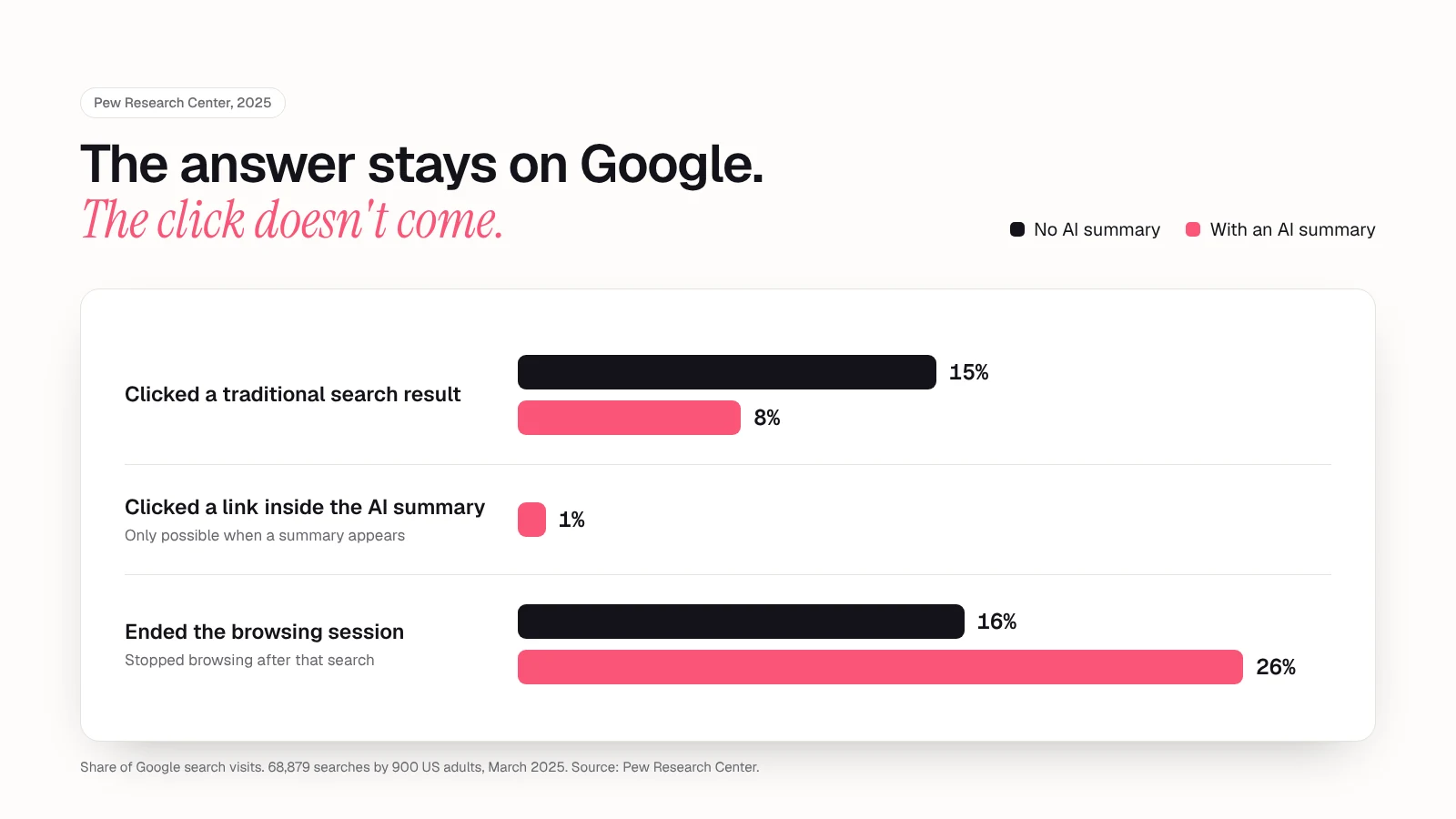
The user still gets an answer. The brand that supplied the information often gets nothing, unless it is named in that answer.
AI assistants are the new front door. With ChatGPT near a billion weekly users, a growing share of "what should I use for X?" questions never touch a search results page. The assistant gives a shortlist of two or three names. If you are not on it, you are not considered.
Discovery is moving from ranking to being cited. In classic SEO, ten blue links meant ten chances. In AI answers, there may be one recommendation. That makes visibility more winner-take-most, and it rewards brands that models already know and trust: the ones mentioned across reviews, forums, comparisons, docs and media.
This is why distribution is both more important and harder to fake. You cannot buy your way into an AI's answer the way you can buy a keyword. You earn it through a broad, consistent footprint across the web.
The six distribution moats that matter now
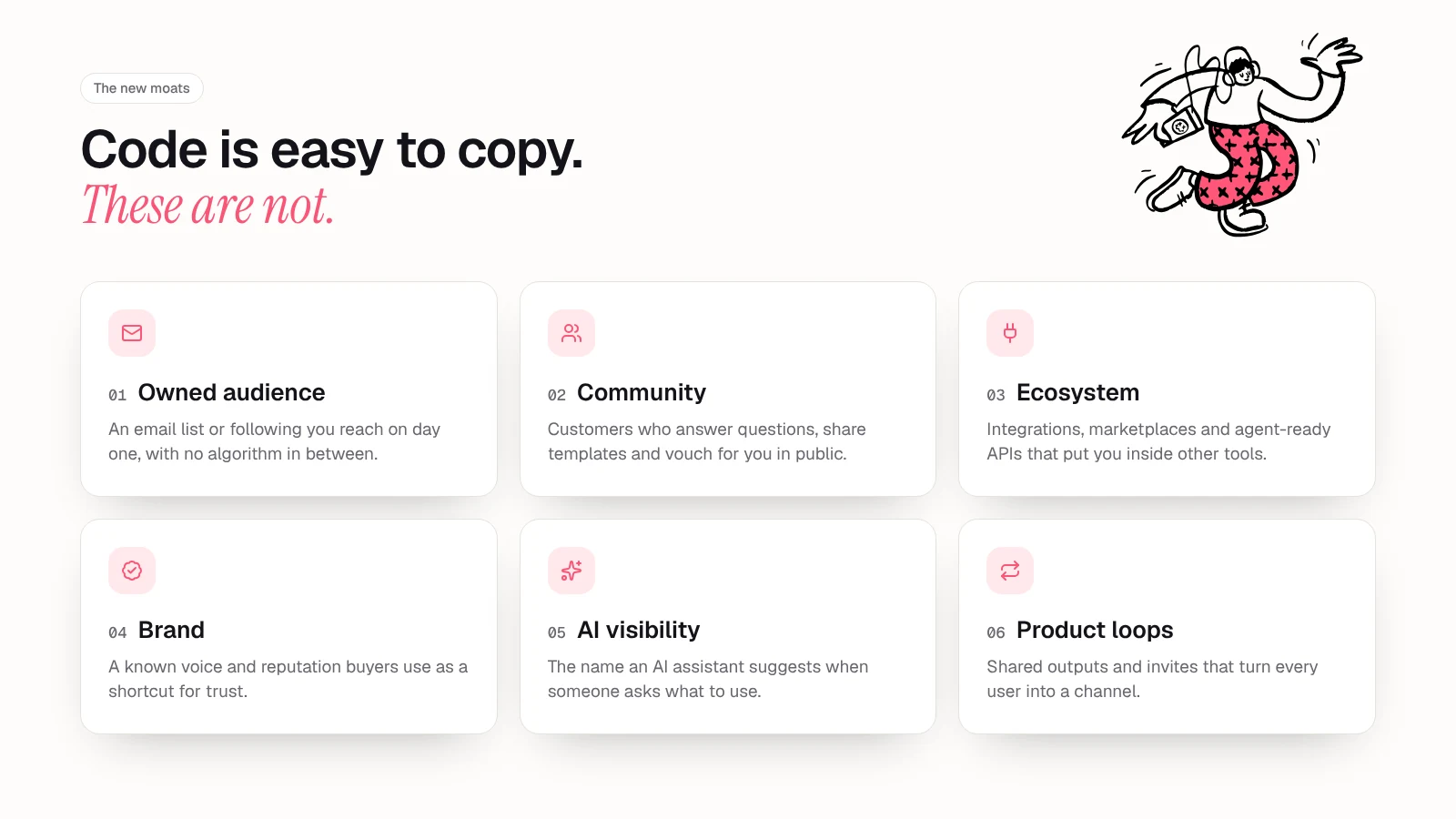
A distribution moat is any advantage in reaching customers that a competitor cannot copy by writing code. Six types stand out in the AI era.
1. An owned audience
An email list, a newsletter, a podcast, a founder with a real following. Owned audiences do not depend on an algorithm or an ad auction. When you launch, you reach people on day one at near-zero cost. A competitor can clone your product in a week; it cannot clone 50,000 people who open your emails.
2. Community
A community turns customers into a channel. Users answer each other's questions, share templates, write tutorials and defend the product in public threads. Those same forums and threads are what AI models learn from and cite. Community creates both trust and training data.
3. Ecosystem and integrations
Being embedded in the tools customers already use is the modern bundle. Integrations, marketplace listings, plugins and partnerships put you where work happens. Increasingly, this includes being callable by AI agents: an API, an MCP server or an app inside ChatGPT. If agents can use you, they can recommend you.
4. Brand
When products look the same, brand is how buyers choose. Brand is a shortcut for trust: a known point of view, a consistent voice, a reputation for quality. It compounds slowly, which is exactly why it is hard to copy.
5. AI visibility
This is the newest moat: being the name an AI assistant suggests when someone asks for a solution. The practice of earning it has a name, generative engine optimization. It is built from mentions across trusted sources, clear and structured content, comparisons, reviews and real third-party discussion. Brands that show up early in AI answers get recommended, then mentioned more, then recommended again. It is a loop that favors whoever starts first.
6. Product-led loops
The best distribution is built into the product. Every shared document, published site, invite or exported report exposes new people to the tool. AI products are especially suited to this because their output is often public and shareable. Design the product so that using it spreads it.
A playbook for building a distribution moat
The practical shift is to treat distribution as a first-class product, with its own roadmap, owner and budget, from day one.
- Start distribution before the product. Build an audience around the problem while you build the solution. Write, post and talk to the people you want to serve. By launch, you should have a list of people waiting.
- Pick one or two channels and own them. Spreading thin across ten channels builds no moat. Go deep where your buyers already spend time, such as LinkedIn, YouTube, a niche forum or a specific marketplace.
- Publish content that AI models will cite. Answer the real questions buyers ask, in plain language, with specifics. Comparison pages, how-to guides, original data and clear documentation get quoted by answer engines far more than generic thought leadership.
- Earn third-party mentions. AI assistants trust what others say about you more than what you say about yourself. Invest in reviews, community answers, podcast appearances, partner content and press.
- Track your AI visibility. Regularly ask the major assistants the questions your buyers ask. Note whether you appear, how you are described and who appears instead. Treat it like a ranking report.
- Build sharing into the product. Make the output of your product public, branded and easy to share. Every user should be a small distribution channel.
- Integrate where your customers work. Ship integrations, marketplace listings and agent-friendly APIs early. Being one click away inside another tool beats being one search away.
- Measure distribution like a product metric. Track audience growth, share of voice, branded search, AI mentions and referral loops alongside activation and retention.
The common thread: use AI's cheap building to ship faster, then reinvest the time saved into reaching and earning trust from customers.
Where this argument has limits
Distribution is the new moat, but it is not the only one, and it cannot rescue a weak product.
- A bad product burns distribution. Reach amplifies whatever you ship. If the product disappoints, a large audience spreads that disappointment faster. Retention still decides whether distribution compounds or leaks.
- Step-change products still break through. When a product is dramatically better, not slightly better, it can create its own distribution through word of mouth. ChatGPT's early growth is the obvious example.
- Some hard moats remain. Network effects, proprietary data, regulatory approval, physical infrastructure and deep domain expertise are still difficult to copy with AI.
- Incumbent defaults are not permanent. Regulators are watching bundling closely, as the Teams case shows. And users do switch when the gap in quality is large enough.
The better framing: product quality gets you into the game, and distribution decides who wins it. In a market of many good-enough products, the one people already trust and can find takes the lead.
The bottom line
AI made building cheap, so the scarce asset is now the customer's attention and trust.
For most of software history, founders asked, "Can we build it?" In the AI era, the answer is almost always yes, for you and for everyone else. The question that decides outcomes is different: "Can we get it in front of the right people, and will they trust us when they see it?"
The companies that win the next decade will not be the ones with the cleverest code. They will be the ones with an audience that listens, a community that vouches for them, a place inside the tools customers use, and a name that AI assistants say out loud.
Build the product with AI. Build the distribution like your business depends on it, because now it does.
Sources
- Pew Research Center: Google users are less likely to click on links when an AI summary appears (July 2025)
- Alphabet Q2 2025 earnings call: CEO's remarks (July 2025)
- TechCrunch: Meta AI now has 1B monthly active users (May 2025)
- SiliconANGLE: Microsoft avoids EU fine by agreeing to unbundle Teams (September 2025)
- LeadDev: Unpacking the Y Combinator CEO's 95% AI-written code claim (March 2025)
- Lovable: $100M ARR and Lovable Agent (July 2025)
- ALM Corp: ChatGPT reaches 900 million weekly active users (2026)