Growth hacking in 2026: what still works, and what AI changed
What growth hacking is, where the term came from, which methods still work in 2026, which got shut down, and a simple, ethical experiment process for startups.


Growth hacking is a way of growing a company through fast, cheap experiments across the whole customer journey, where every idea is judged only by its effect on growth. Sean Ellis coined the term in 2010. In 2026 the method still works, but many of the tactics that made it famous are now blocked by platforms, regulators or plain user fatigue.
This guide separates the methods that still work from the tricks that got shut down, and ends with a simple experiment process you can run every week without burning trust.
What is growth hacking?
The term comes from a July 2010 post by Sean Ellis, Find a Growth Hacker for Your Startup. His definition was short: "A growth hacker is a person whose true north is growth. Everything they do is scrutinized by its potential impact on scalable growth." Ellis argued that startups ready to scale were hiring for the wrong skills when they recruited a traditional VP Marketing, and recommended "hiring or appointing a growth hacker" instead. He described someone creative enough to find new ways to grow, disciplined enough to test them and analytical enough to drop what did not work.
That last part is the real definition. Growth hacking was never a list of tricks. It was a working style built on testing and measurement: pick one metric, test ideas from anywhere in the product or funnel, and keep only what moves the number.
Today the experiment-led approach sits inside a broader discipline. If you want the full picture of channels, metrics and team structure, start with our guide to what growth marketing is and how startups run it. Growth hacking is best understood as the testing engine inside that playbook.
Growth hacking vs growth marketing vs traditional marketing
The three terms overlap, so here is how they differ in practice.
| Growth hacking | Growth marketing | Traditional marketing | |
|---|---|---|---|
| Main goal | Find what drives growth, fast | Grow sustainably across the funnel | Build awareness and demand |
| Scope | Any lever: product, onboarding, pricing, channels | Acquisition through retention and referral | Mostly top of funnel |
| Pace | Many small tests, weekly | Planned programs plus tests | Campaigns, quarterly |
| Risk | Short-term tactics that damage trust | Slower to show results | Spend without clear attribution |
The famous growth hacks, and what they leave out
Most growth hacking articles repeat the same three stories. They teach less than they seem to.
Hotmail's email footer. In an excerpt from Adam Penenberg's book Viral Loop published by TechCrunch, investor Tim Draper suggested adding "PS: I love you. Get your free e-mail at Hotmail" to the bottom of every message users sent. According to the excerpt, Hotmail reached 1 million users within six months, and gained three times as many users as rival Juno in half the time, while Juno spent $20 million on marketing.
Dropbox's referrals. Dropbox's 2018 S-1 filing says "Our 500 million registered users are our best salespeople" and describes a "word-of-mouth and user referral marketing model". It also says more than 90% of revenue came from self-serve channels. Most of the growth came through the product and its users rather than a sales force.
Airbnb and Craigslist. In his 2012 essay Growth Hacker is the new VP Marketing, Andrew Chen described how Airbnb let hosts post their listings to Craigslist by reverse-engineering Craigslist's posting flow.
What these stories leave out:
- Survivorship bias. We retell the tactics of companies that won. Nobody writes up the startups that added a footer or a referral bonus and saw nothing, so a tactic that appears in every success story can still fail most of the time.
- The product did the heavy lifting. Free web email in 1996 and simple file sync were things people already wanted. The tactic spread a product with real pull. It did not create the pull.
- The context is gone. Email footers are standard, referral bonuses are everywhere, and the channels those hacks used have changed. Copying the move without the conditions rarely works.
The lesson is not "copy the hack". It is "find the point where your product already spreads, and remove friction there".
What still works in growth hacking
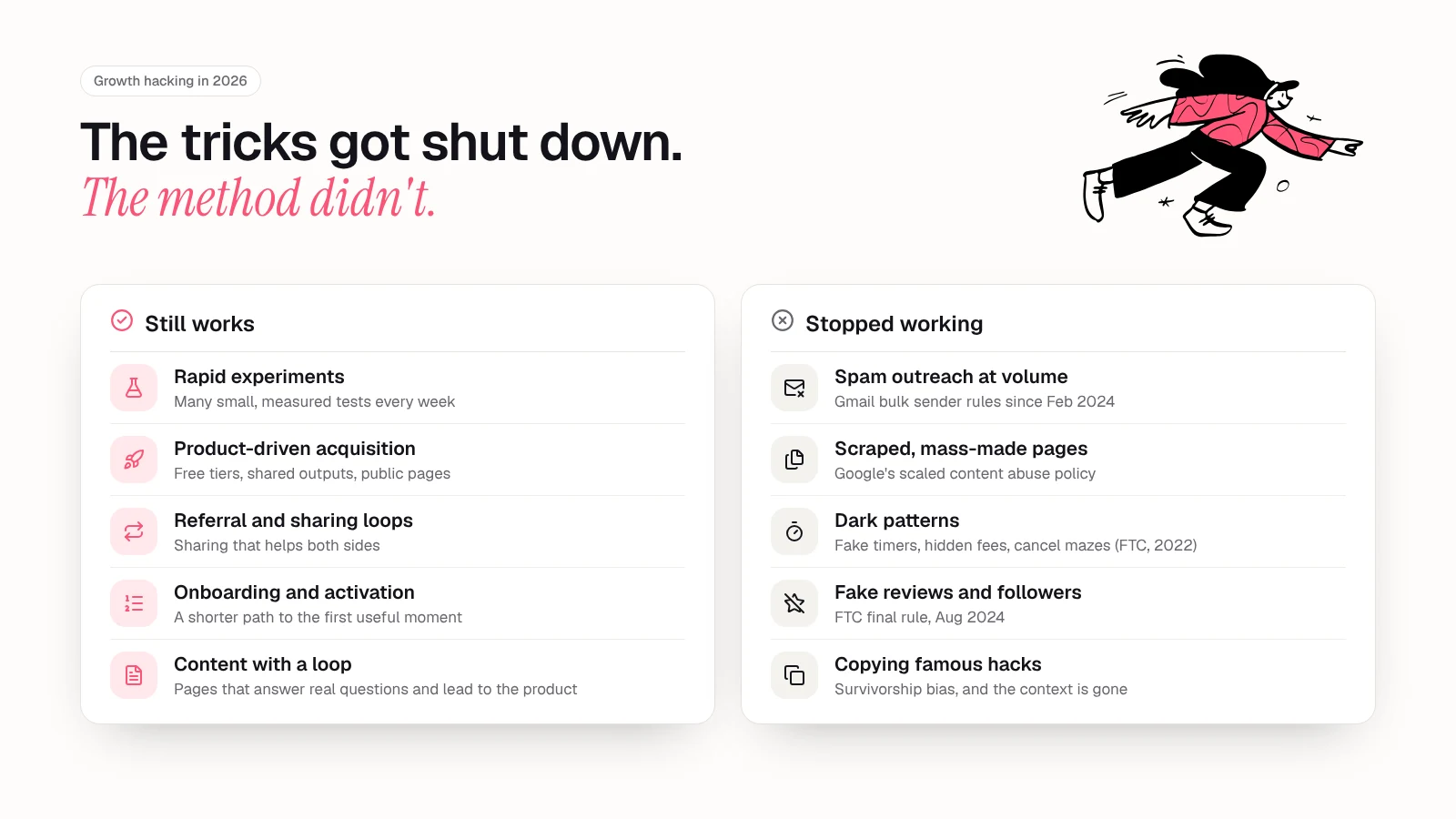
The parts of growth hacking that last are the ones tied to real user value. Five methods still hold up in 2026.
1. Rapid, structured experimentation
This is the core of Ellis's original idea. A team that runs ten small, well-measured tests a month learns faster than one that runs a big campaign a quarter. The advantage comes from the system: a shared backlog, a clear way to prioritise and a written record of what each test taught you.
2. Product-driven acquisition
The strongest channels are built into the product: free tiers, shareable outputs, templates, public pages and invites. When using the product exposes it to new people, acquisition gets cheaper as you grow. Our guide to product-led growth covers how to design for this.
3. Referral and built-in sharing
Referral works when sharing helps the person who shares, not only you. Dropbox's model worked because a shared folder is useful to both sides. The modern version is designing loops, where each new user brings in the next. See how growth loops work for the mechanics and how they differ from a one-way funnel.
4. Onboarding and activation
Every sign-up who leaves before the first useful moment is acquisition spend wasted. Test ways to shorten that path: fewer form fields, a pre-filled example, a clearer first screen. Every channel benefits from the gain.
5. Content and SEO with a loop
Content still works when it answers real questions better than what already ranks, and feeds back into the product: a calculator that leads to sign-up, a template that carries your name, a comparison page for buyers ready to choose. Our SEO content strategy guide explains how to plan topics around real search demand.
What stopped working
The tactics that broke share one trait: they took value from users or platforms instead of creating it. Platforms and regulators have spent the last few years closing them down.
Spam outreach at volume
Cold email blasts and scraped lead lists were a staple of early growth hacking. In October 2023, Google announced new rules for bulk senders to Gmail, starting February 2024: anyone sending more than 5,000 messages a day must authenticate their email, offer one-click unsubscribe and process unsubscribes within two days, and stay under a spam rate threshold. Volume without consent now damages your sender reputation, which then hurts the emails people actually want.
Scraped and mass-produced pages
Programmatic pages built from scraped data were once an easy way to capture long-tail traffic. Google's spam policies now name "scaled content abuse", which it defines as "when many pages are generated for the primary purpose of manipulating search rankings and not helping users". The listed examples include scraping feeds or search results to generate pages, and stitching content together from other sites without adding value.
Dark patterns
Fake countdown timers, hidden fees and cancellation mazes can lift conversion for a quarter, and draw regulators. In September 2022, the FTC published a staff report, Bringing Dark Patterns to Light, grouping these designs into four types: misleading consumers and disguising ads, making cancellation difficult, hiding key terms and fees, and steering people into sharing more data than they meant to.
Fake social proof
In August 2024, the FTC announced a final rule that covers reviews by people who do not exist, "such as AI-generated fake reviews", reviews bought on the condition that they express a particular sentiment, and the purchase of "fake indicators of social media influence, such as followers or views generated by a bot". The rule lets the FTC seek civil penalties against knowing violators.
Put side by side, the pattern is clear. What still works makes the product easier to find, try and share. What stopped working hides costs, fakes demand or floods a channel.
How AI changed growth hacking
AI made each step of an experiment cheaper. It also made the same cheap tactics available to every competitor at once, which raised the bar for what gets noticed.
Faster cycles
The slow parts of a test used to be the build and the analysis. AI tools now draft landing page variants, ad copy, onboarding emails and survey summaries quickly, and help you query results without waiting on an analyst, so a small team can run more tests each week. For a wider view of where AI fits across a marketing team, see our guide to how startups use AI for marketing.
More noise, and platforms pushing back
When everyone can generate a thousand pages, volume stops being an edge. Google's 2023 guidance on AI-generated content says "Appropriate use of AI or automation is not against our guidelines". The same post says that using automation, including AI, to generate content mainly to manipulate search rankings violates its spam policies. In March 2024, Google strengthened its scaled content abuse policy to cover content made at scale "whether automation, humans or a combination are involved", and said it expected the changes to cut low-quality, unoriginal content in results by 40%. In an April 2024 update to the same post, Google said the finished rollout delivered 45% less of that content.
So AI did not kill growth hacking. It killed the version that relied on doing more of something than competitors could. The edge moved to judgment: picking the right test, adding something original, and reading results honestly.
A simple, ethical growth experiment process
You do not need a growth team to run this. You need one metric, a shared document and an hour a week.
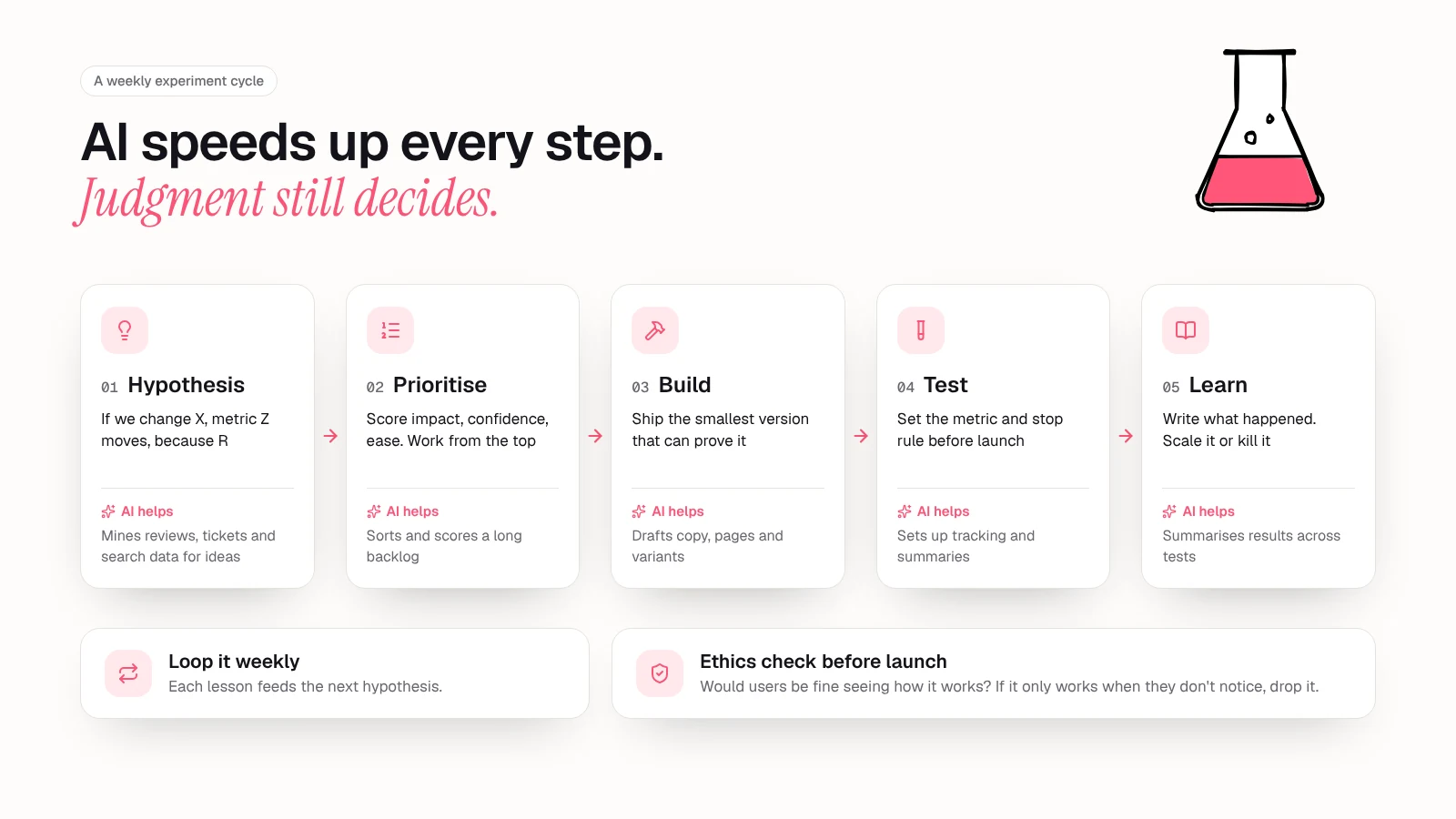
- Write a hypothesis. Use one sentence: "If we change X for audience Y, metric Z will move, because of reason R." The "because" is the belief you are really testing.
- Prioritise the backlog. Score each idea on impact, confidence and ease, from 1 to 10, work from the top and re-score weekly. Tools like LogNorm do this for search and content work, turning site audits, Search Console, competitor and AI-answer signals into Moves ranked in a weekly backlog.
- Build the smallest test. Ship the cheapest version that can prove or disprove the hypothesis, such as a copy change or a single landing page. AI can draft it; a person checks it.
- Run the test with a stop rule. Decide before launch how long it runs and what result counts as a win. Do not stop early because the first two days look good.
- Record what you learned. One paragraph per test: what you tried, what happened, what comes next. A failed test with a clear lesson is still progress.
Before anything ships, run a short ethics check. Would you be comfortable if the user saw exactly how this works? Does it match one of the FTC's four dark pattern types? If a test only works when users do not notice it, drop it.
Judge results against your own baseline
Skip benchmark conversion rates quoted without a named source and sample. Measure your own rate for the metric over the last four to eight weeks, note how much it swings week to week on its own, and count a test as a win only if the change is clearly larger than that swing. If traffic is too low to see a difference, test bigger changes.
When a test wins, fold it into the wider plan. The growth marketing playbook covers how winning experiments become ongoing programs with owners and budgets.
Growth hacking for SaaS: where to start
If you run a SaaS product and are starting from zero, test in this order.
- Activation. Find the action that separates users who stay from users who leave, and get more new sign-ups to it in their first session.
- Built-in sharing. Make your product visible and useful in what users already share: reports, links, invites, exports.
- One acquisition channel. Pick the channel where buyers already search or ask for recommendations, and make it predictable before adding a second.
- Retention throughout. Watch retention for every cohort, because acquisition is wasted if new users leave in the first month.
FAQ
What is growth hacking in simple terms?
Growth hacking is growing a business by running many fast, low-cost experiments across the product and marketing, and keeping only what measurably increases growth. Sean Ellis coined the term in 2010.
Is growth hacking still relevant in 2026?
The method is: fast, structured experimentation is still how small teams find what works. Many famous tactics are not, because spam outreach, scraped pages, dark patterns and fake reviews are now restricted by Gmail, Google Search and the FTC.
What is the difference between growth hacking and growth marketing?
Growth hacking is the experiment-first mindset for finding what drives growth quickly, usually at an early stage. Growth marketing is the broader discipline that turns those findings into sustained programs across the funnel.
What are some examples of growth hacking?
The most cited are Hotmail's "PS: I love you" email footer, Dropbox's user referral model and Airbnb's Craigslist posting integration. Each worked because the product already had real demand, so treat them as principles, not tactics to copy.
Is growth hacking ethical?
It can be. It becomes unethical when tests rely on deceiving users through hidden fees, fake urgency or fake reviews, which the FTC has flagged as dark patterns or banned outright.
Can AI do growth hacking for you?
AI speeds up most steps of an experiment, from finding ideas to drafting variants and summarising results. It does not replace judgment, and using it to mass-produce pages runs into rules such as Google's scaled content abuse policy.
Sources
- Sean Ellis: Find a Growth Hacker for Your Startup (July 2010)
- TechCrunch: PS: I Love You. Get Your Free Email at Hotmail (excerpt from Viral Loop by Adam Penenberg) (October 2009)
- U.S. SEC: Dropbox, Inc. Form S-1 registration statement (February 2018)
- Andrew Chen: Growth Hacker is the new VP Marketing (April 2012)
- Google: New Gmail protections for a safer, less spammy inbox (October 2023)
- Google Search Central: Spam policies for Google web search (updated August 2026)
- Federal Trade Commission: FTC report shows rise in sophisticated dark patterns designed to trick and trap consumers (September 2022)
- Federal Trade Commission: FTC announces final rule banning fake reviews and testimonials (August 2024)
- Google Search Central Blog: Google Search's guidance about AI-generated content (February 2023)
- Google: New ways we're tackling spammy, low-quality content on Search (March 2024)