AI Visibility Tracking: How to Measure Mentions and Citations
AI visibility tracking, step by step: which prompts to track, engines and countries, mention vs citation rate, sampling, run frequency and what moves them.


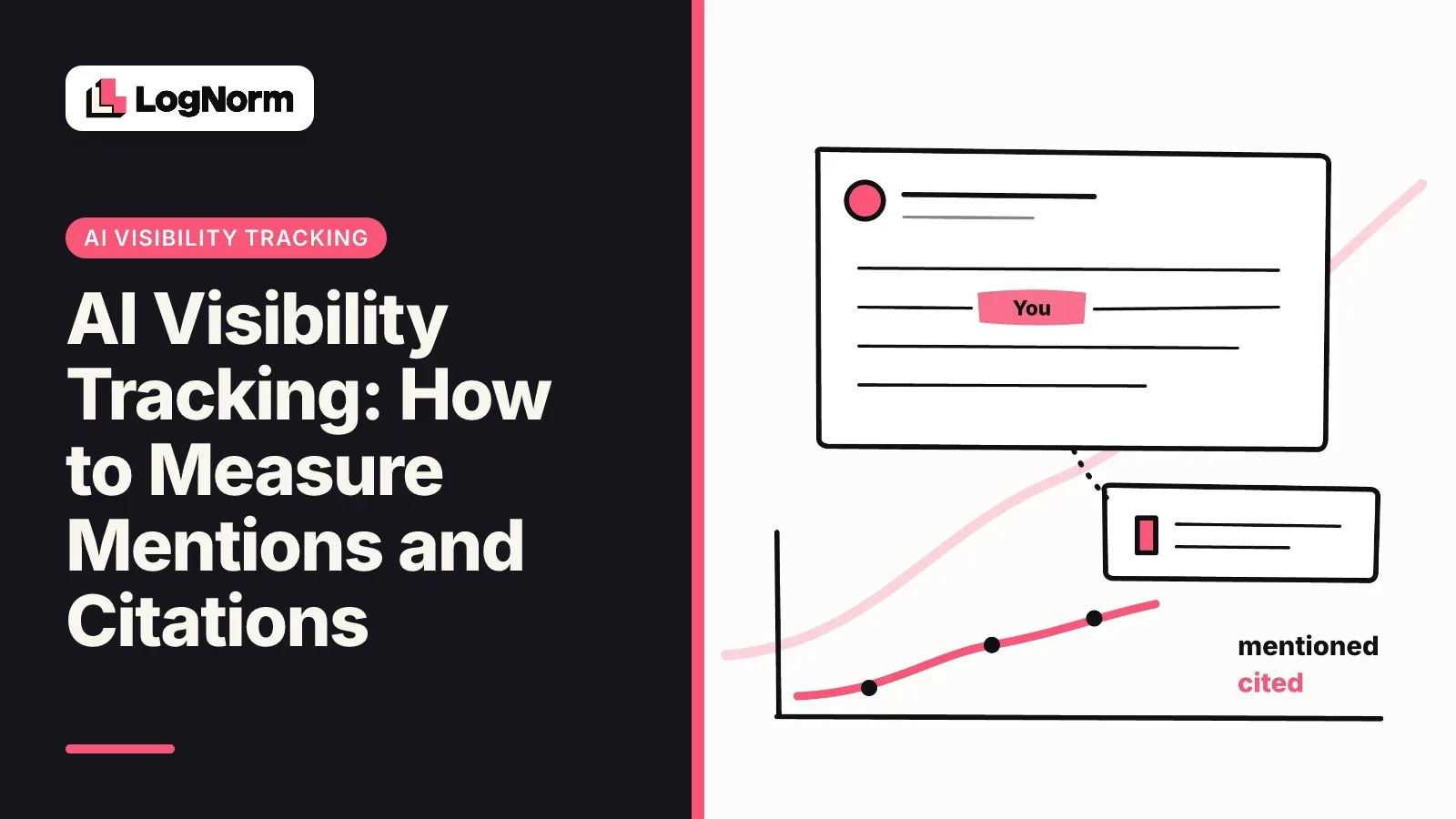
AI visibility tracking means asking AI assistants the questions your buyers ask, on a schedule, and recording two facts about every answer: whether it names your brand, and whether it cites one of your pages. Done well, it tells you where you are missing, why, and whether the work you ship changes the answers.
Most guides on this topic are tool lists. This one is the method: which prompts to track, which engines and countries to ask from, how to keep mention rate, citation rate and recommendation rate apart, how to read answers that change from one run to the next, and what actually moves the numbers. If you want the tools themselves, our guide to AI visibility tools compares them. If you are new to the idea, start with what AI visibility is.
What AI visibility tracking measures
AI visibility tracking measures how often AI answers to your buyers' questions name you, cite you or recommend you, compared with your competitors in the same answers. The unit is the answer, not a ranking position. One prompt asked on three engines gives you three answers, and each answer either includes you or does not.
This matters because buyers already ask assistants before they search. In a Pew Research Center survey, 57% of U.S. teens had used AI chatbots to search for information. Those are tomorrow's buyers, and the habit is forming now.
For most startups, three engines cover what buyers see:
- ChatGPT, asked with web search on
- Gemini
- Google AI Overviews, the AI summary above normal Google results
Perplexity, Copilot and Claude are worth adding if your buyers use them, but start where the volume is.
Mention rate, citation rate and recommendation rate are different numbers
A mention means the answer names you in its text. A citation means one of your pages is among the answer's sources. A recommendation means the answer picks you as the top choice or as one of the options it recommends. Track each as its own rate: the share of answers in which it happens, shown next to the number of answers behind it.
Many tools roll these into one "visibility score". That number goes up and down, but it cannot tell you what to do. The two facts are independent, so every answer lands in one of four cases, and each case needs different work.
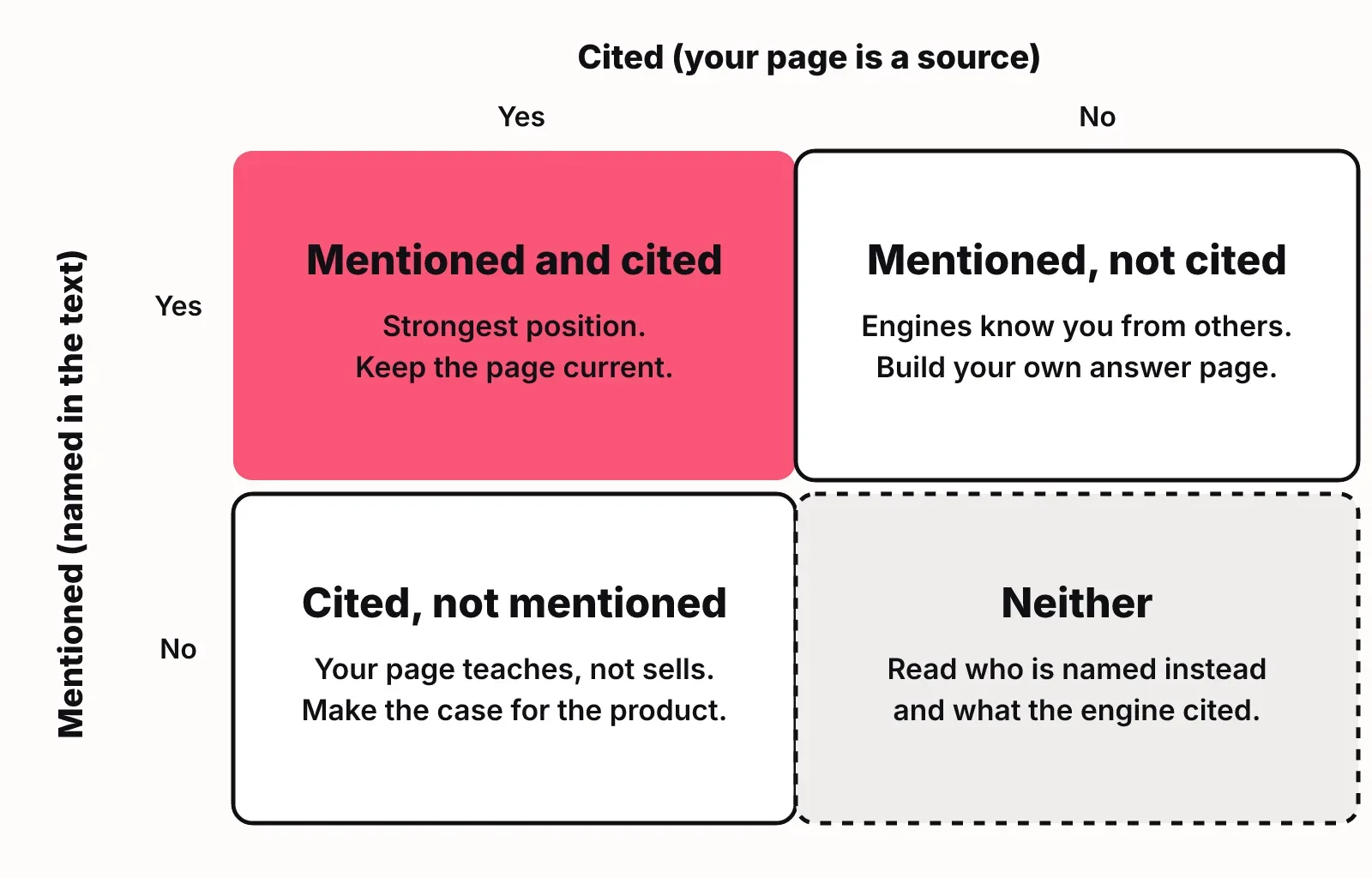
| Case | What it looks like | What it means | What to do |
|---|---|---|---|
| Mentioned and cited | The answer names you and uses your page as a source | Strongest position | Keep that page current and accurate |
| Mentioned, not cited | You are named, but the sources are other sites | The engine knows you from third parties | Build a page of your own that answers the prompt directly |
| Cited, not mentioned | Your page is a source, but the answer never names you | Your content teaches without making the case for your product | Add the product, the use case and the comparison to that page |
| Neither | You are absent | Someone else owns the answer | Read who is named and which pages the engine cited for them |
Mentions also differ in quality. Being the top pick is not the same as being listed as a fallback, or being named with a warning. Record the type of each mention: top pick, recommended, neutral, alternative only, or negative. A rising mention rate made of "alternative only" mentions is not progress.
Which prompts to track
Track the questions a buyer would type before they know your name, phrased without your brand, spread across the stages of a purchase. Prompt choice decides what your numbers mean, so it deserves more thought than tool choice.
A useful starting set covers five kinds of prompt:
- Category: "best AI visibility tools for startups"
- Alternatives: "alternatives to [competitor] for small teams"
- Comparison: "[competitor A] vs [competitor B] for tracking ChatGPT mentions"
- Evaluation: "how much do GEO and AI search visibility tracking tools typically cost"
- How-to: "how to track brand mentions in ChatGPT"
Start with 20 to 50 prompts. Fewer than that and one odd answer swings your rates. Far more and nobody reads the answers. Keep each prompt tied to a page you have or could build, so a bad result points at specific work.
Leave branded prompts ("what is [your brand]") out of your main rates. They tell you whether engines describe you correctly, which is worth checking, but they inflate mention rate without saying anything about whether buyers find you.
When your positioning changes, prune prompts that no longer describe what you sell, and pause rather than delete the ones you drop, so their history stays comparable.
Engines, countries and how the question is asked
Ask the consumer products from your buyers' country, in their language, because the same prompt gets different answers depending on where and how it is asked. The ChatGPT a buyer uses searches the web, picks sources and phrases answers differently from the raw model behind a developer API. A tracker that only calls APIs measures something your buyers never see.
Country matters for the same reason. A buyer in Germany gets German sources, local competitors and a different shortlist. Set the market once and ask every prompt from it. If you sell in two markets, track them as two sets rather than averaging them together.
Google AI Overviews need one extra rule. Google writes an overview only for some searches, and whether it does can change between runs. When a search comes back with no overview, record that fact, but leave it out of your mention, citation and recommendation rates. Otherwise a week where Google showed fewer overviews looks like a week where you lost visibility. Report the count of no-overview searches next to the rates instead.
Sampling, variance and how often to run
Treat every answer as one sample, not a fixed ranking. Ask the same prompt twice and you can get a different shortlist, different sources and a different order. A single run tells you what one answer said; a trend across runs tells you where you stand.
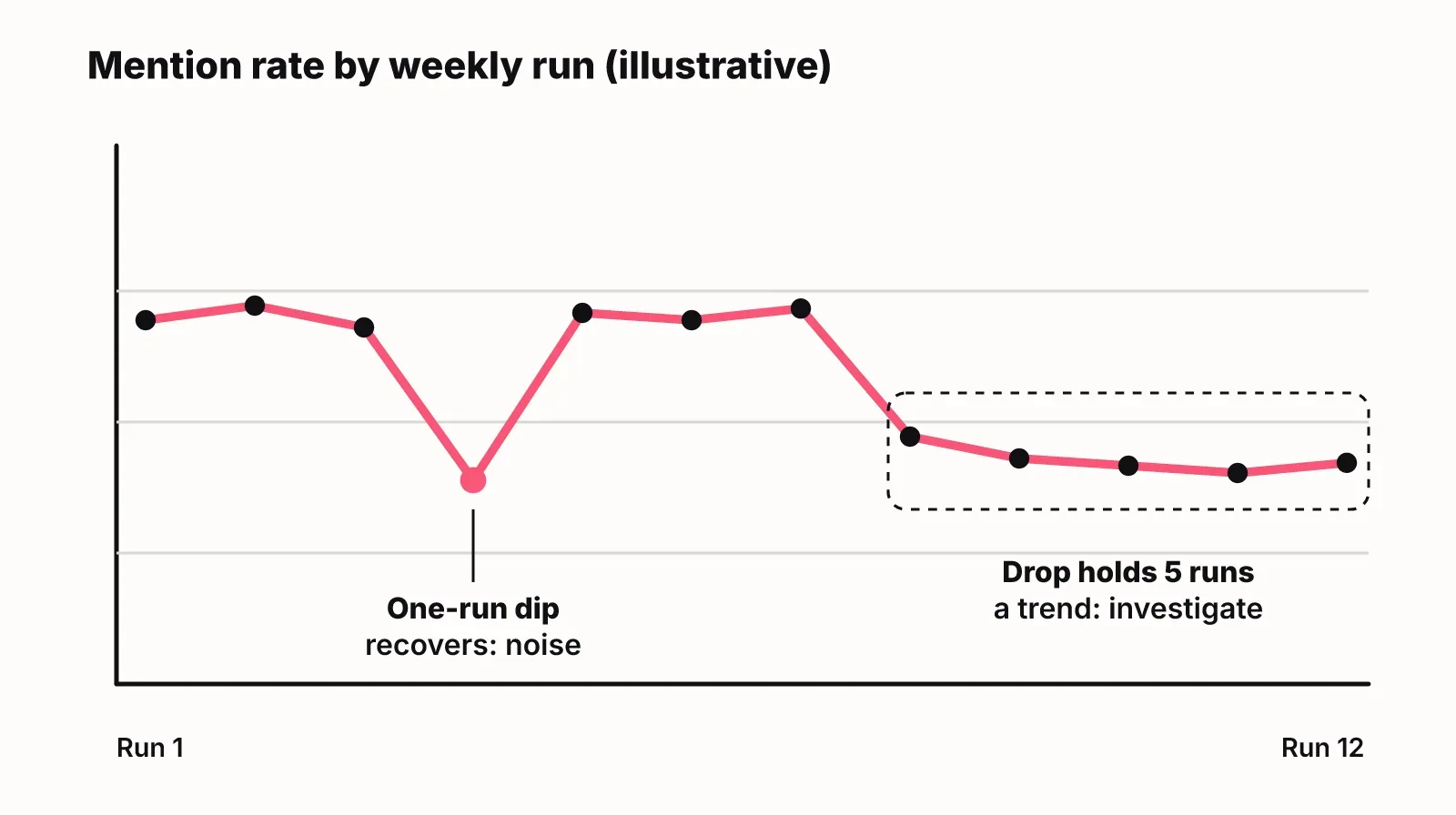
Three habits keep you from reacting to noise:
- Read every rate with its answer count. "40% of 10 answers" and "40% of 200 answers" are not the same evidence.
- Compare across several runs before you call a change. A drop that shows up once and recovers the next week is variance. A drop that holds for three or four runs is a trend.
- Change one thing at a time where you can. If you add 30 prompts and ship five pages in the same week, you will not know which one moved the rate.
How often to run depends on how fast your answers move and what you are trying to learn:
| Schedule | Use it when |
|---|---|
| Daily | You just launched, shipped a major page or are watching a competitor's launch |
| Twice a week | Your category is busy and you want earlier signal on shipped work |
| Weekly | The default for most startups: enough runs to see trends, low cost |
| Monthly | Stable categories, or prompts you only keep for reference |
Expect the effect of new work to be slow. Engines take days to weeks to pick up a new page, so judge a page on the runs after it has had time to be found, not on the first run after you publish.
Track the sources behind the answers
The pages an engine cites tell you why an answer looks the way it does, so record every source, not only your own. For each answer, keep the pages it cited, the pages it linked in the text and, where the engine shows them, the pages it searched but left out.
Then group sources by kind: your own pages, competitors' pages, review sites, publishers, forums, docs and video. Patterns show up quickly. For the two prompts this article targets, ChatGPT, Gemini and Google AI Overviews cited third-party roundups, pricing guides and a Reddit thread far more than any vendor's own page.
Engines often cite different kinds of sources than you would guess. An analysis of over 24,000 conversations across OpenAI, Perplexity and Google search systems found that only 9% of more than 366,000 citations referenced news sources. Don't assume the press or your blog is what engines read for your category; look at what they cite.
The most useful row in your source data is a third-party page that engines cite and that names your competitors but not you. That is a concrete gap: get listed, get reviewed, or publish the better version of that page yourself.
One caution: a cited source does not prove the answer is correct. When researchers benchmarked citation quality, even the best models lacked complete citation support 50% of the time on one dataset. Open the answers that matter most and read what they say about you.
What changes the numbers
Your numbers change when the pages engines read change: your own pages, the third-party pages that cite you, and your competitors' pages. Tracking is only useful if you link it to that work.
What tends to move each rate:
- Citation rate rises when you publish pages that answer a prompt directly, in the first sentence under a clear heading, with specific facts. See how to get cited in Google AI Overviews for the page-level detail.
- Mention rate rises when third-party pages that engines already cite start naming you: listicles, reviews, comparison pages, forum answers.
- Recommendation rate rises when those pages and your own make a clear case for who you are best for, so the engine has a reason to pick you.
- Any of them can fall because a competitor shipped a better page, a new brand entered the answers, or engines simply cite different sources this month.
Technical access also matters. If AI crawlers are blocked in robots.txt, or your pages render without their main text, engines cannot read you at all. A GEO audit checks that before you spend time on content.
To know whether your work helped, link each shipped page to the prompts it was meant to affect. Then compare those prompts' rates in the runs before the ship date with the runs after, with the answer counts on each side, and check whether any answer now cites the new page. That before-and-after view is the difference between a dashboard and a feedback loop.
Choosing an AI visibility tool and what it costs
The price of an AI visibility tool is driven by how many answers it collects: prompts, multiplied by engines, multiplied by how often it runs, multiplied by markets. Competitor tracking and source analysis add to that. When you compare plans, convert each one into answers per month for your prompt set rather than comparing headline prices.
Whatever you pick, check that it supports the method:
- Mention, citation and recommendation reported as separate rates, with answer counts
- Answers collected from the consumer products, from your country
- No-overview Google searches kept out of the rates
- Full answers and every cited source stored, so you can read them
- Competitors measured in the same answers
- A way to tie shipped work to the prompts it should affect
We built LogNorm's AI visibility tracking around this method: it asks ChatGPT, Gemini and Google AI Overviews from your market's country, keeps mentions and citations as separate facts, turns gaps into ranked moves for your growth plan and measures shipped work before and after. The full rules are in LogNorm's AI visibility docs. For a side-by-side of the other tools, see our AI visibility tools guide.
FAQ
How much do GEO and AI search visibility tracking tools typically cost?
Cost scales with the number of answers a tool collects: prompts times engines times run frequency times markets. Price a plan by what it costs for your own prompt set at your schedule. A weekly run of 30 prompts on three engines is a very different bill from a daily run of 200 prompts on six engines.
What are the best AI visibility tools to monitor brand mentions in ChatGPT?
The best tool is the one that reports mention and citation separately, asks ChatGPT with web search on from your country, and stores the full answers and sources. Our AI visibility tools guide compares the main options.
How do AI visibility tools work?
They send a fixed set of prompts to AI engines on a schedule, store each answer and its sources, and check every answer for your brand, your domain and your competitors. The rates you see are shares of those answers.
Do AI visibility tools replace traditional SEO tools?
No. Keyword research, rank tracking and site audits cover Google's normal results, which still send traffic. AI visibility tracking adds the answer layer on top of them.
Do AI visibility tools improve SEO rankings?
Tracking alone changes nothing. The pages you build because of what tracking shows, clear answers to real buyer questions, are the work that can help in both Google results and AI answers.
How can you improve AI visibility?
Find the prompts where you are absent, read which pages engines cite there, then either publish a better page yourself or get named on the third-party pages they already cite. Measure the same prompts before and after.