Best AI Visibility Tools in 2026: Tracking That Leads to Action
Compare the best AI visibility tools for 2026: what they track in ChatGPT, Gemini and AI Overviews, what drives the price, and which turn gaps into fixes.


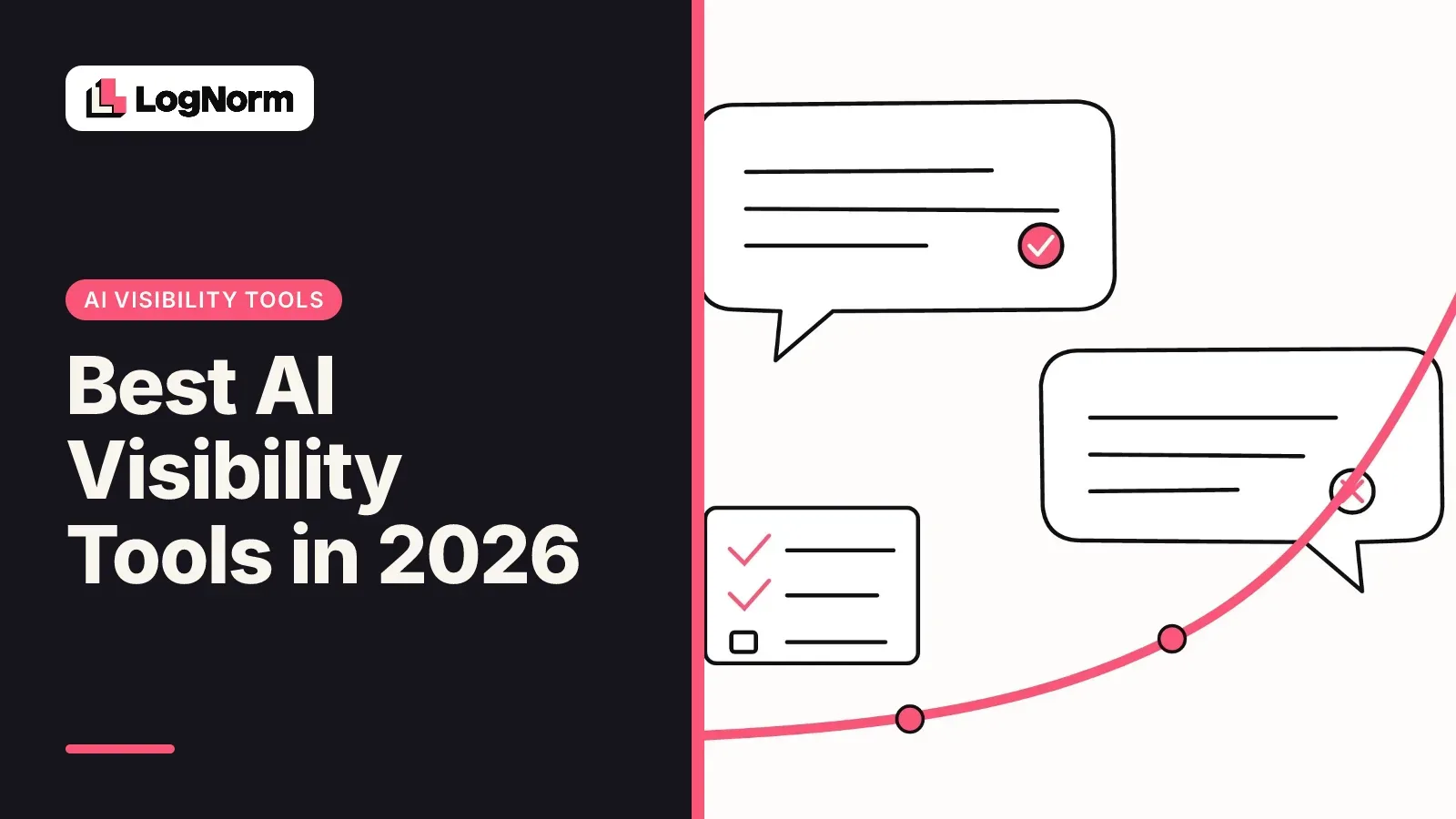
AI visibility tools ask ChatGPT, Gemini, Google AI Overviews and other AI engines the questions your buyers ask, then record whether the answer names your brand and whether it cites your pages. The best ones go one step further: they show you why a competitor gets picked instead of you and tell you what to fix first.
This guide compares the AI visibility tools that come up most in 2026, explains what drives their price, and gives you a test for telling a monitoring dashboard apart from a tool that changes the answers.
A disclosure before we start: we make LogNorm, which is one of the tools below. When we track the prompt "best AI visibility and GEO tools to monitor brand mentions in ChatGPT" today, the engines recommend Profound, OtterlyAI, Peec AI, Ahrefs and Semrush. They don't name LogNorm. We've tried to write the comparison we'd want to read as a buyer, limits included.
What AI visibility tools measure, and why rank trackers miss it
An AI visibility tool measures your presence inside AI-written answers, which a classic rank tracker cannot see. A rank tracker tells you where your page sits in the blue links. It can't tell you whether Gemini recommends you, or whether Google's AI summary cites a forum thread about your competitor instead.
The gap between the two is real. A study of Google AI Overviews found the overview appears on 13.7% of queries overall, rising to 64.7% for queries phrased as questions. Nearly 30% of the domains those overviews cite don't appear anywhere in the first page of organic results shown alongside them. Ranking well and being cited are related, but they are not the same thing.
Starting position matters too. A large study of brand visibility across AI search engines found that on a first visibility run, global household names appear in 73% of relevant AI answers, mid-market and regional brands in 44%, and niche and small brands in just 11%. If you're a startup, expect to start near the bottom of that ladder. A good tool shows you the specific prompts and sources where you can climb.
For a deeper primer on the metric itself, read what AI visibility is and how to measure it.
The best AI visibility tools in 2026 at a glance
The right AI visibility tool depends on what you'll do with the data: monitor it, report it inside an SEO suite you already pay for, or turn it into a ranked list of fixes. The table below groups the tools buyers compare most often by that job.
Positioning for third-party tools reflects how they're described in the comparison pages currently ranking for this search and in the AI answers we track. Engine coverage, limits and prices change often, so the last column lists what to confirm in a demo or on the vendor's pricing page.
| Tool | Type | Best fit | Check before you buy |
|---|---|---|---|
| LogNorm | Tracking plus a ranked action plan | Startups and small teams who want gaps turned into prioritised work for people or AI agents | Covers ChatGPT, Gemini and Google AI Overviews only |
| Profound | Enterprise AI visibility platform | Large brands and agencies with an enterprise budget | Price, contract length, seats |
| Peec AI | Dedicated AI search monitor | Agencies that want clean prompt and citation analytics | Engines per plan, prompt limits |
| OtterlyAI | Budget AI search monitor | Teams that want the cheapest way to start tracking | Prompt limits, run frequency |
| Semrush AI Visibility Toolkit | Add-on to an SEO suite | Teams already working in Semrush | Whether it's an add-on or bundled on your plan |
| Ahrefs Brand Radar | Prompt index inside an SEO suite | Benchmarking your brand against competitors at scale | Which engines and countries are included |
| SE Ranking (AI visibility) | Add-on to an SEO suite | SEO agencies adding AI reporting for clients | Reporting and white-label options |
| Scrunch AI | AI search experience platform | Mid-market teams focused on technical GEO | Pricing model, onboarding |
| Rankscale | Dedicated AI search tracker | Deep citation analysis across several engines | Engine list, prompt limits |
If you only need to know whether ChatGPT mentions you, almost any monitor on this list will do. If you need to know what to do about it on Monday, read the next section before you shortlist.
How to judge an AI visibility tool: tracking that leads to action
Judge an AI visibility tool by what it helps you change, not by how many charts it draws. Seven questions separate the tools that move the numbers from the ones that only report them.
- Does it ask the real consumer products, or the developer APIs? ChatGPT and Gemini in the browser search the web and choose sources differently from the raw models behind them.
- Does it ask from your buyers' country and language? Answers vary by market.
- Does it keep mentions and citations as separate numbers? One blended "visibility score" hides the most useful signal.
- Does it show the sources each answer used, page by page? That's where the fixes come from.
- Does it show which prompts a competitor wins while you're absent, and which sources earned them the spot?
- Does it rank what to do next, or hand you a list of every issue?
- Does it re-check the same prompts after you ship, so you can see whether the work changed the answer?
The fourth question matters more than it looks. The same arXiv study of AI search visibility found that about 78% of the sources AI engines cite are corporate websites. Among non-corporate sources, YouTube leads, ahead of Reddit, editorial media and Wikipedia. Your own pages are the biggest lever you control, and a tool should tell you which ones to build or change.
The AI visibility tools, one by one
Each tool below earns its place for a different kind of team. We describe third-party tools by their positioning and leave out prices and feature claims we couldn't verify; confirm the details with each vendor.
LogNorm: best when you want tracking turned into ranked work
LogNorm tracks prompts in ChatGPT, Gemini and Google AI Overviews, asked in the real consumer products from your market's country. It records two separate facts about every answer: whether it mentions you, and whether it cites one of your pages. It never merges them into one number.
Each mention gets a type: top pick, recommended, neutral, alternative only, or critical. The Sources tab lists every site and URL the engines cited, including third-party pages that name your competitors and not you. The Competitors tab shows the prompts a competitor wins while you're absent.
The part most tools skip is what happens next. After each run, LogNorm turns the numbers into learnings, such as "a cited third-party page lists competitors and not you" or "a competitor's type of page gets cited and you have no equivalent." One click makes a learning into a move, which is ranked head to head against your SEO, content and technical work in a weekly growth plan. Your team or an AI agent such as Claude Code or Codex can then pick it up. You can connect your AI agent to work the plan directly. The Impact tab compares mention, citation and recommendation rates on the linked prompts before and after you ship.
The limit: LogNorm covers three engines. If Perplexity, Claude or Copilot answers matter to your buyers, pair it with a monitor that covers them or pick one of the dedicated trackers below. Details are in LogNorm's AI visibility tracking page and the AI visibility docs.
Profound: best for enterprise teams
Profound is positioned as the enterprise AI visibility platform, and comparison pages consistently place it there, including for agencies tracking client narratives. It's also the brand AI engines recommend most often for our tracked prompts. Choose it when you have an enterprise budget and need a vendor built for large brands and many stakeholders.
Peec AI: best dedicated monitor for agencies
Peec AI is usually described as a clean, focused monitor for AI search analytics, prompt visibility and citation analysis, without an SEO suite around it. Roundups name it the best pure monitor for agencies. Check how many engines and prompts your plan includes.
OtterlyAI: cheapest way to start tracking
OtterlyAI is the tool roundups name most often as the budget entry point for monitoring AI search mentions. It suits a solo founder or small team that wants to see where they stand before committing to a bigger platform.
Semrush AI Visibility Toolkit: best if you already live in Semrush
Semrush offers AI visibility tracking alongside its SEO suite. If your team already does keyword research and audits there, keeping AI reporting in the same place saves a login and a budget line. Check whether it's an add-on or included on your plan.
Ahrefs Brand Radar: best for benchmarking
Ahrefs Brand Radar is positioned as a prompt index: a set of search-backed prompts you can use to compare your brand's presence with competitors'. It's strongest for research and benchmarking across a category.
SE Ranking, Scrunch AI and Rankscale
SE Ranking adds AI visibility reporting to its SEO platform and is aimed at SEO agencies adding AI to client reports. Scrunch AI is positioned for mid-market teams and technical GEO. Rankscale is a dedicated tracker focused on citation analysis across several engines.
Mentions versus citations: why one score isn't enough
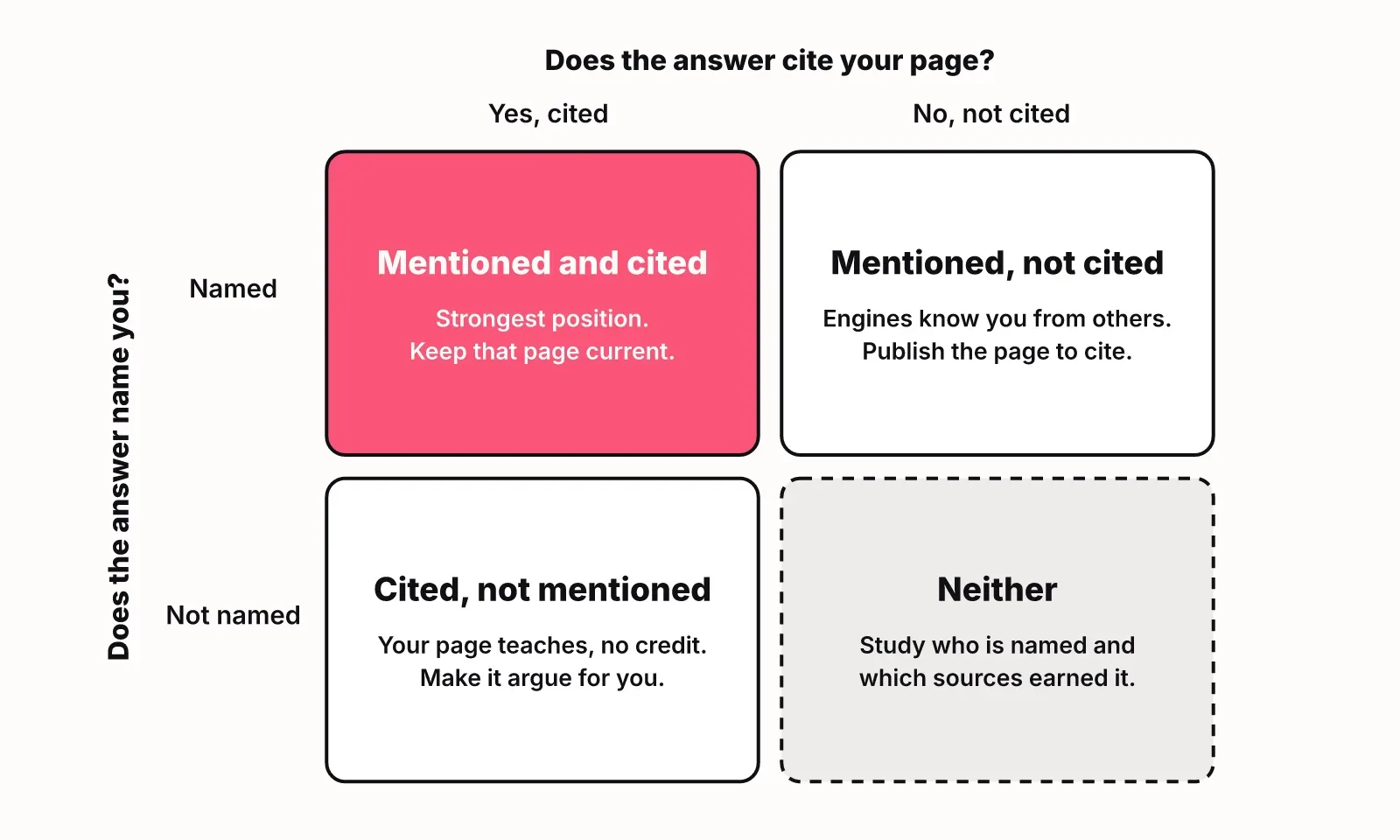
A mention means the AI answer names your brand in its text. A citation means one of your pages is among the sources the answer used. The two are independent, so every answer lands in one of four cases, and each needs a different fix.
| Case | What it means | What to do |
|---|---|---|
| Mentioned and cited | The answer names you and uses your page as a source | Keep that page current |
| Mentioned, not cited | The engine knows you from third-party pages | Publish the page the engine should be citing |
| Cited, not mentioned | Your page informs the answer but doesn't earn the recommendation | Make the page argue for your product, not only teach |
| Neither | You're absent | Study who is named and which sources were cited for them |
A tool that blends these into one score would report "Mentioned, not cited" and "Cited, not mentioned" as the same middling number. They have opposite fixes. When you trial a tool, open one prompt and check that you can see both facts for every engine.
For the Google side specifically, see how to get cited in Google AI Overviews.
How much AI visibility tools cost
AI visibility tools usually price on how many answers they collect: the number of prompts you track, multiplied by the engines, countries and how often each prompt runs. Seats, client workspaces and reporting features add to that. A tool that checks 50 prompts weekly in one engine costs far less to run than one checking 500 prompts daily across four engines.
We haven't quoted competitor prices here because we couldn't verify them independently, and vendors in this category change plans often. Check each vendor's pricing page on the day you buy and compare like for like: prompts, engines, countries and run frequency.
Here is what LogNorm's pricing looks like, because we can verify our own:
- Plans are Free, Starter, Growth and Scale. They differ in websites, seats, included credits, tracked AI prompts and publishing.
- Free works with your own AI provider keys. Starter includes 1,500 credits a month, Growth 4,000 and Scale 12,000.
- Each AI answer costs half a credit. A Google search that returns no AI Overview still costs half a credit, because knowing Google shows none is part of the picture. A failed search costs nothing.
- Every plan can bring its own AI keys, so AI tokens are billed by your provider instead of using credits. Search data, crawling and a small per-job fee still use credits.
- You can start with a 14-day Growth trial with 1,000 credits and no card.
The same credits cover the rest of the loop: keyword research, site and GEO audits, briefs, drafts and publishing. That matters when you compare. A monitor-only tool may cost less per prompt, but you'll pay separately for the work that changes the answers.
Affordable Profound alternatives: how to pick
The best affordable Profound alternative is the one that matches what your team will do with the data. Profound is built for enterprise brands; most startups and small agencies need less coverage and more direction.
- If you only need to watch your mentions, start with a budget monitor such as OtterlyAI.
- If you report to clients, a dedicated monitor such as Peec AI or an SEO-suite add-on such as SE Ranking fits agency workflows.
- If your team already pays for Semrush or Ahrefs, try their AI visibility features before adding another vendor.
- If you have a small team and need the tool to tell you what to fix first, and want people or AI agents to ship it, LogNorm is built for that.
Stay with Profound, or shortlist it, when you're a large brand with many product lines, many markets and stakeholders who need enterprise reporting.
From report to fix: the loop that changes AI answers
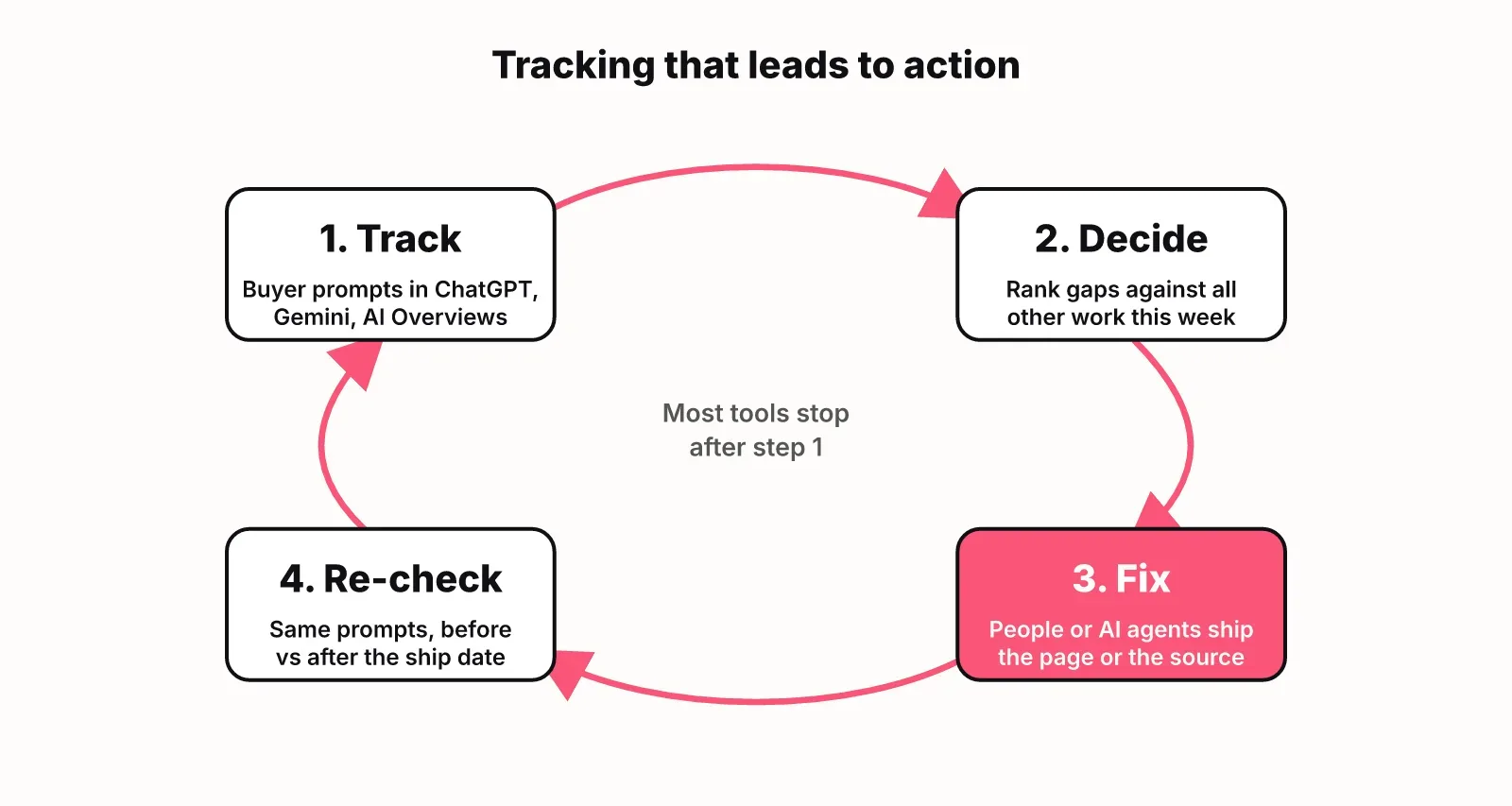
Tracking only pays off when it feeds a loop: track the prompts, decide what to fix first, ship the fix, then re-check the same prompts. Most tools cover the first step well. The other three are where visibility actually changes.
Being named inside the answer matters more than the click. Pew Research Center found that users clicked a link inside a Google AI summary in just 1% of visits to pages with such a summary. Users who saw an AI summary clicked a traditional search result in 8% of visits, against 15% for those who didn't see one. If the summary is where the decision happens, you need to be in it by name.
Here is what each step looks like in practice:
- Track: a fixed set of buyer prompts, run on a schedule, in the engines and country your buyers use.
- Decide: rank the gaps against everything else your team could do this week, so AI visibility work competes fairly with SEO and product pages.
- Fix: publish the comparison page that's missing, rewrite the page that's cited but doesn't name you, or earn a place on the third-party list the engines keep citing.
- Re-check: compare the same prompts before and after the ship date. Engines take days to weeks to pick up a new page, so give it several runs.
If you're building the wider stack around this, our guides on AI SEO for startups, choosing SEO tools and AI tools for marketing cover the other jobs.
FAQ
What are AI visibility tools?
AI visibility tools track how AI engines such as ChatGPT, Gemini and Google AI Overviews answer your buyers' questions. They record whether each answer mentions your brand, whether it cites your pages, which sources it used, and which competitors it recommended. They're also called GEO (generative engine optimization) tools.
What are the best AI visibility tools to monitor brand mentions in ChatGPT?
For enterprise brands, Profound. For agencies that want a focused monitor, Peec AI. For the cheapest start, OtterlyAI. For teams inside an SEO suite, Semrush or Ahrefs Brand Radar. For startups that want mentions turned into a ranked list of fixes, LogNorm, which tracks ChatGPT, Gemini and Google AI Overviews by country.
What are affordable alternatives to Profound?
OtterlyAI and Peec AI are the dedicated monitors most often named as lower-cost alternatives. Semrush and Ahrefs add AI visibility to suites you may already pay for. LogNorm is an alternative for startups that want tracking and a prioritised action plan in one place, with a free plan for teams that bring their own AI keys.
How much do GEO and AI search visibility tools cost?
Cost scales with the number of prompts tracked, the engines and countries checked, and how often each prompt runs, plus seats and reporting. Compare tools on those four inputs, not on headline price. LogNorm prices in credits: each AI answer costs half a credit, paid plans include 1,500 to 12,000 credits a month, and there's a 14-day trial.
How are AI visibility tools different from rank trackers?
Rank trackers report your position in the organic results. AI visibility tools read the AI-written answer itself. The two diverge: nearly 30% of domains cited in Google AI Overviews don't appear on the first page of organic results shown with them, according to research on AI Overviews.
What should agencies look for in an AI visibility tool?
Agencies need separate mention and citation rates per client, source lists they can act on, competitor comparisons, and reports clients understand. Check the per-client cost of prompts and engines, since that's what grows with your roster.
Why do AI visibility tools matter for small brands?
Small brands start far behind. Niche and small brands appear in 11% of relevant AI answers on a first run, against 73% for household names, per the arXiv study. A tool shows you the specific prompts and sources where you can close that gap.