What Is AEO? Answer Engine Optimization Explained
What is AEO? Answer engine optimization makes your content the answer in AI Overviews, ChatGPT and voice search. What it means and how to measure it.


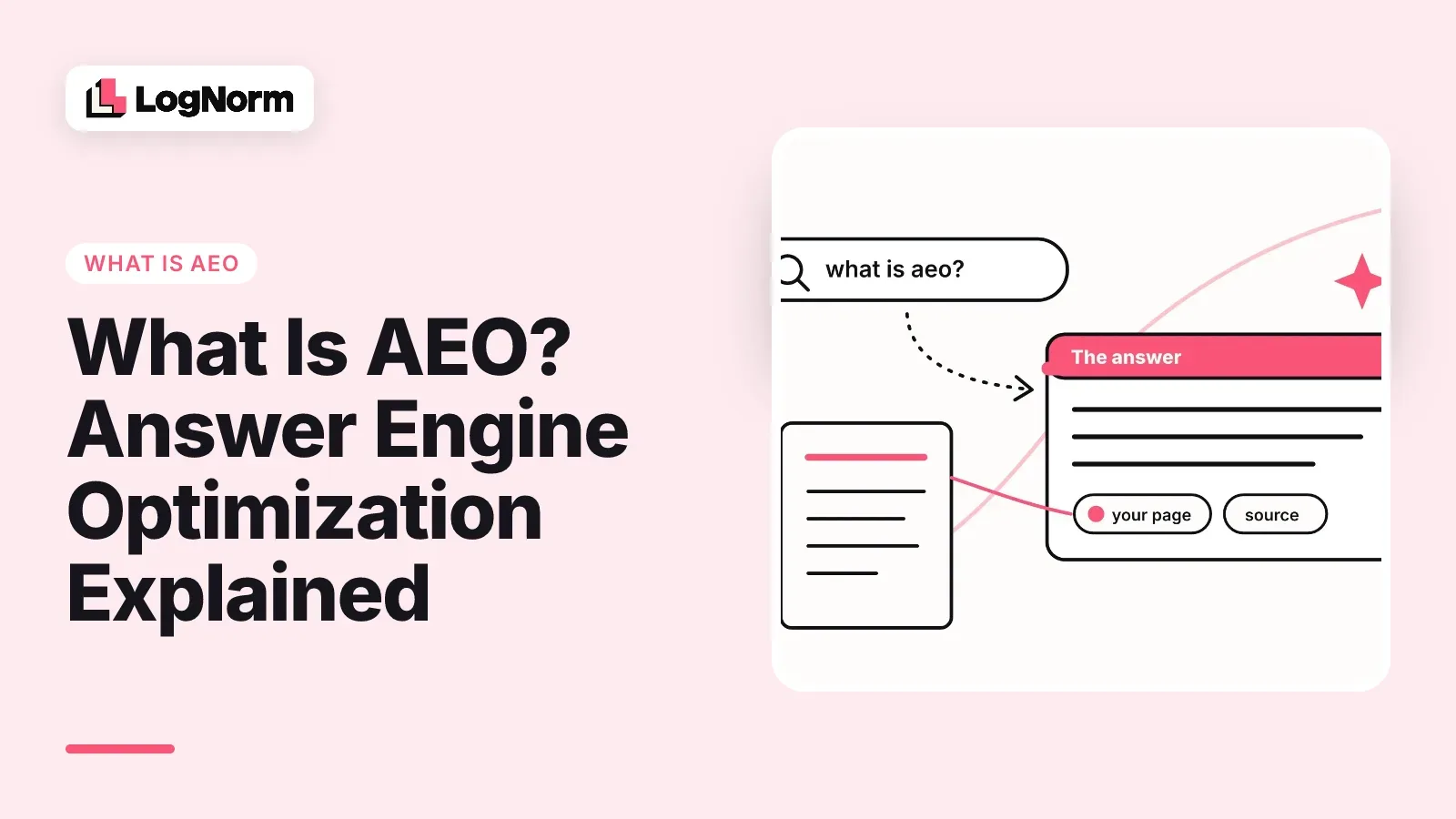
AEO, or answer engine optimization, is the practice of shaping your content so answer engines can use it as the direct answer to a question and name you as the source. Answer engines include Google's featured snippets and AI Overviews, voice assistants, ChatGPT and Perplexity. SEO works to rank a page in a list of links. AEO works to make your page the text the person actually reads.
You do not need a separate team, a new file format or a bag of tricks to do it. You need pages that answer real questions clearly, on a site machines can read, from a company they can identify. This guide covers what AEO means, where it came from, why it matters more each year, what it looks like in practice and how to tell whether it is working.
What is AEO?
AEO stands for answer engine optimization: making your content easy for search engines and AI assistants to lift as the answer, and easy to credit. Its unit of success is a single extracted answer, such as a snippet, a spoken reply or a quoted line inside an AI response, rather than a position in a list of links.
In marketing, the AEO meaning is practical. When a buyer asks "what is the cheapest way to get SOC 2?" or "which CRM works for a two-person sales team?", the AI answer they read is the new shelf space. AEO marketing is the work of being on that shelf: the source the answer draws from, and ideally the brand it names.
The acronym has other meanings. In customs and trade, AEO is an Authorized Economic Operator, a security status that speeds up border checks. In audio engineering it can refer to acoustic echo cancellation. This article is about the marketing term.
AEO is not a replacement for SEO. Google's own guide to generative AI search says its AI features are built on its core ranking and quality systems, and that optimizing for them "is optimizing for the search experience, and thus still SEO." Treat AEO as a lens on SEO that focuses on the answer itself. If you want the ranking-versus-citation differences in detail, read GEO vs SEO.
Where the term answer engine came from
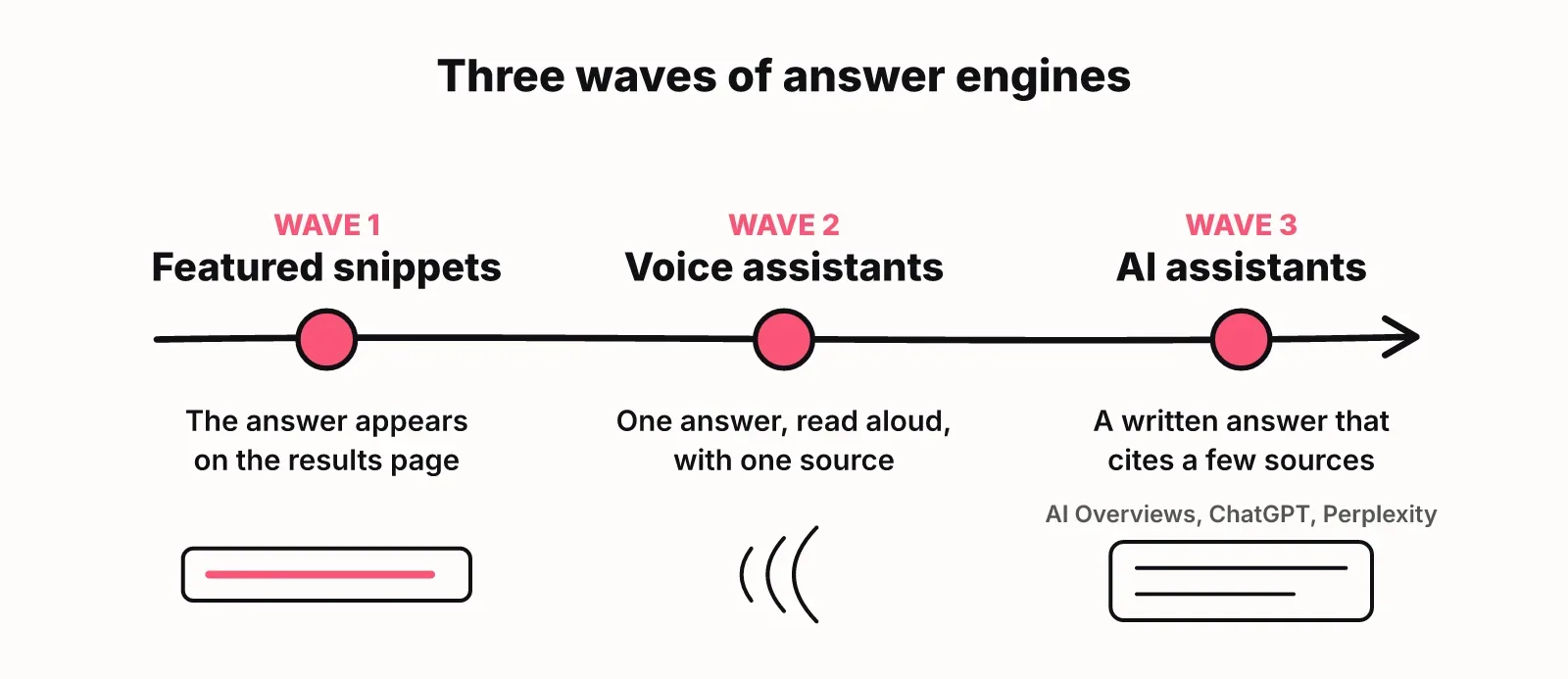
The idea of an answer engine is older than ChatGPT. It arrived in three waves, and each one changed what "being the answer" meant.
Wave one was featured snippets. Google describes them as boxes where "the format of a regular search result is reversed, showing the descriptive snippet first" (Google Search Central). For the first time, a result could answer the question on the results page itself, and marketers started optimizing to win that box.
Wave two was voice. When Google reintroduced featured snippets in 2018, it noted they are especially helpful for people searching by voice. A voice answer has no page two. There is one answer, read aloud, with one source.
Wave three is AI assistants. Perplexity calls itself an answer engine: a tool that gives direct answers instead of a list of links. ChatGPT search, Google's AI Overviews and AI Mode work the same way. They write an answer and cite a handful of sources.
The goal has stayed the same while the list of surfaces has grown. The newest wave also has a newer name, generative engine optimization, which our practical guide to generative engine optimization covers in depth.
Why AEO matters now
AEO matters because more searches now end with an answer instead of a click. In an October 2025 survey, Pew Research Center found that 65% of U.S. adults at least sometimes come across AI summaries in search results, including 45% who see them often or extremely often.
The click data is starker. In Pew's analysis of real Google browsing behavior, users who saw an AI summary clicked a traditional result in 8% of visits, against 15% for users who did not see one. Clicking a link inside the summary itself happened in just 1% of visits. Sessions also ended entirely on 26% of pages with an AI summary, compared with 16% of pages with only traditional results.
Two things follow for a startup. First, if the summary is where the reading happens, being quoted and named in it is worth more than ranking fifth underneath it. Second, the summary is not built from one search. Google's documentation on AI features says AI Overviews and AI Mode may use "query fan-out", issuing several related searches across subtopics to find supporting pages. A clear page on a narrow question can be pulled into answers for broader questions it never targeted.
AEO examples: what being the answer looks like
Being the answer looks different on each surface, but the win is always your text or your brand inside the response. The table shows what counts as a win on each one.
| Answer surface | What the person sees | What counts as an AEO win |
|---|---|---|
| Featured snippet | A boxed passage above the results | Your paragraph, list or table is the box, with your link |
| Voice assistant | One spoken answer | Your page is the source read aloud and credited |
| Google AI Overview or AI Mode | An AI-written summary with source links | Your page is among the cited links, ideally with your brand named in the text |
| ChatGPT or Perplexity answer | A written answer with citations | Your brand is recommended and your page is cited |
Here is a worked example. Say you run a compliance tool and buyers ask "how long does a SOC 2 Type 1 audit take?" A page with that exact question as a heading, followed by a two-sentence answer with a real range from your own customer data, then the steps, is easy to lift. A page titled "Our approach to compliance" that answers the same question in its sixth paragraph is not.
AEO also happens off your site. A 2025 study of AI search found that engines show a systematic bias toward third-party earned media over brand-owned and social content when picking citations. In practice, how review sites, publishers and community threads describe you shapes the answer as much as your own pages do. Good AEO marketing includes giving those writers accurate, specific material to quote.
How AEO works: eligibility first, then structure
AEO works in two layers: a crawler has to be allowed to read your page, and then the page has to contain a passage worth lifting. Most failed AEO efforts break on the first layer, not the second.
Make sure answer engines can reach you
Google says there are no special requirements for AI Overviews or AI Mode beyond being indexed and eligible to show a snippet. You also cannot apply for a featured snippet; its systems decide. Settings like nosnippet or a low max-snippet can keep you out of these features.
For ChatGPT, OpenAI says sites that block its search crawler will not appear in ChatGPT search answers, and recommends allowing OAI-SearchBot. That crawler is separate from GPTBot, which relates to model training, so you can allow one and block the other. Perplexity's docs recommend allowing PerplexityBot, including in your web application firewall. A security rule that blocks AI crawlers by default will undo every editorial improvement, so check this before you rewrite a heading. A GEO audit checks crawler access alongside the rest of your AI readiness.
Write passages that are easy to lift
Answer engines pull passages, not whole pages. These habits make the right passage easy to find and worth trusting:
- Phrase headings the way people ask. "How much does SOC 2 cost for a startup?" beats "Pricing considerations." Use sales calls, support tickets and keyword data to find the real wording.
- Answer first. Put a direct, self-contained answer of roughly 40 to 60 words right under the heading, then the steps, table, exceptions and examples. The 40 to 60 range is a working habit, not a Google rule.
- Add specifics a model cannot produce from the rest of the web: your own numbers, customer patterns, screenshots and named sources. In the original GEO paper, adding citations, quotations and statistics improved one visibility metric by 30 to 40% on a research benchmark, while keyword stuffing did not help.
- Use tables for comparisons. Pricing tiers and feature differences read better, and extract more cleanly, as tables.
- Make your company an unambiguous entity: one consistent name, a plain about page, author bylines, and Organization structured data on your home or about page.
- Keep pages current. A stale number is a weak answer.
Structured data still helps for rich results, but it is not required for Google's AI features, and FAQ rich results are gone. Google first limited them to authoritative government and health sites in August 2023, then recorded in its documentation updates that the feature would stop appearing in Search in 2026. Write FAQ sections for readers, not for markup.
What AEO does not require
AEO does not require new file formats, chopped-up pages or a page for every query variation. Google's guide to generative AI search lists several things you can skip for Google Search:
- An llms.txt file. Google Search does not use it. Keeping one for other systems is fine; it neither helps nor hurts on Google.
- Chunking content into tiny blocks. Google says users appreciate clear sections and headings, which is all you need.
- Rewriting for every synonym. AI systems understand related phrasing.
- Separate pages for every query or fan-out variation. Google warns that doing this mainly to manipulate rankings or AI answers violates its scaled content abuse policy.
If an AEO vendor's plan leans on these, be skeptical. The work that moves answers is the unglamorous work above: access, clear structure and specific, sourced content.
How to measure AEO
You measure AEO by tracking whether answer engines use your pages and name your brand for the questions your buyers ask, over time. Rankings and clicks alone will miss it, because the point of an answer is that people often do not click.
Start with Google's own data. In June 2026 Google introduced generative AI performance reports in Search Console, showing impressions and the URLs that appeared in AI features such as AI Overviews and AI Mode. Google rolled them out to a subset of sites first, so check whether your property has them.
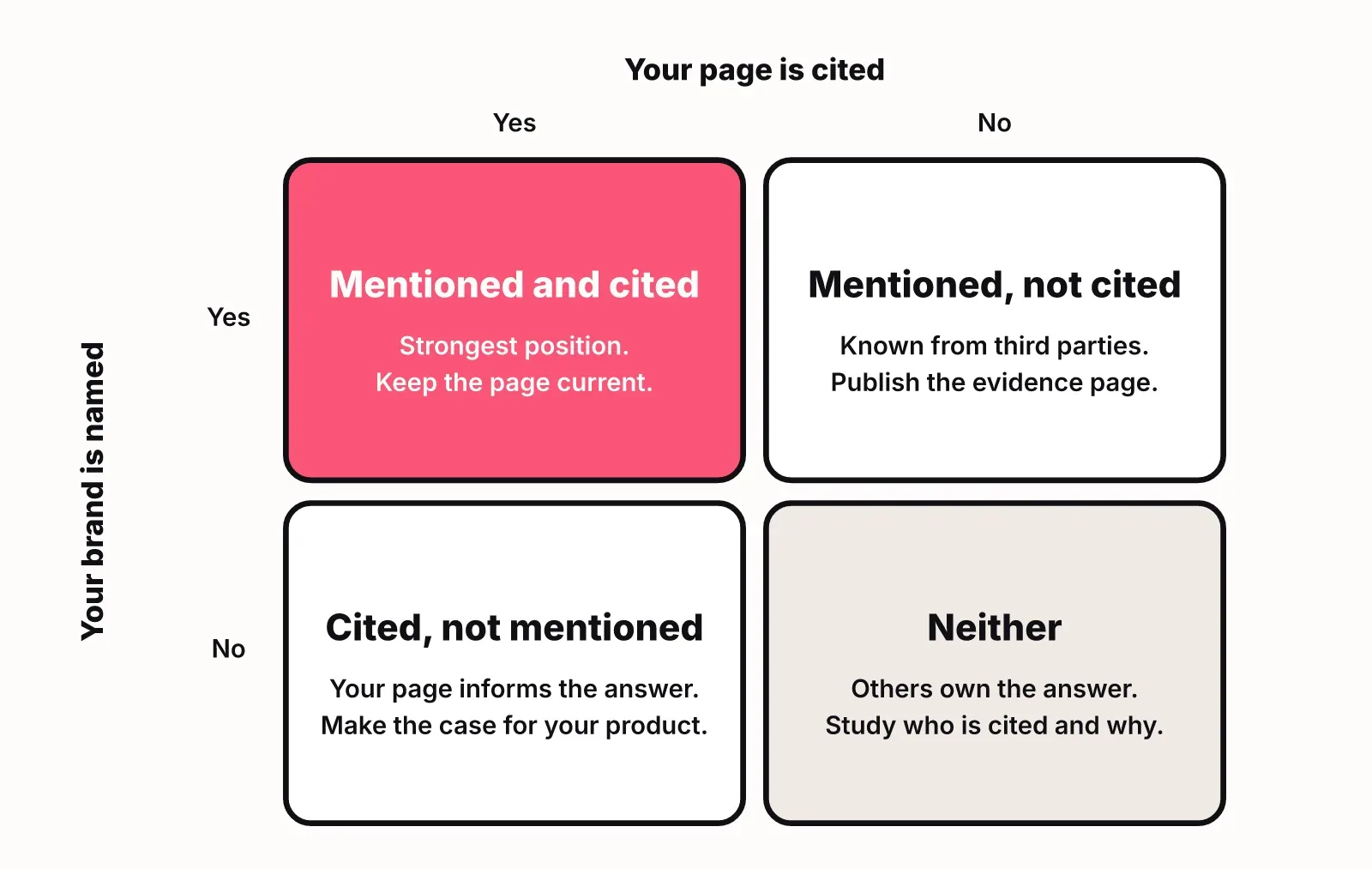
For ChatGPT, Gemini and Perplexity there is no equivalent console, so you have to ask the engines. Pick 10 to 30 questions a buyer would ask before they know your name, run them on a schedule, and record two separate facts about each answer:
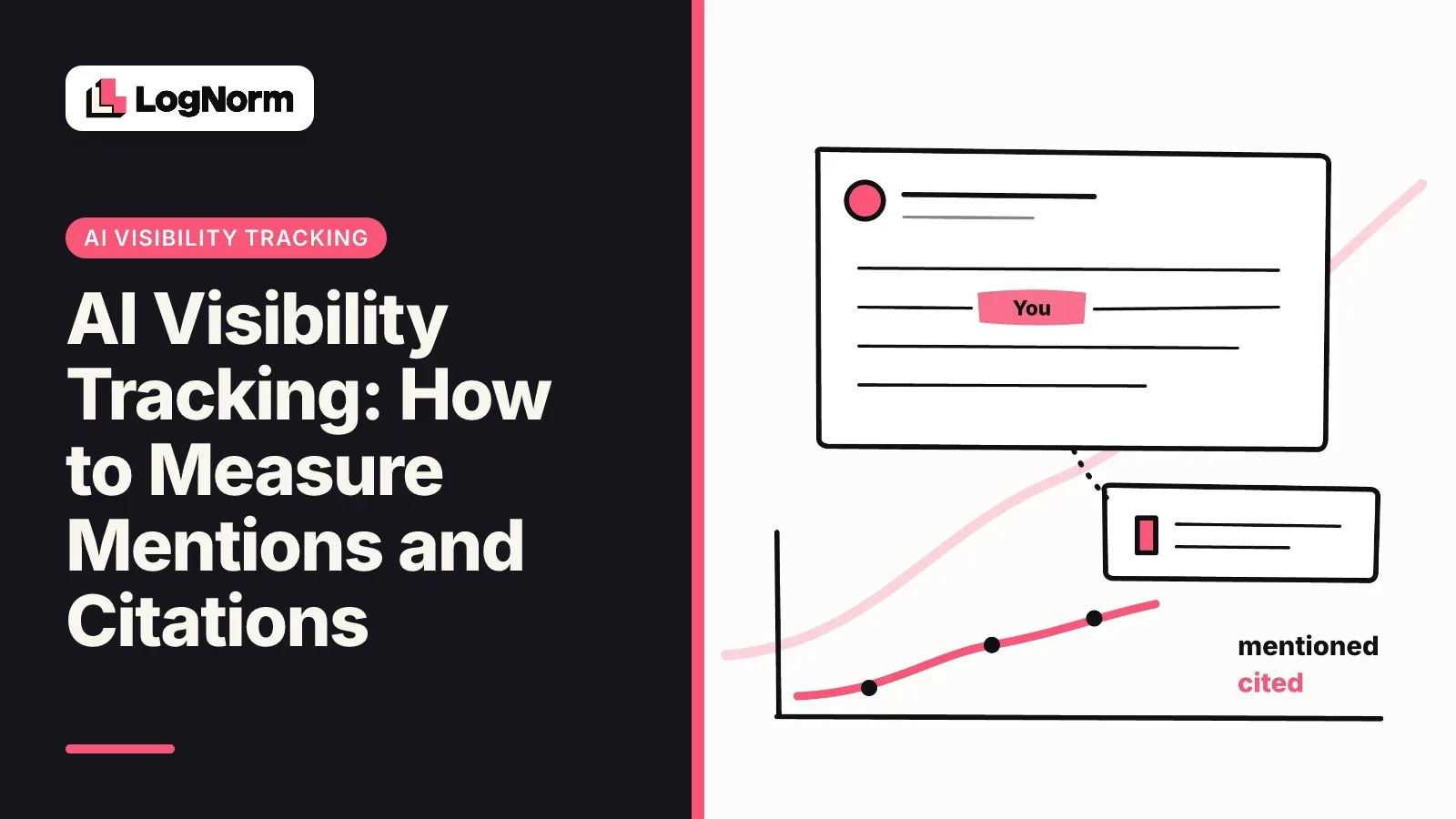
- A mention: the answer names your brand in its text.
- A citation: one of your pages is among the answer's sources.
Those two are independent, and the four combinations call for different work.
| Answer outcome | What it tells you | What to do |
|---|---|---|
| Mentioned and cited | The engine names you and uses your page as evidence | Keep that page current |
| Mentioned, not cited | The engine knows you from third parties | Publish the page that should be the evidence |
| Cited, not mentioned | Your page informs the answer without earning the recommendation | Make the case for your product on that page |
| Neither | Others own the answer | Read who is cited instead and why |
LogNorm's AI visibility tracking runs this for you: it asks ChatGPT, Gemini and Google AI Overviews your tracked prompts in the real products, keeps mention and citation as separate numbers, logs every source the engines used and compares results before and after you ship a page. If you track by hand, a spreadsheet with one row per prompt, engine and date works; the discipline matters more than the tool. For engine-specific tactics, see how to rank in ChatGPT and Perplexity.
FAQ
What is AEO in simple terms?
AEO is making your content easy for search engines and AI assistants to use as the direct answer to a question. That means question-style headings, short answer-first paragraphs, specific supporting detail and a site that crawlers are allowed to read.
Can AEO be used with SEO?
Yes, and it should be. Google treats optimizing for its AI features as part of SEO, so AEO builds on the same foundation: indexable pages, helpful content and technical health. AEO adds a focus on the answer passage and on being named in the response.
How does AEO work?
Answer engines retrieve pages, pick the passages that best answer a question and write or read out a response with sources. AEO works by making sure those engines can crawl your pages, and that each important question has a clear, specific, well-sourced answer near the top of its section.
Is AEO the same as GEO?
Many people use the terms interchangeably. Where a line is drawn, AEO comes from the featured snippet and voice era and focuses on being the extracted answer, while GEO comes from a 2023 research paper and focuses on visibility inside AI-generated responses. The practical work overlaps almost completely.
Does FAQ schema still help with AEO?
Not for Google's FAQ rich results, which Google has retired. FAQ sections still help readers and give answer engines clean question-and-answer pairs, so write them for people rather than for markup.
Do I need an llms.txt file for AEO?
Not for Google. Google says its Search features, including AI Overviews and AI Mode, do not use llms.txt. It is fine to keep one if another service you care about reads it.