LLM SEO: How to Get Your Brand Into AI Answers
LLM SEO is how you get named and cited by ChatGPT, Gemini, Perplexity and AI Overviews. A five-step playbook from crawler access to measuring answers.


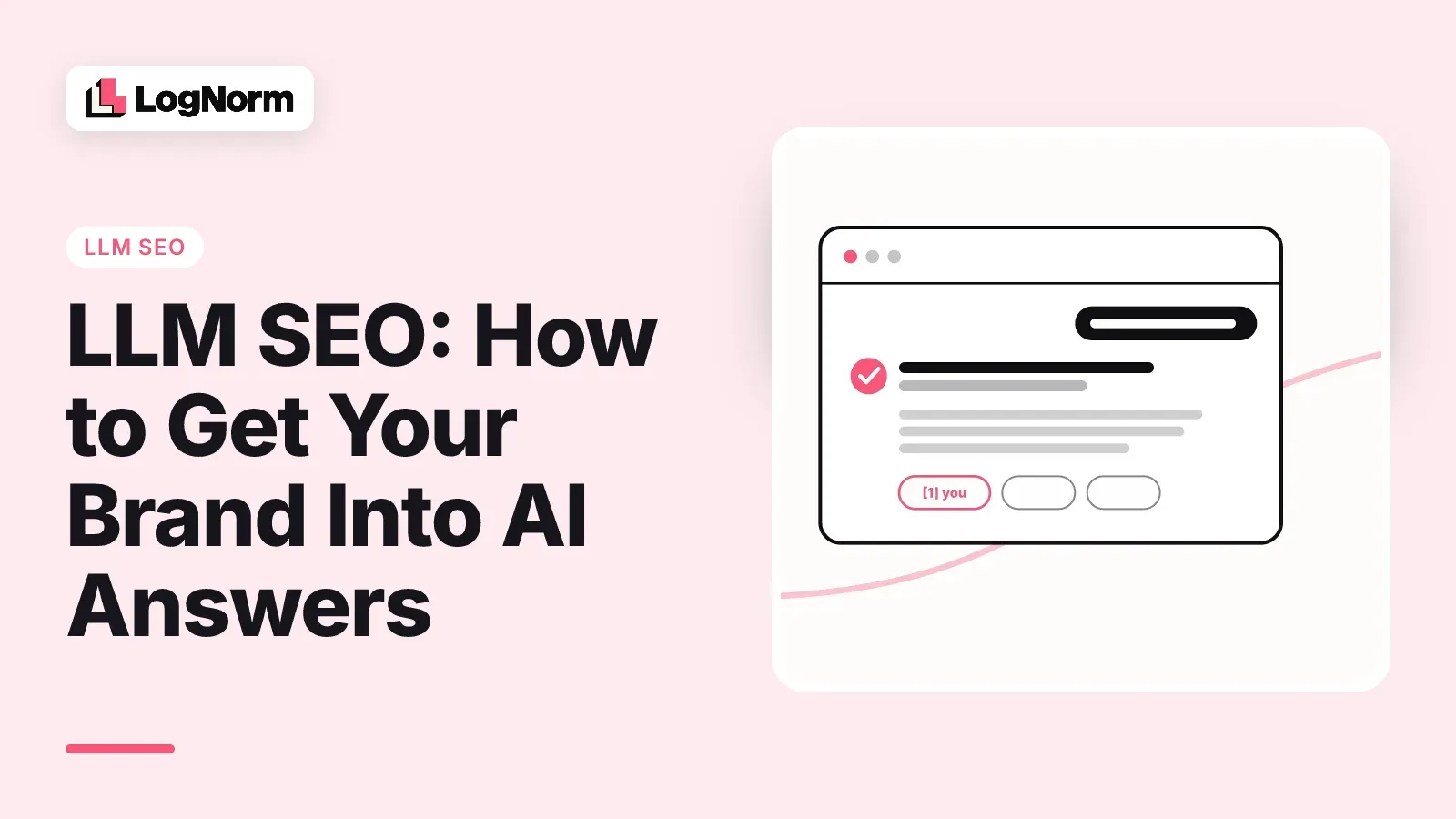
LLM SEO is the work of getting AI assistants like ChatGPT, Gemini, Perplexity and Google's AI Overviews to name your brand in their answers and cite your pages as sources. Most of it comes down to five things: let the AI crawlers read your site, describe your company the same way everywhere, write pages that answer questions in their first sentence, get onto the third-party pages the engines already trust, and measure the answers instead of guessing.
This guide is the practical version. Each step says what to change, where to check it, and what it fixes. If you want the wider strategy first, read our guide to generative engine optimization. If you came here to use AI tools for classic SEO work, our post on using AI to do SEO covers that instead.
What LLM SEO is and how it differs from SEO
LLM SEO is optimizing for the answer, not the results page: success means an assistant names you when a buyer asks for a recommendation, and links one of your pages as its evidence. Classic SEO still matters, because most assistants search the web before they answer. The difference is in what wins and how you measure it.
| Classic SEO | LLM SEO | |
|---|---|---|
| Goal | Rank a page and earn the click | Be named in the answer and cited as a source |
| Unit of success | A position for a keyword | A mention or citation for a prompt |
| What decides it | Relevance, links, page experience | Whether the engine can retrieve, trust and quote you, on your site and on others |
| Where the work happens | Mostly your own pages | Your pages plus the third-party pages the engines read |
| How you measure | Rankings, impressions, clicks | Mention rate and citation rate across tracked prompts |
The answer itself is becoming the shelf. SparkToro found that 68.01% of Google searches in the first four months of 2026 ended without a click. When the buyer reads the summary and stops, the brands named in it are the ones that get considered.
You will also see this work called GEO (generative engine optimization) or AEO (answer engine optimization). The labels differ in emphasis. The tasks below are the same under all three names.
How AI engines decide which brands to name
An AI assistant answering a buying question usually runs a short pipeline: it searches the web, pulls a handful of pages, extracts the passages that answer the prompt, and writes an answer that names brands and lists some of those pages as sources. You can influence every stage except the last one, which is the model's own judgement.
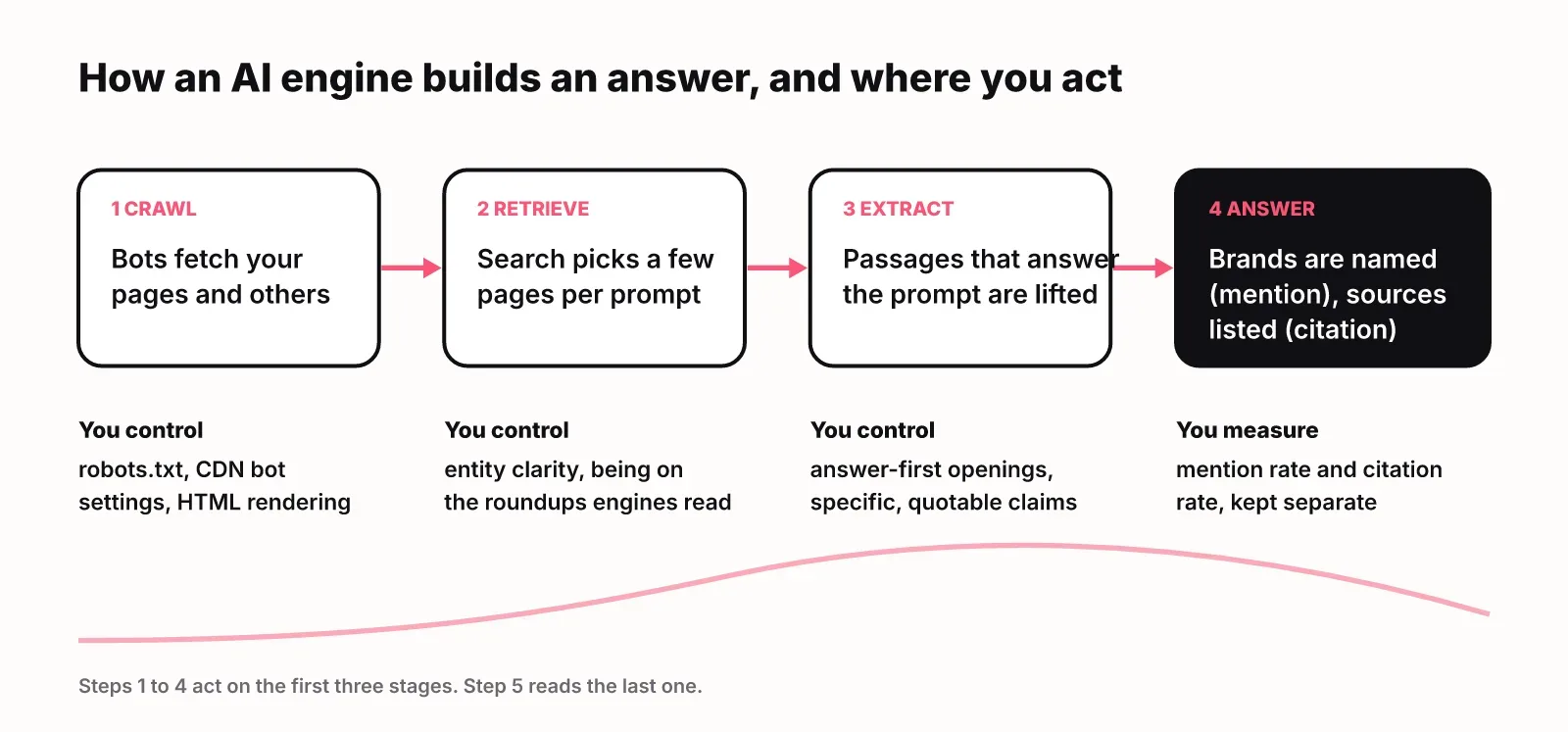
That pipeline creates two separate outcomes. A mention is your brand named in the answer text. A citation is one of your pages in the answer's sources. They come from different places. An engine can name you because three review sites did, while citing none of your pages. It can also cite your guide while recommending a competitor.
The engines also differ in where they look and which crawler fetches your pages.
| Engine | Where answers come from | Crawler to allow |
|---|---|---|
| ChatGPT (search) | Live web search plus the model's training | OAI-SearchBot for search, ChatGPT-User for pages a user asks it to open, GPTBot for training |
| Gemini | Google Search grounding plus the model's training | Googlebot for Search; Google-Extended controls Gemini's use of your content |
| Perplexity | Live web search on every answer | PerplexityBot |
| Google AI Overviews | Google's search index | Googlebot (Google-Extended does not affect AI Overviews) |
For ChatGPT in particular, our ChatGPT SEO guide goes deeper on how its search picks sources. The rest of this playbook works across all four.
Step 1: Let the AI crawlers in
An engine cannot cite a page its crawler was refused, so check access before you touch any content. Open yourdomain.com/robots.txt and look for Disallow rules under the AI user agents above, or a blanket User-agent: * block that catches them.
A permissive setup for a marketing site looks like this:
User-agent: OAI-SearchBot
Allow: /

User-agent: ChatGPT-User
Allow: /

User-agent: PerplexityBot
Allow: /

User-agent: Googlebot
Allow: /

Sitemap: https://yourdomain.com/sitemap.xml
Whether to allow training crawlers such as GPTBot, ClaudeBot and Google-Extended is a separate choice. Blocking them keeps your content out of future training data. Allowing them means the model may know your brand without searching. For a startup that wants to be known, allowing them is usually the better trade.
Then check the layers robots.txt does not show you:
- Your CDN or firewall. Bot protection settings can block AI crawlers even when robots.txt allows them. Look for an AI bot or verified bot setting in your CDN dashboard.
- Rendering. Load a key page with JavaScript turned off. If the product description, pricing or comparison table is missing, crawlers that read raw HTML will miss it too.
- Status codes. Pages that redirect in chains or return errors to unknown user agents drop out quietly.
An llms.txt file, a plain Markdown index of your most important pages, is a cheap extra once the basics work. It does not replace any of the checks above. You can test robots.txt and build an llms.txt with our free robots.txt, schema and llms.txt tools. LogNorm's GEO audit also checks AI crawler access in robots.txt as part of a full site crawl.
Step 2: Make your brand an unambiguous entity
An engine names you confidently only when every source agrees on what you are. Write one plain sentence that says what you do and for whom, then use it word for word on your home page, about page, docs, social profiles, directory listings and press boilerplate.
"Acme is invoicing software for freelance designers" gives an engine something to repeat. "Acme reimagines the future of getting paid" does not. When sources disagree on your category, the engine may describe you wrongly or leave you out.
Next, build one page that states the facts an assistant needs. Some teams call it an LLM info page; your about or product overview page can do the job. Include:
- What the product is and the category it belongs to.
- Who it is for, and who it is not for.
- How pricing works, even if you only publish the model and the starting tier.
- What it integrates with and what it replaces.
- Links to the deeper pages for each of the above.
Then add structured data that matches the visible text. Organization with sameAs links to your profiles tells engines that your site, LinkedIn page and GitHub are the same company. SoftwareApplication or Product describes what you sell. Keep it honest: markup that claims things the page does not say is a mismatch, not a signal.
{
  "@context": "https://schema.org",
  "@type": "Organization",
  "name": "Acme",
  "url": "https://acme.com",
  "description": "Acme is invoicing software for freelance designers.",
  "sameAs": [
    "https://www.linkedin.com/company/acme",
    "https://github.com/acme"
  ]
}
Schema helps engines read you, but it is not a requirement for being cited. Plenty of cited pages carry none. Treat it as the last layer of entity work, after the sentence and the info page.
Step 3: Write answer-first pages the engines can quote
Engines lift passages, not whole pages, so the sentence right under each heading has to answer that heading on its own. If someone copied only that sentence into an answer, it should still be correct and still name the thing it is about.
Compare two openings under "How much does Acme cost?":
- "Pricing is something we think about carefully, because every team is different."
- "Acme costs $12 per user per month, with a free plan for one user."
Only the second can be quoted. The same rule applies to definitions, comparisons and how-to steps. Put the claim first, then the nuance.
Answer-first writing matters most on the pages that answer buying prompts:
| Page type | The prompt it answers | What to put first |
|---|---|---|
| Pricing | "How much does X cost?", "affordable X tools" | The starting price and what it includes |
| Comparison | "X vs Y" | Who should pick which, in one sentence |
| Alternatives | "best alternatives to Y" | Who you are better for, and why |
| Use case | "best X for [team or job]" | The job, the result, the fit |
| Category explainer | "what is [category]" | A definition that includes your category name |
Here is what that looks like in practice. One of the prompts we track is a buyer asking for affordable alternatives to a well-known AI visibility tracker. ChatGPT's answer cited the pricing pages of three tracking tools directly. Clear, public pricing was the evidence it used. Gating pricing behind a demo form removes you from that kind of answer.
This also explains why some well-written pages never get cited. They teach the topic well but never make a specific claim about a product, so an engine can use them as background without having a reason to name anyone. If your guides inform the answer while a competitor gets the recommendation, add the sentence that says who your product is for.
Step 4: Get onto the third-party pages the engines already cite
For buying prompts, the engines lean on roundups and lists more than on product pages. In the same tracked prompt, Gemini and Google AI Overviews cited roundup posts, not product pages: lists on Zapier, Exploding Topics, Medium and Reddit, plus alternatives roundups that tool vendors had published on their own blogs. If you are missing from those lists, your own product pages cannot make up for it.
This step is the least glamorous part of LLM SEO and often the most effective. Work it from the evidence:
- For each prompt you care about, list every source each engine cited.
- Group the sources by type: roundups, review sites, communities, docs or directories.
- For roundups that leave you out, write to the author with a short factual pitch: what you do in one sentence, who it is for, the pricing model, and one difference that matters to their readers.
- For communities, answer the questions people are actually asking, under your own name, and mention your product only where it fits the question.
- For directories and review sites, make sure your listing uses the same one-sentence description as your site.
Publishing your own honest roundup of the category counts too, since vendor-written lists were among the cited sources. Do not buy placements or post fake reviews. The engines pick sources that people trust, and a source caught selling slots stops being one.
Step 5: Measure mentions and citations separately
Measure LLM SEO by running a fixed set of buyer prompts in the real assistants and recording, for each answer, whether it names you and whether it cites you. Keep the two numbers apart. Merged into one "visibility score", they hide which problem you have.
Start with 10 to 30 prompts phrased the way buyers ask, without your brand name in them. Run them in the consumer products, not the developer APIs, from the country you sell in, because the products search the web and choose sources differently from the raw models. Re-run them at least monthly, since answers change between runs.
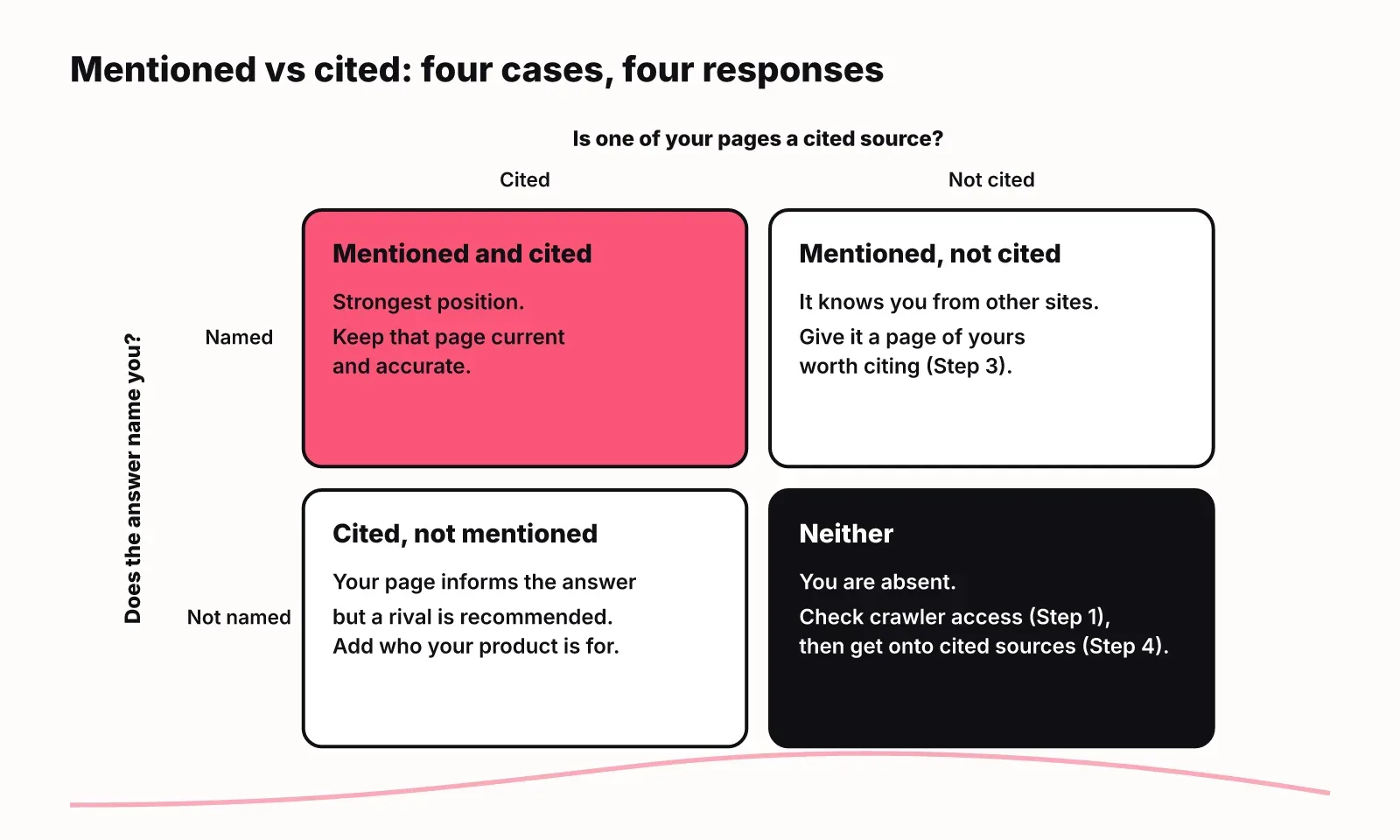
Every answer then lands in one of four cases, and each needs a different response.
| Case | What it means | What to do |
|---|---|---|
| Mentioned and cited | The engine names you and uses your page as evidence | Keep that page current and accurate |
| Mentioned, not cited | It knows you from third-party sources | Step 3: give it a page of yours worth citing |
| Cited, not mentioned | Your page informs the answer but you are not recommended | Add the claim about who your product is for |
| Neither | You are absent | Steps 1 and 4: check access, then get onto the cited sources |
You can do this by hand in a spreadsheet for a handful of prompts. To track your prompts in ChatGPT, Gemini and AI Overviews on a schedule, LogNorm runs them in the real products by country, records mention and citation separately, keeps every source the engines used and follows your competitors through the same answers. It does not track Perplexity today, so run those prompts by hand if Perplexity matters to your buyers.
A 30-day LLM SEO plan
A small team can work through the whole playbook in a month if it goes in this order:
| Week | Work | Done when |
|---|---|---|
| 1 | Write your prompt list and record a baseline in each engine. Audit robots.txt, CDN bot settings and JavaScript rendering. | Baseline saved, crawlers allowed, key pages readable without JavaScript |
| 2 | Write the one-sentence description and roll it out everywhere. Build or fix the info page. Add Organization and product schema. | Every profile and listing matches |
| 3 | Rewrite the openings of your pricing, comparison and alternatives pages answer-first. Publish public pricing if you can. | Each heading's first sentence answers it alone |
| 4 | List the third-party sources cited for your prompts and start outreach to the top five. | Pitches sent, community answers posted |
Re-run the prompts at the end of the month and again a month later. Changes on other people's sites can take longer to reach the answers than changes to your own pages, so judge step 4 on the second run.
If you would rather not run this from a spreadsheet, LogNorm's LLM SEO tool does the finding and ranking: its GEO audit checks crawler access and answerability across your site, its AI visibility tracking shows who is named and cited for your prompts, and each gap becomes a ranked move in your weekly plan. Your team or your coding agents ship the fixes, and LogNorm re-checks them on the live site and measures the result at 28 and 90 days.
FAQ
What is LLM SEO?
LLM SEO is optimizing your website and your presence on other sites so that AI assistants such as ChatGPT, Gemini, Perplexity and Google AI Overviews name your brand in their answers and cite your pages as sources.
Does LLM SEO replace classic SEO or blog content?
No. Most assistants search the web before answering, so pages that rank and get crawled are the raw material for their answers. LLM SEO changes how you write those pages and adds off-site work. It does not replace the blog.
Is schema required for AI search visibility?
No. Schema helps engines confirm who you are and what you sell, but pages without it get cited all the time. Fix crawler access, your description and your page openings first, then add schema that matches the visible text.
Why do some pages never get cited even when they're well written?
Usually for one of three reasons: a crawler cannot reach or render the page, the answer is buried under an introduction, or the page never makes a specific claim an engine could quote. Check them in that order.
Where should an LLM info page live, and will it create duplicate content?
Put it at a stable, linked URL such as your about page or a product overview, and link it from the footer. It should summarize and link to your deeper pages rather than copy them, which avoids duplicate content.
What's the biggest mistake teams make with LLM SEO?
Working only on their own site. For buying prompts, engines lean heavily on third-party roundups, reviews and communities, so a team that never checks which sources get cited is optimizing the part of the answer it controls least.
How do you measure the impact of LLM SEO work?
Track a fixed set of unbranded buyer prompts in the real assistants, record mention rate and citation rate separately, and compare against a baseline taken before the work. Re-run at least monthly and note what you shipped in between, so you can connect changes in the answers to specific work.