Agentic Marketing: How AI Agents Change the Growth Workflow
Agentic marketing means AI agents that plan, act and get checked. See how the growth workflow and team roles change, with a worked example.



Agentic marketing is marketing work done by AI agents that plan their own steps, act in your tools, and get checked before anything ships. The planning and acting are what vendors talk about. The checking is what decides whether it works for your team.
Most guides to agentic marketing describe an agent running campaigns across channels. This one is about something closer to home: how your team's weekly workflow changes, and who does what, once agents take on the first pass of growth work. It is part of our guide to running SEO and growth from your terminal with Claude Code.
What is agentic marketing?
Agentic marketing is the practice of giving AI agents a goal and a ranked list of work, letting them choose the steps, and checking the result against evidence before it goes live. The agent does the doing. People set direction and keep the final call.
It is already common. Forrester's 2026 report on AI inside US marketing agencies found that nine in 10 agencies use generative AI, and half use agentic AI for marketing execution. A January 2026 RevSure and Ascend2 study of 306 B2B go-to-market leaders found 76% of organizations already deploying agentic AI in marketing, sales or revenue operations.
Adoption is not the hard part. The hard part is a workflow where agent output gets checked as reliably as it gets produced.
Agentic marketing vs marketing automation
Marketing automation runs steps you wrote in advance. Agentic marketing gives an agent the goal and lets it pick the steps.
A welcome sequence is automation: form fill, enrich, send email one, wait three days, send email two. It breaks when inputs change, and it never decides that the sequence itself is the wrong fix. An agent working a move like "Refresh the pricing guide" reads the page, checks what ranks, drafts the changes and asks for review. The steps vary every time.
You do not replace one with the other. Keep AI marketing automation for repeatable steps. Use agents for work where the steps change each time. For a task-by-task list of where agents help and where they fail, see what AI agents can do for marketing today.
The old growth workflow and where it stalls
The usual growth workflow stalls in two places: deciding what to do first, and checking whether it worked.
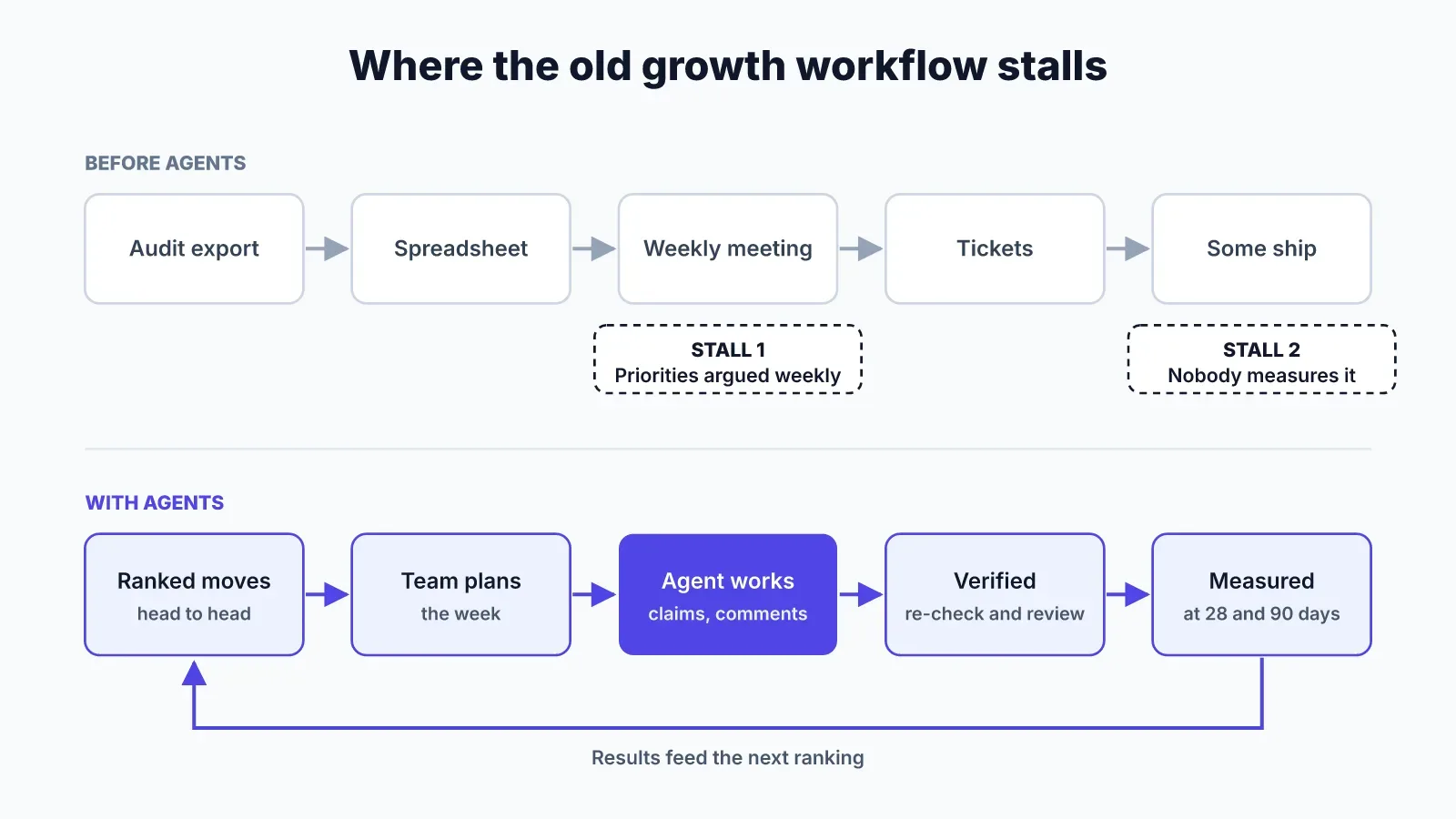
A typical small team runs it like this. Someone exports an SEO audit and a keyword list into a spreadsheet. A weekly meeting argues about priorities. A few items become tickets. Some ship. Almost nobody goes back to measure them at 30 or 90 days, so the next meeting starts from the same spreadsheet.
Dashboards made this worse. They produce findings, and findings are not decisions. A list of 200 audit issues tells you what is wrong. It does not tell you which three to fix this week.
Adding an agent to this workflow without changing it gives you faster tickets and the same two stalls. The workflow has to change around the agent.
The agentic loop: move, agent, verification
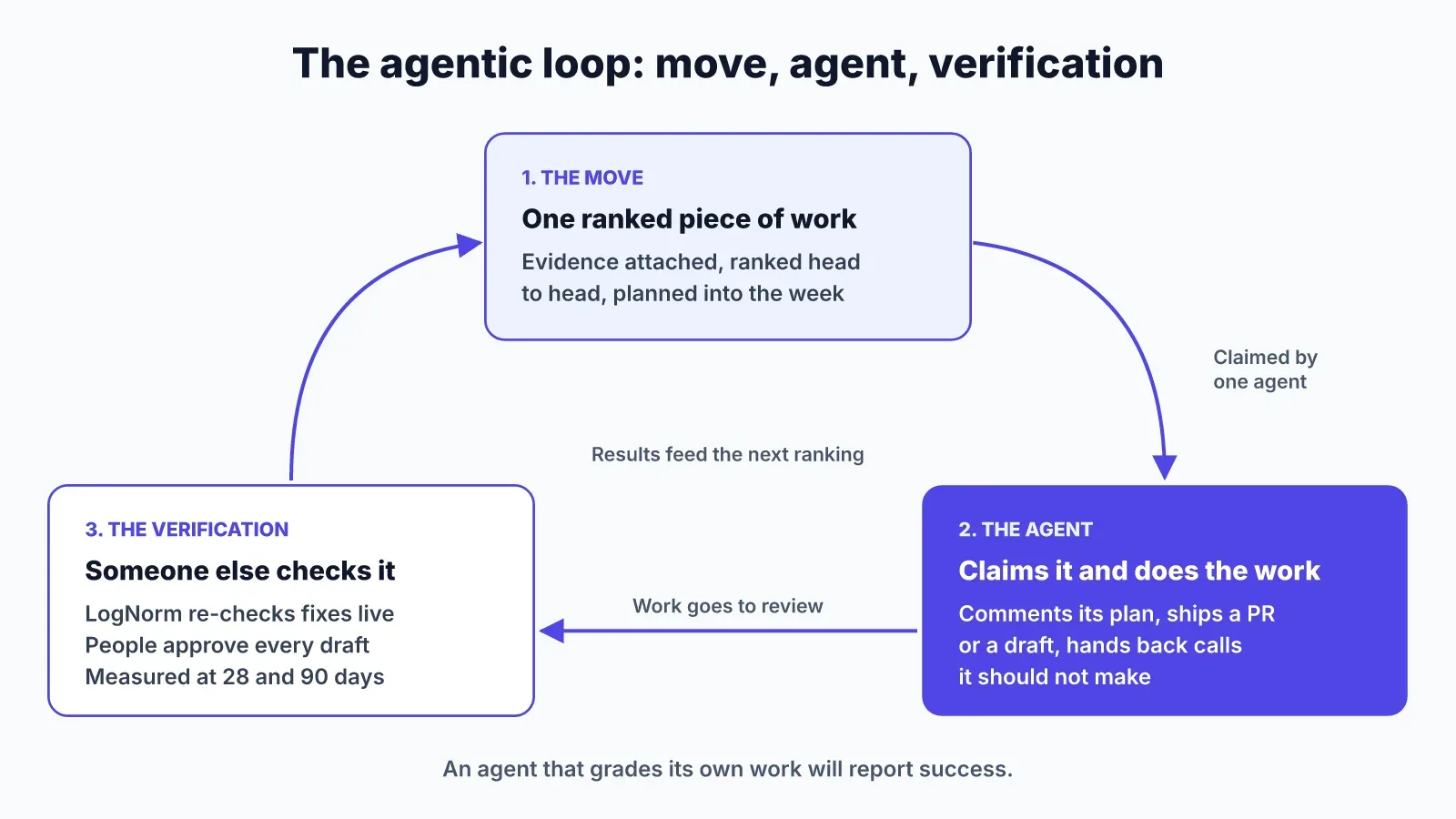
The agentic loop has three parts: a ranked move, an agent that works it, and a verification step that checks the result. Each part fixes one of the old stalls.
The move
A move is one concrete piece of growth work with its evidence attached. In LogNorm, every finding from the site audit, GEO audit, keywords, Search Console, competitors and AI answers becomes a move. LogNorm ranks moves head to head ("if the team can only do one this week, which comes first?") and says how sure it is about each call. The team plans the best moves into the week.
This fixes the first stall. The priority argument happens once, against evidence, before anyone starts work.
The agent
The agent claims a move from the week's plan, posts its plan as a comment, and does the work. A fix lands in your repository as a commit or pull request. A content move becomes a brief, a draft with images, and a request for review. When the agent hits a decision it should not make, it hands the move back to a person with a note.
A claim locks the move to one agent, so parallel agents never collide.
The verification
Verification means a system other than the agent checks the agent's work. LogNorm re-checks a fix on the live site instead of trusting the agent's report. People approve drafts before anything is published. Shipped moves are then measured at 28 and 90 days, and the results feed the next ranking.
This fixes the second stall, and it is the step most agentic marketing setups skip. An agent that grades its own work will report success.
How team roles change
In agentic marketing, people move from doing the first pass to deciding, reviewing and owning the voice. The agent takes the first pass.
Here is how the split works on a small growth team using LogNorm:
| Role | Before agents | With agents |
|---|---|---|
| Founder or growth lead | Builds the backlog, argues priorities | Plans the ranked week, makes the calls agents hand back |
| Marketer or writer | Researches, briefs and drafts every post | Edits and approves drafts, owns voice and positioning |
| Engineer | Fixes SEO tickets between product work | Reviews the agent's pull requests |
| AI agent | Not involved | Claims moves, researches, drafts, fixes, comments |
| LogNorm | Not involved | Ranks moves, re-checks fixes, measures at 28 and 90 days |
Three practical changes follow.
Review becomes the main job. A writer who used to produce two posts a week now reviews more drafts than they could write. That only works if each draft arrives with its sources and the agent's notes, so review takes minutes.
The Company Brain becomes shared infrastructure. Positioning, docs, pricing, customer language and voice live in one place that every agent draft draws on. When the marketer updates it, every future draft changes.
Requests replace briefing meetings. Anyone on the team can send an agent a request from the dashboard. Growth reviews run as Growth strategist sessions the team can reply to, instead of a slide deck once a quarter.
A week of agentic marketing on lognorm.com
On 2 October 2026, one agent session on lognorm.com went from audit to a planned content cluster without a meeting.
The agent ran a site audit covering 66 pages, which scored 89 out of 100. It triaged the findings into fixes worth doing and noise. It then researched about 30 keywords and planned a 13-post content cluster. Each post became a ranked move in the Growth Plan.
Sub-agents then picked up the content moves in parallel, each under its own name. Each one claimed its move, posted a plan, saved a brief, wrote a draft with diagrams and sent it for review. This post is one of those drafts.
The people on the team did three things that week: chose which moves went into the plan, reviewed the drafts, and decided what to publish. Everything else was a first pass they could read on the dashboard.
Guardrails that keep the loop honest
The guardrails that matter most in agentic marketing are permission limits, a visible record and screened inputs. Without them, the verification step has nothing to check.
- Scoped permissions. In LogNorm, an agent joins as an editor or contributor, never above the person who connected it. You switch off what it should not do, such as running research that uses credits.
- Hard limits. Agents cannot publish, change billing, members, integrations or AI keys, or permanently delete.
- A visible record. Every claim, comment and decision appears on the dashboard under the agent's name, with a live status line.
- Screened inputs. Third-party text (crawled pages, competitor pages, AI answers) is screened, and instructions aimed at agents are withheld before the agent reads them.
- Calibrated calls. LogNorm's decision model shows its confidence, and an unsure call waits for a person.
The identity side of this, what makes an agent a named teammate rather than a background process, is covered in what is a growth agent.
FAQ
What are some examples of agentic marketing?
An agent that claims a "missing meta descriptions" move, fixes the pages in your repository and asks LogNorm to re-check them is one. Another is an agent that researches a keyword, writes a brief and draft, and sends it to a person for review.
Do I need to replace my marketing automation platform?
No. Automation keeps running your fixed sequences. Agents sit beside it and work the open-ended moves in your growth plan.
How much does agentic marketing cost?
With LogNorm, the agent's own thinking runs on the Claude or Codex plan you already pay for, so you need no extra AI key. Anything LogNorm runs for the agent, such as research runs, keyword lookups and fix re-checks, uses credits within your spend cap.
Is agentic marketing right for small teams?
Yes. Small teams gain the most, because they have the longest backlog per person. Start with one agent, a ranked week and a person who reviews every draft.
What are the biggest risks of agentic marketing?
The biggest risk is unchecked output: an agent publishing or reporting success with nobody verifying. The second is injected instructions in pages the agent reads. Keep publishing with people, verify fixes on the live site, and use a tool that screens third-party text. To try the loop yourself, connect an agent to LogNorm.