What Is a Growth Agent? How AI Teammates Run Growth
A growth agent is an AI teammate with a name, permissions and a visible record. See how one works from a ranked weekly plan.



A growth agent is an AI teammate that works your growth backlog. It picks up the next piece of ranked work, does it, and leaves a record your team can check. It has a name, a set of permissions you chose, and a visible trail of every claim, comment and decision it makes.
That last part is what separates a growth agent from a black box. Most products that use the label today show you outcomes ("we published 40 articles") and hide the steps. A teammate shows you the steps.
This post defines the term, compares it with the things it gets confused with, and walks through how a growth agent spends a normal week. It is part of our guide to running SEO and growth from your terminal with Claude Code.
What is a growth agent?
A growth agent is an AI agent that takes ranked growth work (a technical SEO fix, a blog post, a keyword plan, a competitor check) and finishes it inside your team's tools, under its own name. It decides how to do each task. Your team decides which tasks matter.
Search "growth agent" today and almost every result is a product homepage. They describe an autopilot that maps your market and publishes for you. That is a description of output, and it skips the question a founder actually asks before connecting anything to their site: what will it do, and how will I know?
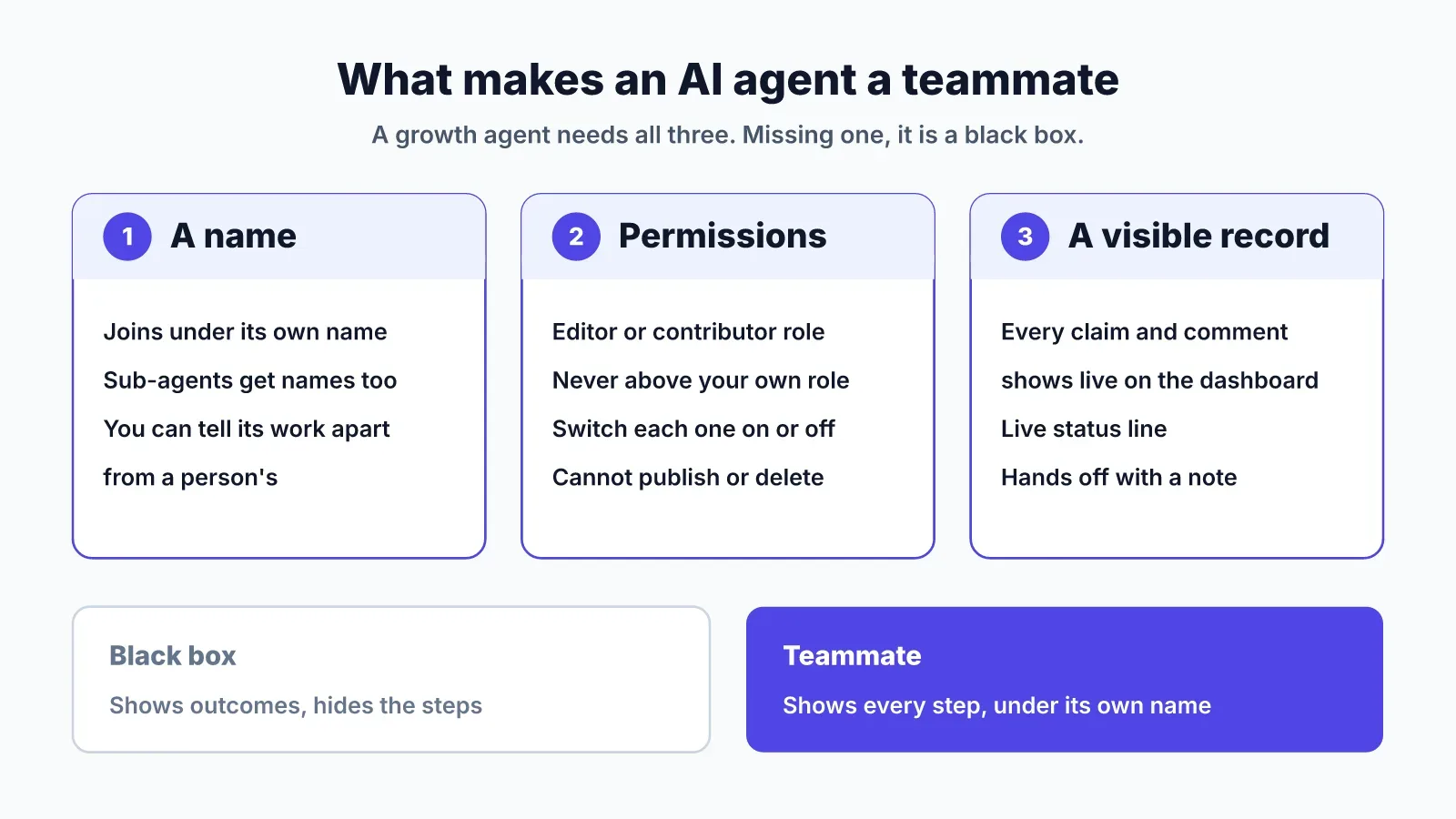
Here is a test you can run on any AI growth agent. A product counts as a growth agent only if it has:
- a name, so you can tell its work apart from a person's and from other agents
- permissions, so it can do some things and is blocked from others
- a visible record, so every action can be read, questioned and undone by a person
If a tool has none of these, it is automation with a chat box. If it has all three, you can treat it like a junior teammate.
Growth agent vs chatbot, automation and agency
A growth agent chooses its next task from a shared plan and acts on it. A chatbot waits for your prompt. Automation repeats steps someone wrote. An agency is people you brief once a month.
The differences show up in who decides what happens next and who can see the work.
| Chatbot | Marketing automation | Agency | Growth agent | |
|---|---|---|---|---|
| Who picks the next task | You, each prompt | The rule you wrote | The account manager | The ranked plan, then the agent |
| Acts in your tools | No | Yes, fixed steps | Yes, by hand | Yes, within its permissions |
| Where the work shows | Your chat history | Run logs | Monthly report | Live, on the team dashboard |
| Best for | One-off drafting | Repeatable steps | Strategy and creative | The weekly backlog |
If you want the general definition of an AI agent, and the tasks agents handle well today, read what AI agents can do for marketing today. This post is narrower. It is about the agent that owns your growth backlog.
The three things that make an agent a teammate
An agent becomes a teammate when it joins the workspace the way a person does: with an identity, a role and accountability. Here is what each of those looks like in practice, using LogNorm agents as the example.
A name
Each agent joins under a name of its own, such as "Kuldeep's Panda". When it starts helpers for parallel work, each sub-agent shows under its own name too, such as "Panda · Pip". You always know which agent wrote a draft or claimed a fix.
Permissions
The agent joins as an editor or contributor, never above the role of the person who connected it. You switch each permission on or off: read the website's data, work on moves, write drafts, re-check fixes, add to the Company Brain and run research. It leaves the team after 1, 7 or 30 idle days, or when you remove it.
A visible record
Every claim, comment and decision appears live on the dashboard, credited to the agent. A status line shows what it is doing right now. When it needs a decision, it hands the move to a person with a note instead of guessing.
How a growth agent works from a ranked weekly plan
A growth agent works from a ranked list of moves, and your team decides which of them go into the week. The agent does not set its own priorities.
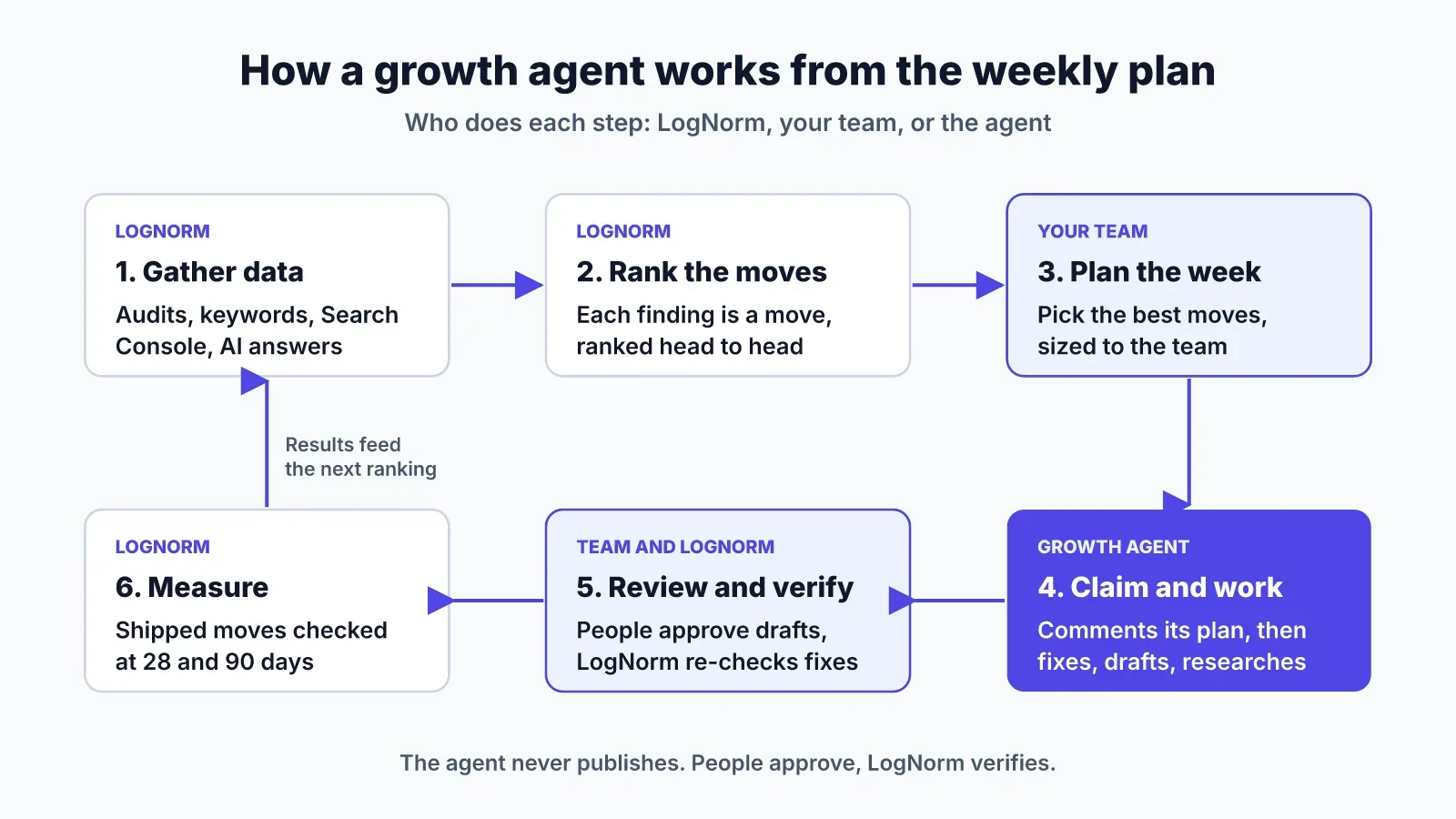
Here is how the loop runs in LogNorm:
- LogNorm gathers the data: a crawl and SEO audit, a GEO audit, keywords, Google Search Console, competitors, and how ChatGPT, Gemini and Google AI Overviews answer your buyers.
- Every finding becomes a move. LogNorm ranks moves head to head and shows how sure it is about each call.
- Your team plans the best moves into a ranked weekly Growth Plan sized to the team.
- The agent claims a move, posts its plan as a comment, and does the work: a fix in your codebase, a brief and draft, a keyword plan.
- LogNorm re-checks fixes on the live site, and people review drafts.
- Shipped moves are measured at 28 and 90 days.
Claims matter more than they look. A claimed move is locked to one agent, so two agents never work the same move.
Here is a first-hand example. In one session on 2 October 2026, an agent ran a site audit on lognorm.com. It covered 66 pages and scored 89 out of 100. The agent triaged the findings, then planned a 13-post content cluster from about 30 researched keywords. Each post became a ranked move in the plan. This article is one of them.
What a growth agent should never do alone
A growth agent should never publish, spend, or change who has access. Those calls stay with people.
In LogNorm, agents cannot publish content. They send drafts for review, and a person approves and publishes. They also cannot change billing, members, integrations or AI keys, and they cannot permanently delete anything.
Two less obvious guardrails matter as much:
- Third-party text is screened before the agent reads it. Crawled pages, competitor pages and AI answers can contain hidden instructions aimed at agents. LogNorm withholds them and tells the agent something was withheld.
- Calls come with a confidence. LogNorm's decision model says how sure it is, and when it is not sure, the decision waits for a person.
If a product cannot tell you which of these it enforces, assume it enforces none.
Can a growth agent replace an AI marketing team?
No. A growth agent replaces the slow first pass of growth work. It does not replace the people who decide what the company stands for.
The work that moves to the agent is the work that eats a small team's week: reading audit findings, researching a keyword, drafting a brief, fixing 38 missing meta descriptions, re-checking that a fix went live. The work that stays with people is positioning, the order of priorities, the final read of anything public, and the call on anything that costs money.
The phrase "AI marketing team" usually means a stack of separate tools, one per job. A growth agent works better as one teammate inside your existing team. A two-person startup gains the most, because it has the longest backlog per person and the least time to work it.
How to bring a growth agent onto your team
Plan the week first, then connect the agent. An agent with no plan will do busy work.
- Accept and order this week's moves in your Growth Plan.
- Connect your agent (Claude Code, Claude desktop or web, OpenAI Codex or Cursor) to LogNorm's MCP server and sign in. Choose its role, its idle timer and its permissions on the consent screen.
- Give it the week. A starter prompt tells it to read the plan, claim the moves it can do, and start sub-agents for fixes, drafts and research.
- Review its drafts and comments. Let LogNorm re-check its fixes on the live site.
You do not need an AI key for this. The agent's own plan (your Claude or Codex subscription) does the thinking, while LogNorm's ranking, audits and research runs keep running on LogNorm. The agent docs list every permission and command.
FAQ
Can you give an example of a growth agent?
Claude Code connected to LogNorm is one. It joins the workspace under a name, claims a ranked move such as "38 pages are missing a meta description", fixes them in your repository, and asks LogNorm to re-check the live pages.
What are the three types of agents?
People usually mean chatbots, workflow automations and true agents. A chatbot answers, a workflow follows fixed steps, and an agent chooses its own steps toward a goal. A growth agent is the third kind, pointed at your growth backlog.
Do growth agents run growth reviews?
Yes. In LogNorm, an agent can run a growth review as a Growth strategist session that your team can read and reply to. See growth reviews for how they work.
How is a growth agent different from agentic marketing?
A growth agent is the teammate. Agentic marketing is the way of working that agents make possible. We cover the second in how AI agents change the growth workflow.