SEO Roadmap Template: Plan 90 Days of Startup SEO
A copyable 90-day SEO roadmap template for startups: what to do in weeks 1-2 and months 1-3, how to rank tasks as a backlog, and how to measure results.


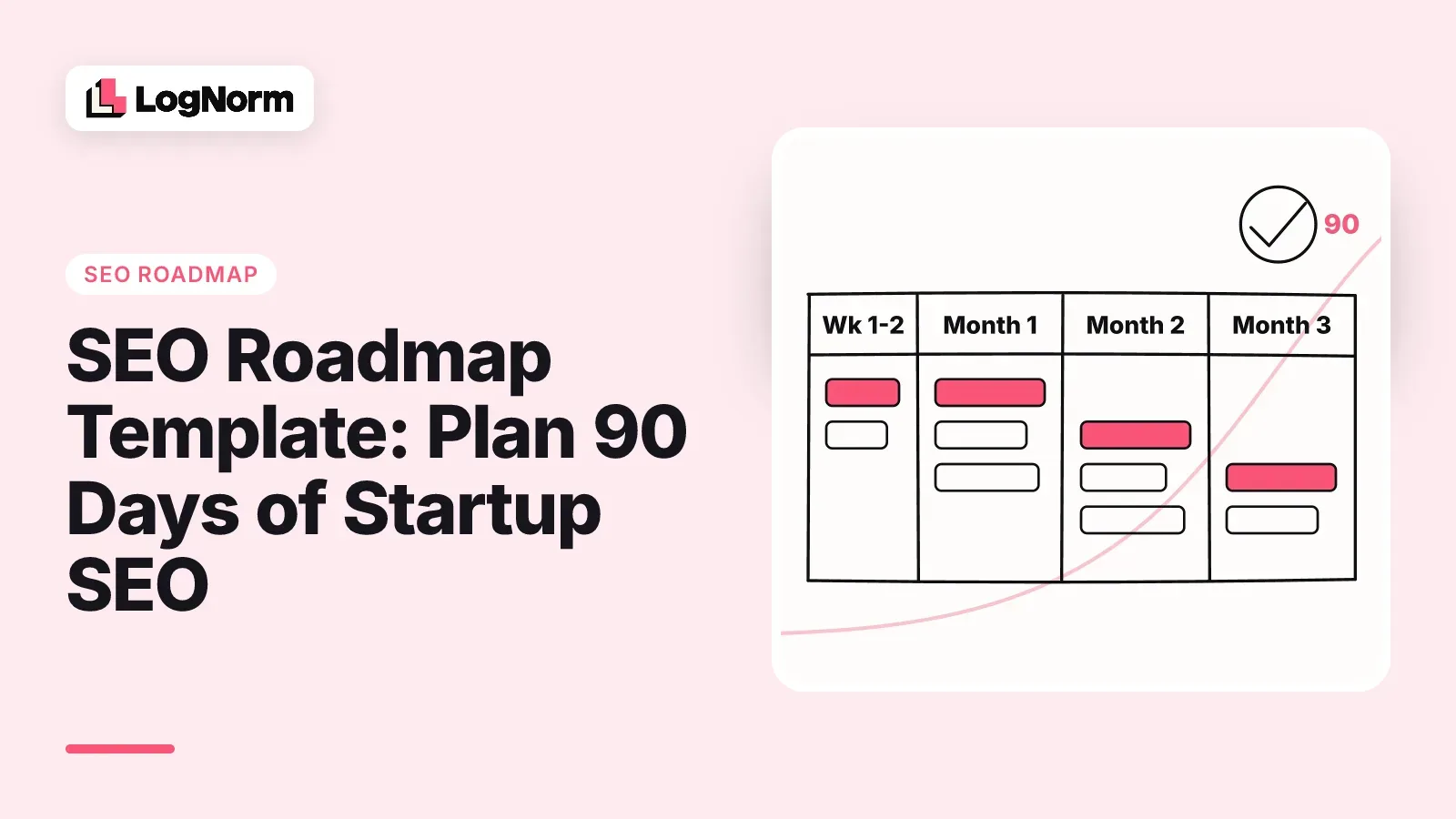
An SEO roadmap is a time-boxed plan that turns your search goals into ordered tasks, each with an owner, the data behind it and a clear definition of done. For a startup, 90 days is the right length: long enough for Google to react to your changes, short enough that you re-plan before the plan goes stale. This guide gives you a copyable 90-day template, shows how to fill it from your own data, and shows how to run it as a ranked backlog you review every week.
What is an SEO roadmap?
An SEO roadmap is the bridge between an SEO strategy and the work your team does this week. The strategy says where you want to win. The roadmap says what ships first, who ships it and how you will know it worked.
Three terms get mixed up, and the difference matters for how you plan:
| Term | Answers | Time horizon | Changes |
|---|---|---|---|
| SEO strategy | Which topics, buyers and search engines you want to win | 6 to 12 months | Rarely |
| SEO roadmap | Which themes come in which order, and what done looks like | 90 days | At each 90-day review |
| SEO backlog | Which specific tasks ship next, in rank order | 1 week | Every week |
Most roadmaps fail because they try to be all three. A 12-month Gantt chart with 80 dated tasks is out of date by week three, because your data changes faster than the chart. Keep the roadmap at the level of themes and outcomes, and let the backlog carry the individual tasks.
Why 90 days? Google's own documentation is clear that SEO changes land on a slow, uneven clock. Its SEO Starter Guide says some changes take effect in a few hours, while others could take several months. Its core updates guidance adds that it could take several months for Google's systems to confirm a site is producing helpful content over the long term. A 30-day plan ends before most changes show up. A 90-day plan gives you one full read on the early work and a clean point to re-plan.
If you are still deciding which topics to go after at all, start with our SEO for startups playbook and come back here to schedule the work.
The 90-day SEO roadmap template
The template below splits 90 days into a two-week foundation and three monthly themes. Copy it into a doc or spreadsheet and replace the example tasks with ones from your own data.
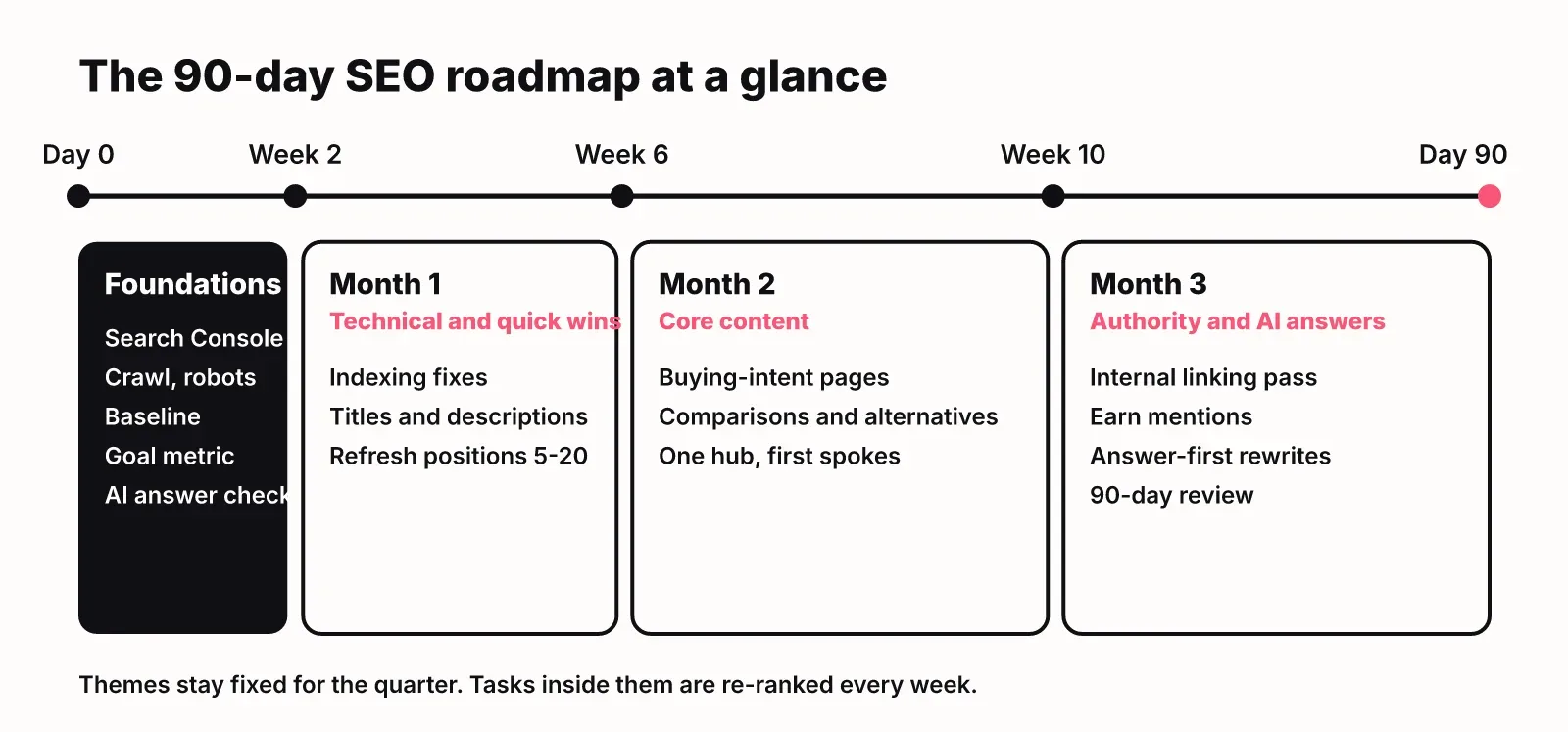
| Phase | Weeks | Theme | Example tasks | Input data | Done when |
|---|---|---|---|---|---|
| Foundations | 1-2 | Access and baseline | Verify Search Console, check robots.txt and sitemap, crawl the site, record baseline numbers, pick the goal metric | Search Console, site crawl | Baseline sheet saved, every key page indexable |
| Month 1 | 3-6 | Technical fixes and quick wins | Fix indexing and crawl errors, rewrite weak titles and meta descriptions, refresh pages ranking in positions 5 to 20 | Site audit, Search Console queries | Top issues fixed and re-checked on the live site |
| Month 2 | 7-10 | Core content | Publish pages for buying-intent keywords, comparison and alternatives pages, one hub with its first spokes | Keyword research, competitor pages | Planned pages live and internally linked |
| Month 3 | 11-13 | Authority, AI answers and review | Internal linking pass, earn mentions on sites your buyers read, make key pages easy for AI engines to quote, run the 90-day review | Backlinks, AI answer checks | Review written, next 90 days planned |
Each row is a theme, not a contract. If week 5 shows a competitor page you need to answer, it goes into the backlog and competes with everything else. The theme tells you what the month is mostly about, so the team does not split its attention across everything at once.
Two columns do most of the work. "Input data" stops you from adding tasks that come from opinion rather than evidence. "Done when" stops tasks from staying 80% finished for a month.
Weeks 1-2: set up foundations and a baseline
The first two weeks exist so that every later task can be measured. Without a baseline, you cannot tell at day 90 whether anything you shipped worked.
Work through this list in order:
- Verify the site in Google Search Console and confirm the sitemap is submitted and read.
- Check robots.txt allows the pages you want found, including by AI crawlers if you want to appear in AI answers.
- Crawl the site and list pages that return errors, redirect in chains, or carry a noindex tag by mistake.
- Record the baseline: clicks and impressions for the last 28 days, the number of indexed pages, and your top 20 queries.
- Ask ChatGPT, Gemini and Google a handful of the questions your buyers ask, and note whether you are mentioned.
- Pick one goal metric for the quarter, such as non-brand clicks to product pages or demo sign-ups from organic search.
- Choose one or two topics to focus on. More than two will spread a small team too thin.
The AI answer check belongs in the baseline now, not later. A SparkToro and Datos clickstream study found that 58.5% of US Google searches and 59.7% of EU Google searches ended without a click. Clicks alone undercount how often buyers see your answer, so track mentions next to traffic from day one.
Months 1-3 by theme
Each month has one theme, chosen so that earlier work makes later work pay off faster. Technical fixes come first because a new page on a site with crawl problems ranks slower than the same page on a clean site.
Month 1: technical fixes and quick wins
Month 1 is about pages you already have. Fix the audit issues that block indexing or confuse search engines first, then the ones that only affect click-through.
The quickest wins usually sit in Search Console: queries where you rank between positions 5 and 20 with plenty of impressions. A better title, a clearer answer near the top of the page and a few internal links can move those pages without writing anything new. These refreshes are the fastest way to show progress in the 28-day check.
Month 2: core content
Month 2 is when you publish new pages, starting with the ones closest to a buying decision. For a startup, that usually means comparison pages, alternatives pages and pages that answer the specific problems your product solves, before broad top-of-funnel guides.
Group the new pages into a hub with spokes, so each one supports the others. Our guide to SEO content strategy covers how to turn a keyword list into that structure. Two to four solid pages a month is a realistic pace for a founder-led team. Ten thin ones is not.
Month 3: authority, AI answers and the review
Month 3 makes what you built easier to find and easier to cite. Run an internal linking pass so every new page gets links from your strongest existing pages. Then work on mentions: guest posts, community answers and listings on sites your buyers already read.
This is also where you look at AI answers on purpose. Check whether the questions from your baseline now mention you, and rewrite key pages so the answer sits in the first sentence under each heading. Our guide to AI SEO for startups goes deeper on this. The last week of month 3 is the 90-day review, covered below.
How to fill the template from real data
Every task in your roadmap should point at the data that justified it. If you cannot name the evidence, the task is a guess and should rank below tasks that have it.
Each data source tends to produce a specific kind of task:
| Data source | What it shows | Task it produces |
|---|---|---|
| Site audit or crawl | Broken pages, missing tags, indexing blocks | Technical fix |
| Search Console | Pages losing clicks, queries in positions 5 to 20 | Refresh or title rewrite |
| Keyword research | Searches you have no page for | New page |
| Competitor pages | Topics and comparisons rivals rank for and you don't | Comparison or alternatives page |
| AI answer checks | Questions where assistants name rivals but not you | Answer-first rewrite or new page |
| Sales and support calls | The words buyers use for their problem | Page angle and keyword choice |
Write each task as one line with four parts: the action, the evidence, the owner and the done-criteria. For example: "Rewrite the title and intro of /pricing-guide. Evidence: impressions steady, clicks down for 28 days. Owner: content lead. Done when: live and re-checked." That line is specific enough that anyone on the team, or an AI agent, can pick it up.
If your keyword list is long and noisy, filter it for fit before it reaches the roadmap. A keyword with volume that your buyers never search is a cost, not a win. LogNorm's keyword research rates each keyword for fit with your business for this reason.
How to prioritise SEO tasks into a backlog
To turn an SEO roadmap into an actionable backlog, rank every open task against the others, then take only as many from the top as your team can finish this week. The roadmap's theme decides which tasks are eligible. The ranking decides the order.
A workable process for a small team:
- Put every task from the template into one list, with its evidence.
- Remove tasks with no evidence, or park them in a separate "ideas" list.
- Rank what remains by expected impact on your goal metric, how sure you are, and how much effort it takes.
- Set a weekly capacity: the number of tasks your team can finish, not start.
- Commit to the top tasks up to that capacity, and leave the rest ranked for next week.
For step 3, scoring frameworks such as ICE and RICE are the common starting point. We cover them in separate guides to ICE scoring and to choosing between ICE and RICE, so they are not repeated here. One limit worth knowing: scores given to each task in isolation drift, because a "7" on Monday means something different from a "7" on Friday. Comparing tasks in pairs ("if we can only do one of these this week, which comes first?") gives a more stable order. That is how LogNorm ranks its moves: head to head, with the reasons shown on each one.
Keep the backlog ranked even for tasks you will not touch for weeks. When something urgent appears, you can see exactly what it displaces.
Run the roadmap weekly
The roadmap runs on a weekly loop: plan on Monday, ship during the week, check on Friday. The 90-day themes stay fixed. The weekly backlog changes as new data arrives.
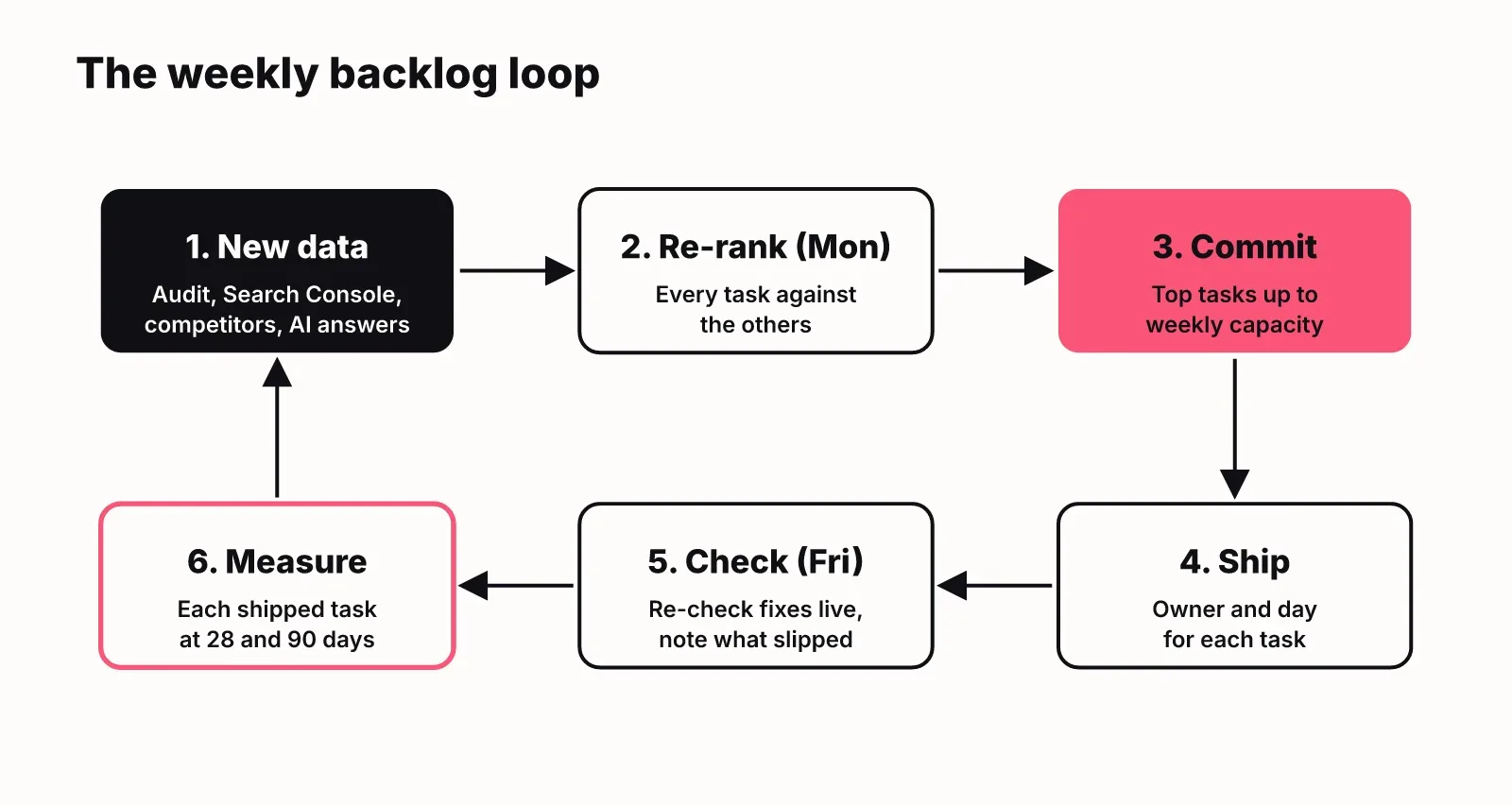
On Monday, re-rank the backlog with anything new from the past week: a page that lost clicks, an audit issue, a competitor's new page. Pick the week's tasks up to capacity and give each one a day and an owner. On Friday, mark what shipped, re-check fixes on the live site, and note what slipped and why.
For a founder-led team, three to five finished tasks a week is a sensible starting capacity. Adjust it after four weeks based on what you actually finished. If your team keeps carrying tasks over, the capacity is too high, and the right fix is fewer tasks, not longer weeks.
You can run this loop in a spreadsheet. If you want the ranking, the weekly plan and the measurement in one place, our SEO project management page shows how LogNorm builds a ranked weekly plan from your audit, Search Console, keyword and competitor data, and how AI agents such as Claude Code or Codex can pick up tasks from it.
Measure results at 28 and 90 days
Measure each shipped task twice: once 28 days after it went live and again at 90 days. Record a baseline on the day it ships, so the comparison is against that page's own history rather than the whole site.
The 28-day check is an early signal. Title rewrites and refreshes often show movement in impressions and position by then. New pages usually do not, which matches Google's note that some changes take several months to be confirmed. The 90-day check is the real verdict for most work.
| Check | What to compare | What it tells you |
|---|---|---|
| Day 0 | Clicks, impressions and average position for the page or its queries | The baseline |
| Day 28 | Same metrics over the 28 days since shipping | Early signal, especially for fixes and refreshes |
| Day 90 | Same metrics, plus AI answer mentions for the target questions | Whether the task worked |
Call a task a win if it moved the metric it was meant to move. When a task shows no change at 90 days, look at why before writing it off: the page may not match search intent, or it may need links. Feed those findings into the next 90-day roadmap. Over two or three cycles you learn which kinds of tasks work on your site, and your ranking gets better with each one.
The 90-day review itself takes an afternoon. List what shipped, what won, what did not, and what the data now says about the next quarter's themes. Then fill a fresh copy of the template.
FAQ
What is an SEO roadmap?
An SEO roadmap is a time-boxed plan, usually 90 days, that turns SEO goals into ordered themes and tasks with owners, evidence and done-criteria. It sits between your SEO strategy, which sets direction, and your weekly backlog, which sets the order of individual tasks.
Who is an SEO roadmap for?
An SEO roadmap is for any team that has more SEO tasks than time, which includes most startups. It is most useful for founder-led teams and small marketing teams without a dedicated SEO hire, because it decides the order of work in advance so the team does not re-argue it every week.
How long does it take to see SEO results?
Some changes show up within days and others take several months. Google's SEO Starter Guide says some changes take effect in a few hours and others could take several months. Plan for early signals at 28 days and judge most work at 90 days.
How do you prioritise SEO tasks for a startup?
Rank every task against the others by expected impact on your goal metric, confidence in the evidence and effort, then commit only to what your team can finish this week. Tasks without evidence go to a separate ideas list. Re-rank every week as new data arrives.
How often should you update an SEO roadmap?
Update the backlog every week and the roadmap every 90 days. The weekly re-rank absorbs new data without rewriting the plan, and the 90-day review is when you change themes, goal metrics or focus topics.
Should an SEO roadmap include AI search?
Yes. A large share of Google searches now end without a click, so record whether ChatGPT, Gemini and Google AI Overviews mention you in your baseline, and check again at 90 days. Pages that answer the question in their first sentence are easier for AI engines to quote.