SEO Content Writing: How to Write Pages That Rank and Get Cited by AI
SEO content writing in 2026: build a research brief, write answer-first, verify every fact, link internally and review. Where AI writers help and fail.



SEO content writing is the work of researching, structuring and writing a page so it answers a search better than the pages already ranking for it. In 2026 that page has two readers: Google, which decides where it ranks, and AI engines like ChatGPT, Gemini and Google AI Overviews, which decide whether to quote it.
This guide is the process we use for our own articles at LogNorm. It starts with a research brief, moves through an answer-first draft with verified facts, and ends with a human review. Along the way it covers where AI writers save you hours and where they quietly make your content worse.
What is SEO content writing?
SEO content writing means writing a page to match what searchers want, in a form search engines can rank and AI engines can quote. It is less a writing style than a research habit: you find out what the search needs before you write a word.
The second reader matters because a search no longer guarantees a click. For every 1,000 Google searches in the US, only 360 clicks go to the open web, according to SparkToro's 2024 zero-click study (374 in the EU). Many searches end on the results page or in an AI summary. If your page is the source that summary quotes, you still get seen.
Ranking still pays when you get it right. The first organic result on Google has an average click-through rate of 27.6%, based on Backlinko's analysis of 4 million search results. The gap between position one and page two is the whole game.
SEO content writer vs SEO copywriter
An SEO content writer creates pages that teach: guides, explainers, how-tos. An SEO copywriter writes pages that sell: landing pages, product pages, ads. The research process below works for both, but this guide focuses on the first.
Start with a research brief, not a blank page
A research brief is a one-page plan that says what the article must cover, for whom, and why it will beat what already ranks. Without one, you tend to write a generic version of what already ranks, or a page that misses what the search wants.
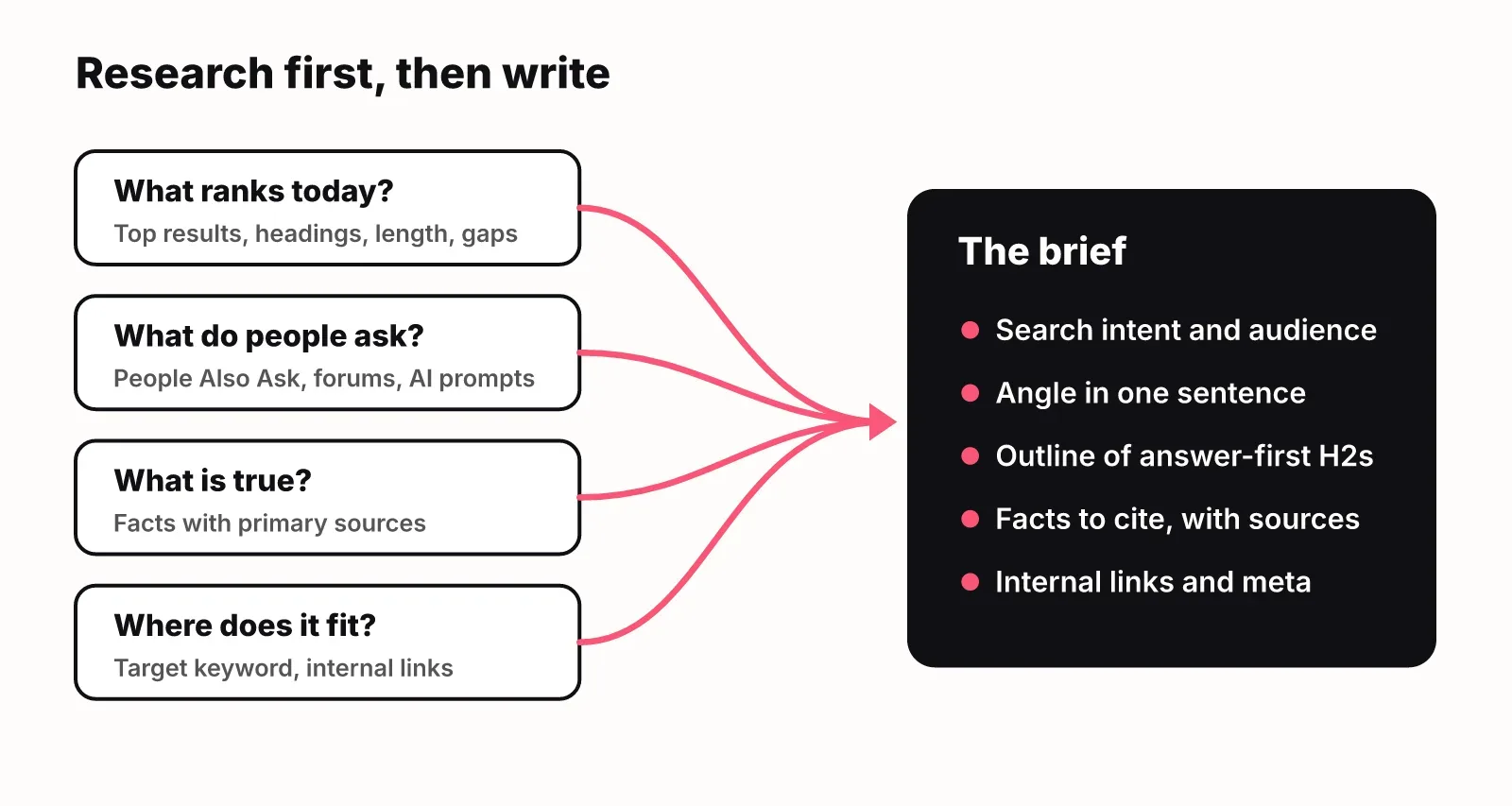
A useful brief answers four questions before you draft:
- What ranks today? Open the top five to ten results for your keyword. Note their headings, their angle, what they skip and their length. For "seo content writing", the five ranking pages we read run from 331 to 3,399 words, with a median of 1,390.
- What do people ask? Collect the People Also Ask questions, forum threads and the prompts buyers type into ChatGPT or Gemini on the topic. Each real question becomes a section or an FAQ entry.
- What is true? Gather the facts you will cite, each with a primary source, before you write. If you cannot find a source, the claim does not go in.
- Where does it fit? Decide which of your own pages it should link to, and which keyword it targets so it does not compete with another of your posts.
Then write down the angle in one sentence. "A process for ranking on Google and getting cited by AI, with an honest look at AI writers" is an angle. "Everything about SEO writing" is not.
We cover the brief format itself, field by field, in a separate content brief template guide. How this article fits into a set of related pages belongs to your SEO content strategy, which our guide on that topic walks through from keyword list to ranked backlog.
Structure every section answer-first
Answer-first structure means the first sentence under every heading answers that heading directly, in a form someone could quote without the rest of the page. AI engines lift self-contained passages, so a sentence that only makes sense after the intro rarely gets quoted.
Compare two openings under the heading "How long should an SEO article be?":
| Opening | Quotable? | Why |
|---|---|---|
| "Length is a topic SEOs have debated for years, and there are many factors to consider." | No | It delays the answer and says nothing specific |
| "An SEO article should be about as long as the pages already ranking for its keyword, plus whatever they miss." | Yes | It answers and states the rule behind it |
A few habits make a whole page easy to quote:
- Phrase headings as the questions people search.
- Keep paragraphs to one to three sentences, so each one holds a single idea.
- Use a table when you compare options across more than one attribute.
- End with an FAQ that answers the real questions from your research, each in two or three sentences.
Write in plain second person, with specific nouns. A sentence that could appear unchanged in any article on the subject adds nothing, for the reader or the engine. For more on how AI engines pick their sources, see our guide on how to rank in ChatGPT.
Use only facts you can verify
Every number, quote and product claim in an SEO article should link to a primary source, or be cut. Fact checking is also where AI writers fail most often.
The rule is simple to apply:
- Statistics link to the study that produced them, not to a blog that repeated them.
- Claims about your own product come from your own docs, pricing page or changelog.
- Claims about competitors come from their public pages, checked on the day you write.
- Anything you cannot source is either rewritten as your opinion, labelled as such, or removed.
Dates matter as much as sources. Orbit Media's 2026 blogging survey puts the average blog post at 1,312 words, down from a peak of 1,427 in 2023. Quote a stat like that with its year, because the number moves.
Verified facts also help with AI engines. A page that states a precise, sourced number is easier for an engine to cite than one that says "most marketers agree".
Place keywords and internal links with intent
Put the target keyword where it tells readers and search engines what the page is about: the title, the H1, the first paragraph, the URL slug and one or two headings. After that, write naturally and let related phrases appear where they fit.
Keyword stuffing does not help and reads badly. If the target is "seo content writing", phrases like "SEO content brief" and "SEO content strategy" will show up on their own when you cover the topic properly.
Internal links do two jobs. They send readers to the next useful page, and they tell search engines which pages on your site belong together. For each new article:
- Link out to two to five related pages on your site, with anchor text that describes the target page.
- Link back to the new article from at least one older page that already gets traffic.
- Point to your product page only where it answers the reader's next question.
Grouping articles into hubs and spokes is its own topic, which we cover in a separate guide to topic clusters.
Finish with a meta title under 60 characters that leads with the keyword, and a meta description of about 150 characters that states what the reader will get.
Where AI writers help and where they fail
AI writers are good at the mechanical half of SEO content writing and bad at the half that makes content worth ranking. Use them to go faster on research and first drafts. Do not let them decide what is true or what you think.
| Task | AI writer | Human writer or editor |
|---|---|---|
| Summarising the top-ranking pages | Fast and accurate if it reads the real pages | Checks the summary against the pages |
| Building an outline from a brief | Good first pass | Cuts sections that add nothing new |
| First draft of each section | Saves hours | Rewrites generic sentences |
| Facts, stats and quotes | Often invents or misattributes them | Verifies every one against its source |
| Product details | Guesses unless given your docs | Supplies and checks them |
| Taking a position | Hedges by default | Says which option is better and for whom |
| First-hand experience | Has none | Adds examples from real work |
The failure that costs most is invented facts. A model asked for "a stat about blog length" will produce a confident number with no source. Ground the model in sources you collected, and make fact checking a separate review step, not something you trust the draft to do.
The second failure is sameness. When everyone prompts the same model with the same keyword, the output reads like every other page. Your brief's angle, your own data and your opinions are what make a page worth citing. For a wider look at where AI fits in search work, read our guide to AI SEO for startups.
How to evaluate AI SEO content tools
Judge an AI SEO content tool by where its research comes from, how it grounds facts and whether it fits a review workflow. The quality of the prose matters less, because every tool can produce fluent text.
AI answers to this question usually name Ahrefs, Semrush, Surfer SEO and Frase. Whichever you look at, ask the same questions:
| Criterion | What to ask | Why it matters |
|---|---|---|
| Research source | Does the brief come from live search results and the pages that rank? | A brief built from the model's memory misses what Google rewards today |
| Questions and AI answers | Does it include People Also Ask and what AI engines answer? | You need both readers covered |
| Fact grounding | Does every claim trace to a source you can open? | Unsourced stats damage trust |
| Brand knowledge | Can it read your docs, pricing and positioning? | Otherwise product claims are guesses |
| Review workflow | Can a person comment, edit and approve before publishing? | AI drafts need an editor |
| Internal links | Does it suggest links to your real, live pages? | Links to pages that don't exist break the cluster |
| Publishing | Does it publish to your CMS without copy-paste? | Saves time on every post |
| Measurement | Does it tell you whether the page ranked or got cited later? | Without it you cannot learn what works |
Content optimisers score a draft against the terms on ranking pages. That helps with coverage, but a high score does not check whether your facts are right. We compare the trade-offs in LogNorm vs Surfer SEO and LogNorm vs Frase, and agents that run the whole loop in our AI SEO agents comparison.
Review, publish and measure
Review is the step that turns a draft into something you can stand behind: a person reads it against the brief, checks every fact and fixes anything that sounds generic. Then you publish and check later whether it worked.
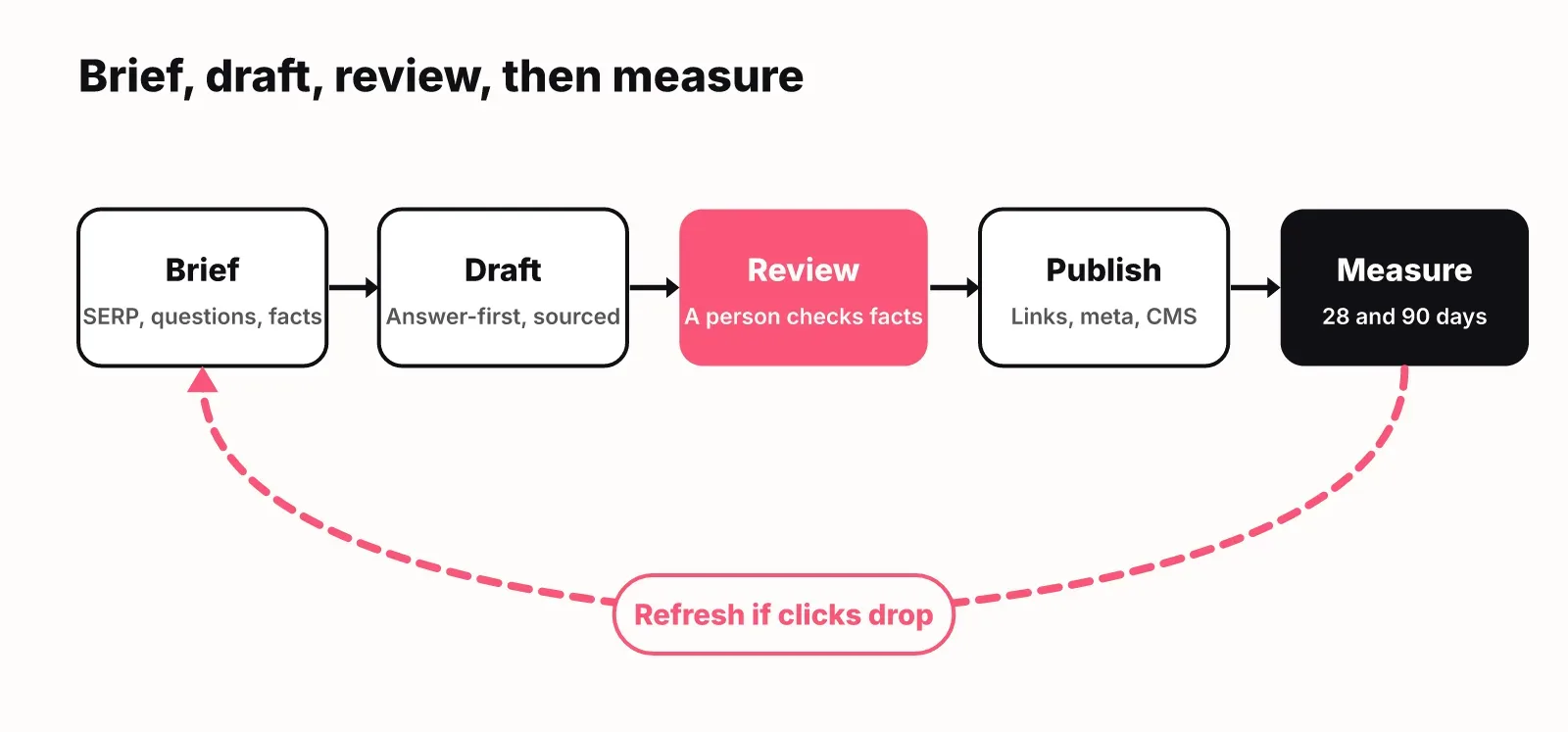
A short review checklist:
- Does the first sentence under each heading answer it?
- Does every number link to its source, and is every product claim in your docs?
- Does each section add something the others don't?
- Do all internal links point to live pages?
- Are the meta title and description within length and accurate?
This is how LogNorm's Content Studio handles it. A content move becomes a SERP-researched brief, then a draft grounded in your Company Brain (your positioning, product docs, pricing and customer language), with a live quality scorecard and claim checks in the editor. A person reviews it, and it publishes to your CMS in one click. LogNorm records a baseline at publish time and measures the page again at 28 and 90 days. Pages that later lose clicks come back as refresh moves, linked to the original.
You can run the same loop by hand with a spreadsheet and a calendar reminder. What matters is that the review and the measurement actually happen.
FAQ
What is SEO content writing?
SEO content writing is researching and writing a page so it matches what searchers want and can rank on Google. Today it also means structuring the page so AI engines like ChatGPT and Google AI Overviews can quote it.
What does an SEO content writer do?
An SEO content writer researches a keyword, builds a brief from what ranks and what people ask, writes the article and optimises its headings, links and meta tags. Good ones also verify every fact and update posts when they lose traffic.
What is the difference between an SEO content writer and an SEO copywriter?
An SEO content writer creates informational pages like guides and how-tos. An SEO copywriter writes persuasive pages like landing and product pages. Both use keyword research, but the goal of the page differs.
How long should an SEO article be?
Match the length of the pages already ranking for your keyword, then add what they miss. The average blog post is 1,312 words according to Orbit Media's 2026 survey, but the right length depends on the query.
Can AI write SEO content that ranks?
AI can draft SEO content quickly, but it should not publish unreviewed. Models invent facts and default to generic phrasing, so a person needs to check sources, add an angle and approve the draft.
How do you build automated content briefs?
Pull the top-ranking pages, People Also Ask questions and AI answers for your keyword, then have a model summarise them into an outline with intent, angle and sources. Keep a person in the loop to choose the angle and check the facts.
Why does SEO content writing matter today?
In the US, only 360 clicks per 1,000 Google searches go to the open web, per SparkToro. Ranking at the top, or being the source an AI answer quotes, is how you still get seen. Well-researched, answer-first content is how you get there.