Best AI SEO Agents in 2026: Tools Compared by What They Ship
Compare 7 AI SEO agents on what they actually change: your code, a served layer or just text, and whether each SEO agent checks its own fixes.



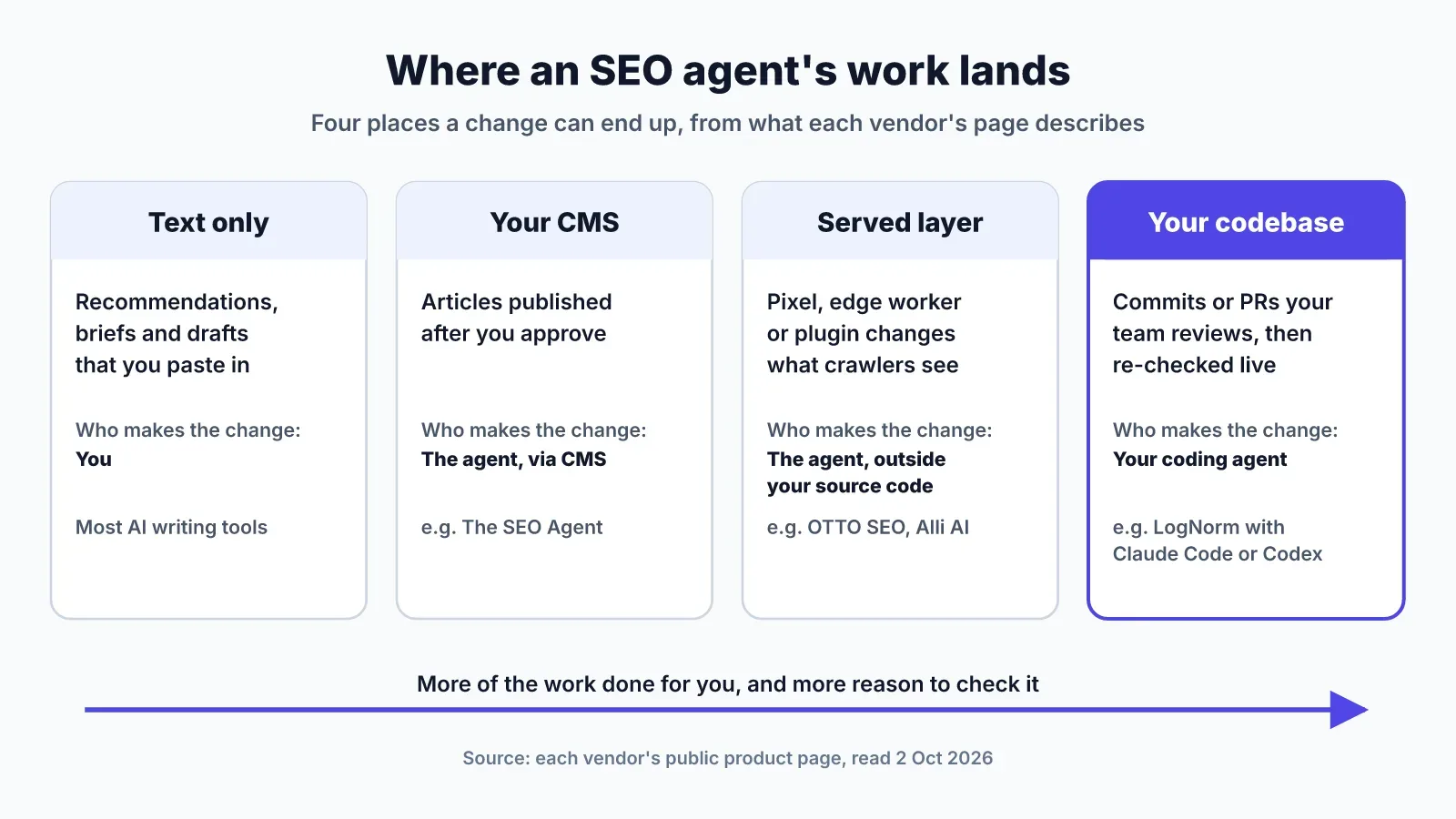
The best SEO agent for you depends on where you want its work to land. Some agents change your code, some change the page a visitor is served, some publish articles to your CMS, and many only hand you text. This guide compares seven of them on that one question, using only what each vendor says on its own public page.
What an SEO agent is, and the test that separates them
An SEO agent is software that takes a goal, such as "fix the technical issues on my site" or "rank for this topic", and runs the steps itself: research, plan, change, check. A chatbot answers one prompt at a time. An agent chains the steps and acts on your site or content.
The label is now on almost every SEO product, so you need a test. Ask four questions of any AI SEO agent before you trust it with your site:
- Where does the change land: your codebase, a served layer (a script, edge worker or plugin), your CMS, or nowhere because it only writes recommendations?
- Does it check its own fix on the live site, or does it count a task as done when it runs?
- Does it work from a ranked plan, so the most valuable change goes first?
- Who approves a change before it goes live?
A tool that answers "nowhere" to the first question is a writing or research assistant. That can still be useful. It just isn't doing the SEO work for you.
The SEO agents compared at a glance
The seven AI agents for SEO below fall into four groups: code-level, served-layer, content pipeline, and research and recommendations. The table sums up what each vendor's own page says. "Not described" means the page doesn't say, not that the feature is missing.
| Tool | Where changes land | Checks its own fix | Ranked plan | Approval |
|---|---|---|---|---|
| LogNorm with Claude Code, Codex or Cursor | Your repo, through your commits or PRs | Yes, re-checks the audit rule on the live site | Yes, ranked moves and a weekly plan | You review code; drafts go to review |
| Search Atlas OTTO SEO | Live site via pixel, Cloudflare Worker, CMS or code pipeline | Reports issues fixed in OTTO Grade | Not described | Autopilot, or approval mode |
| Alli AI | Served to crawlers via plugin or integration, no source changes | Not described | Not described | Not described |
| The SEO Agent | Articles published to your CMS | Quality gate before publishing | 30-day content plan | Nothing publishes until you approve |
| Writesonic SEO AI Agent | Fixes "without touching a line of code" | Not described | Content plans | Not described |
| Nightwatch SEO AI Agent | "Site changes" and automatic optimizations | Not described | Opportunity alerts | Not described |
| Relevance AI SEO Agent | Content published to your CMS; reports and plans | Not described | Keyword recommendations | Not described |
LogNorm with Claude Code, Codex or Cursor
LogNorm is the option to pick if you already build with a coding agent and want SEO fixes made in your own code, then checked on the live site. LogNorm is a growth engine: it runs the crawl, SEO and GEO audits, keyword research, Search Console and competitor data, and tracks how ChatGPT, Gemini and Google AI Overviews answer your buyers. It turns all of that into ranked "moves" and your team plans the best into a weekly Growth Plan.
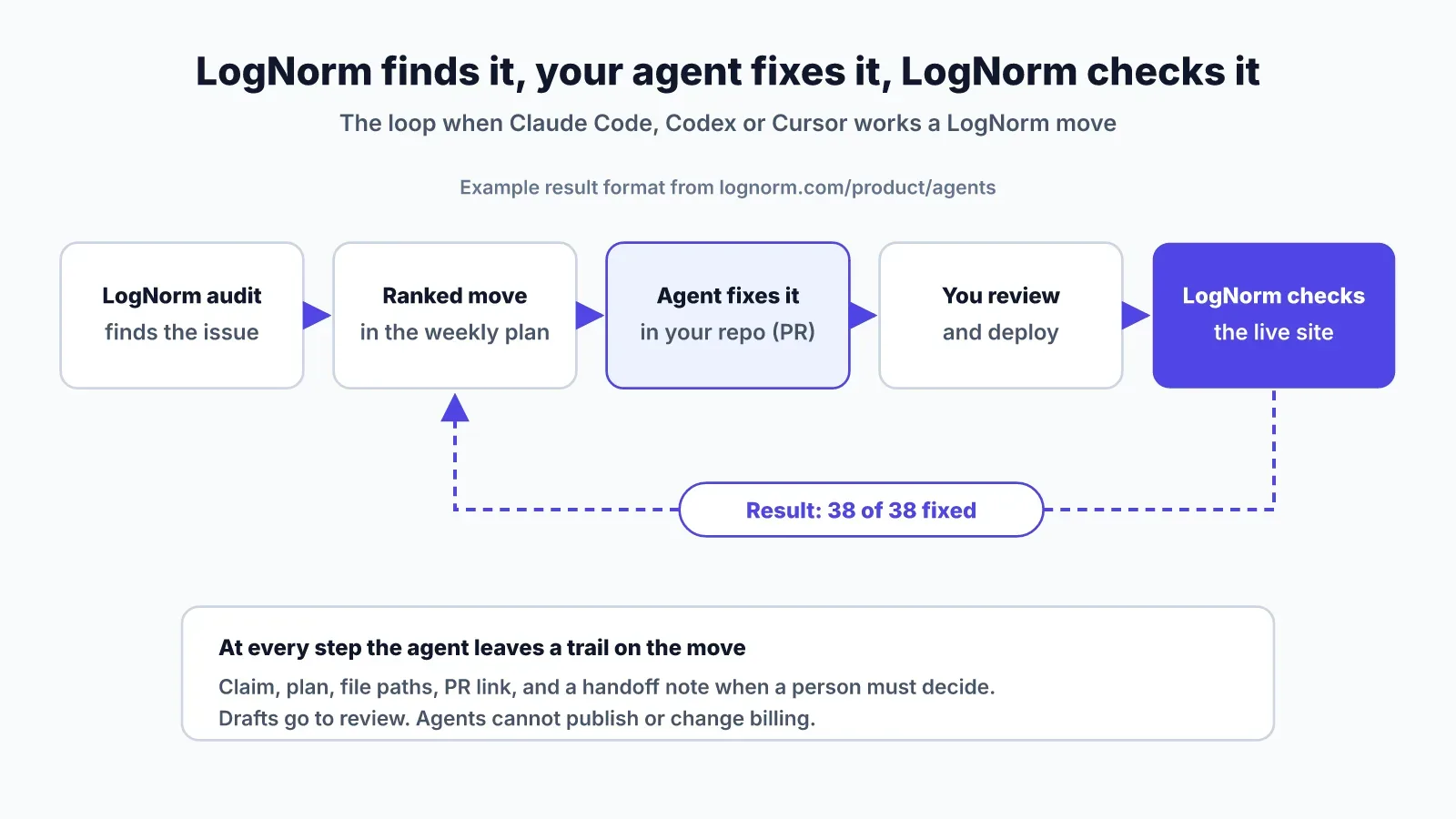
The agent part is your own. You connect Claude Code, Codex or Cursor to LogNorm over MCP, sign in with OAuth, and the agent joins your workspace as a named teammate, such as "Kuldeep's Panda". For Claude Code it's one command:
claude mcp add --transport http --scope user lognorm https://lognorm.com/api/mcpThen run /mcp, choose lognorm, Authenticate, and click Allow in the browser. There are no API keys to copy, and you don't need an AI key: your agent's own plan does the thinking.
From there the agent claims a move, posts its plan, fixes the issue in your repository and leaves comments with file paths and PR links. When the fix is live, it asks LogNorm to re-check that audit rule on the live site without re-running the whole audit. The result reads like "38 of 38 fixed". If the agent needs a decision, it hands the move to a person with a note.
There are hard limits. Agents can't publish content, change billing, members or integrations, or permanently delete anything. Drafts go to review and people publish them. Instructions hidden in third-party text are withheld before the agent sees them.
The trade-off is plain: you need a codebase and a coding agent. If your site lives in a hosted builder and nobody on the team touches code, a served-layer tool below will suit you better. The agents and MCP docs cover every permission, and the SEO and GEO audit is where the moves come from.
Search Atlas OTTO SEO
OTTO SEO is the strongest pick for changing a live site without touching your code. According to its product page, OTTO deploys fixes through the OTTO Pixel in your site header, a Cloudflare Worker, native CMS connectors (WordPress, HubSpot, Webflow, Shopify, Contentful, Duda) or your code pipeline. It then submits changed URLs for indexing through Google Search Console and IndexNow.
Its scope is wide: titles, schema, canonicals, broken links, internal links, content, link building, press releases and local SEO. It runs on autopilot by default. You can turn on approval mode to review each change, and roll changes back. OTTO Grade shows issues fixed, and "Deep Freeze" keeps optimizations live after you cancel.
The trade-off is where the change lives. A fix served by a pixel or edge worker sits outside your source code. If your developers later rebuild a template, they won't see what OTTO changed unless they look in the dashboard. Keep approval mode on if you care about what ships under your name.
Alli AI
Alli AI fits agencies and teams running many sites who want structural fixes deployed across a portfolio at once. Its homepage says it writes titles, schema, internal links and "AI readable structure" for more than 50 AI crawlers, then deploys it across your sites "without waiting on engineering".
It installs through a WordPress plugin or other integrations, with "no source code modifications". The page's own example is one rule applied to 9,412 pages in 47 seconds.
Like OTTO, Alli changes what crawlers are served rather than your repository. That is fast and avoids engineering queues. It also means the fix and the codebase can drift apart. The homepage doesn't describe how it confirms a change worked or how it ranks which fix goes first.
The SEO Agent, Writesonic, Nightwatch and Relevance AI
These four rank on page one for "seo agent", and each one leans toward content or research rather than code.
The SEO Agent is a content pipeline. It reads your site and Search Console data, builds a 30-day plan of buyer-intent articles, drafts and fact-checks them, then publishes to WordPress, Webflow, Shopify, Ghost, Wix or a webhook. Nothing publishes until you approve it, and a quality score holds weak drafts back. It is the only one of the four with clear pricing: $99 a month for one site and 30 articles, $79 for each extra site, and a $1 trial.
Writesonic's SEO AI Agent covers SERP and competitor analysis, content plans, technical audits and internal linking. Its page says the agent "implements proven fixes without touching a line of code" and quotes $99 a month. It doesn't explain where those fixes are applied or how they are checked.
Nightwatch's SEO AI Agent promises to automate research, technical audits, "site changes" and rank tracking, and to implement optimizations automatically. Its page also mentions Agent Pro, which exposes Nightwatch data over REST and MCP. That last part is useful if you want to feed rank data into your own agent.
Relevance AI's SEO Agent is a set of configurable task agents: a competitor keyword analyzer, a blog post outliner, a content refresh planner, a cluster planner, an intent optimizer and a backlink prospector that drafts outreach emails. It can publish content to a CMS. It suits teams who want to build their own workflow on a general agent platform.
Do AI SEO agents actually work?
AI SEO agents work well on repeatable jobs with a clear right answer, and poorly on calls that need judgement. The second result for "seo agent" is a Reddit thread titled "Do AI SEO Agents actually work? Looking for real results", which tells you how many buyers are unsure.
Here is where they do well:
- Metadata: missing titles, meta descriptions, H1s and canonicals.
- Links: broken internal links and links to redirects.
- Briefs and first drafts grounded in real search data.
- Monitoring: spotting a ranking drop or a new competitor page.
Here is where they slip:
- False positives. An audit can flag a link as broken when a CDN rewrote it. An agent that "fixes" every finding will break things.
- Positioning. Which keyword fits your business is a judgement call.
- Proof. Many tools count tasks run, not changes confirmed on the live page.
So ask any vendor for proof the change landed. A re-check on the live site beats a dashboard count. Our agentic SEO walkthrough shows a real audit where all three critical findings traced back to one Cloudflare setting, and how the team dismissed them with a note instead of "fixing" them.
How to pick an SEO agent
Pick by where you can accept changes, then by how much review you want:
- You have a repo and use Claude Code, Codex or Cursor: pick a code-level option like LogNorm. Fixes live in your code, go through your normal review, and get re-checked.
- You can't touch code, or you run many client sites: pick a served-layer tool like OTTO or Alli AI, and keep approval on.
- You mainly need articles: pick a content pipeline like The SEO Agent with a review gate before publishing.
- You want to build your own: start with Relevance AI's task agents or Nightwatch's MCP data, and wire them into the agent you already use.
For marketing jobs beyond SEO, see our guide to AI agents for marketing. If you want the full terminal workflow, start with Claude Code for marketing.
FAQ
How are AI agents different from AI SEO tools?
An AI SEO tool returns an output when you prompt it. An AI SEO agent takes a goal, chains the steps and acts on your site or content. The test is whether something changes on your site without you copying and pasting.
Can AI agents replace human SEO professionals?
No. Agents take the repeatable work: metadata, links, briefs, drafts and monitoring. People still decide positioning, which findings are real and what to publish. Check how each tool lets you approve a change before it ships.
What tasks can AI agents handle for SEO?
Keyword research, content briefs and drafts, technical audits, metadata and link fixes, internal linking, rank tracking and backlink prospecting. Which of these a given agent can finish on your live site depends on where its changes land.
How do AI agents handle AEO and GEO?
Some check how AI crawlers read your site and how AI answers mention you. Alli AI serves AI-readable structure to crawlers. LogNorm runs a GEO audit and tracks how ChatGPT, Gemini and Google AI Overviews answer buyers, then ranks the fixes with your other moves.