Growth Marketing Strategy: Build One Around a Weekly Plan
Build a growth marketing strategy your startup can run: one goal, two channels, a ranked backlog, a weekly plan and results measured at 28 and 90 days.



A growth marketing strategy is a ranked list of bets toward one goal, worked through on a weekly rhythm, with every shipped item measured against a baseline. That is the whole idea. The rest of this guide is how to build each part so a small team can run it every Monday without a strategy offsite.
If you want the background first, read what growth marketing is. This piece assumes you know the definition and need the operating system.
What a growth marketing strategy is (and what it is not)
A growth marketing strategy decides what your team works on this week and why, and it changes as results come in. A document that describes your market, your personas and twelve channels is research. It becomes a strategy only when it turns into an ordered list of work with owners.
Search for this topic and you will find two popular frameworks. The Ansoff Matrix sorts growth into selling more to your current market, entering new markets, building new products, or diversifying. AARRR (acquisition, activation, retention, referral, revenue) splits the funnel into stages you can measure. Both are useful for deciding where growth could come from. Neither tells you what to ship on Tuesday.
Here is the difference in practice:
| Annual marketing plan | Growth marketing strategy | |
|---|---|---|
| Unit of work | Campaigns and themes | Single pieces of work with evidence |
| Order | Calendar order | Ranked by expected impact for the effort |
| Review rhythm | Quarterly or yearly | Weekly plan, quarterly goal review |
| What happens to results | Reported in a deck | Fed back into the ranking |
| Who it fits | Teams with a fixed budget and channel mix | Startups still finding what works |
For a startup, the second column wins. You do not know yet which channel will work, so the plan has to be cheap to change.
Step 1: Pick one goal and a north star metric
Start with one business goal for the quarter, written as a number and a date, such as "reach 40 qualified demo requests a month by the end of March." One goal forces trade-offs. Three goals let every idea qualify.
Next, choose the north star metric: the number that rises when customers get real value from the product. For a B2B tool that might be weekly active teams; for a marketplace, completed transactions. We cover how to pick one in our guide to the north star metric, so here is the short version for strategy work:
- Pick two or three input metrics your team can move within a week, such as organic sign-ups, demo requests from content, or activation rate.
- Tie every item in the backlog to one of those inputs. If an idea moves none of them, it waits.
- Write down what you will not chase this quarter. "No social media until organic sign-ups pass 200 a month" is a real strategic decision.
Step 2: Choose one or two channels, not ten
A startup should run one primary channel and at most one secondary channel at first. Spreading a two-person team across SEO, paid ads, LinkedIn, events and partnerships produces ten half-finished experiments and no signal from any of them.
Choose the primary channel with three questions. Where do your buyers already look when they have the problem? What can your team produce every week without heroics? How long until you see a first signal? Then commit for at least a quarter.
| Channel | Time to first signal | Ongoing cost | Compounds over time | Best fit |
|---|---|---|---|---|
| SEO content | Weeks to months | Writing time | Yes, pages keep ranking | Buyers who search for the problem |
| AI answers (ChatGPT, Gemini, AI Overviews) | Weeks | Content and site fixes | Yes, if you keep being cited | Categories where buyers ask assistants for recommendations |
| Paid search | Days | Ongoing ad spend | No, stops when spend stops | Clear, high-intent queries with budget behind them |
| Outbound email and LinkedIn | Days to weeks | Founder or SDR time | Little | High-value B2B deals with a narrow buyer list |
| Community and social | Weeks to months | Daily presence | Some, through audience | Founders with a point of view and time to post |
| Partnerships and integrations | Months | Relationship time | Yes, through referrals | Products that plug into a bigger platform |
The cheapest channels in cash, SEO and AI answers, are the slowest to read. Paid search gives fast answers at a price. Pick based on how much runway you have to wait.
Whatever you pick, the discipline is the same. An Entrepreneur piece on small business marketing names regular market research and consistent monitoring of results as foundations of sustainable growth. A channel you do not measure every week is a channel you cannot judge.
Step 3: Turn ideas into a ranked backlog
A growth backlog is one list of concrete pieces of work, each with its evidence attached, sorted by what the team should do first. "Do more SEO" is not a backlog item. "Publish a comparison page for the competitor that ranks for our category term" is.
To build it:
- Collect every idea, fix and opportunity in one place: audit findings, keyword gaps, content ideas, product launches, sales requests.
- Rewrite each one as a single shippable task with the evidence behind it (the search data, the customer quote, the competitor page).
- Rate impact, confidence and effort for each. Our guide to ICE scoring walks through the scoring with a worked SEO example.
- When two items tie, compare them head to head: if you could only ship one this week, which one?
- Keep foundational fixes (broken pages, missing titles, slow templates) and revenue bets (new pages, campaigns) in the same list, so fixes compete on impact instead of piling up in a separate ticket queue.
Scores on their own drift. Two people rate the same idea a 6 and an 8, and the list reshuffles every time someone opens it. Head-to-head comparison is steadier because the question is concrete. LogNorm uses exactly this approach: it compares open moves pairwise ("if the team can only do one of these this week, which should come first?"), fits one ranking from those calls, and shows each move the items it beat and lost to. You can override the order, and it keeps your calls on later passes.
Step 4: Run the strategy on a weekly plan
The weekly plan is where a growth marketing strategy becomes work: each Monday you set how many items the team can finish, pull the top of the backlog to that size, and give each item a day and an owner. Anything that does not fit stays in the backlog, still ranked.
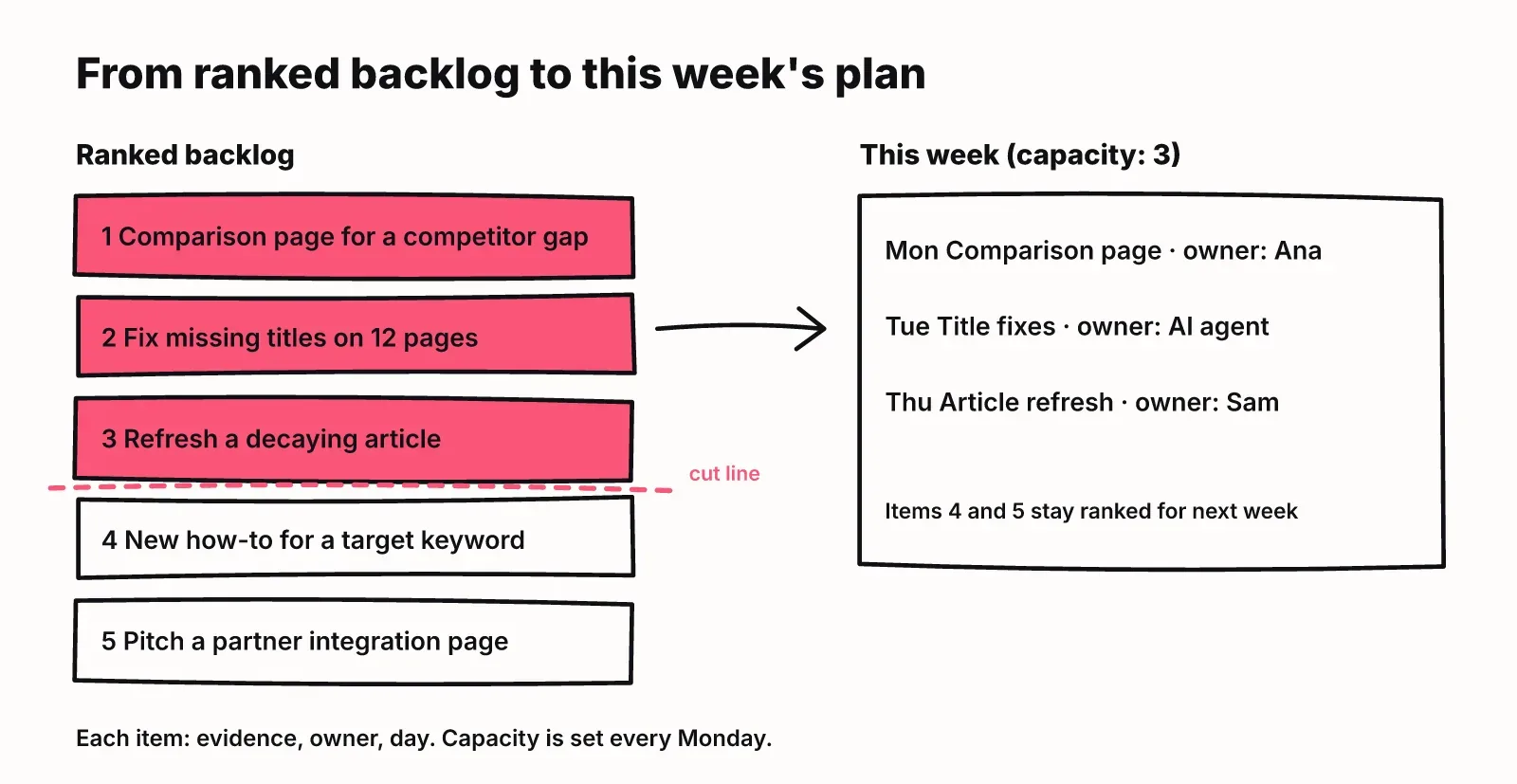
A simple weekly rhythm:
- Monday: review last week's results, set the week's capacity, pick the top items, assign a day and an owner to each.
- Tuesday to Thursday: ship. New ideas go into the backlog, not into this week.
- Friday: mark items done, write one line on what you learned, and flag anything that slipped.
Weekly is the right length for a small team. It is short enough to change course when a channel goes quiet and long enough to ship a real page or fix. Short, planned cycles are the core of Agile marketing, and teams that work this way rate it highly: in the State of Agile Marketing report, 87% of Agile marketers said they were more productive because of Agile, and 77% reported lower stress.
This is the loop LogNorm's Growth Plan is built around. Analyses and monitors (site audit, Search Console, keyword research, competitors, AI visibility) produce moves with evidence. LogNorm ranks each new move against the rest within a minute or two and re-ranks everything at least weekly. You set a weekly target for how many moves your team can realistically finish, LogNorm recommends the top moves, and you choose what goes into the week with a day and an owner for each. The target guides you but never limits you. On plans that include it, a digest email arrives every Monday with the week's plan, last week's outcomes and pages that decayed.
The owner does not have to be a person. Some teams hand fixes and drafts to AI agents doing the execution, while people decide the ranking and review the output. If SEO is your primary channel, you can also run SEO work from a ranked weekly plan instead of a ticket board.
Step 5: Run experiments with a stop rule
Every experiment in the plan needs four things written down before it starts: the hypothesis, the metric it should move, the minimum time it runs, and the rule for keeping or killing it. Without the last two, experiments either get killed after three quiet days or run forever because nobody decided.
Match the run time to the channel. A paid search test can be read in a week or two. A new article or a page rewrite needs weeks before search data means anything, so judge it at a fixed window instead of checking daily.
When an experiment works, ask whether it can feed itself. A page that brings sign-ups whose usage creates more pages is the start of a loop. See growth loops for how to spot and build them.
Log the failures too. An idea that failed with a written reason does not come back next quarter dressed as a new idea.
Step 6: Measure at fixed windows and feed results back
Measure every shipped item against the baseline recorded on the day it shipped, at fixed windows chosen in advance. Fixed windows stop you from declaring victory on a lucky Tuesday or giving up on a page that was still climbing.
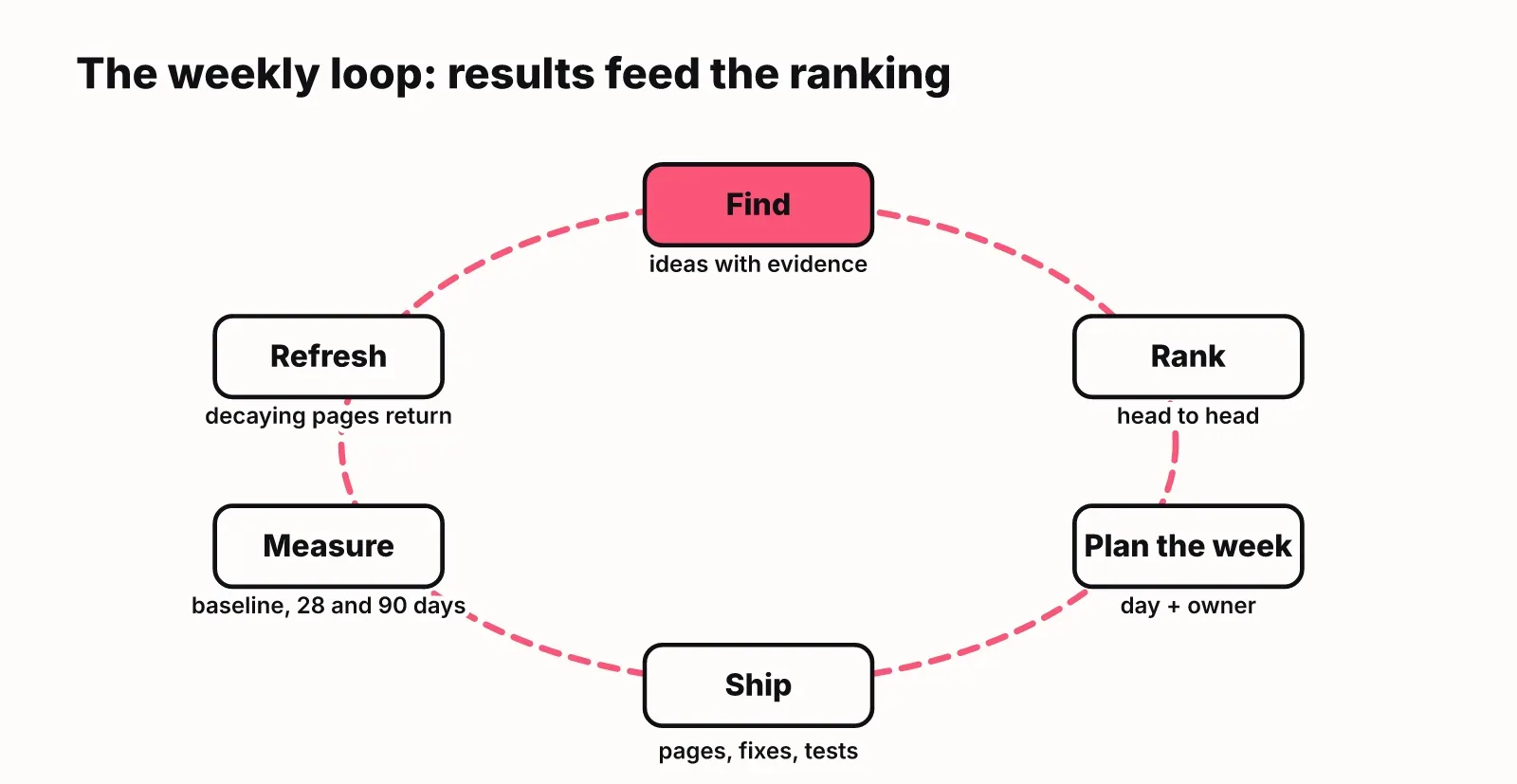
Decide what counts as a win before the work ships. For a content move that might be more clicks, more impressions or a better average position than the baseline. For an AI answers move, it might be whether ChatGPT or Gemini starts citing the page.
Then feed results back into the backlog:
- Wins raise confidence in similar items, so they move up.
- Losses lower it, and the reason goes in the log.
- Pages that lose traffic come back as refresh work, linked to the original.
LogNorm does this on a schedule: it records a baseline at publish time and measures again at 28 and 90 days, marks moves that lift clicks, impressions or position as won, and turns pages that lose clicks into refresh moves linked to the original.
Review the goal and the channel choice once a quarter, not every week. The weekly plan changes constantly; the goal should not.
FAQ
How many marketing channels should a startup use at first?
Start with one primary channel and at most one secondary channel. Run them for at least a quarter with weekly measurement before adding a third. More channels split a small team's attention and make it impossible to tell which one is working.
What are the most cost-effective digital marketing channels for startups?
SEO content and AI answer visibility cost the least in cash because you pay in writing and site work, and the results compound. They are slow to show results. Paid search is faster to read but stops the day spending stops. Pick by how long your runway lets you wait.
How do inbound and outbound marketing strategies differ?
Inbound brings buyers to you through content, search and AI answers when they are already looking. Outbound reaches out to a chosen list of buyers through email, LinkedIn or calls. Inbound compounds over time; outbound gives faster feedback and suits high-value B2B deals with a narrow buyer list.
How do you prioritize SEO tasks into an actionable growth backlog?
Collect every SEO task in one list, rewrite each as a single shippable item with its evidence, rate impact, confidence and effort, and compare ties head to head. Keep technical fixes and new content in the same ranking so they compete on impact. Then pull the top items into a weekly plan sized to your team.
How often should a growth marketing strategy change?
The weekly plan changes every week as results come in. The goal, the north star metric and the channel choice should hold for a quarter. Changing those weekly means no experiment runs long enough to read.