Programmatic SEO for Startups: When It Works and When It Backfires
Programmatic SEO for startups: the three conditions that make templated pages work, how they become scaled content abuse, and a checklist to start small.


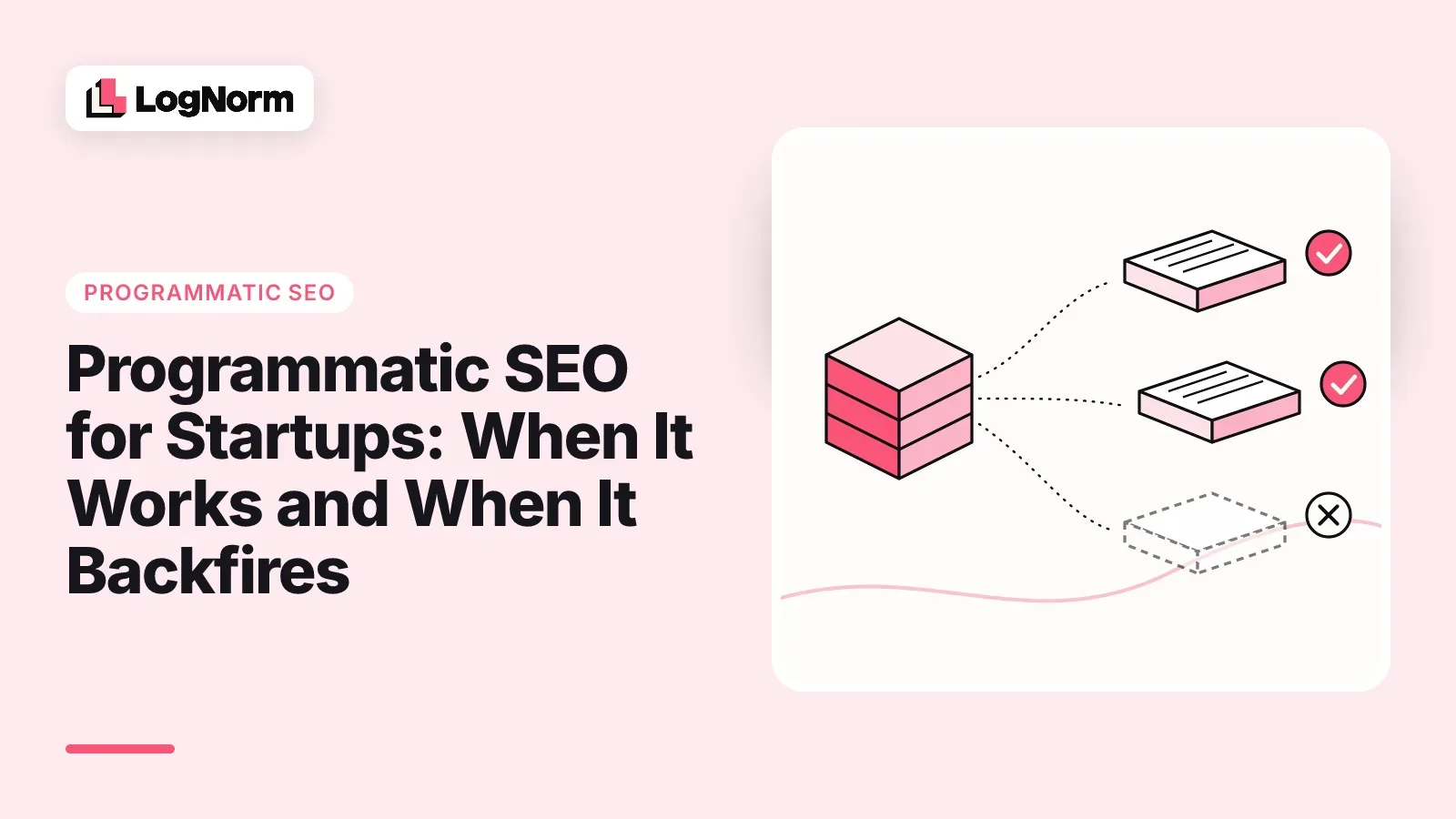
Programmatic SEO works for a startup when every generated page has its own data, its own search demand and a layout that answers the query. Remove any one of those and you are publishing what Google's spam policies call scaled content abuse, which can make your pages "rank lower in results or not appear in results at all".
Most guides to programmatic SEO lead with Tripadvisor and Zapier, then hand you a no-code stack. This one starts from the other end: the conditions that decide whether templated pages help a small site, the exact policy wording that decides when they hurt, a checklist, and a pilot you can measure in about two months.
What is programmatic SEO?
Programmatic SEO is publishing many pages from one template and one dataset, where each page targets one variant of a repeatable search pattern. "Notion vs Airtable", "Notion vs Coda" and "Notion vs Asana" are one pattern ("X vs Y") with many variants. A comparison template filled from a table of product facts can serve all of them.
Every programmatic SEO project has three parts:
- A query pattern: a search people make with one slot that changes, such as "[tool] alternatives", "[app] + [app] integration" or "[service] in [city]".
- A dataset: one row per variant, holding the facts that make that page different.
- A template: the page layout that turns a row into an answer.
The difference from traditional SEO is where you spend the effort. In traditional SEO you research, write and edit each page. In programmatic SEO you design one page type and its data model once, then the work moves to collecting accurate data and checking output. That shift is the whole appeal, and also where it goes wrong: it is as easy to publish 500 bad pages as 500 good ones.
When programmatic SEO works: three conditions
Programmatic SEO works when three conditions hold at the same time: real data per page, real search demand per variant and a template that answers the query. Each one fails differently, so check them separately.
Real data per page. Each page needs facts the other pages in the set do not have. An integration page needs what the two apps actually exchange, the triggers and the setup steps. A comparison page needs each product's real prices, limits and features. If the only thing that changes between two pages is the name in the H1, the dataset is too thin to support a page per row.
Real search demand per variant. People have to search for the individual variants, not only the head term. "CRM integrations" might have demand while "[your app] + [obscure CRM] integration" has none. Check volume and intent row by row, and drop rows nobody searches for. A page with no demand earns nothing and still has to be crawled, indexed and maintained.
A useful template. The layout has to answer the query faster than a search results page would. For "X vs Y" that means a verdict and a side-by-side table near the top. For "[tool] alternatives" it means a ranked shortlist with who each option suits. A template that is mostly boilerplate intro, a keyword-stuffed paragraph and a signup button fails this test even when the data is good.
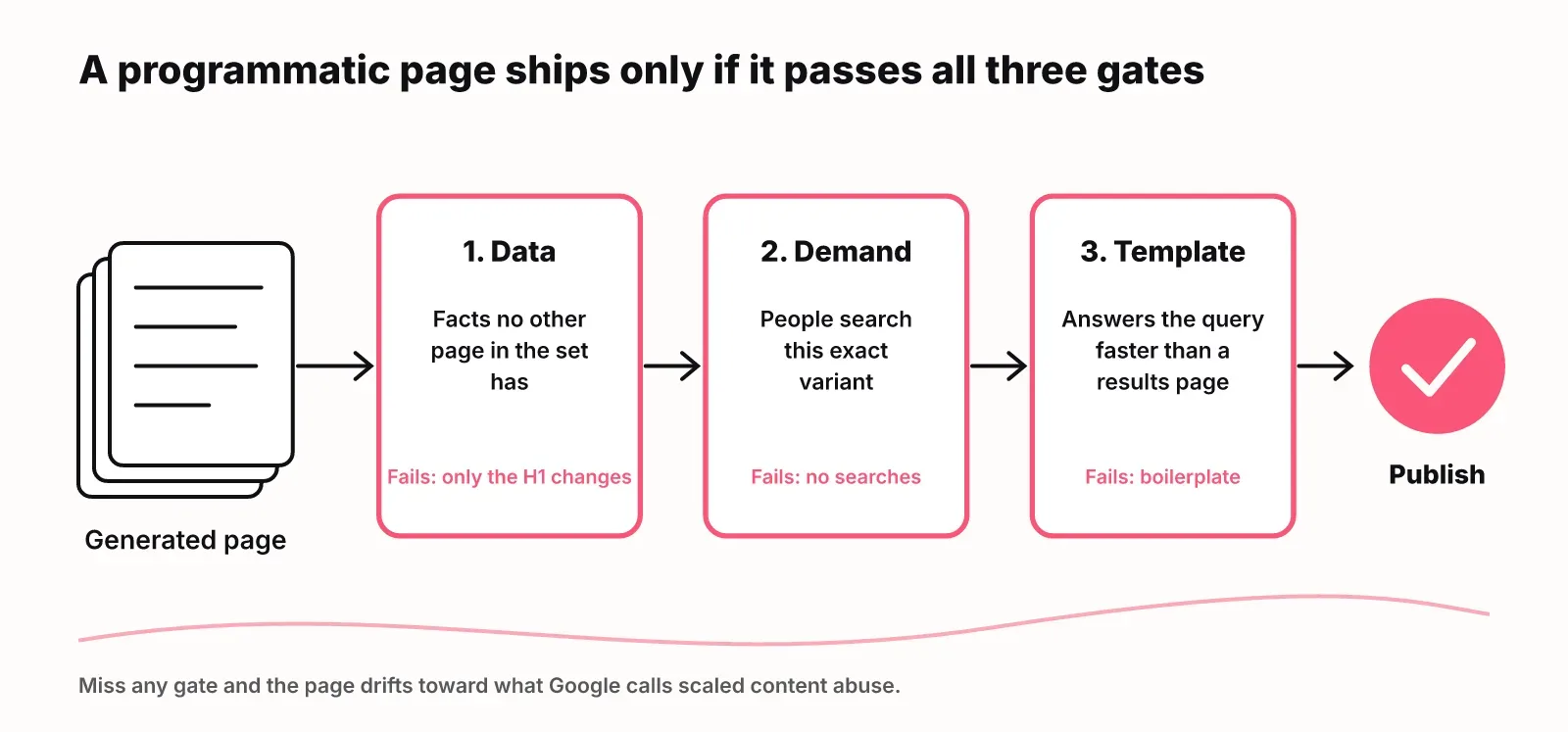
The three conditions do not trade off against each other. Great data in a poor template is still a poor page, and a perfect template over rows nobody searches for is wasted crawl budget. If you need a wider view of where templated pages fit in a startup's search plan, start with our SEO for startups playbook.
How programmatic SEO backfires
Programmatic SEO backfires when the pages exist to rank rather than to help, which Google's spam policies name directly. The relevant policy is scaled content abuse. Google defines it as "when many pages are generated for the primary purpose of manipulating search rankings and not helping users", and adds that it is "typically focused on creating large amounts of unoriginal content that provides little to no value to users, no matter how it's created."
"No matter how it's created" is the line that matters for startups using AI. The policy's first example is "using generative AI tools or other similar tools to generate many pages without adding value for users". Its other examples read like a list of lazy programmatic SEO tactics:
- "Scraping feeds, search results, or other content to generate many pages (including through automated transformations like synonymizing, translating, or other obfuscation techniques), where little value is provided to users"
- "Stitching or combining content from different web pages without adding value"
- "Creating many pages where the content makes little or no sense to a reader but contains search keywords"
The same policy page covers doorway abuse, which catches location and near-duplicate page sets. Its examples include "having multiple domain names or pages targeted at specific regions or cities that funnel users to one page" and "creating substantially similar pages that are closer to search results than a clearly defined, browseable hierarchy". A startup that generates "[product] for [industry]" pages with the same copy and a swapped noun is in this territory.
The policy's stated consequence is that sites violating it "may rank lower in results or not appear in results at all". Thin pages also cost you before any penalty: each one has to be crawled, indexed and maintained, and none of them earns its keep.
Here is how common page patterns tend to land:
| Page pattern | Helps when | Backfires when |
|---|---|---|
| "X vs Y" comparisons | Each page has checked facts for both products and a clear verdict | Pages share copy and only swap product names |
| "[Tool] alternatives" | Each list is ranked for that tool's users and says who each option suits | Every page lists the same tools in the same order |
| Integration pages | Each page shows what the two apps exchange and how to set it up | Pages exist for integrations that do not work or have no setup content |
| Location pages | Each page has local facts: prices, availability, people, addresses | City names are swapped into identical copy that funnels to one page |
| Glossary or "what is" pages | Each definition is written for your audience with examples | Definitions are rewritten from other sites or generated without review |
| Use case or industry pages | Each page describes a real workflow with specifics | One paragraph is reused with the industry name changed |
A decision checklist before you build
Build programmatic pages only if you can answer yes to every question below. A single no means fix that gap first or choose a smaller, hand-written set of pages instead.
- Can you name the query pattern, and does each variant you plan to publish have measurable search demand?
- Does each row in your dataset hold facts that no other row has, from a source you trust?
- Could a reader act on the page without searching again?
- Would the page still be worth publishing if search engines did not exist, for example as a page you would send a prospect?
- Can you keep the data current, and do you know who updates it and how often?
- Can you remove or noindex a page when its data goes stale or its row loses demand?
- If AI writes any of the copy, does a person check facts before publishing? Google's policy names generated pages "without adding value for users" as its first example.
- Is the set small enough to review by hand at launch? If not, start with a subset.
The quickest way to apply question 3: open five generated pages side by side. If you could not tell which page answers which query without reading the H1, the set fails.
A startup-sized example: lognorm.com's page families
Programmatic SEO at startup scale can mean a few page families of 10 to 15 pages each, not thousands of URLs. Our own site is an example. On lognorm.com, the comparison pages hold 10 pages, the alternatives section 13 and the solutions section 13. Each family follows one structure.
What makes them pass the three conditions is visible on the pages themselves:
- The data differs per page. The comparison index says competitor facts "are checked on each vendor's own site and dated", and each page, such as LogNorm vs Frase, is built around one named vendor. The LogNorm vs Semrush page labels its price table "as published on 2 Oct 2026".
- Each variant matches a real search pattern: "[tool] vs [tool]", "[tool] alternatives" and the job a team is trying to get done.
- The template answers the query first. The LogNorm vs Semrush page opens with the main difference, then has sections on when each tool is the better choice, a price table and an FAQ. Alternatives pages give a ranked shortlist with who each option suits.
The trade-off is real work per row. Checking and dating each vendor's facts is the slow part of a page family like this, and it is also the part that makes each page worth indexing. Copy that habit before you copy the page count.
How to start small and measure
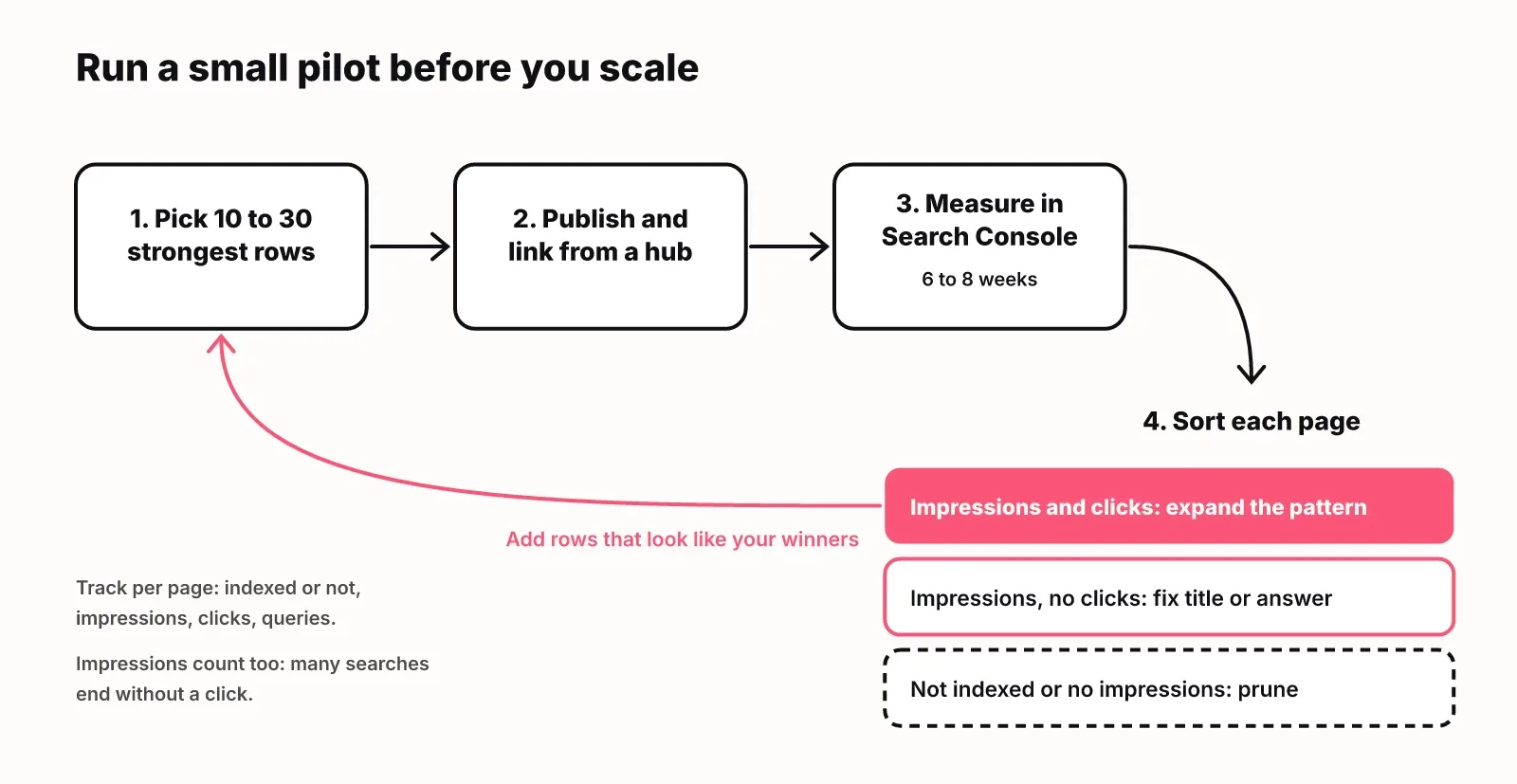
Start with a pilot of 10 to 30 pages built from your strongest rows, measure them for six to eight weeks, then expand, fix or prune. A pilot shows whether the template earns impressions before you multiply its mistakes.
- Pick one query pattern and the 10 to 30 variants with the clearest demand and the richest data.
- Write the template by hand for the first two or three pages, then turn what you wrote into the template. This keeps the layout grounded in a real answer.
- Publish, link the pages from a hub page and a few related posts, and add them to your sitemap.
- In Google Search Console, track for each page whether it is indexed, its impressions, its clicks and the queries it shows for.
- After six to eight weeks, sort the pages. Pages with impressions and clicks show the pattern works. Pages with impressions and no clicks need a better title or answer. Pages that are not indexed or have no impressions point to thin data or no demand.
- Expand only the rows that look like your winners, and prune or merge the rest.
Judge impressions as well as clicks. SparkToro and Datos found that "58.5% of American Google searches resulted in zero clicks". A page that is shown often but rarely clicked may still be doing its job, or may need to give a reason to click through.
AI can help with the build if a person stays in charge of facts. Our guide to using AI for search covers where generated copy helps and where it hurts, and AI SEO agents compares tools that can draft and fix pages for you. LogNorm's keyword research labels each keyword with the kind of page that would win it, including comparison, alternatives, integration, use case and glossary pages, which is a quick way to see whether your keywords form a repeatable pattern at all. Once you publish, the pages become work to maintain. SEO automation that keeps people in charge explains how we handle that side.
Frequently asked questions
What does programmatic SEO mean?
Programmatic SEO means generating many search-targeted pages from one template and a structured dataset, one page per variant of a repeatable query such as "[tool] alternatives" or "[app] integrations". The template stays the same and the data on each page changes.
What is the difference between programmatic SEO and traditional SEO?
Traditional SEO creates each page by hand for a specific keyword. Programmatic SEO designs one page type and fills it from data for many keywords at once. The ranking signals are the same, so each generated page still has to be useful on its own.
Is programmatic SEO right for small businesses?
Programmatic SEO suits a small business only when it has a repeatable query pattern with demand and data that differs per page. A SaaS product with real integrations or close competitors often qualifies. A local service business with one location usually does not, and it should write a handful of strong pages instead.
How much does programmatic SEO cost?
The cost of programmatic SEO depends mostly on the data, not the page generation. Templates and publishing tools are cheap to set up. Collecting accurate data for each row, checking it and keeping it current is the ongoing cost, and it grows with every page you add.
Does Google penalize programmatic SEO?
Google's spam policies do not name programmatic SEO as a method. They target scaled content abuse, defined as many pages generated mainly to manipulate rankings and not to help users, no matter how they are created. Templated pages with real data and a useful answer fall outside that definition.
Can I use AI to write programmatic SEO pages?
You can use AI to draft programmatic pages, but a person should check every fact before publishing. Google's spam policy lists using generative AI to create many pages without adding value for users as an example of scaled content abuse. AI works best for wording around data you have verified, not as the source of the data.
How many programmatic pages should I start with?
Start with 10 to 30 pages from your strongest rows. That is enough to see indexing and impression patterns in Search Console within a couple of months and small enough to review every page by hand before launch.