The 3 Types of Content Marketing Every Startup Founder Ignores
Content marketing for startups works best with three ignored types: comparison pages, founder point of view and answer-first content. Why, how, examples.


Content marketing for startups works when it reaches people close to a decision, and most startup blogs never do. They publish how-to posts aimed at the top of the funnel, compete with publishers that have years of authority, and wonder why signups stay flat.
Three types of content get skipped almost every time: comparison and alternatives pages, founder point-of-view pieces, and answer-first content written to be quoted by Google AI Overviews, ChatGPT and Gemini. This post covers why each one works, how to make it and what a good one looks like, then how to pick one and measure it.
It is deliberately narrow. If you want the full picture of formats, calendars and distribution, our broader guide, Content Marketing: A Practical Guide, covers that. For channels beyond content before product-market fit, see Startup Marketing: Channels That Work Before Product-Market Fit.
What content marketing for startups usually gets wrong
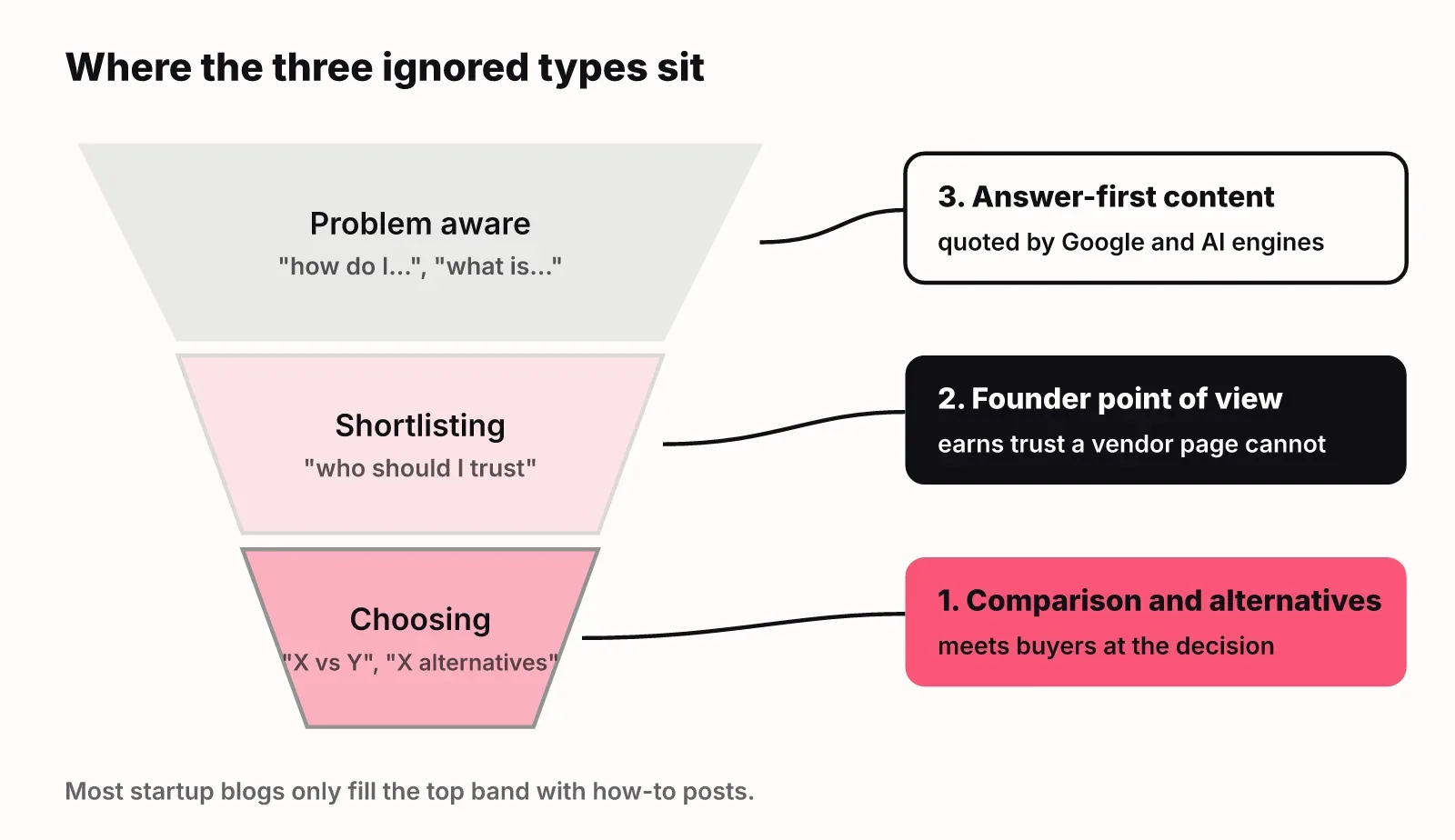
The usual mistake is writing only for people who have a problem but are not yet shopping for a fix. "What is churn", "how to write a cold email", "10 productivity tips". Those posts can bring traffic, but the readers are early, the competition is heavy and the link to your product is thin.
Even the Google AI Overview for this keyword now tells founders to reverse the funnel: build conversion content first, then comparisons, then educational posts. Most startups still do the opposite because how-to posts feel safe and are easy to brief.
The three ignored types fill the gaps. Comparison and alternatives pages sit at the decision. Founder point-of-view content earns trust while buyers are shortlisting. Answer-first content shows up when someone asks a question, whether they search Google or ask an AI assistant.
Type 1: Comparison and alternatives pages
A comparison page answers "X vs Y" and an alternatives page answers "X alternatives". Both meet a buyer who already knows the category and is choosing between named products. That is the highest-intent reader your content will ever get.
Why startups should write them
These searches are usually small. A big publisher will not bother with "your-tool vs the-incumbent", so a startup can rank with one honest page. The reader is comparing vendors right now, so a good page moves them straight to a trial or a demo.
Your sales team gets a second use out of them. When a prospect says "we are also looking at Competitor A", the founder can send a link instead of writing the same email again.
How to write one
Pick competitors your prospects actually name on calls and in signup surveys, not the ones you wish they named. Then follow a structure readers trust:
- Open with a one-sentence verdict: who should pick each product.
- Add a table comparing the things buyers decide on, such as pricing model, setup effort, integrations and who it suits.
- Explain the real trade-offs in a few short sections, including where the competitor is better.
- Say plainly when the reader should choose the other product.
- End with a next step for readers who fit your product.
The honest section is the part founders skip and the part that makes the page work. A page that claims you win on every row reads like an ad, and readers close it.
What a good one looks like
We built both kinds for LogNorm. LogNorm vs Surfer SEO frames the choice as "content optimiser or growth engine", which tells the reader in the title that the two tools do different jobs. AirOps alternatives lists seven options with published pricing, including tools that are not us. Both are written for someone deciding this week.
Type 2: Founder point-of-view content
Founder point-of-view content states what the founder believes about the customer's problem and why, based on what they saw while building the product. It is the one type nobody else can produce for you, including an AI model.
Why it works
Generic how-to content is now cheap. Anyone with an AI writer can publish "7 tips for onboarding emails" by lunch, so that kind of post no longer separates you from anyone. A clear opinion from the person who built the product does.
Buyers shortlisting vendors want to know how you think. A post explaining why your product does not have a feature, or why you rejected the standard approach, answers that faster than a feature page.
How to write one
Keep each piece to a single claim you would defend on a sales call. Then show the evidence from your own work: the customer conversations, the failed version, the decision and what it cost you.
Good shapes for these posts:
- "Why we don't offer [common feature]"
- "The [category] advice we stopped following"
- "What [number of] customer calls taught us about [problem]", using a real number from your own records
- "How we decide [recurring choice] and what it costs us"
Write it as yourself, in the first person. Publish it on your blog so it builds your site, then cut it into a LinkedIn post or a newsletter that links back.
What a good one looks like
Picture the founder of a small analytics tool writing "Why we don't build custom dashboards". The post opens with the claim, describes the requests that led to the decision, and explains what customers get instead. Then it admits the cost: some prospects leave for a competitor that has dashboards, and the founder says which prospects should.
That last part is what makes it credible. This article works the same way. Its claim is that startups over-invest in how-to posts, and its cost is that comparison pages need upkeep every time a competitor changes pricing.
Type 3: Answer-first content that AI engines quote
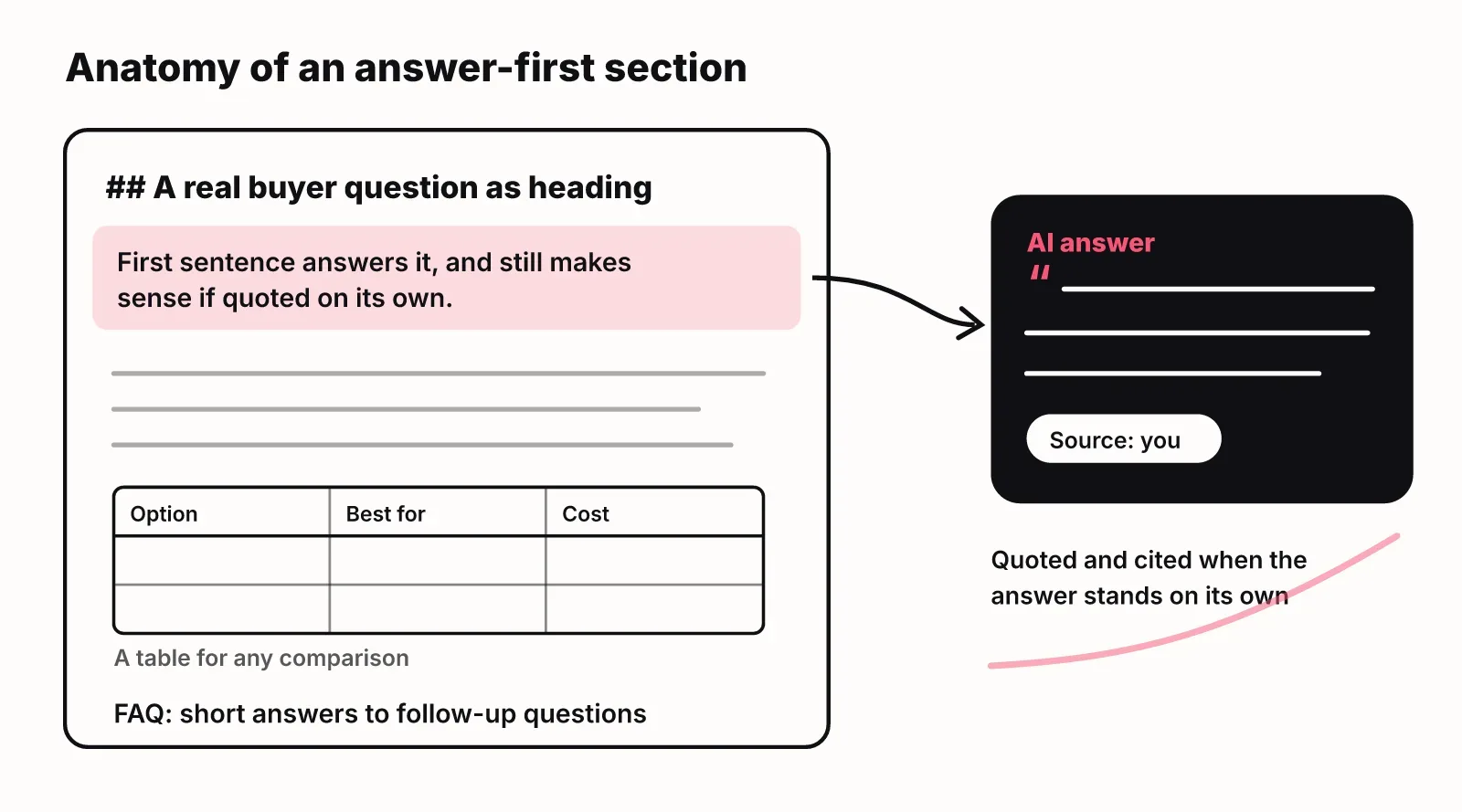
Answer-first content puts a direct, self-contained answer in the first sentence under every heading, so a search engine or AI assistant can quote it without the surrounding page. It is how you get into Google AI Overviews, ChatGPT and Gemini answers instead of only the blue links.
Why it matters now
The keyword for this post already shows an AI Overview above the results. When the answer appears before the click, being quoted or named in it is the visibility that counts. The page that gets quoted is the one that answered cleanly.
Being mentioned and being cited are independent, so LogNorm's AI visibility tracking sorts every answer into four cases:
| Case | What it means | What to do |
|---|---|---|
| Mentioned and cited | The answer names you and uses your page as a source | Keep that page current |
| Mentioned, not cited | The answer names you, but its sources are other sites | Publish your own page that answers the question better |
| Cited, not mentioned | Your page informs the answer, but you are not named | Make the case for your product on that page, not only the teaching |
| Neither | You are absent | Study who is named and which pages the engine cited for them |
How to write it
- Use real questions as headings. Pull them from sales calls, support tickets, Search Console queries and the "People also ask" box.
- Answer in the first sentence, in a form that makes sense on its own. Put nuance after it.
- Define terms in one plain sentence before explaining them.
- Use tables for comparisons and numbered lists for steps, since both are easy to lift into an answer.
- Add an FAQ that answers the follow-up questions in two or three sentences each.
- Keep facts current and dated. An answer engine has no reason to quote a page with last year's pricing.
What a good one looks like
Look at the opening of each section in this post. Each first sentence defines the type or answers the heading, and could be pasted into an answer without editing. That is the whole technique. The rest is keeping it accurate.
How to pick which type to start with
Start with comparison pages if buyers already compare you to a named competitor, because that content converts soonest. Start with founder point of view if you have no audience yet but a strong opinion about the problem. Start with answer-first content if AI answers for your category questions name competitors and not you.
| Type | Best when | Effort per piece | First page to write | What to measure |
|---|---|---|---|---|
| Comparison and alternatives | Prospects name a competitor on calls | Medium, plus upkeep when they change | You vs the competitor named most often | Trials and demos started from the page |
| Founder point of view | You have a clear opinion and no audience | Low to medium, needs founder time | The belief you repeat most on sales calls | Replies, shares, prospects who mention it |
| Answer-first content | AI answers to your category questions skip you | Medium | The question prospects ask before buying | Mentions and citations in AI answers, Search Console impressions |
Most B2B startups should do all three over a quarter, in that order. One comparison page a month, one point-of-view post a month and answer-first rewrites of your existing posts in the weeks between is a realistic load for a founder. If you already have a backlog, our SEO content strategy post shows how to turn a keyword list into a ranked queue.
How to measure each type
Measure each type against the job it does, not by pageviews. A comparison page with a few hundred visits that starts trials beats a how-to post with thousands of visits that starts none.
For comparison and alternatives pages, track signups and demo requests that start on the page, and ask sales which pages prospects mention. For founder point-of-view content, count replies, shares from people in your market and how often prospects bring the post up on calls. For answer-first content, track whether AI answers for your target questions mention or cite you, alongside impressions and clicks in Search Console.
Pick fixed checkpoints before you publish, so you judge the page on its own timeline and not on your mood that week. LogNorm checks every shipped move at 28 and 90 days. Use the early check to catch a page that is not indexed or not answering the question, and the later one to decide whether to expand it, refresh it or drop the topic.
Running this with a small team or AI agents
You can run all three types with one founder and an AI agent, as long as the decisions stay human. The agent drafts and formats. The founder supplies the opinion, picks the competitors and checks the claims.
Three things make that work:
- A ranked backlog, so the next page is always the most valuable one, not the easiest one.
- A single source of truth for positioning, pricing and product facts, so drafts do not invent features.
- A review step before anything ships, especially on comparison pages that make claims about other companies.
This is the loop LogNorm is built for. It turns audits, keywords, competitors and AI answers into ranked moves, drafts content from your Company Brain for your review, and measures what shipped. You can see how LogNorm works, or read how teams use AI agents for marketing and fit content into a wider growth marketing plan.
FAQ
What content should a startup create first?
Start with content for people close to buying. For most B2B startups that means a comparison page against the competitor prospects name most often, then answer-first pages for the questions they ask before buying. Broad how-to posts come later, once those pages exist.
How long does content marketing take to work for a startup?
Bottom-of-funnel pages can start producing signups soon after they are indexed, because the searches are specific and the competition is thin. Broad educational content takes much longer to rank. Set checkpoints, such as 28 and 90 days after publishing, and judge each page against them.
Should startups use AI for content marketing in 2026?
Yes, for research, drafting and formatting, with a human owning the claims and the opinions. AI makes generic how-to content cheap, which is exactly why founder point-of-view content and accurate comparison pages now matter more.
How much does content marketing cost for a startup?
The main cost is time, not money. A founder writing one comparison page and one point-of-view post a month, with an AI tool doing first drafts, can run the program described here. Costs rise when you hire writers or agencies, and the price varies widely by market.
What is the 70-20-10 rule in content marketing?
It is a planning split: about 70 percent of content in proven formats, 20 percent in variations on what works, and 10 percent in experiments. For a startup, the three types in this post can fill the 20 and 10 until one of them proves itself.
What is the 80/20 rule for startups?
It is the idea that a small share of your work produces most of the results. In content marketing, a handful of pages usually drives most signups, which is why measuring each page by the job it does matters more than publishing volume.