AI Search: A Practical Guide for Marketers and Founders
AI search explained for marketers and founders: ChatGPT search, Perplexity, Gemini, AI Overviews and AI Mode, what happens to clicks, and 5 steps to take.


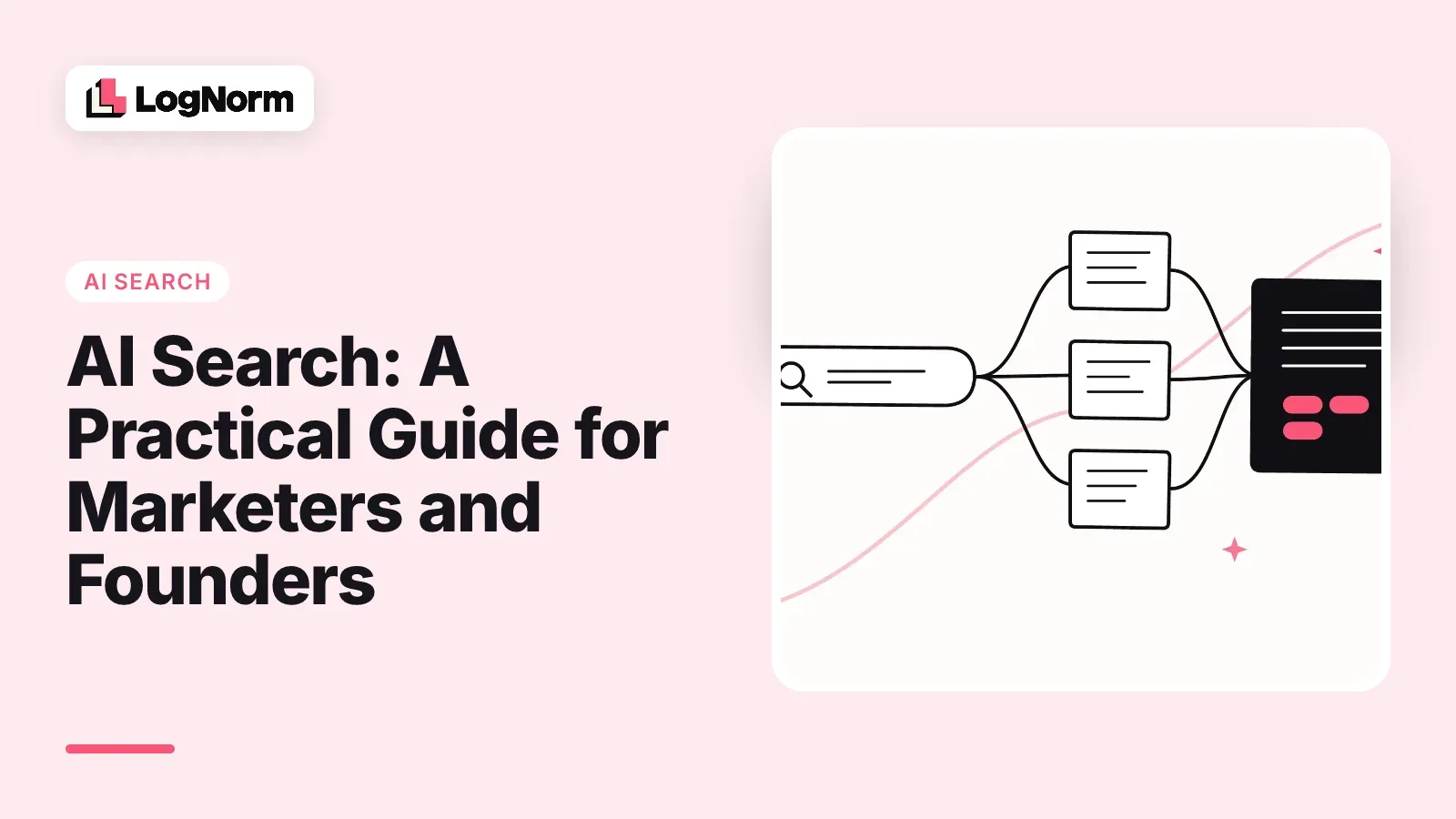
AI search is search where an AI model reads web pages for you and writes the answer, with a few links to its sources underneath. ChatGPT search, Perplexity, Gemini, Google AI Overviews and Google AI Mode all work this way. For a marketer or founder, that changes two things: fewer people click through to your site, and the ones who see your brand often see it inside someone else's sentence.
This guide is the short version. It explains what AI search is, compares the products that matter, sets out what is actually known about clicks, and gives your team five things to do. Each section points to a deeper LogNorm guide when you are ready to go further.
What is AI search?
AI search is a search experience that answers a question in written form, built from pages the system retrieves from the web, and cites some of those pages as sources. A classic results page gives you ten links and leaves the reading to you. An AI search answer does the reading and gives you a summary.
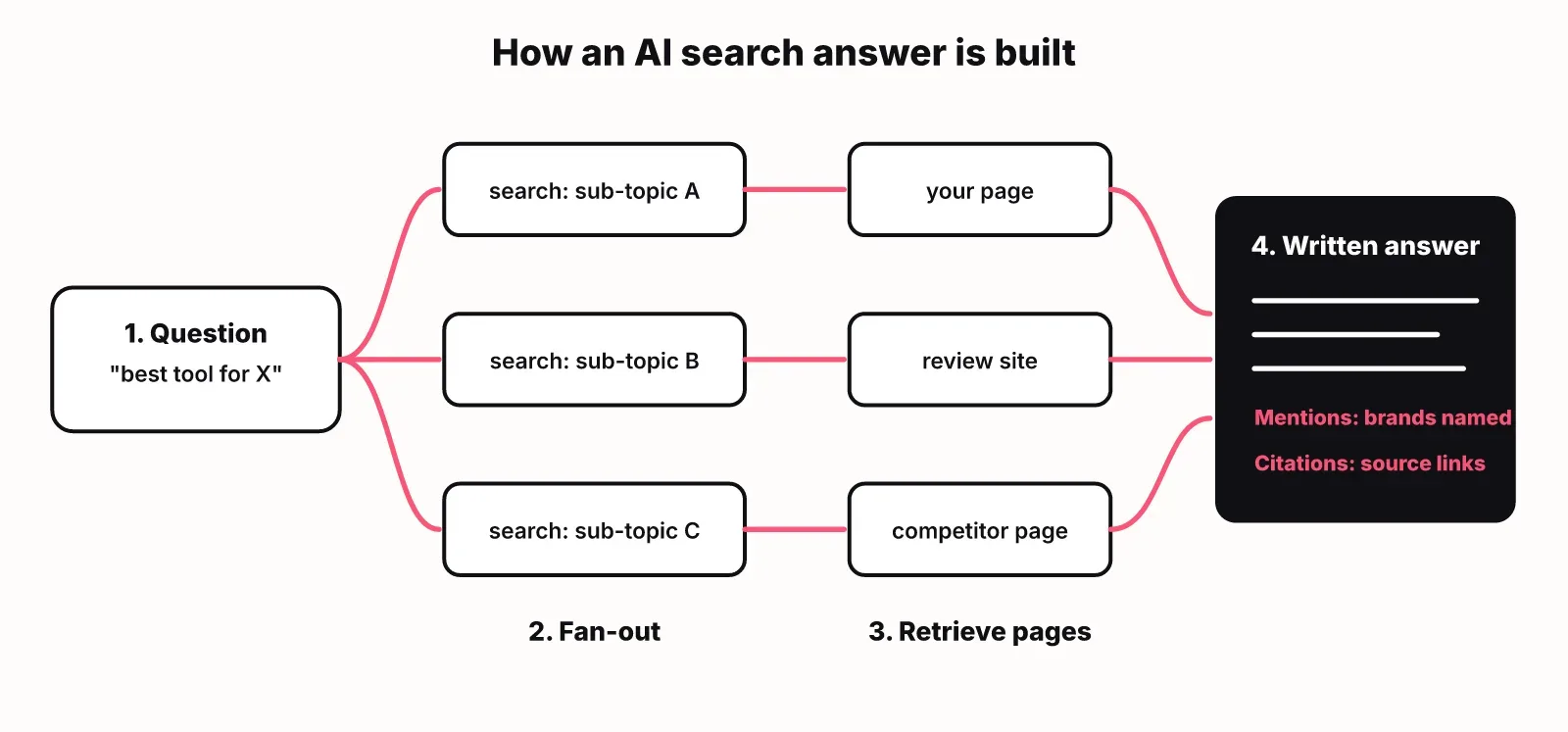
The model behind the answer usually does not rely on what it memorised in training alone. It runs searches, pulls pages, and writes from them. Google describes this for AI Mode and AI Overviews as "query fan-out": issuing multiple related searches across subtopics and data sources to develop a response.
That retrieval step is why AI search is something you can influence. If an engine can crawl your page, and your page answers the sub-question clearly, it can become one of the sources.
The AI search engines that matter, compared
Five surfaces cover most of what your buyers use today: ChatGPT search, Perplexity, Gemini, Google AI Overviews and Google AI Mode. They differ in where they appear and in which crawler decides whether your pages can be used.
| Surface | Where people see it | Crawler that decides if you can be a source | What the owner says |
|---|---|---|---|
| ChatGPT search | Inside ChatGPT, when it searches the web | OAI-SearchBot | Sites opted out of OAI-SearchBot will not be shown in ChatGPT search answers. GPTBot is separate and covers model training. |
| Perplexity | Perplexity's answer engine | PerplexityBot | PerplexityBot surfaces and links websites in Perplexity results and is not used to train foundation models. |
| Google AI Overviews | The AI summary above normal Google results, for some queries | Googlebot (normal Search indexing) | A page must be indexed and eligible to be shown with a snippet; no extra technical requirements. |
| Google AI Mode | A separate AI mode in Google Search for longer, follow-up style questions | Googlebot (normal Search indexing) | Same eligibility as AI Overviews; built on query fan-out across subtopics. |
| Gemini | The Gemini app | Google's crawlers, with the Google-Extended token | Google-Extended controls whether crawled content is used for training Gemini models and for grounding; it does not affect Google Search. |
Two of these are really Google Search. If you already rank and earn snippets, you are eligible for AI Overviews and AI Mode with no new markup. Google says it plainly: there are no additional requirements to appear in AI Overviews or AI Mode, nor other special optimizations necessary.
ChatGPT search and Perplexity are different. They run their own crawlers, so a robots.txt rule written years ago for a different bot can quietly keep you out. That is the first thing to check, and step one below covers it.
How AI search changes discovery and clicks
AI search reduces clicks to websites on the searches where it appears. A large independent measurement comes from Pew Research, which tracked the real browsing of 900 US adults in March 2025 across 68,879 Google searches, 12,593 of which showed an AI summary (Pew Research Center).
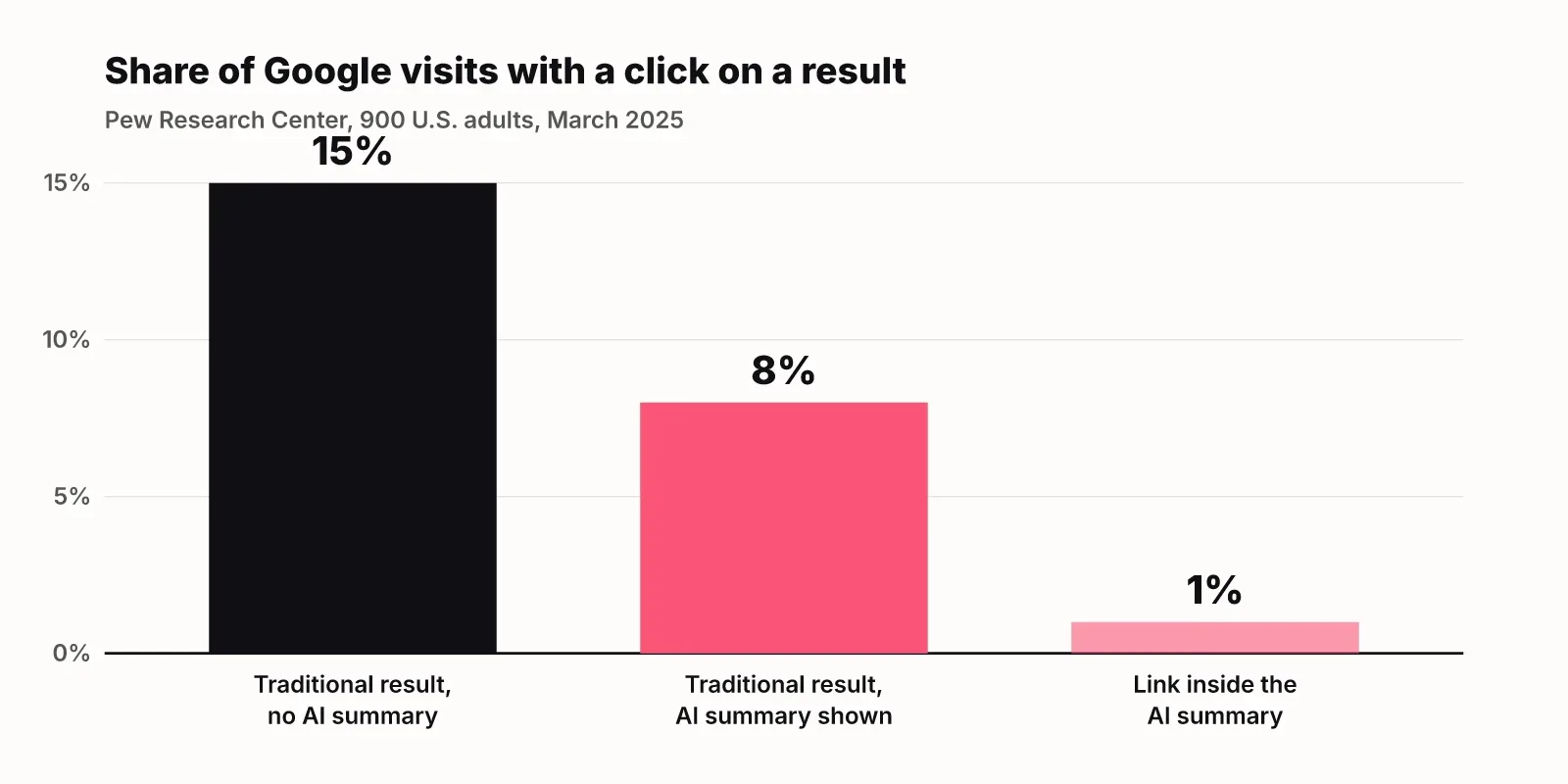
What Pew found:
- People who saw an AI summary clicked a traditional result in 8% of visits. People who did not see one clicked in 15% of visits.
- Clicks on the links inside the AI summary itself happened in 1% of visits.
- Users ended their browsing session on 26% of pages with an AI summary, against 16% of pages with only traditional results.
Google tells a different side of the story. It says that clicks from results pages with AI Overviews are higher quality, and that AI Overviews drove over a 10% increase in usage of Google for the types of queries that show them in markets like the US and India.
Both can be true at once. More people search, a smaller share click, and the clicks that do happen come from people further along. For your team, the practical reading is this: being named in the answer now matters as much as ranking below it, because for many searchers the answer is the last thing they read.
One more practical note: Google counts AI Overviews and AI Mode traffic inside the normal Web search type in the Search Console Performance report. You cannot filter it out there, so you need a separate way to see what the answers say.
Mentions and citations are two different wins
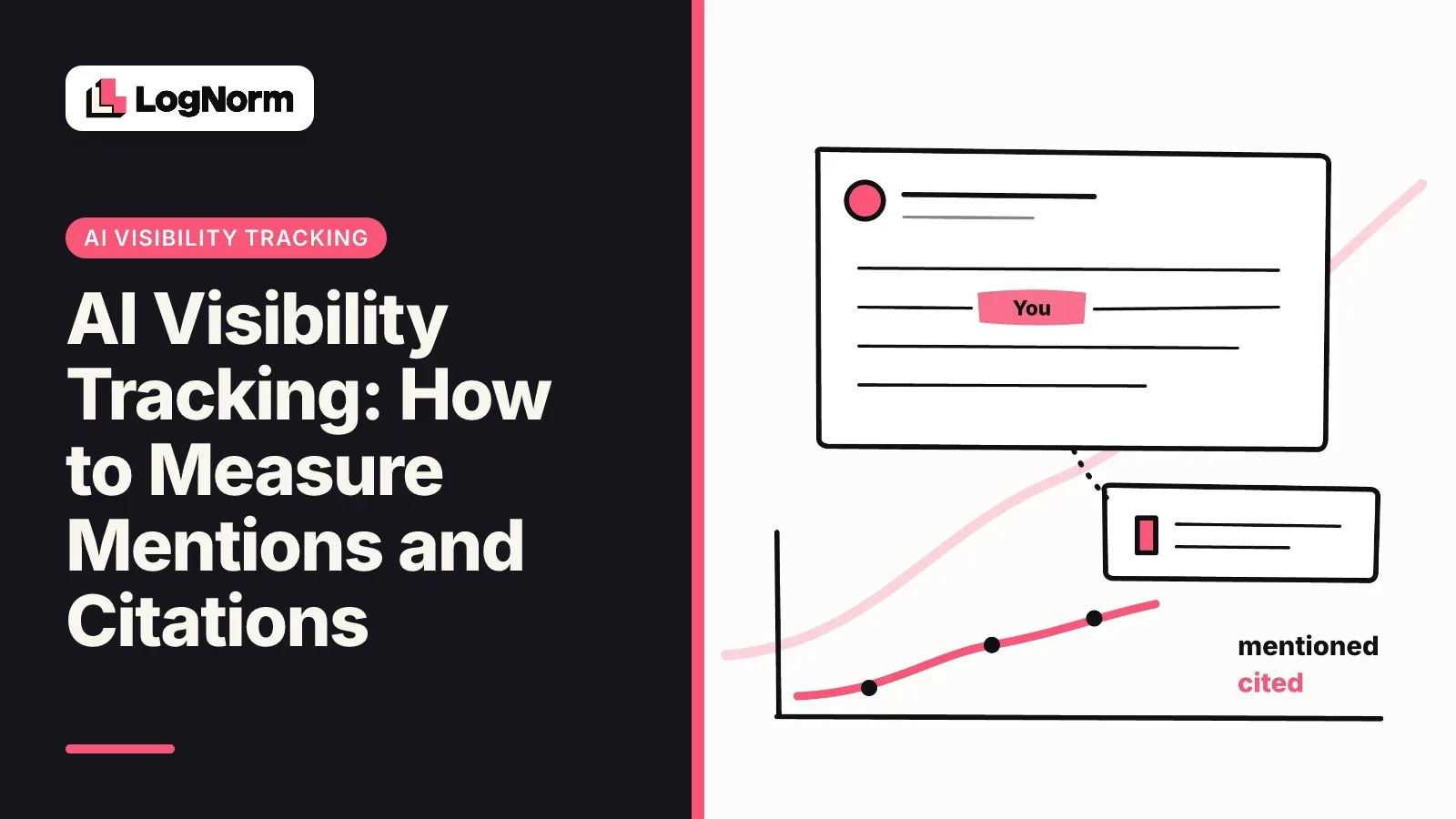
In AI search, being mentioned and being cited are separate outcomes. A mention means the answer names your brand. A citation means the engine used one of your pages as a source. You can get one without the other, and each gap needs a different fix.
That gives you four cases:
| Case | What it means | What to do |
|---|---|---|
| Mentioned and cited | The answer names you and uses your page | Keep that page current |
| Mentioned, not cited | The engine knows you from other sites | Publish the page that should be the source |
| Cited, not mentioned | Your page is a source, but the answer does not name you | Make your brand explicit on that page |
| Neither | You are absent | Start with the third-party pages the engines already cite |
This split is how LogNorm's AI Visibility feature records every answer: it asks ChatGPT, Gemini and Google AI Overviews the questions your buyers ask, and stores mention and citation as two separate facts. For the full method, read what AI visibility is and how to measure it.
What your team should do about AI search
Most of the work is the same work that makes a site good for search, with three additions: crawler access for the AI bots, pages that answer in quotable sentences, and presence on the third-party pages the engines cite. Here is the order we would do it in.
- Check crawler access. Allow OAI-SearchBot for ChatGPT search and PerplexityBot for Perplexity in robots.txt. Blocking GPTBot or Google-Extended is a training decision, not a search one: OpenAI says disallowing GPTBot signals your content should not be used for training, and Google says Google-Extended does not affect Search inclusion or ranking. Note that blocking Google-Extended also opts you out of Gemini grounding.
- Make sure your key pages are indexed and snippet-eligible. For Google's AI features this is the entire technical requirement. A page with noindex or nosnippet cannot be a supporting link.
- Write answer-first pages. Put a direct, self-contained answer in the first sentence under each heading. Engines that fan a question out into sub-queries need a passage that answers each sub-question on its own.
- Get onto the pages that get cited. Comparison pages, listicles, reviews and forum threads often supply the answer. If they name your competitors and not you, that is a gap you can close with outreach or your own equivalent page.
- Track the prompts your buyers ask and measure after you ship. Pick 10 to 30 real buyer questions, check the answers across engines on a schedule, and compare before and after each change.
The deeper how-tos live in their own guides: how to rank in ChatGPT and Perplexity, how to get cited in Google AI Overviews, and the full playbook for generative engine optimization.
If you want this as a running process rather than a one-off audit, LogNorm turns AI answers, a GEO audit of your site and your search data into ranked moves for a weekly plan, then re-checks the answers after you ship. Steps one to five above are the same, whichever tool you use.
Where to go next: the AI search reading map
Use this map to pick the guide that matches your next question.
| Your question | Read |
|---|---|
| How do I show up in ChatGPT and Perplexity answers? | How to rank in ChatGPT and Perplexity |
| How do I become a source in Google's AI Overviews? | How to get cited in Google AI Overviews |
| What is GEO and how is it different from SEO work? | Generative engine optimization: a practical guide |
| How do I measure whether AI engines mention us? | What is AI visibility and how to measure it |
Three more guides in this series are coming soon: one on LLM SEO and getting your brand into AI answers, one on AI citations and why some pages get cited by ChatGPT and Gemini, and a comparison of AEO vs SEO vs GEO.
FAQ
Is AI search replacing Google?
No. Google runs its own AI search inside Google Search, through AI Overviews and AI Mode. What changes is the result format: more searches end in a written answer, and Pew found people click traditional results about half as often when an AI summary appears.
Do I need special optimization to appear in Google AI Overviews?
No. Google says a page needs to be indexed and eligible to show with a snippet, and that there are no additional requirements or special optimizations. Clear, answer-first content still helps your page get chosen among eligible sources.
Does blocking GPTBot remove my site from ChatGPT search?
No. OpenAI uses GPTBot for model training and OAI-SearchBot for ChatGPT search. Blocking GPTBot keeps your content out of training. Blocking OAI-SearchBot keeps you out of ChatGPT search answers.
How do I know if AI search mentions my brand?
Ask the engines the questions your buyers ask and record two things for every answer: whether your brand is named, and whether one of your pages is cited. Do it on a schedule, in the products your buyers use, because answers change between runs. A tracking tool such as LogNorm's AI Visibility does this across ChatGPT, Gemini and Google AI Overviews.
Which AI search engine should a startup focus on first?
Start with Google AI Overviews if you already get organic traffic, because you are eligible through work you already do. Add ChatGPT search next: check that OAI-SearchBot is allowed, then work on the prompts where competitors are named and you are not.