Topic Clusters: Plan a Hub and Spokes That Rank
Plan topic clusters from keyword data: pick the pillar, group keywords by intent, decide hub vs spokes, wire internal links and set a publishing order.


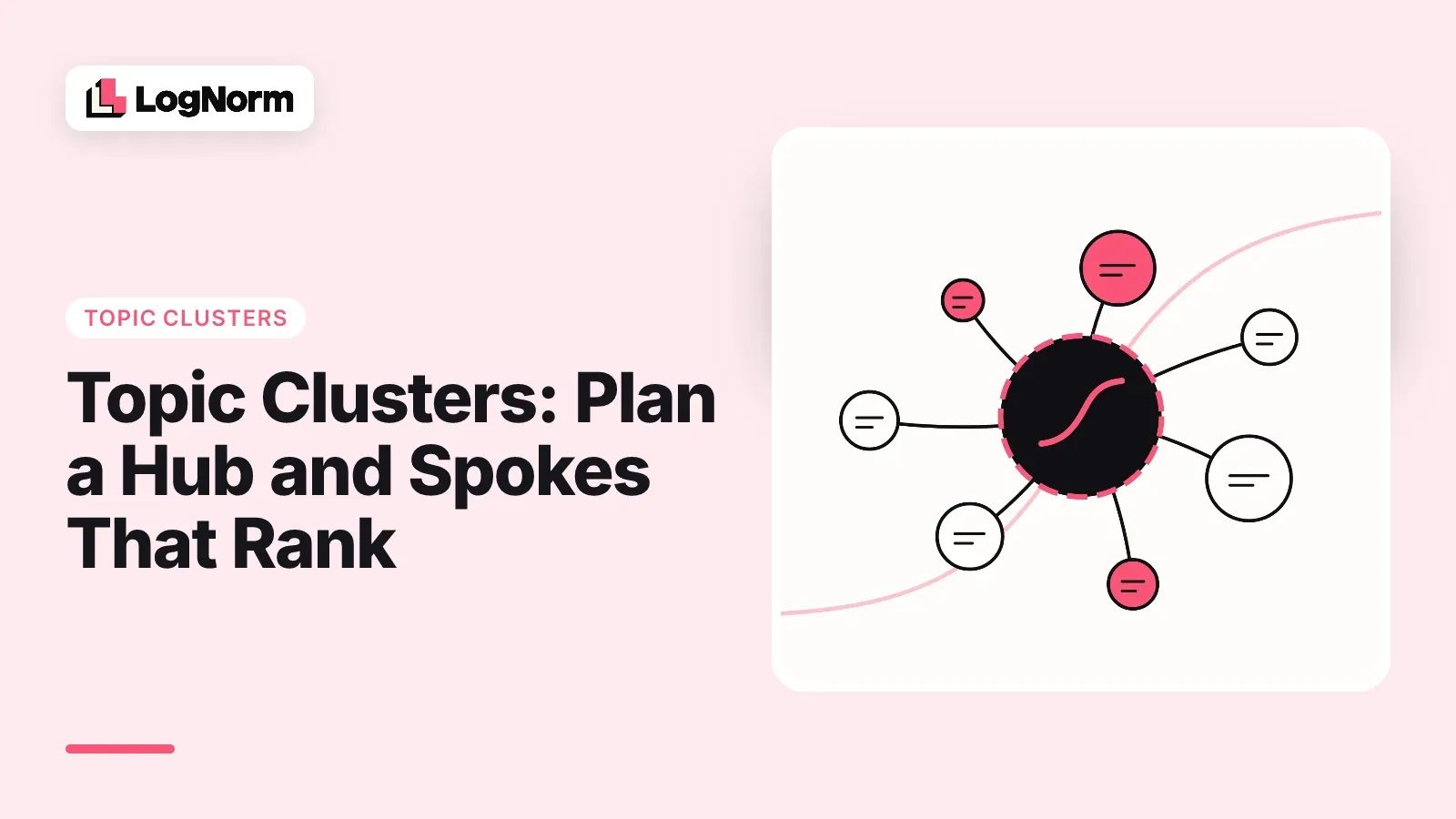
A topic cluster is a set of pages planned together: one hub page that covers a broad topic and several spoke pages that each win one narrower search, all linked to each other. The hub answers "what is this and how does it fit together". Each spoke answers one specific question in depth and links back up.
Most guides stop at that definition and a five-step list. This one walks through the decisions with real numbers from two clusters we planned for lognorm.com: which keyword became the pillar (it was not the biggest one), which keywords were merged into a single page, how the links are wired and what to publish first.
What is a topic cluster?
A topic cluster is a hub page plus a group of spoke pages, where each page targets a different search intent and every spoke links to the hub. The hub targets the broad query. Spokes target the narrower queries that the hub can only mention in a paragraph.
The structure does two jobs. Readers can move from the overview to the detail they need. Search engines and AI answer engines see many pages on one subject that point to each other, instead of scattered posts that compete for the same query.
Two terms get mixed up here. The cluster is the whole plan. The pillar page (the hub) is one page in it, and how to build that page is a separate topic we cover in our article on pillar pages. Grouping keywords into pages is also its own method, covered in our keyword clustering guide. This article is about the plan that sits between them.
Start from keyword data, not a brainstorm
Plan a cluster from a keyword list with numbers attached, not from a whiteboard of ideas. A brainstorm gives you topics you find interesting. Keyword data tells you which questions people actually type, how many of them do, and how hard each one is to win.
Pull candidates from three places:
- Search Console queries where you already get impressions.
- Keywords your competitors rank for and you do not.
- Keyword research from a handful of seed topics.
Then clean the list before you group anything. Drop keywords that are off-topic for what you sell and searches for a competitor's own brand. For every keyword left, record four things: monthly searches, difficulty, intent (informational, commercial, transactional, navigational) and the kind of page that would win it (guide, comparison, listicle, how-to, glossary, template).
That last column matters most. Two keywords with similar words but different winning page types belong on different pages.
Pick the pillar: the job you are the answer to
The pillar keyword is the broadest query that every spoke can naturally point up to and that describes the job your product does. It is usually not the keyword with the most searches.
Here is the cluster we planned for lognorm.com around AI agents doing growth work. It holds 30 keywords and about 62,190 monthly searches in our keyword data. Fourteen articles from it are live.
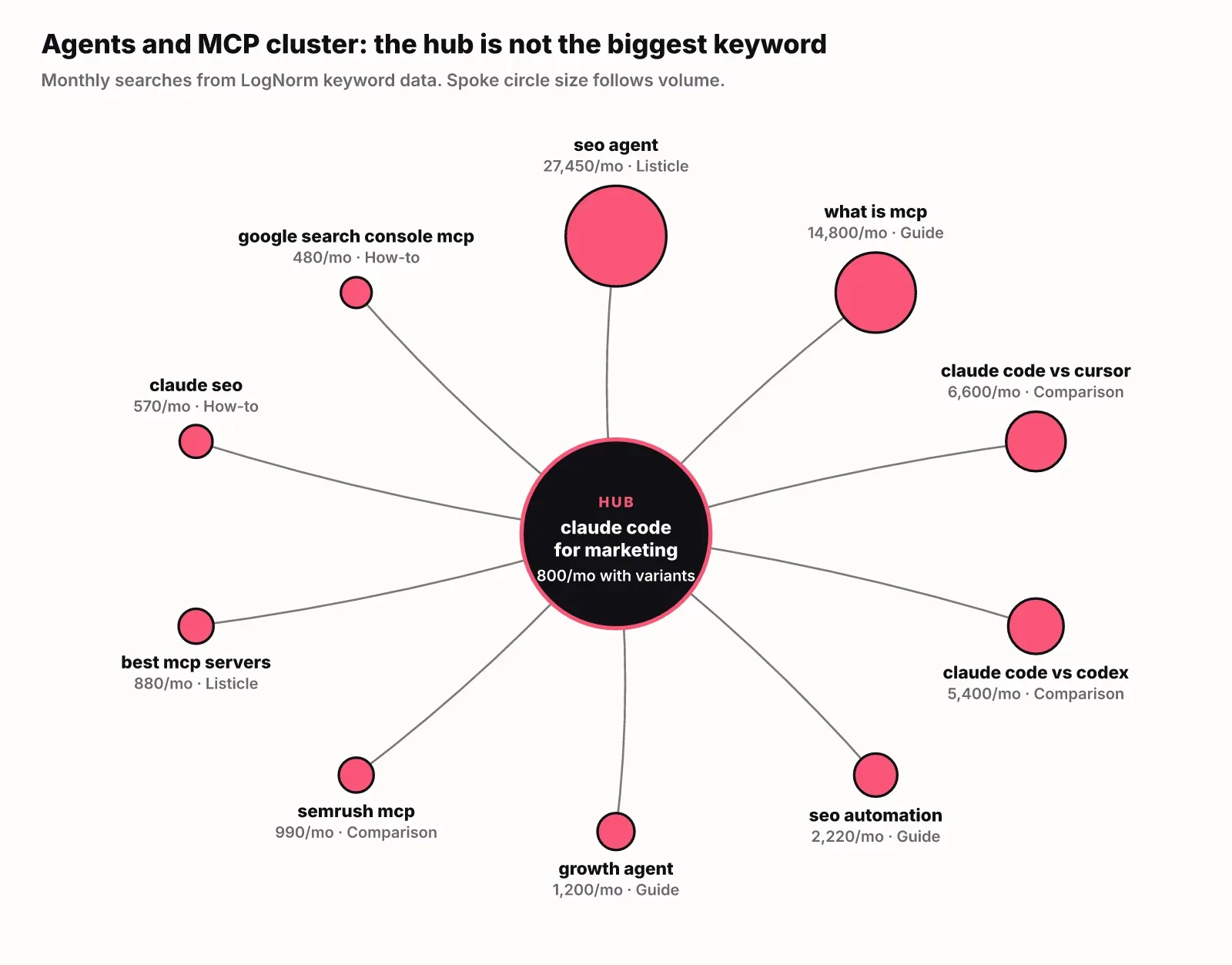
The obvious pillar would have been "seo agent" at 27,450 searches a month. We made it a spoke. People searching "seo agent" want a list of tools to compare, so the page that wins is a listicle. A listicle makes a poor hub: it cannot hold the definitions, setups and workflows that the other spokes cover.
The hub became "claude code for marketing" at 320 searches a month and difficulty 13, together with "claude for marketing" (390, difficulty 1) and "claude code marketing" (90). That is 800 searches combined. It won the role for three reasons:
- It describes the job our product does: a coding agent running growth work.
- Every spoke, from "what is mcp" to "claude code vs codex", is a natural next step from it.
- The pages ranking for it were newsletters, a course and Medium posts, with no product doing the work, so a hands-on guide had room to win.
The test we use: if a reader lands on the hub, would every spoke be a link they might want next? If one spoke feels like a detour, the hub is too narrow. If the hub could link to half your blog, it is too broad.
Group keywords by intent and page type
Put two keywords on the same page only when they want the same answer in the same format. If one wants a comparison and the other wants a how-to, they are two pages, even if they share most of their words.
These are the ten planned spokes of the Agents and MCP cluster, with the format each one got:
| Spoke keyword | Monthly searches | Difficulty | Page format |
|---|---|---|---|
| seo agent | 27,450 | 19 | Listicle |
| what is mcp | 14,800 | 29 | Guide |
| claude code vs cursor | 6,600 | 0 | Comparison |
| claude code vs codex | 5,400 | 6 | Comparison |
| seo automation | 2,220 | 14 | Guide |
| growth agent | 1,200 | 1 | Guide |
| semrush mcp | 990 | 15 | Comparison |
| best mcp servers | 880 | 14 | Listicle |
| claude seo | 570 | 8 | How-to |
| google search console mcp | 480 | 17 | How-to |
Notice that "semrush mcp" and "best mcp servers" share a subject but not a format. One searcher wants a head-to-head of specific servers. The other wants a ranked list. They became separate pages.
The reliable way to decide this is to compare the results pages: if the same URLs rank for both keywords, one page can win both. That method has its own article, our guide to keyword clustering.
Decide what is a spoke, what merges and what stays out
Every keyword ends in one of three places: its own spoke, folded into another page as a related keyword, or out of the cluster. Make the call explicitly for each one, or you end up writing near-duplicate posts that compete with each other.
The cluster this article belongs to, "Content briefs and planning", shows all three calls. Its hub is "seo content writing" at 1,000 searches a month and difficulty 13.
| Keywords | Searches | Call | Why |
|---|---|---|---|
| content brief template, content brief, seo content brief, content brief generator | 650 combined | Merge into one spoke | Same reader, same answer: what goes in a brief. Difficulty 0 to 8 across the set |
| keyword clustering | 480 | Own spoke | A method, with its own how-to format |
| pillar page | 320 | Own spoke | Definition intent, different from planning a cluster |
| topic clusters | 260 | Own spoke (this article) | Planning intent, difficulty 34 |
| content decay, content refresh | 90 combined | Merge into one spoke | Small volume, but it supports work the product already does |
Two of those calls are worth spelling out. "Pillar page" and "topic clusters" overlap heavily in wording, yet one searcher wants a definition and the other wants a plan, so they got separate pages. And four brief keywords that look like four articles became one page, because a separate post for each would split the same answer four ways.
A keyword stays out when it shares your vocabulary but its searchers are rarely your buyers. Low relevance is a better reason to cut than low volume. The decay spoke above has 90 searches a month and still earned its place.
Wire the internal links
The hub links to every spoke, and every spoke links back to the hub using the hub's keyword or a close variant as the anchor. Spokes link to each other only where the other spoke is the reader's obvious next question.
Keep three rules:
- Link from the hub in the body text where each subtopic comes up, not only in a list at the bottom.
- Put the link up to the hub early in each spoke, where you hand off the broad context.
- Add spoke-to-spoke links sparingly. "Claude Code vs Cursor" linking to "Claude Code vs Codex" helps a reader choosing an agent. Linking every spoke to every other spoke adds noise.
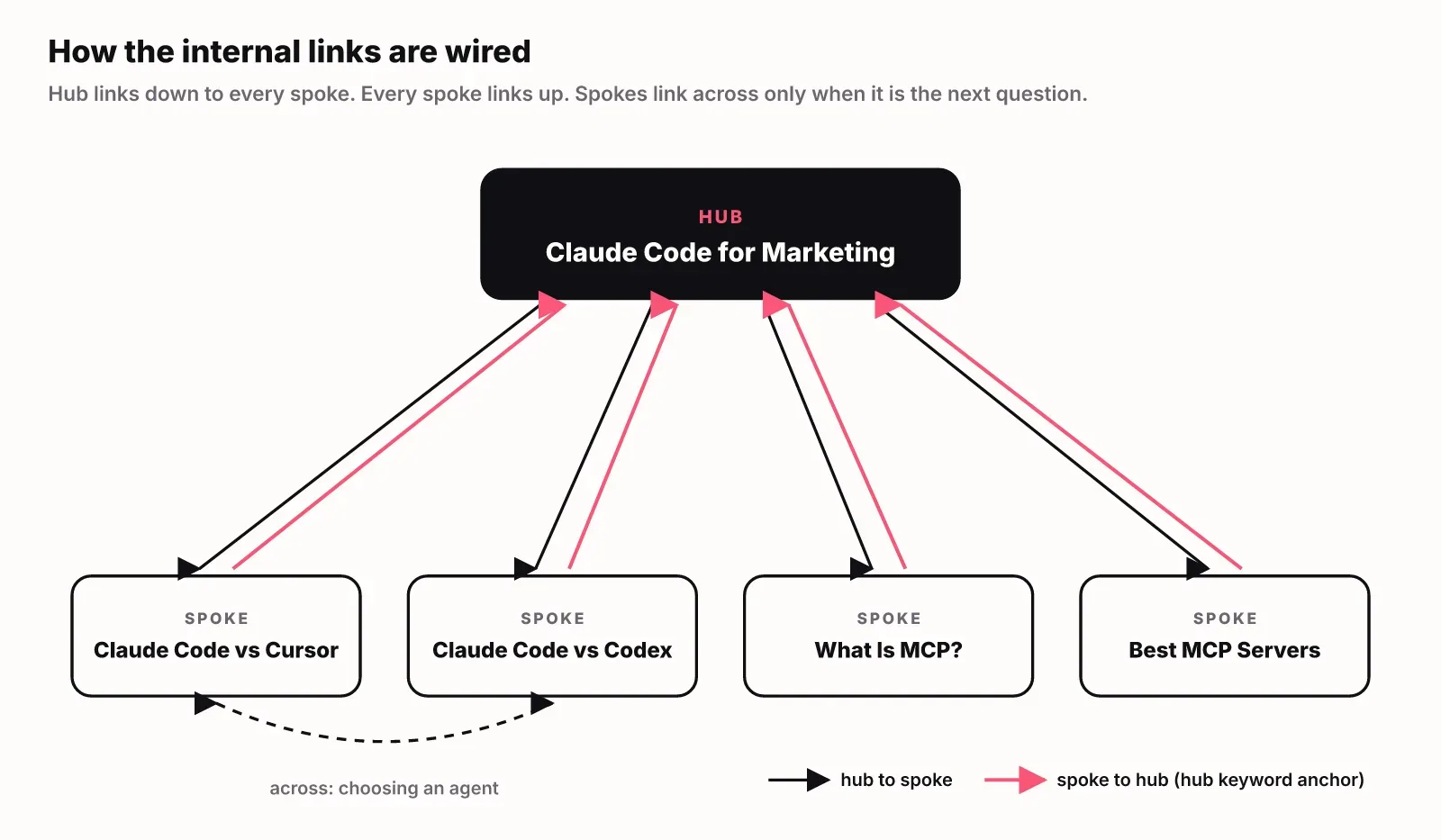
Links between clusters are fine when they serve the reader. This article belongs to the content planning cluster but links to AI teammates for growth, because it explains the agent-on-the-team setup the Agents and MCP cluster is about.
Choose the publishing order
Publish the hub first, or together with the first spoke, so every spoke has a live page to link up to from day one. Then publish spokes from easiest to hardest to win, adjusted for how close each one is to what you sell.
Starting with low-difficulty spokes gets pages ranking and earning links while the harder pages are still being written. Those early pages then link up to the hub and across to the later spokes as they go live.
This is the order we would follow for the Content briefs and planning cluster:
| Order | Page | Keyword | Searches | Difficulty | Reason |
|---|---|---|---|---|---|
| 1 | Hub | seo content writing | 1,000 | 13 | Every spoke links to it |
| 2 | Spoke | content brief template (+3 related) | 650 | 2 | Easiest win, highest spoke volume |
| 3 | Spoke | pillar page | 320 | 13 | Low difficulty |
| 4 | Spoke | content decay (+1 related) | 90 | 5 | Easy, supports decay work |
| 5 | Spoke | keyword clustering | 480 | 28 | Harder, needs the hub live first |
| 6 | Spoke | topic clusters | 260 | 34 | Hardest in the set |
Two cautions. A link to a page that is not live yet is a broken link, so add spoke links to the hub as each spoke publishes, not in advance. And do not wait for the whole cluster to be written before publishing anything. A cluster of six pages can take weeks, and the first pages can start ranking in the meantime.
How LogNorm plans clusters and briefs
LogNorm builds clusters from your keyword data and turns each planned page into a piece of work in your plan. A keyword research run checks volume and difficulty, screens each suggestion for relevance, groups keywords into topic clusters and turns clusters into moves, ranked against the rest of your weekly Growth Plan.
The Topic clusters tab in Keywords and Topics shows keywords grouped into hubs and spokes, one cluster per page you could write. Each keyword carries LogNorm's read on its intent, its relevance to your buyers and the kind of page that would win it, the same columns this article recommends. Keywords you skip stay out of clusters, and you can move any keyword to another cluster from its detail sheet. The topics and clusters docs cover the hub-and-spoke plan in full.
That answers the other half of the question "how do you plan ranking articles and automate their briefs". Once a spoke is a move, LogNorm writes a brief from the live results page, the ranking competitors, your keywords and your Company Brain, then a draft for your review. If you run a coding agent, it can do the planning and writing over MCP; Claude Code for marketing shows the setup. A dedicated keyword clustering tool page is on the way.
FAQ
What is a topic cluster?
A topic cluster is one hub page on a broad topic plus several spoke pages that each target a narrower search, linked together so the hub points to every spoke and every spoke points back to the hub.
What are the benefits of topic clusters?
Clusters stop your own pages from competing for the same query, because each keyword is assigned to exactly one page. They also give readers a clear path from overview to detail, and give search engines a connected set of pages on one subject.
What is the difference between a topic cluster and a pillar page?
The topic cluster is the whole group of pages and the links between them. The pillar page is the hub of that group: the single broad page the spokes link up to.
Are topic clusters still relevant with AI search?
Yes. When we tracked how Google's AI Overview answers "how to build automated content briefs and plan ranking articles for search" in October 2026, its plan included grouping keywords into pillars and subtopics with internal links between them. AI answers also pull from pages that answer one question well, which is what a spoke is.
How many spokes should a cluster have?
As many as there are distinct intents worth a page, and no more. Our content planning cluster has five spokes from eleven keywords. The Agents and MCP cluster planned ten from thirty. Merge keywords that share a results page instead of padding the count.
Can you automate content briefs and cluster planning?
Partly. Software can gather the keyword data, group keywords, read the ranking pages and draft a brief for each spoke. The calls in this article (which keyword is the pillar, what merges, what stays out) still need someone who knows what the business sells. A tool that shows its reasoning makes those calls fast to check.