Keyword Clustering: How to Group Keywords Into Pages
Keyword clustering groups searches one page can rank for. Learn to cluster by intent and SERP overlap, handle overlaps and map each cluster to one page.


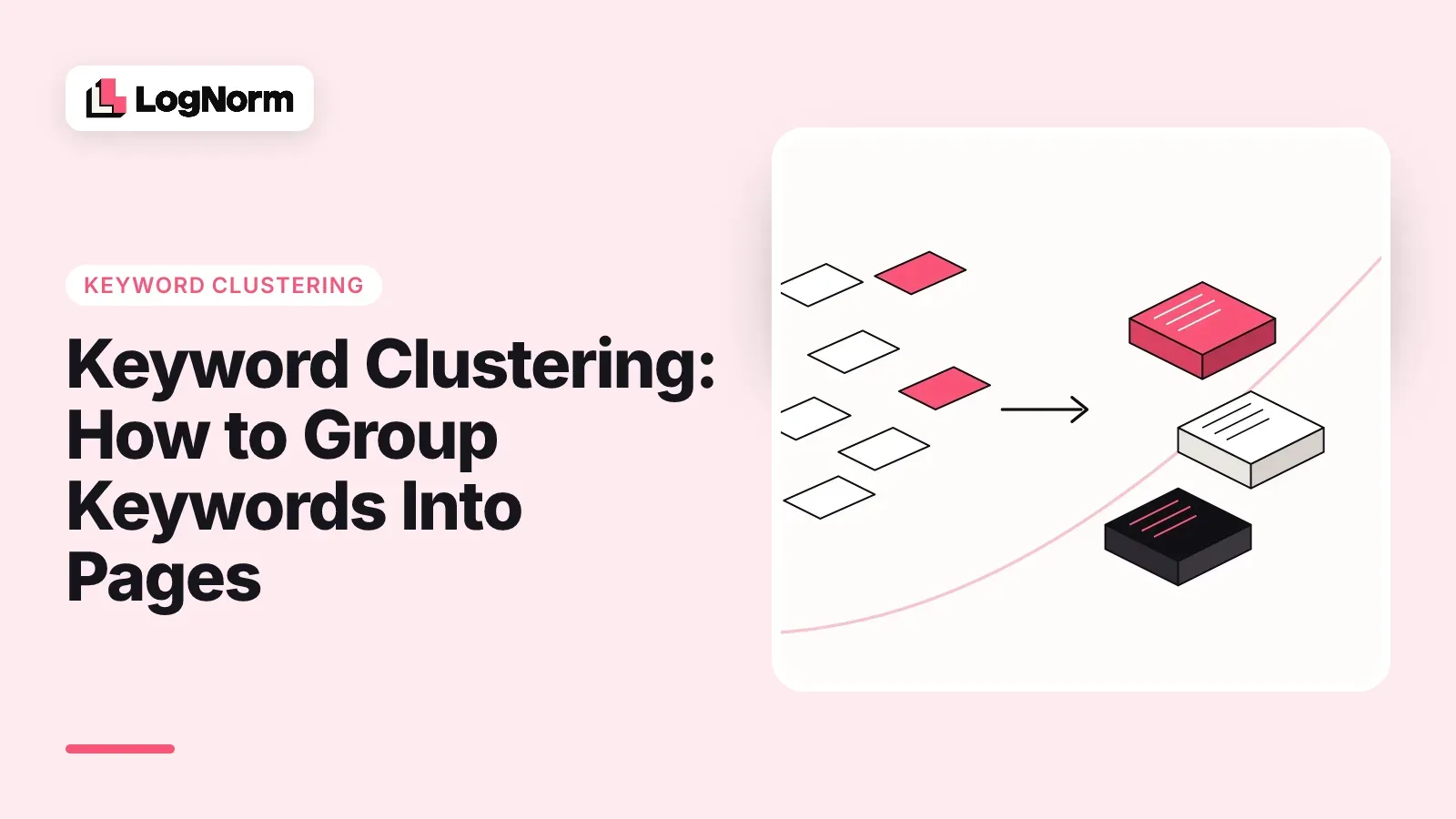
Keyword clustering is the step that turns a keyword list into a page map. You group searches that one page can rank for, then write one page per group. Done well, it tells you how many pages to build, which keyword each page leads with, and which pages you already have that cover a cluster.
This guide covers the method: which grouping signal to trust, a step-by-step process, a worked example, and the rules for keywords that fit two clusters at once.
What is keyword clustering?
Keyword clustering is grouping keywords that a single page can rank for, so that each group becomes one page with one primary keyword. The test for a cluster is simple: would the same page satisfy every search in it?
The output is a page map, not a spreadsheet of themes. Each row is a page you will write or update, with its primary keyword, its supporting keywords and its format (guide, comparison, template, product page).
Keyword clustering is not the same as planning topic clusters. Keyword clustering decides what goes on each page. Topic clusters decide how pages link together around a hub. Do keyword clustering first, because a hub-and-spoke plan built on badly grouped keywords inherits every mistake. Our separate guide on topic clusters covers the hub side.
Three ways to group keywords, and which to trust
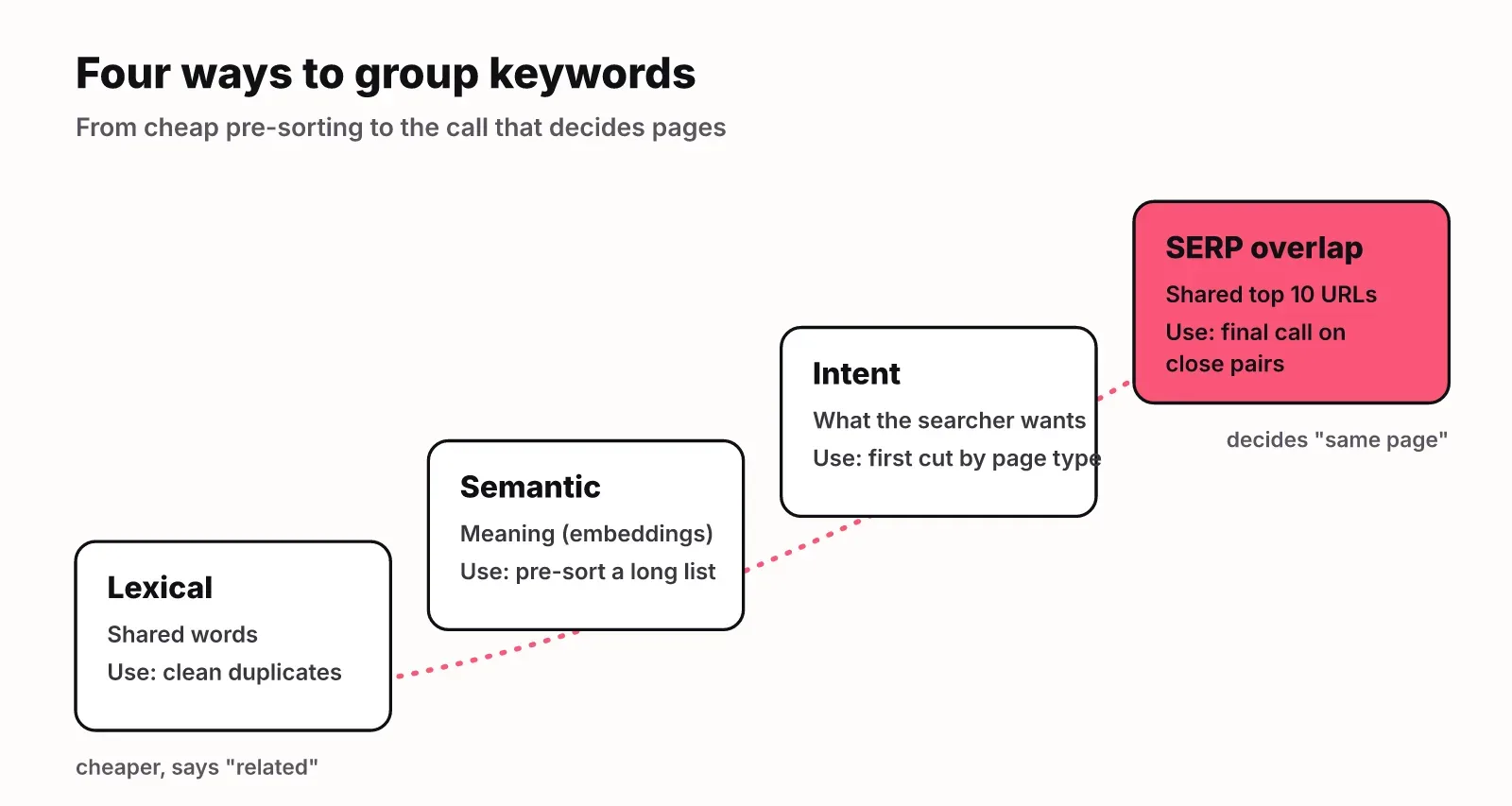
Group keywords by intent and confirm with search-results overlap. Use word or meaning similarity only to pre-sort a long list. Similarity tells you two searches are related. Only intent and the results page tell you whether they belong on the same page.
| Method | What it compares | What it misses | Cost | Best use |
|---|---|---|---|---|
| Lexical | Shared words and stems | Synonyms; same words with different intent | Free, instant | Cleaning duplicates and plurals |
| Semantic | Meaning, via text embeddings | Whether Google shows the same pages | Cheap at scale | Pre-sorting hundreds of keywords |
| Intent | What the searcher wants to do | Fine splits within one intent | Your judgement, or a model | First cut into page types |
| SERP overlap | Shared URLs in the top 10 results | Why the pages rank; results shift over time | One results check per keyword | Final call on close pairs |
Semantic grouping is good at finding related terms that share few words. Research comparing language-model search with keyword search found the semantic results were overwhelmingly semantically similar despite lower exact overlap. That is the strength and the trap. "Invoice template" and "invoicing software" are close in meaning, yet one searcher wants a free file and the other wants to buy a product. Similarity scores do not show that. The results page does.
SERP overlap works because the results page shows which pages Google currently ranks for each search. If two keywords show many of the same URLs, Google is treating them as one need, and one page can rank for both. If they share none, a single page will usually win one and lose the other.
How to cluster keywords, step by step
Clean the list, label intent, pre-sort by meaning, confirm close pairs with a results check, then assign one page per group. Here is each step in order.
- Clean the list. Merge plurals, misspellings and word-order variants. Drop keywords your buyers would never search, and searches for a competitor's brand name.
- Label intent and format. For each keyword, note what the searcher wants (learn, compare, buy, find a specific site) and the page type ranking today. If the top results are templates, a long guide will not win.
- Pre-sort by meaning. Sort by head term or run a semantic grouping so related keywords sit next to each other. Treat these groups as drafts.
- Check overlap on close pairs. For any two keywords you might merge, compare their top 10 results. Pick a threshold before you start, for example three or more shared URLs means one page, and apply it the same way every time.
- Name the cluster and assign a page. The primary keyword is the one with the clearest intent match and the most demand. Map the cluster to an existing URL if you have one, or mark it as a new page.
You do not need to check every pair of keywords. Check only pairs your pre-sort put together and pairs where the intent label is borderline. On a list of a few hundred keywords, that is usually a small share of the work.
A worked example: fifteen invoicing keywords into pages
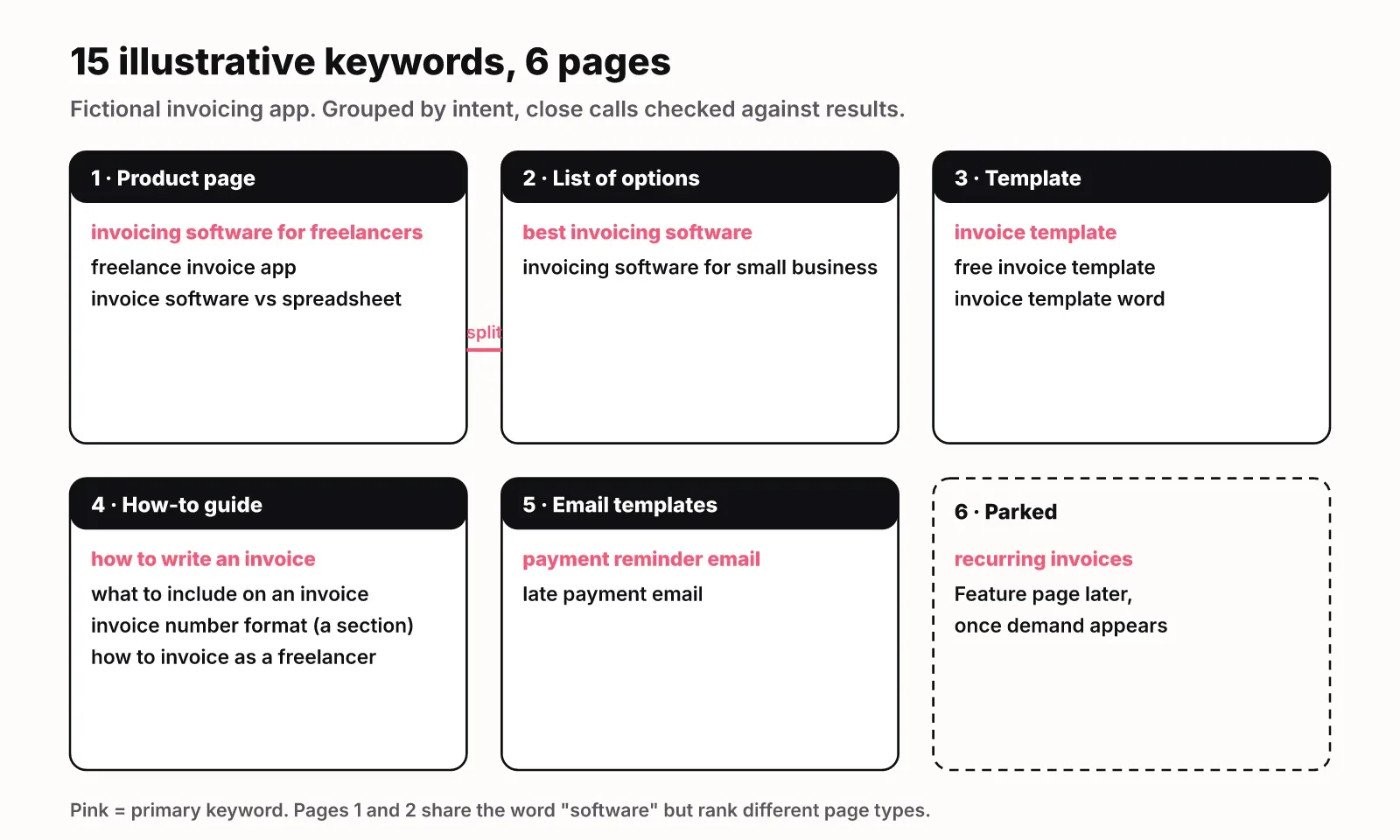
Take a fictional invoicing app for freelancers and fifteen keywords from its research. The keywords and groupings below are illustrative, written to show the decisions, not pulled from live search data.
The list: invoicing software for freelancers, freelance invoice app, best invoicing software, invoicing software for small business, invoice template, free invoice template, invoice template word, how to write an invoice, what to include on an invoice, invoice number format, how to invoice as a freelancer, late payment email, payment reminder email, invoice software vs spreadsheet, recurring invoices.
Group by shared words and you get one giant "invoice" bucket, with "invoice template" next to "invoicing software". Group by intent and the list falls into clear jobs. Check the results and the close calls settle themselves.
| Page | Primary keyword | Supporting keywords | Intent and format |
|---|---|---|---|
| 1 | invoicing software for freelancers | freelance invoice app, invoice software vs spreadsheet | Commercial, product or comparison page |
| 2 | best invoicing software | invoicing software for small business | Commercial, list of options |
| 3 | invoice template | free invoice template, invoice template word | Transactional, downloadable template |
| 4 | how to write an invoice | what to include on an invoice, invoice number format, how to invoice as a freelancer | Informational, how-to guide |
| 5 | payment reminder email | late payment email | Informational, email templates |
| 6 | recurring invoices | (none yet) | Feature page; parked until more demand appears |
Two decisions are worth spelling out. "Best invoicing software" and "invoicing software for freelancers" share the word software, but one results page is list articles and the other is product pages, so they split. "Invoice number format" sounded like its own topic, but its results are guides on writing invoices, so it became a section of page 4.
One page per cluster, and how to handle overlaps
Each cluster gets exactly one page, and each keyword belongs to exactly one cluster. Two pages chasing the same cluster split your links and confuse which URL Google should rank. A keyword left in two clusters creates the same problem one level down.
Use these rules when a keyword or a pair does not fit cleanly.
- Same intent and shared results: merge into one cluster, one page.
- Different intent, even with shared words: split into separate pages.
- A subtopic whose results show the broader guide: make it a section of that guide, not a page.
- A keyword that fits two clusters: assign it to the cluster whose primary keyword shares the most results with it. Write a short link from the other page instead of a second section.
- A keyword with unclear intent or almost no results to compare: park it. Recheck it in a few months.
The goal is the same one information retrieval research uses for grouping documents: clusters that cover the ground while minimising overlap between clusters. In practice, a clean map is one where you can point to any keyword and name its single page.
Before you write anything new, map every cluster to the pages you already have. If an existing page ranks for part of a cluster, update it rather than publishing a competitor to it. New pages go only where no URL covers the cluster.
Keyword clustering tools and where LogNorm fits
Under about a hundred keywords, a spreadsheet and manual results checks are enough. Above that, use a tool to do the pre-sort and the labelling, and keep your own judgement for the close calls.
Clustering tools differ mostly in which signal they use. Some group by shared ranking URLs, some by embeddings, some by an AI read of intent. Ask any tool which signal it uses before you trust its groups, because that decides which mistakes it will make.
LogNorm Keywords and Topics works from a judgement of each keyword rather than a count of shared URLs. Every keyword gets a read on fit with your business, intent and the kind of page that would best win the search, then keywords are grouped into pages and pages into topics, with one cluster per page you could write. You can move a keyword to another cluster from its detail sheet, and keywords you skip stay out of clusters. The Keywords docs explain how LogNorm rates each keyword.
Because LogNorm does not group by results overlap, run the results check from step 4 on any two clusters that look like they should be one page. Once the page map is settled, the next job is ordering it: our guide to SEO content strategy covers how to turn the page map into a ranked backlog.
FAQ
What is the difference between keyword clustering and topic clusters?
Keyword clustering groups keywords into pages. Topic clusters group pages into a hub with supporting articles that link to it. You need keyword clusters first, because each spoke in a topic cluster is one keyword cluster.
Are semantic clusters the same as LSI keywords?
No. Semantic clustering groups keywords by meaning using language models. "LSI keywords" is an older SEO term for related words to sprinkle into a page. Semantic clusters decide page structure. Related-word lists only influence wording.
How many keywords do you need before clustering is worth it?
Clustering is worth doing as soon as you have more keywords than pages, which for most sites is the first research session. Manual grouping works up to roughly a hundred keywords. Past that, automate the pre-sort and keep manual checks for close pairs.
Does Google use semantic clustering?
Google matches on meaning, not only exact words, so a page can rank for searches that use different wording. It still ranks different pages for related searches when the intent differs. That is why the results page, not meaning alone, should decide your clusters.
Can keyword clustering replace keyword research?
No. Clustering organises keywords you already have. Research finds them, with demand, difficulty and fit for your business. Weak research gives you neatly grouped keywords nobody you sell to searches. If you want both in one place, see keyword research judged for your business.