Best AI SEO Tools in 2026, Judged by the Work They Ship
Compare the best AI SEO tools by the work they ship: research, content, fixes, AI visibility and measured results. Pick the right stack for a startup.


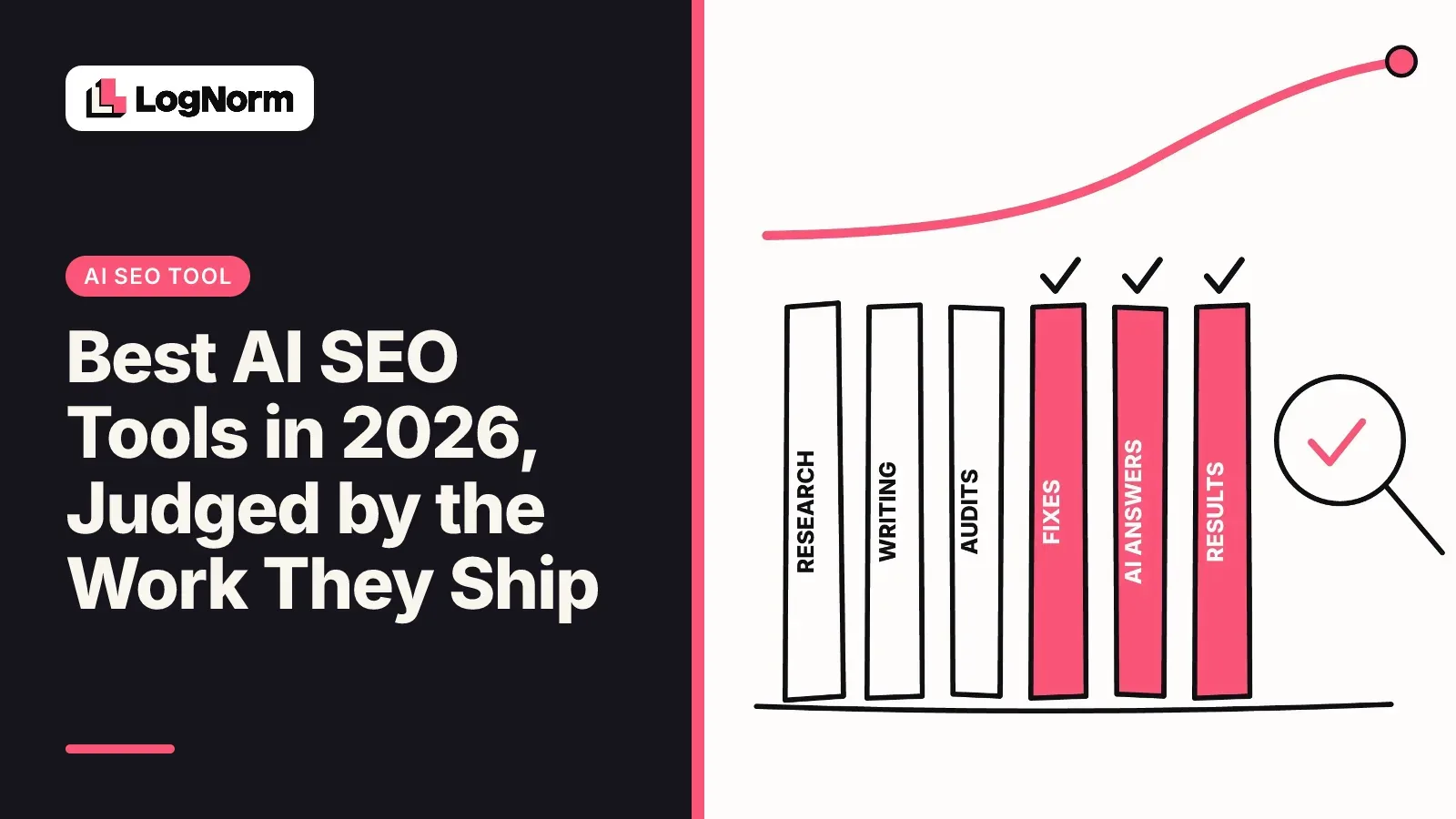
The best AI SEO tool is the one that changes your website and then shows you whether the change worked. Most AI SEO tools stop earlier than that. They research keywords, grade drafts or count how often ChatGPT names you, and leave the shipping and the checking to you.
This guide judges AI SEO tools by the work they ship. It groups them by job, names where each one stops, gives you a checklist for AI content tools and ends with a stack for your team size. If you want the strategy first, start with how startups should use AI for search.
What an AI SEO tool is, and the test that matters
An AI SEO tool is software that uses AI to do part of the search work for you: keyword research, content briefs and drafts, technical audits, or tracking how you appear on Google and in AI answers from ChatGPT, Gemini and Google AI Overviews.
Using AI is no longer the differentiator. 78% of organizations now use AI in their marketing operations, according to the Stanford AI Index. Your competitors have the same tools you do.
So the useful question is narrower. For each tool, ask two things:
- Does it change something on your site, or does it only hand you a report?
- After the change ships, does it tell you whether rankings, clicks or AI answers moved?
A tool that does neither is a research subscription. That can still be worth paying for, but you should know which kind you are buying.
The six jobs AI SEO tools do
AI SEO tools do six jobs: research, writing, audits, fixes, AI visibility tracking and measurement. Most products cover one or two. The jobs at the end of the chain, fixes and measurement, are where the gaps usually are.
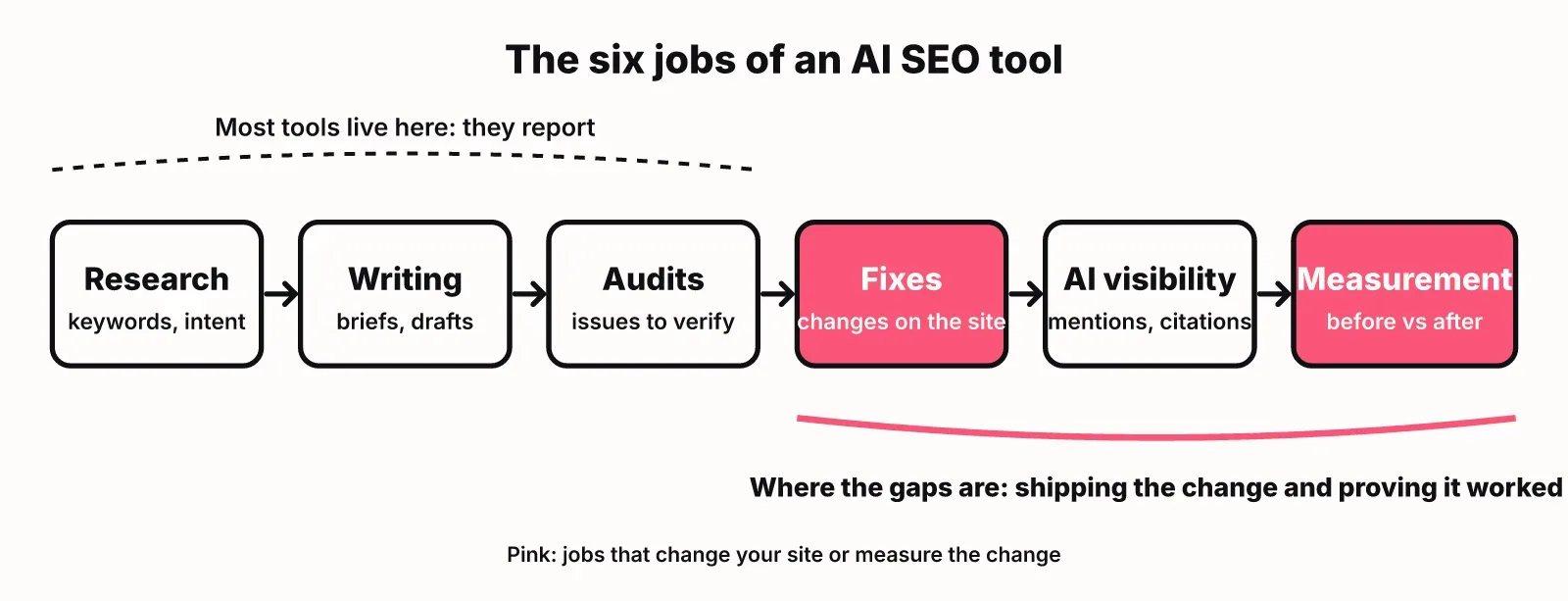
| Job | What shipped work looks like | What a report looks like |
|---|---|---|
| Research | A keyword assigned to one page, with intent and a reason it fits your business | A raw export of every keyword you could target |
| Writing | A reviewed draft with sources, published to your CMS | A content score |
| Audits | Issues you can verify, ranked by what matters | A list of hundreds of "issues" |
| Fixes | A changed title, a new schema block, a merged pull request | A recommendation to change them |
| AI visibility | A page written to win a specific prompt | A share-of-voice chart |
| Measurement | Before and after numbers for each change | A traffic graph with no link to the work |
Read the table as a checklist for your current stack. If every tool you pay for sits in the right-hand column, nobody is accountable for the left one, and that is usually you.
Best AI SEO tools in 2026, by the work they ship
The best AI SEO tools in 2026 split cleanly by job. Semrush One and Ahrefs lead research, Surfer, Frase and Clearscope lead content optimization, seo.ai publishes on autopilot, and a group of AI visibility trackers (SE Ranking, Peec AI, OtterlyAI, Profound, Rankscale) report how AI engines talk about you. LogNorm sits across them as the layer that ranks the work, ships it and measures it.
| Tool | Main job | What it ships | Where it stops |
|---|---|---|---|
| Semrush One | Research suite | Keyword research, site audits, competitor analysis and AI visibility tracking across Google AI Mode, ChatGPT and Perplexity | You decide what to do with the data and do the work |
| Ahrefs | Research | Backlink research and competitive intelligence | Research only; changes happen elsewhere |
| Surfer SEO | Content optimization | Real-time content grading in an editor scored against the search results | Scores your draft; does not check your claims or measure the page later |
| Frase | Content briefs | Fast content briefs and outlines | The brief is the output; writing and publishing are on you |
| Clearscope | Content optimization | Content reports for a target query | Same as Surfer: guidance, not a shipped page |
| Writesonic | AI writing | Drafts from its AI writer | Draft quality depends on your review |
| seo.ai | Autopilot SEO | New pages published on your site each week and link building, in 50+ languages | Volume without a human plan; check what it publishes under your name |
| SE Ranking | Rank and AI tracking | AI Overview and ChatGPT visibility tracking | Tracking; the fix is yours |
| Peec AI, OtterlyAI, Profound, Rankscale | AI visibility tracking | Brand mentions, citations and competitor share of voice in AI answers | Tracking; none of them rewrite your pages |
| LogNorm | Plan, ship, measure | Ranked moves from audits, Search Console, keywords, competitors and AI answers; drafts with claim checks; fixes validated on the live site; results at 28 and 90 days | Not a backlink database; brings no link building |
Three patterns stand out. Research suites are wide but leave every decision to you. Content optimizers grade text against what already ranks, which tells you nothing about whether a sentence is true. AI visibility trackers are the newest category and the most report-shaped of all.
LogNorm is our product, so weigh that line accordingly. It does not replace a backlink index like Ahrefs. What it adds is the part the table shows is missing: every finding becomes a move ranked against the others, the work ships through your team or AI agents such as Claude Code and Codex over MCP, and each shipped move is measured afterwards.
How to evaluate AI SEO content creation tools
Evaluate an AI SEO content creation tool on whether its drafts are true, specific to your company and measurable after they ship. Readability and keyword scores matter less than any of those three.
Use these criteria in a trial:
- Grounding. The draft should draw on your positioning, docs and pricing, not on generic web text. Ask where each product claim came from.
- Claim checks. Every statistic should link to a real source. A tool that invents a "studies show" line will do it on your live site too.
- Research from the live results. The brief should reflect the pages ranking today and the questions people ask, not a template outline.
- Your rules. You should be able to set house style once (banned words, formatting, image rules) and have every draft follow it.
- Publishing. One step to your CMS or repository, so drafts don't die in a doc.
- Measurement. After publishing, the tool should report what happened to that page's clicks, rankings and AI citations.
The fastest trial is a page you know well. Have the tool write about your own product, then count the claims you would have to correct. Two or three errors on a page about your own business tells you what it will do on topics you know less about.
Watch for three warning signs: numbers without sources, no record of what changed between versions, and no way to see results after publishing.
LogNorm's content studio was built against this list. Briefs come from the live search results, drafts are grounded in a Company Brain of your own docs, a live scorecard runs claim checks, and the page goes to your CMS in one click.
Search Atlas alternatives that pair keyword research with content workflows
If you want a Search Atlas alternative that connects keyword research to content generation, choose a tool where the keyword you pick feeds the brief and the draft directly, with no export and re-import between steps. There are four ways to get that.
| Approach | Example | Good for | Trade-off |
|---|---|---|---|
| All-in-one suite | Semrush One | Teams that want research, audits and AI tracking under one login | Content still needs a writer and an editor |
| Research plus optimizer | Ahrefs or Semrush with Surfer, Frase or Clearscope | Teams with writers who want scoring in the editor | Two tools, two subscriptions, a manual hand-off |
| Autopilot publisher | seo.ai | Owners who want pages live with no involvement | Less control over what ships under your name |
| Planning layer | LogNorm | Small teams that want each keyword judged, briefed, drafted, published and measured in one flow | Uses your team or AI agents for code fixes rather than editing your site itself |
In LogNorm, keyword research rates every keyword for fit, intent and format, groups keywords into pages and pages into topics, and turns clusters into moves. A content move then runs research, brief, draft and publish in sequence. See the keyword workflow for how a keyword becomes a page.
The real choice is volume against review. Autopilot tools publish more pages. Reviewed workflows publish fewer pages that you would sign your name to. For a startup whose site is its main sales asset, the second is usually the safer bet.
AI tools for SEO and GEO: where tracking ends and fixes begin
AI tools for SEO and GEO (generative engine optimization) mostly track. They ask ChatGPT, Gemini and Google AI Overviews your buyers' questions and report whether you were named. Very few change anything on your site.
Tracking still matters, because it tells you which prompts to work on. Two facts about every answer are worth separating: whether the engine mentions you, and whether it cites one of your pages. They need different fixes. Mentioned but not cited means engines know you from third parties. Cited but not mentioned means your page teaches without making the case for your product. Our guide to what AI visibility is and how to measure it covers the four cases in full.
The fix side looks different. It is a GEO audit (AI crawler access in robots.txt, answerability across the site, agent readiness), followed by pages written to answer specific prompts. For Google's summaries, see our guide to getting cited in Google AI Overviews.
The step most trackers skip is closing the loop. In LogNorm, every shipped page is linked to the prompts it was meant to affect. The Impact tab then compares mention, citation and recommendation rates before and after the ship date, and counts the answers that cite the new page.
A stack that ships: picks by team size
The right AI SEO stack depends on who will do the work, not on how many features you can afford. Pick one tool per job you actually have people (or agents) for.
| Team | Research | Writing | AI visibility | Who ships fixes |
|---|---|---|---|---|
| Solo founder | One tool that turns research into a short ranked list | Drafts you review, with claim checks | A handful of prompts that matter to buyers | You, or an AI coding agent working from the list |
| Small growth team | Search Console plus a keyword tool that judges fit | Briefs and drafts in one flow, published to your CMS | Weekly runs across ChatGPT, Gemini and AI Overviews | An engineer or AI agent, with fixes validated on the live site |
| Agency | A research suite like Semrush One or Ahrefs | An optimizer like Surfer or Clearscope for writers | A dedicated tracker per client | Account teams, with before and after numbers for each client |
For a solo founder or a small team, the expensive mistake is buying three research tools and no capacity to act. One ranked list you finish beats five dashboards you skim.
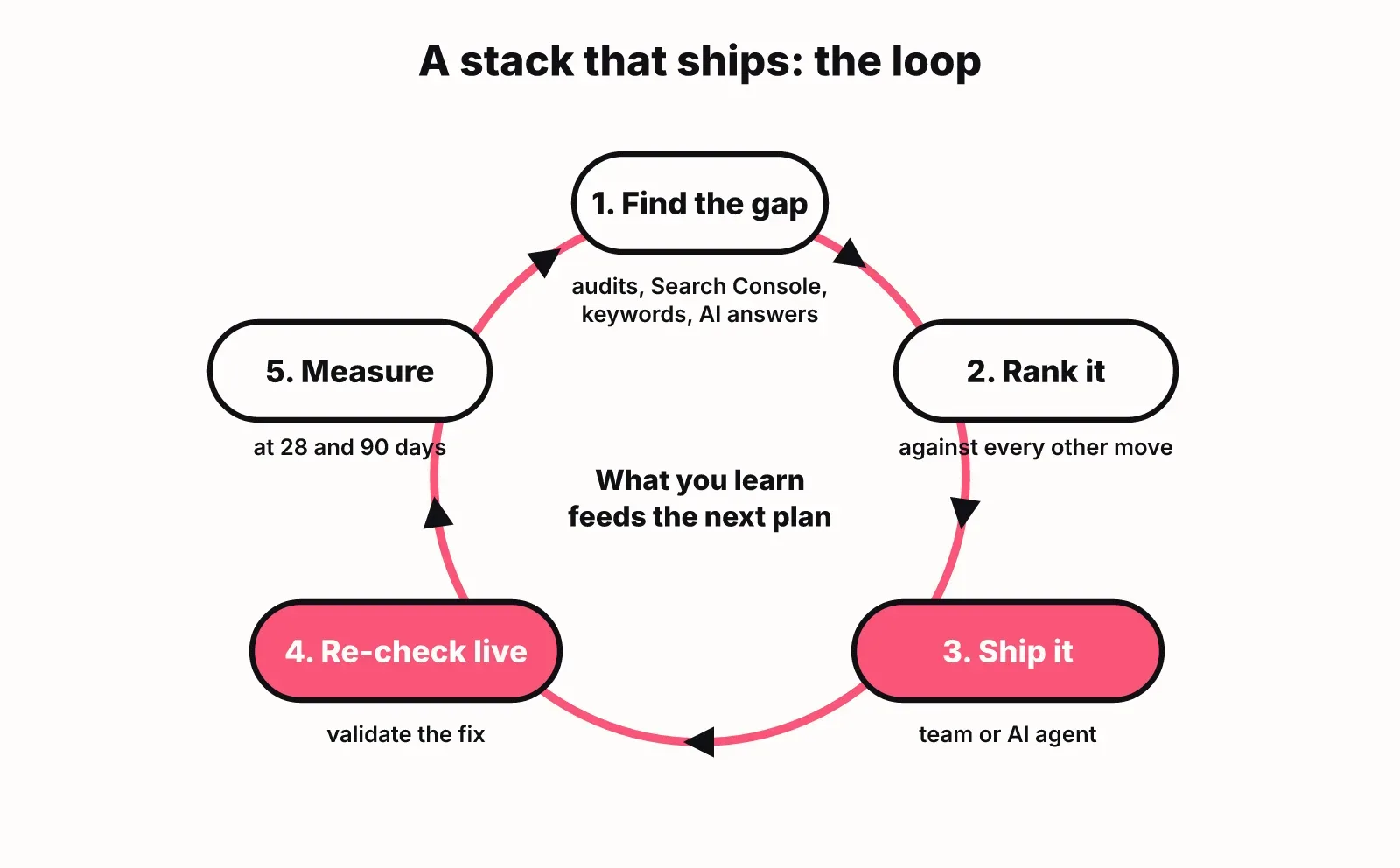
The loop matters more than any single tool: find the gap, rank it against everything else, ship it, check the fix on the live site, then measure. LogNorm's SEO and GEO audit validates a fix without re-running the whole audit, and shipped moves are measured at 28 and 90 days. For a wider view of the category beyond AI features, see our guide to choosing search engine optimization tools.
FAQ
What are AI SEO tools?
AI SEO tools use AI to do search work: keyword research, briefs and drafts, technical audits and tracking how you appear on Google and in AI answers. They differ most in whether they change your site or only report on it.
What is the best AI SEO tool?
There is no single best tool, because each covers different jobs. Semrush One is the widest research suite, Surfer and Frase lead content optimization, and AI visibility trackers such as Peec AI and OtterlyAI cover AI answers. If your bottleneck is getting work shipped and measured, use a planning layer like LogNorm alongside one research tool.
Can ChatGPT be used for SEO?
Yes, for drafting outlines, rewriting titles and brainstorming questions. It does not see your Search Console data, your rankings or the live results, and it will state facts it cannot source, so check every claim before you publish.
Is an AI SEO tool integrated with Google Search Console and Google Analytics 4?
Many are, but check each one. LogNorm connects to Search Console, which adds striking-distance, click-through and decay moves plus daily rank data. Ask any vendor whether it uses that data to choose work or only to chart it.
Can AI tools help me optimize for AI search results?
Yes. Trackers show which prompts skip you and which sources the engines cite instead. A GEO audit finds crawler and answerability gaps. Then pages written to answer those prompts, measured against the same prompts after shipping, are what move the answers.
Does your website need an llms.txt file?
An llms.txt file is a short Markdown index of your site written for AI agents. It is cheap to add and helps agents find your key pages, so treat it as part of agent readiness rather than a ranking lever. LogNorm's GEO audit checks markdown and discovery for agents alongside AI crawler access.
How much do GEO and AI search visibility tracking tools cost?
Pricing for GEO trackers mostly scales with the number of prompts you track, the number of AI engines you check and how often runs happen. Compare plans on cost per tracked prompt per engine, and check whether the price includes anything beyond tracking.