Content Gap Analysis: Find the Pages You're Missing
A content gap analysis method for startups: find missing pages via competitor keywords, buyer-journey page types, Search Console and AI answers, then rank.


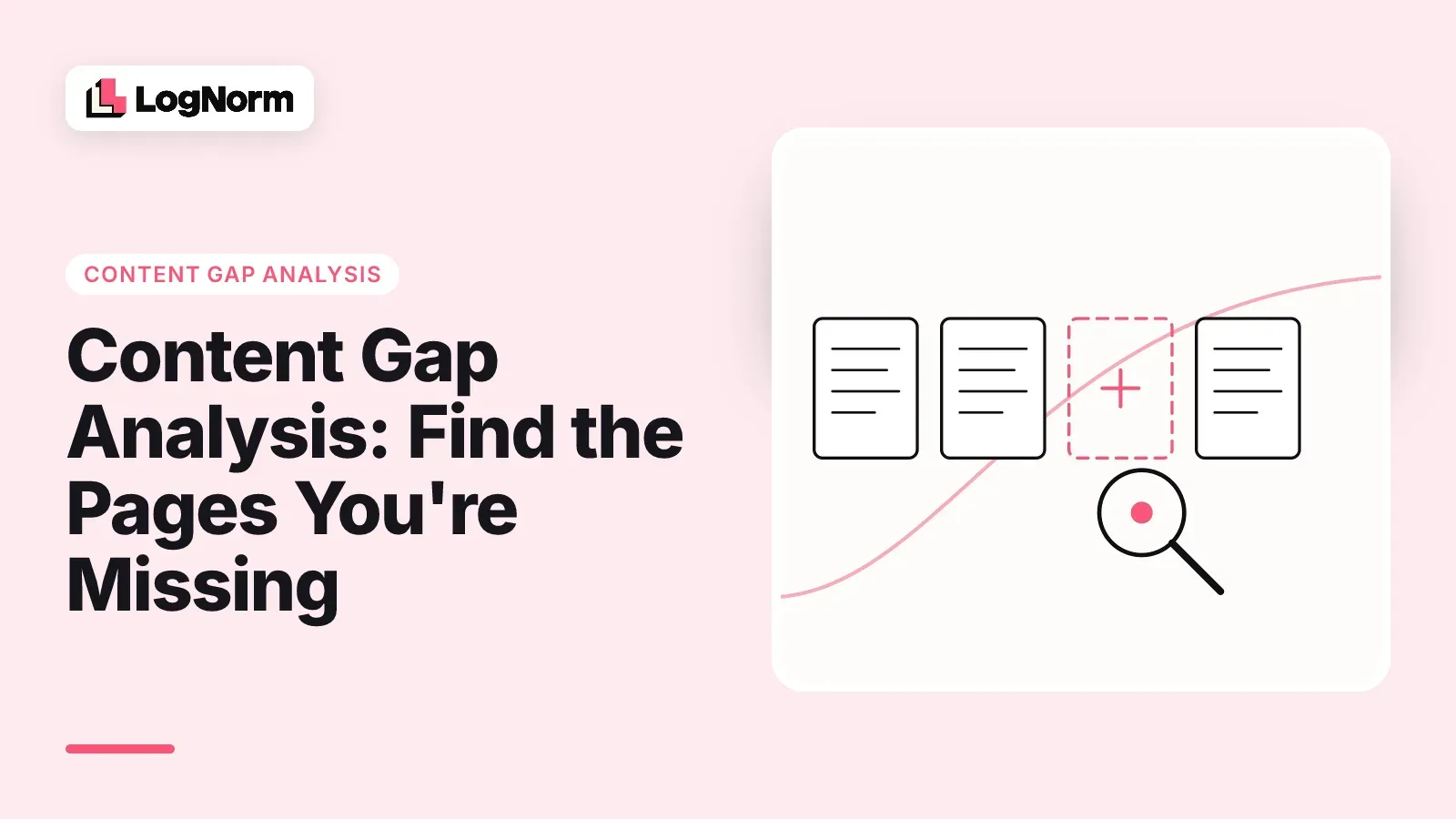
A content gap analysis is the process of finding the pages your buyers look for that your site doesn't have, or has too thinly to compete. You compare what you've published against searcher demand, competitor sites, your Search Console data and AI answers, then decide which missing pages to build first.
Most guides treat it as a keyword exercise: export a competitor's rankings, subtract yours, write about what's left. That finds blog topics. It rarely finds the comparison or integration page a buyer needs on the way to signing up, and those are usually the pages a startup is missing.
This guide uses four sources of gaps, each answering a different question, and ends with a way to rank what you find.
What is a content gap analysis?
A content gap analysis finds the topics and page types your audience needs that your site doesn't cover yet. The output is a list of pages to create or rebuild, each tied to evidence that someone is looking for it.
Two kinds of gap matter:
- A missing page: nobody on your site answers the question at all.
- A thin page: you have something, but it answers a different question, or answers this one in a paragraph when the searcher needs a full page.
Count gaps in pages, not keywords. Twelve gap keywords about "X vs Y pricing", "X or Y for small teams" and "difference between X and Y" are one missing comparison page. If you count them as twelve gaps, you'll plan twelve thin posts that compete with each other.
Content gap analysis vs keyword gap analysis
A keyword gap analysis is one input to a content gap analysis. It lists queries a competitor ranks for and you don't. A content gap analysis asks the wider question of which pages your buyers need, using keyword gaps plus your own search data, the buyer journey and AI answers. If you only run the keyword version, you only see gaps that a competitor has already filled.
Why missing pages cost more than weak ones
A page you don't have can't rank or be cited. A weak page at least sits in the index and collects impressions you can learn from. That's why gap analysis usually beats polishing existing posts as the next piece of work for a young site.
The returns also concentrate near the top. In Backlinko's study of 4 million Google results, the first organic result had an average click-through rate of 27.6%. A page built for the exact question has a far better shot at that position than a loosely related post.
There's a second reason to think in pages that answer a question completely. SparkToro's 2024 clickstream study found that 58.5% of US Google searches ended without a click, and First Page Sage puts the US figure at 74.2%. When so many searches end on the results page or in an AI answer, the page that gets quoted is the one that answers the question directly. A missing page can't be quoted.
Most teams feel the problem already. In the Content Marketing Institute's 2025 B2B benchmark, 58% of B2B marketers rated their content strategy only "moderately effective". A list of pages backed by evidence is a cheap way to make the next quarter's content less of a guess.
Source 1: competitor keyword gaps
A competitor keyword gap is a query a competitor ranks for, say in the top 30, and you don't rank for at all. It's the fastest gap source to pull and the one every SEO tool supports.
Three rules keep it useful:
- Leave out searches for the competitor's own brand. You won't rank for their name, and you shouldn't try.
- Keep "X vs Y" and "X alternatives" searches. They mention a competitor but they're winnable, and they're often the highest-intent queries on the list.
- Group the gap keywords into pages before you count anything. One group is one page you could write.
Pick competitors from the search results, not from your sales deck. The sites ranking for your target queries are your search competitors, even when they sell something different. We cover choosing them, pulling their rankings and studying their winning pages step by step in our guide to SEO competitor analysis, so this guide won't repeat it.
The limit of this source is that it only shows gaps your competitors have filled. If nobody in your category has built a good integration page, a keyword gap report will never tell you to build one.
Source 2: buyer-journey page types
A buyer-journey gap is a page type your buyers expect at some step of evaluating you that your site doesn't have. Checking by page type finds gaps that keyword exports hide, because these pages often target modest-volume queries with strong intent.
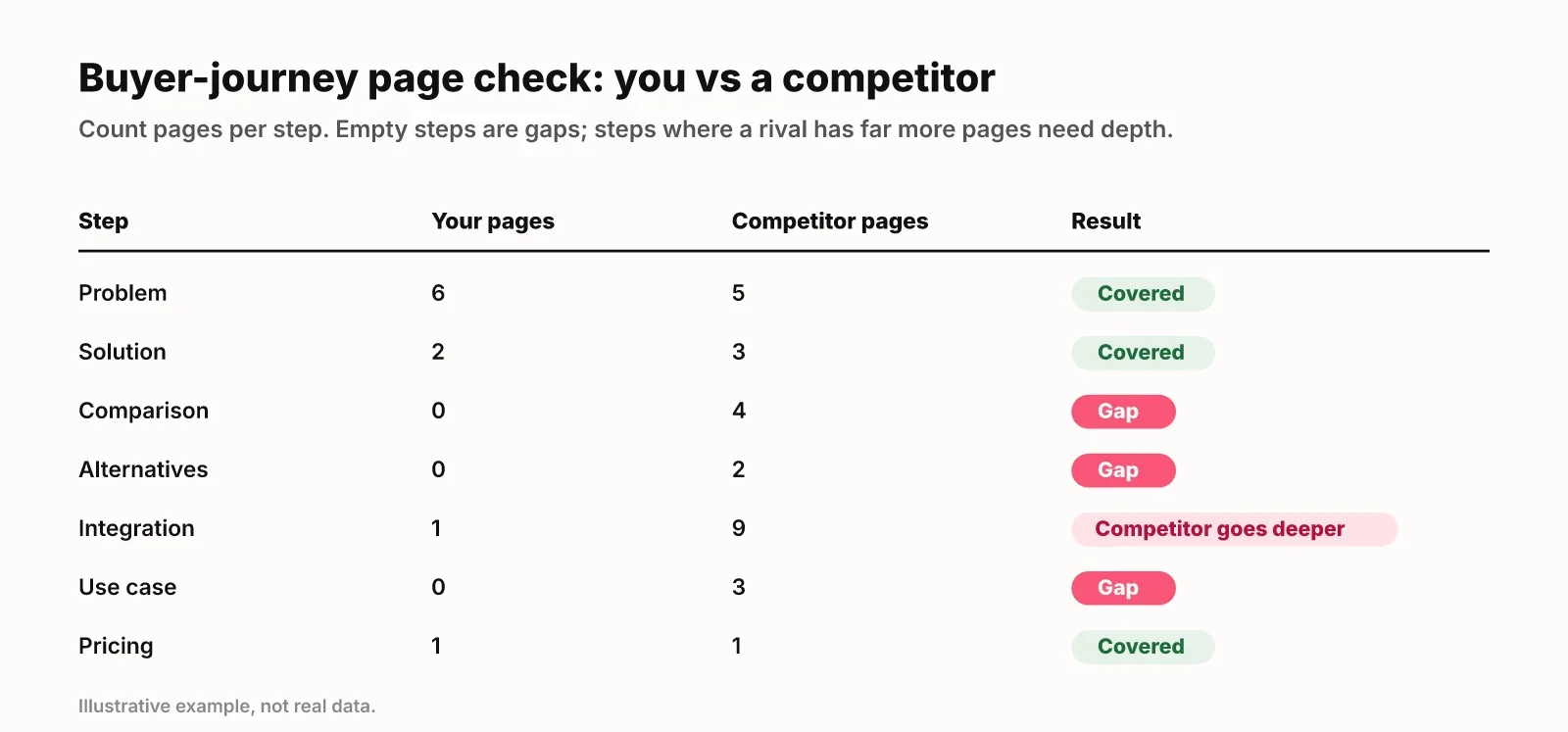
Inventory your site against seven page types:
| Step | Page type | The buyer's question | Typical example |
|---|---|---|---|
| Problem | Problem explainer | "Why does this keep happening, and is it worth fixing?" | "Why SaaS trials don't convert" |
| Solution | Solution or category page | "What kind of tool fixes this?" | "Trial conversion software" |
| Comparison | Head-to-head page | "How does X compare with Y?" | "Acme vs Globex" |
| Alternatives | Alternatives page | "What else should I look at besides X?" | "Globex alternatives" |
| Integration | Integration page | "Does it work with the tools I already use?" | "Acme + HubSpot" |
| Use case | Use-case page | "Does it fit a team like mine?" | "Acme for agencies" |
| Pricing | Pricing page | "What will it cost me?" | "/pricing" |
For each step, write down how many pages you have and how many each competitor has. Three outcomes are possible:
- Covered: you have at least one solid page for the step.
- Gap: you have nothing.
- Competitors go deeper: you have a page, but a competitor has several times as many, for example one comparison page per rival or one use-case page per industry.
Startups are usually strong on the problem and solution steps, because that's where the blog lives, and empty on comparison, alternatives and integration. Those decision-stage pages are where a gap costs the most, because the buyer has already chosen a category and is choosing a vendor.
Source 3: Search Console queries without a dedicated page
Your own Search Console data shows gaps no competitor tool can see: queries where Google already shows your site, but from a page that was written for something else. Each one is a page Google is half-willing to rank.
Here's the check:
- Open the Performance report, set the range to the last 3 months and add the Page dimension next to Query.
- Keep queries with steady impressions and an average position somewhere between 8 and 30. Below that range Google barely associates you with the query; above it you already have a page that works.
- For each query, open the ranking page and ask one question: was this page written to answer this query?
- If the answer is no, decide between a new page and a new section. A new page when the query has its own intent (a comparison, a use case, a how-to). A section on the existing page when the query is a sub-question of what the page already covers.
Look out for a pattern: one page ranking for many unrelated queries at position 15 to 25. That's a page doing the work of several, and it's usually a sign that a cluster of missing pages is hiding behind it.
Source 4: AI answers where competitors are cited
An AI-answer gap is a buyer prompt where ChatGPT, Gemini or Google AI Overviews cite a competitor's page and you have no equivalent page to cite. This is the gap source most content gap guides skip, and it matters more as searches end without a click.
Run it like this:
- Write the 10 to 20 prompts a buyer would type while evaluating your category, without your brand name: "best tools for X", "X vs Y", "how do I do Z without hiring", "alternatives to Y for small teams".
- Ask each prompt in the assistants your buyers use, from the country you sell in, and save the answers with their sources.
- For each cited source, note who it is (a competitor's own site, a review site, a publisher, a forum) and what kind of page it is (listicle, comparison, docs, product page, how-to).
- Mark a gap when a competitor's own page of a given type is cited and you have no page of that type.
Separate two cases. When a competitor's own comparison page is cited, you need your own comparison page, which is a content gap. When a third-party listicle names your competitors and not you, writing a page on your site won't fix it; that's an outreach gap. Put it on a different list.
Run the prompts more than once before acting on them. Answers change between runs and engines, so one answer is an anecdote; the same competitor page cited across several runs is a pattern.
Prioritise: score each gap and pick what to build first
Prioritising gaps means merging all four sources into one list of pages and ranking them by how close each page sits to a buying decision and how much evidence backs it. A page that shows up in more than one source is almost always worth building before a page that shows up once.
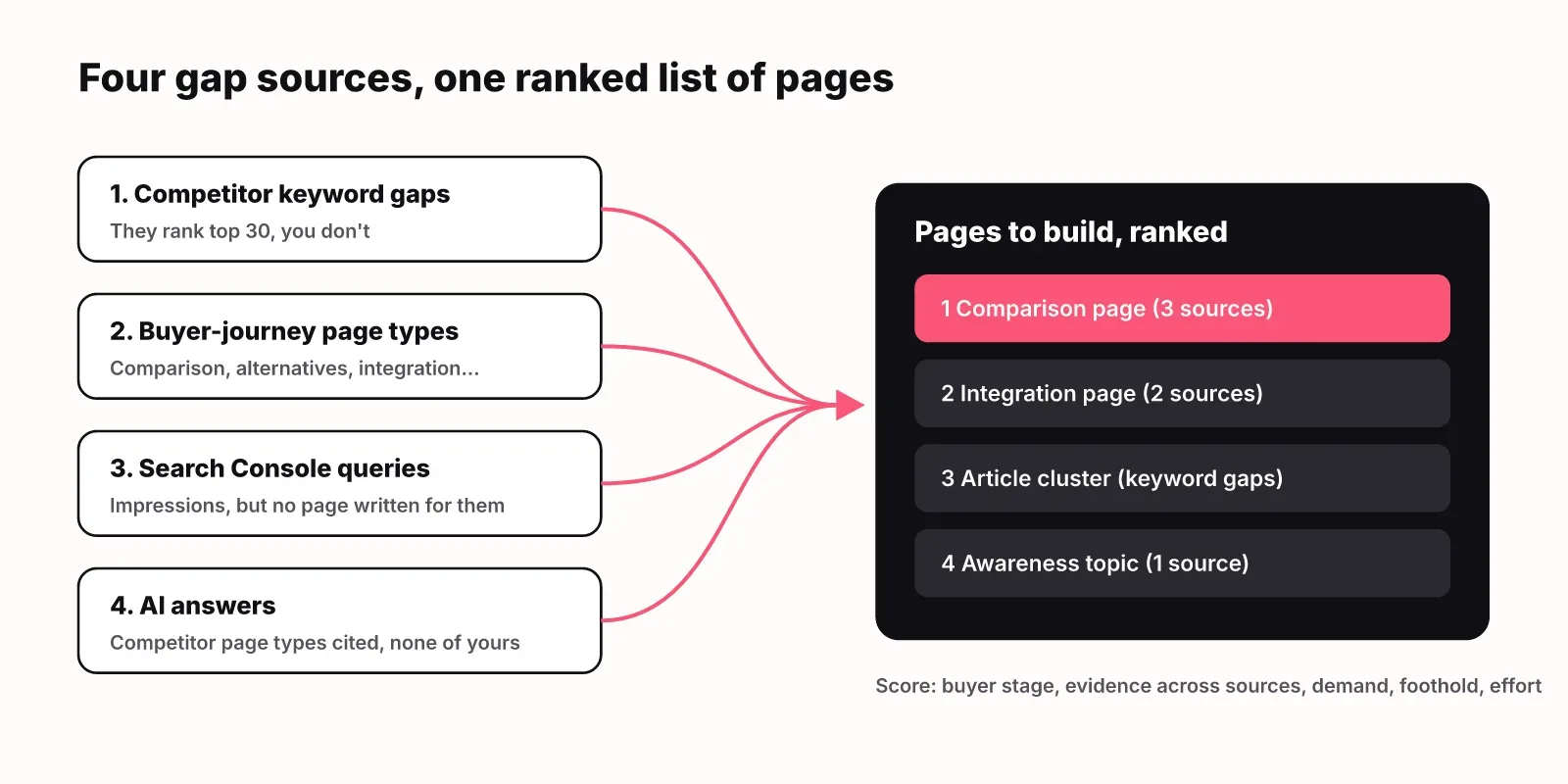
Score each candidate page on these signals:
| Signal | What to check | How it moves the score |
|---|---|---|
| Buyer stage | Is this a problem, solution or decision page? | Decision pages (comparison, alternatives, pricing, integration) first |
| Evidence across sources | How many of the four sources point to it? | Two or more sources beats one high-volume keyword |
| Demand | Combined monthly searches of the grouped keywords | Higher demand raises it, but low volume doesn't rule out a decision page |
| Your foothold | Search Console impressions or a page at position 8 to 30 | A foothold makes the win faster |
| Effort | Can you write it from what you know today? | Pages that need research, data or a customer you don't have yet go later |
Then sort into three batches:
- Decision-stage pages with evidence from two or more sources. Build these first, even if each one targets only a few hundred searches a month.
- Clusters of gap keywords that form a full article or a hub with spokes. Plan these as a series so they link to each other; our guide to SEO content strategy covers turning them into a ranked backlog.
- Awareness-stage topics that only one source supports. Keep them, but don't let them crowd out batch one.
How long does it take? Pulling the four sources by hand for three competitors is a day or two of work. Rerun it quarterly, and again whenever a new competitor starts ranking for your core terms or you launch a new product line. A gap list older than six months is mostly a list of pages someone else has built since.
Doing it with LogNorm
LogNorm runs the page-type part of this analysis for you in the page-gap map, and puts every gap into the same ranked plan as the rest of your growth work.
Under Site, the Page-gap map tab lines up the seven buyer-journey steps (problem, solution, comparison, alternatives, integration, use case and pricing) and marks each one Covered, Gap or, once competitors are analysed, Competitors go deeper, which means a competitor has more than twice as many pages for that step. It also places every analysed page of yours in the funnel. With competitors tracked, you see coverage per competitor and can create a head-to-head comparison or alternatives move for each one. After each analysis, LogNorm creates gap moves for the commercial steps on its own.
The other sources feed the same plan. A keyword gap in LogNorm is a keyword a tracked competitor ranks for in the top 30 that you don't, with the competitor's brand searches left out, and related gap keywords are grouped into article topics. Keyword research also pulls in Search Console queries with at least 10 impressions over the last 90 days. AI visibility tracking raises "Pages to build" learnings when a competitor's type of page gets cited and you have no equivalent. Each gap becomes a move, ranked against fixes and other content in a ranked weekly plan, and the chosen pages go through briefs and drafts grounded in your Company Brain.
You can run every step in this guide without a tool. What a tool saves you is the merging: four exports, one list, rerun every quarter.
FAQ
What is a content gap?
A content gap is a question your buyers ask that no page on your site answers well. It can be a missing page, such as no comparison with your main rival, or a thin one, such as a paragraph where the searcher needs a full guide.
What's the difference between a content gap and a keyword gap analysis?
A keyword gap analysis lists queries a competitor ranks for and you don't. A content gap analysis decides which pages you're missing, using keyword gaps as one input along with buyer-journey page types, your Search Console queries and AI answers.
How often should I run a content gap analysis?
Run a full content gap analysis every quarter. Rerun the competitor and AI-answer parts sooner when a new competitor appears in your search results or you launch a product line that brings new buyer questions.
How long does a content gap analysis take?
By hand, plan on one to two days for a small site and three competitors: a few hours per source, then a few more to group gaps into pages and score them. The scoring is the part not to rush.
Which competitors should I compare against?
Compare against the sites that rank for your target queries and get cited in AI answers for your buyer prompts. Three to five is enough. Include a publisher or review site if it owns the results you want, even though it doesn't sell what you sell.
Can a content gap analysis tool analyze whole websites?
It depends on the tool. Article-level tools compare one of your pages with one competitor page, which helps improve a thin page but won't find missing ones. Site-level tools compare rankings or page inventories across whole domains, which is what you need to find the pages you're missing.