Competitor Intelligence for Startups: A Lightweight System
A lightweight competitor intelligence system for startups: what to watch, how often to check, a one-page template and how to turn signals into decisions.



Competitor intelligence for a startup is a short, repeatable habit: watch a handful of public signals from the three to five companies your buyers compare you with, write down what changed, and decide what, if anything, you will do about it. You do not need a CI platform or an analyst. You need a list, a page, a calendar slot and an owner.
This guide gives you that system. It covers which competitors to pick, the five signals worth watching, a cadence a small team can keep, a one-page template you can copy today, and a rule for turning each signal into a decision.
What competitor intelligence means for a startup
Competitor intelligence is the practice of collecting and reading public information about the companies your buyers weigh you against, so you can make better product, pricing and marketing decisions. At a large company it is a function with its own tools and reports. At a startup it is about an hour a week.
The difference is scope. A startup version watches few competitors, few signals and produces one page. Anything you collect that never changes a decision is noise, and noise is what makes most CI efforts die after a month.
Someone has to own it. At an early startup that is usually the founder or the first marketer. In bigger teams it tends to sit with product marketing: Product Marketing Alliance reports that 65.2% of product marketers are involved in competitive intelligence (Product Marketing Alliance). Pick one person by name. Shared ownership means no ownership.
Pick the competitors worth watching
Watch three to five companies, chosen by where your buyers actually meet them. More than five and the weekly sweep stops fitting in half an hour.
Build the list from evidence, not from who annoys you on social media:
- Search the phrases a buyer would type when looking for a product like yours, and note who shows up repeatedly.
- Ask ChatGPT, Gemini and Google (which may show an AI Overview) the same buyer questions and note which brands they name.
- Check which names come up in sales calls and lost deals.
- Add one status quo option, such as spreadsheets, an agency or doing nothing, because that is often what you really lose to.
Revisit the list every quarter. Competitors drop out and new ones appear, especially in AI answers, which often name brands you have never heard of.
This article stays broad on purpose. If you want the search-specific version, with keyword gaps and the pages that rank against you, that belongs in an SEO competitor analysis, which is a deeper exercise covered by our SEO competitor analysis tool page.
The five signals to watch
The five signals that matter most for a startup are positioning, pricing pages, new pages and launches, search and AI-answer presence, and reviews. Each one is public, each one changes slowly enough to check weekly or monthly, and each one maps to a decision you can actually make.
| Signal | Where to look | Change that matters | Check |
|---|---|---|---|
| Positioning | Homepage headline, meta title, About page, LinkedIn tagline | New category words, new target customer, a claim aimed at you | Weekly |
| Pricing page | /pricing, plan comparison table, FAQ | New tier, changed limits, free plan added or removed, "contact sales" gating | Weekly |
| New pages and launches | Changelog, blog, sitemap, "vs" and "alternatives" pages, integrations directory | A comparison page naming you, a launch in your core use case, a new integration | Weekly |
| Search and AI-answer presence | Google results for buyer queries, ChatGPT, Gemini, Google AI Overviews | They start ranking or being recommended where you were, or you drop out | Monthly |
| Reviews | G2, Capterra, app stores, Reddit threads, public community forums | The same complaint or praise repeated across several reviews | Monthly |
Positioning is the first thing to read because it tells you who they think they are selling to. A rival that changes its headline from "for agencies" to "for startups" has just moved toward you, often months before any feature does.
Pricing pages are the most honest page a competitor publishes. Limits and gating show which customers they want and which they would rather lose. A new low tier or a removed free plan is a signal you can act on within a week.
New pages are where intent shows first. Watch especially for comparison and alternatives pages that name you, because buyers who search "you vs them" are close to a decision and the competitor has written the answer.
Search and AI-answer presence is the signal most guides skip. Buyers now ask assistants which tool to use, and the answer names a few brands. If a competitor is recommended for your core question and you are not mentioned, that is a distribution problem you can work on.
Reviews tell you what customers feel after buying. One angry review is an anecdote. The same complaint in five reviews is a gap you can position against.
A cadence a small team can keep
A lightweight system runs on three rhythms: a weekly sweep of about 30 minutes, a monthly review that ends in decisions, and a quarterly reset of the competitor list and your own positioning.
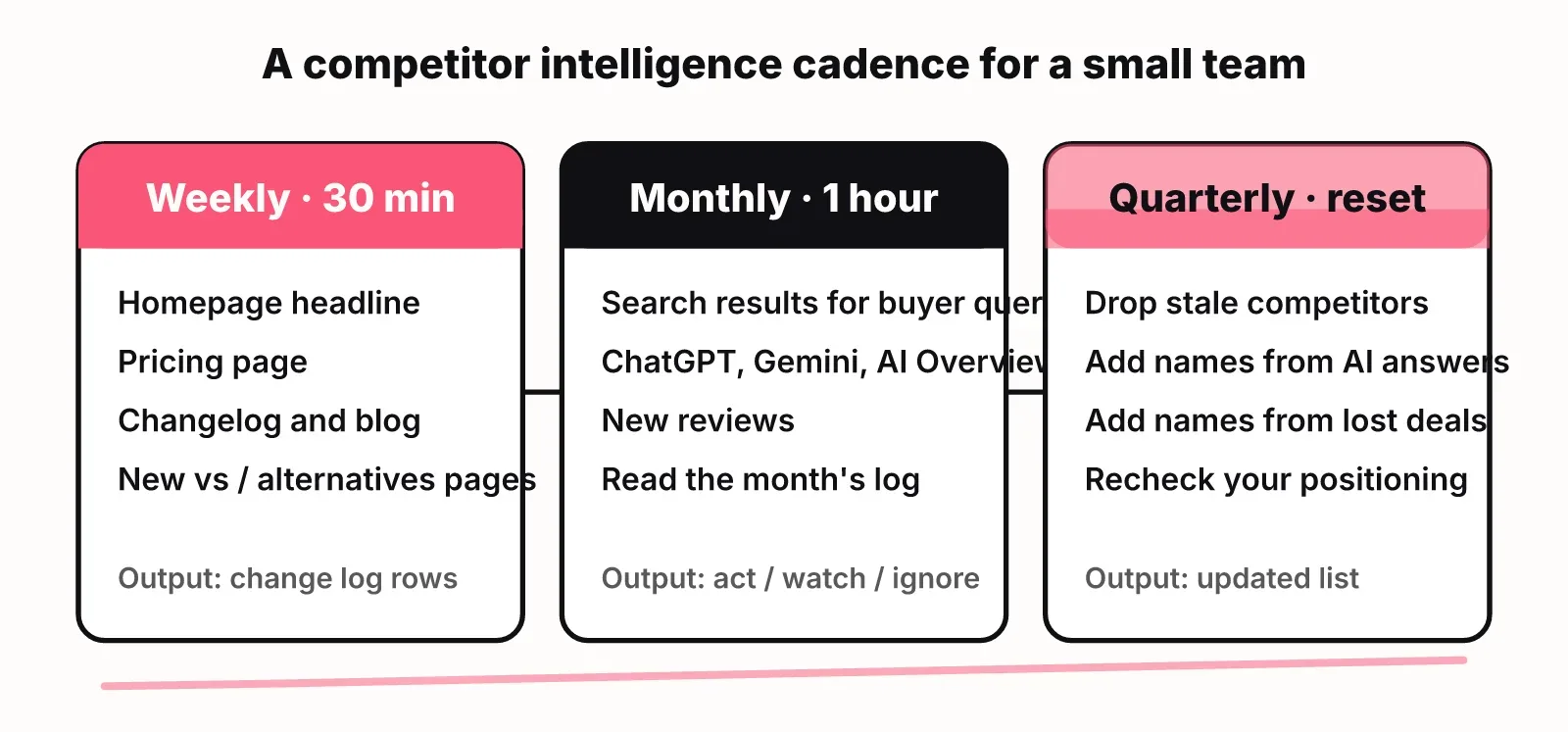
The weekly sweep covers the fast signals. Open each competitor's homepage, pricing page, changelog and blog, compare against last week's notes and log only what changed. If nothing changed, write "no change" and move on. That line is still useful, because it tells you a quiet competitor is quiet.
The monthly review covers the slower signals and forces choices. Run your buyer queries in Google and the AI assistants, skim new reviews, then read the month's change log as a whole. Patterns show up here that single entries hide, such as three launches that all point at the same customer segment.
The quarterly reset is where you step back. Swap out competitors that no longer matter, add new names from AI answers and lost deals, and check whether your own positioning still holds against what changed.
Put all three in the calendar with the owner's name on them. A system that depends on remembering is not a system.
The one-page competitor intelligence template
Keep one page per competitor and one shared change log. The page holds the current picture; the log holds what moved and when. Copy this into a doc or a Notion page:
COMPETITOR: ______________________    Last updated: ________   Owner: ________

Positioning (their headline, in their words):
Who they say it is for:
Pricing snapshot (tiers, entry price, key limits, free plan yes/no):
Recent launches and new pages (last 90 days):
Comparison or alternatives pages that name us:
Search: buyer queries where they rank and we don't:
AI answers: prompts where they are named or recommended and we are not:
Review themes (repeated praise / repeated complaints):
Where they beat us (honestly):
Where we beat them:
What we are doing about it (act / watch / ignore, with date):
The change log is a simple table with five columns: date, competitor, signal, what changed and decision. Every weekly sweep adds rows. Every monthly review reads them.
Two rules keep the template useful. Quote competitors in their own words rather than paraphrasing, so you notice when the words change. And always fill in "where they beat us", because a CI page that only flatters you will not change any decision.
Turn signals into decisions
Every signal you log should end in one of three outcomes: act, watch or ignore. If you cannot name which one, you have not finished reading the signal.
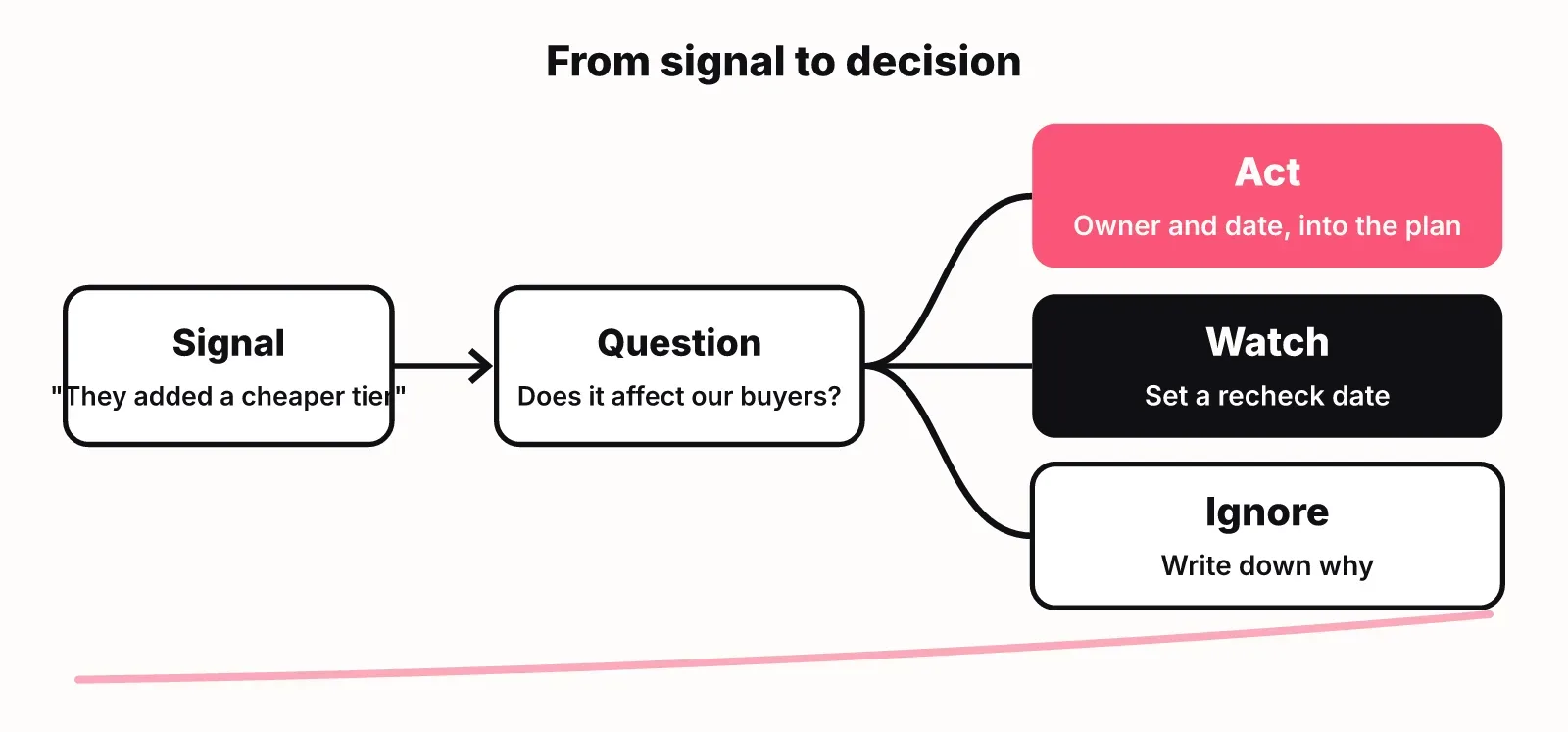
Act means a specific change with an owner and a date. Watch means you set a check for a later date because one data point is not enough. Ignore means you decided it does not affect your buyers, and you wrote down why so nobody relitigates it next week.
| Signal | Question to ask | Possible decision |
|---|---|---|
| A competitor publishes a "them vs you" page | Is their comparison accurate, and do we have our own? | Act: publish an honest comparison page from your side |
| A competitor adds a cheaper tier | Are we losing deals on price, or on fit? | Watch: check lost deals for price objections over the next month |
| A competitor's headline moves toward your customer | Do our buyers now see them as an option? | Act: sharpen your homepage claim for that segment |
| AI assistants recommend a competitor for your core question and skip you | Which pages do the answers cite for them? | Act: build or improve the kind of page being cited |
| Reviews repeat the same complaint about a competitor | Do we solve that problem well, and can we prove it? | Act: add the proof to your comparison and pricing pages |
| A competitor ships a feature you do not have | Do our target buyers ask for it? | Ignore or watch, unless it shows up in your own sales calls |
Responding is not the same as copying. A competitor's new feature is a decision they made for their customers. Your job is to decide whether it changes anything for yours, and to answer in your own positioning rather than theirs.
The decisions then go into the same backlog as everything else, ranked against your other work. Competitor moves are not automatically urgent. A comparison page that buyers search for may beat a feature response; a pricing tweak may beat both.
Tools: what to automate and what to keep manual
Keep the judgement manual and automate the noticing. Reading a competitor's pricing page takes two minutes, and you will understand it better than any summary. What is hard to do by hand is spotting new pages, tracking where competitors rank and checking what AI assistants say across many prompts every week.
A sensible split for a small team:
- Manual: positioning, pricing, reviews and the monthly decisions.
- Automated: change detection on competitor sites, search rankings for your buyer queries, and AI-answer tracking.
Competitor tracking in LogNorm covers the automated half for search and AI answers. You track your competitors, see their pages, catch new comparison pages and see keyword gaps where a tracked competitor ranks and you do not. Its AI visibility tracking reads answers from ChatGPT, Gemini and Google AI Overviews and puts you next to each tracked competitor on mention, citation and recommendation rates, including the prompts they win while you are absent. Answers often name brands you do not track, and LogNorm lists those so you can add them. Findings become moves in a ranked weekly plan, which is the act step of this system. The Competitors docs explain the setup.
It does not replace reading a pricing page yourself or talking to customers who chose someone else. Those stay manual, whichever tool you use.
Mistakes that kill a competitor intelligence habit
Most startup CI efforts fail for a few predictable reasons:
- Tracking too many companies, so the sweep takes hours and gets skipped.
- Logging everything and deciding nothing, so the page becomes an archive nobody reads.
- Reacting to every launch, which turns your roadmap into someone else's.
- Ignoring the status quo, even though "do nothing" often wins more deals than any rival.
- Only watching Google and never checking what AI assistants tell buyers.
If your system feels heavy, cut competitors before you cut cadence. A weekly look at three companies beats a monthly look at ten.
FAQ
What is competitor intelligence?
Competitor intelligence is collecting and analysing public information about the companies your buyers compare you with, such as their positioning, pricing, launches, search and AI-answer presence and reviews, to make better business decisions. For a startup it is a weekly habit, not a department.
Is competitor intelligence the same as competitive intelligence?
The terms are used almost interchangeably. Competitive intelligence is often used for the wider practice that also covers markets, regulation and industry trends. Competitor intelligence focuses on specific rival companies, which is where a startup should start.
How is competitor intelligence gathered?
Gather it from public, ethical sources: competitor websites, pricing pages, changelogs, search results, AI assistant answers, review sites, job postings, press releases and conversations with your own customers and prospects. Never misrepresent who you are to get information.
How many competitors should a startup track?
Track three to five: the direct competitors buyers compare you with most, one adjacent tool and the status quo alternative. Revisit the list every quarter.
How often should you review competitors?
Do a short weekly sweep of homepages, pricing pages and changelogs, a monthly review of search, AI answers and reviews that ends in decisions, and a quarterly reset of the competitor list.
Where does funding data such as Crunchbase fit?
Funding data tells you who has new money to spend, which hints at hiring and marketing pushes ahead. It is a useful context signal in the quarterly reset, alongside job postings. It is less useful week to week than pricing, pages and AI answers, because those show what a competitor is actually doing with buyers.