AI Brand Monitoring: Know What ChatGPT and Gemini Say About You
AI brand monitoring, step by step: track mentions, citations and recommendations by engine and country, and fix answers that miss or misdescribe you.


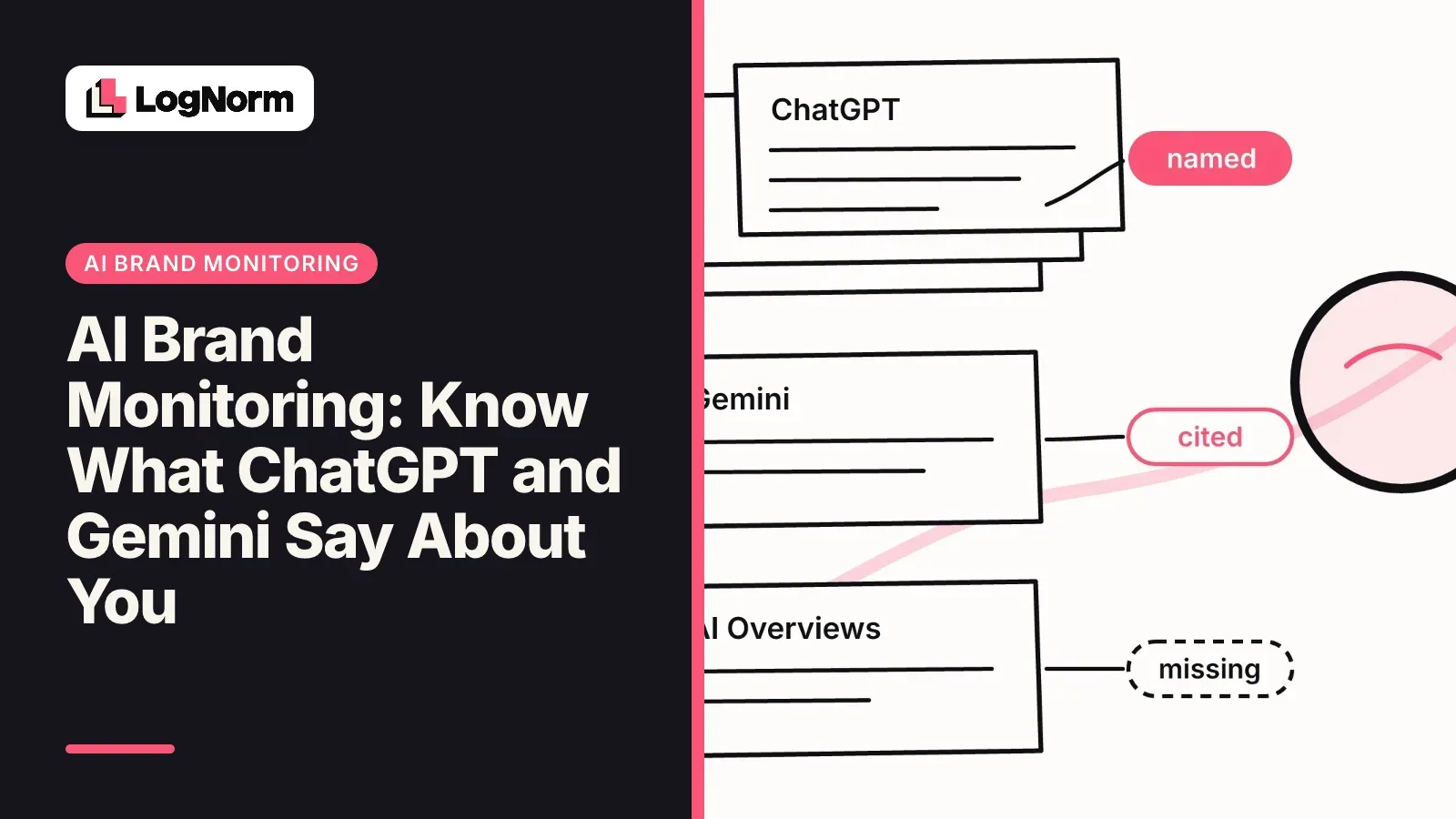
AI brand monitoring means asking ChatGPT, Gemini and Google AI Overviews the questions your buyers ask, then recording whether each answer names you, cites your pages and recommends you. Do it per engine and per country, on a schedule, and act on each kind of gap differently. This guide covers what to track, how to set it up, how often to check and what to do when an engine leaves you out or gets you wrong.
If you are still choosing software, the comparison lives in our hub on the best AI visibility tools. This article is about the method, which stays the same whichever tool runs it.
What AI brand monitoring is (and what it is not)
AI brand monitoring is the practice of running a fixed set of buyer prompts through AI assistants and logging how each generated answer treats your brand. The unit you track is a prompt, answered by one engine, from one country, on one day.
That makes it different from social listening. A social listening tool finds posts that already exist and mention you. An AI answer does not exist until someone asks, and it is written fresh each time. You cannot search for it. You have to ask the question yourself and read what comes back.
Two rules follow from that:
- Phrase prompts the way a buyer would, without your brand name. "Best invoicing tool for freelancers in Germany" tells you whether you get recommended. "What is Acme?" only tells you what the engine knows when someone already found you.
- Ask the consumer products with web search on, not the raw developer APIs. ChatGPT, Gemini and AI Overviews search the web, pick sources and phrase answers differently from the bare models, and the products are what your buyers use.
Some teams call this ai search monitoring, AEO monitoring or GEO tracking. The work is the same. For the wider concept, see what AI visibility is and how to measure it.
Mentions, citations and recommendations are three different signals
A mention, a citation and a recommendation each tell you something different, so track all three and never fold them into one visibility score. A mention means the answer names your brand in its text. A citation means one of your pages is among the answer's sources. A recommendation is how the answer treats you once it names you.
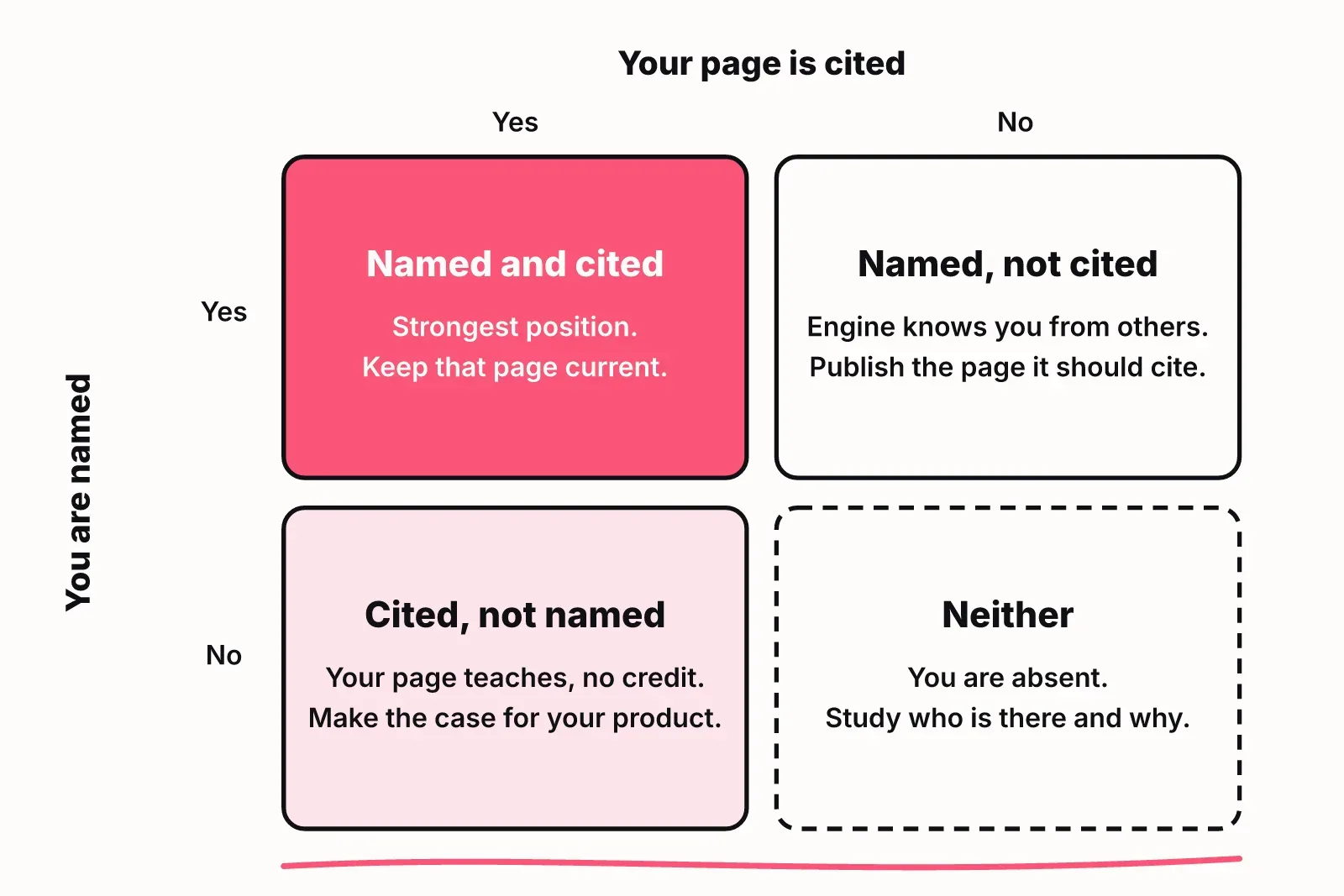
Mention and citation are independent, so every answer lands in one of four cases:
| Case | What it means | First response |
|---|---|---|
| Mentioned and cited | The answer names you and uses your page as a source | Keep that page current |
| Mentioned, not cited | The engine knows you from third-party sites | Publish the page it should be citing |
| Cited, not mentioned | Your page informs the answer, but you are not named | Make the case for your product on that page |
| Neither | You are absent | Study who is there and which sources they got |
Recommendation strength sits on top of the mention. In LogNorm's AI visibility docs we grade it on a scale: top pick, recommended as one of several options, neutral mention, alternative or fallback, critical or warning, and not mentioned. Being named as "a cheaper fallback to X" counts as a mention, but it is a weak position. A warning is worse than absence.
A single "AI visibility score" hides all of this. A rising score can mean more neutral mentions while your top-pick answers fall. Keep the signals separate and you can see which fix each prompt needs.
Monitor each engine and country separately
Track each engine on its own, because ChatGPT, Gemini and Google AI Overviews give different answers to the same prompt. Our own tracked prompt shows how far apart they get. When we asked "best AI visibility and GEO tools to monitor brand mentions in ChatGPT", Google's AI Overview named five tools (Profound, SE Ranking, Peec, Ahrefs and OtterlyAI) and cited six pages. ChatGPT's answer to the same prompt named no brands and cited no sources at all. Averaging those two would describe neither.
Country matters too. Engines search the web from where the question is asked, in that market's language, so the sources they find differ. A brand that is the top pick in the US can be absent in the UK because the local review sites and listicles are different. Run your prompts from each market you sell into.
Watch for bias in how models describe brands. Researchers who audited brand representation across language models found a consistent pattern of associating global brands with positive attributes more than local brands. If you are a smaller or regional company, expect to work harder for the same description, and check the wording of answers, not just whether you appear.
Two engine quirks to plan around:
- Google shows an AI Overview for some searches and not others. A search with no overview is not an answer where you were absent. Count it separately, or your rates will look worse than they are.
- Answers vary from run to run, even for the same prompt on the same engine. One answer is an anecdote. A trend across several runs is a signal.
Build the prompt set
A good prompt set covers your category at every buying stage, phrased the way buyers ask, with 10 to 30 prompts to start. Fewer than 10 and one odd answer swings your numbers. More than 30 and you pay to track prompts nobody acts on.
Mix five kinds of prompt:
- Category: "best project management tool for small agencies"
- Alternatives: "alternatives to [the leader in your category]"
- How to: "how do I track client hours across projects"
- Comparison: "[competitor A] vs [competitor B] for agencies"
- Evaluation: "is [your category] software worth it for a 5-person team"
Comparison and alternatives prompts are where you see how competitors are recommended next to you. If a rival is the top pick and you are the fallback, that is the gap to close.
Then set your brand identity before the first run. A tracker that only matches your site name and domain will miss part of your presence. Add product names, former names and abbreviations as brand terms, and add owned sites such as your docs subdomain, your GitHub organisation or a marketplace listing. Skip this and an answer that recommends your product by its old name, or cites your GitHub README, counts as a miss.
How often to check
Weekly is the right default for AI brand monitoring. It catches changes within days, gives you enough runs to see a trend within a month, and keeps cost down, since monitoring cost grows with every answer you collect.
Adjust from there:
| Cadence | Use it when |
|---|---|
| Daily | Launch weeks, a rename, a PR issue, or a page you shipped and want to watch |
| Twice a week | A competitive category where rivals publish comparison pages often |
| Weekly | The default for most startups |
| Monthly | A slow category, or a tight budget while you build the first fixes |
Do not judge a fix by the next day's run. Publishing a page does not change answers overnight. Engines take days to weeks to find and use a new page, so give each change several scheduled runs before you call it.
What to do when you are missing or misdescribed
Each failure case has its own fix, and the sources the engine cited tell you which one applies. Open the answer, read every page it used, and match the case:
| What you see | Likely cause | What to do |
|---|---|---|
| Not mentioned, competitors are | The cited listicles, reviews and forum threads name them, not you | Get onto those pages: pitch the listicle author, answer the forum thread, claim your review profile |
| A competitor's page type gets cited, you have none | You lack the comparison, alternatives or pricing page the engine wants | Build that page for the prompt |
| Mentioned, not cited | The engine knows you only through third parties | Publish a clear owned page on the topic so the engine has your version to cite |
| Cited, not mentioned | Your page teaches but never names the product as the answer | Add a section that says plainly when to use your product and why |
| Named only as an alternative | Sources frame you as second choice | Find the page doing the framing; publish a direct comparison with honest criteria |
| Misdescribed or warned against | Outdated or wrong facts on a page the engine trusts | Fix the facts on your own pages first, then ask the third-party source to correct theirs |
| One engine ignores you, others do not | That engine prefers different sources, or cannot read your site | Check AI crawler access in robots.txt and the engine's favoured source types |
| One kind of source dominates (forums, review sites) | You are absent from that kind of site | Show up there with real answers, not drive-by links |
Misdescriptions deserve the fastest response. An answer that states the wrong price, a removed feature or a discontinued plan will repeat until the sources change. Start with your own pricing, docs and about pages, because those are the easiest to fix and the most likely to be cited for facts.
If one engine ignores you, run a GEO audit before writing anything new. A blocked crawler or pages that do not load without JavaScript can hide you from one engine while others still find you through third-party sources. LogNorm's SEO and GEO audit checks AI crawler access in robots.txt and answerability across the site. For Google specifically, see how to get cited in Google AI Overviews.
Measure whether your fixes changed the answers
Monitoring only pays off when you link each fix to the prompts it was meant to move and compare before and after. Without that, a better week could be noise and a worse one could be a competitor's new page.
For each page you ship or source you update:
- Note the prompts it targets, and the engines where you were missing.
- Record mention, citation and recommendation rates for those prompts from the runs before the ship date.
- Compare them with the runs since, with the number of answers on each side so a single run does not decide it.
- Check whether any engine now cites the new page itself, for any prompt.
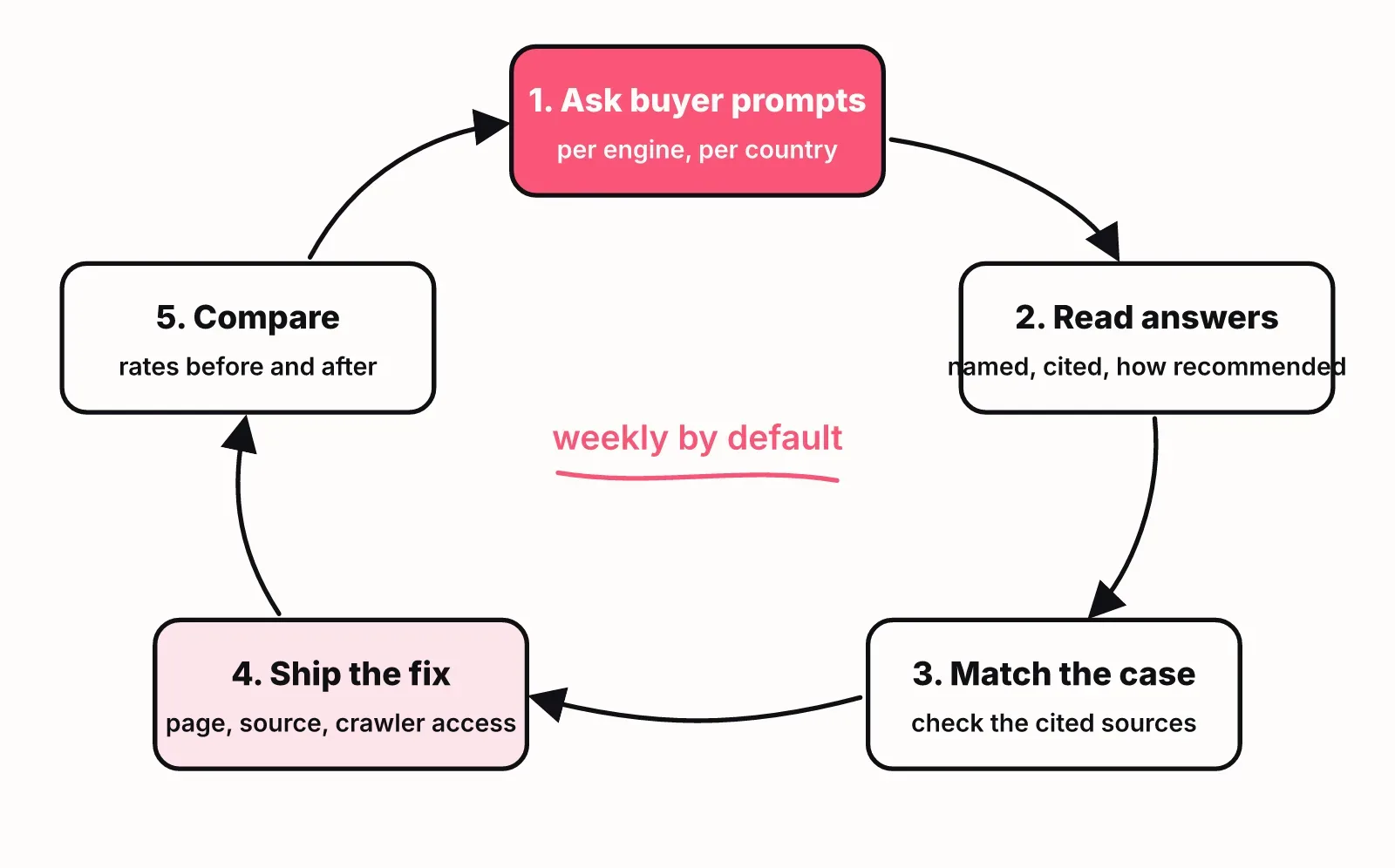
This is the loop we built LogNorm AI Visibility around. It asks ChatGPT, Gemini and Google AI Overviews your prompts from your country on the schedule you pick, records mentions and citations separately, turns gaps into ranked moves in your growth plan, and shows on its Impact tab whether shipped pages changed the answers. LogNorm is not mentioned in any of the 10 prompts we track for our own category yet, so we are running this playbook on ourselves.
FAQ
What is the difference between AI brand monitoring and social listening?
Social listening finds existing posts that mention you. AI brand monitoring asks AI assistants buyer questions and records the answers they generate, which change by engine, country and run. You need prompts and a schedule, not keyword alerts.
Why do ChatGPT and Gemini describe the same brand differently?
Each engine searches the web its own way and draws on different sources, so the pages that shape its answer differ. Training data and model bias add more variation. That is why you track each engine separately.
How often should you monitor what AI says about your brand?
Weekly suits most startups. Go daily around launches or a reputation issue and monthly for slow categories. Judge trends across several runs, not single answers.
What is the best free way to start?
Write 10 buyer prompts without your brand name, ask each in ChatGPT, Gemini and Google from your target country, and log for each answer whether you are named, cited and how you are recommended. Repeat it weekly in a spreadsheet. Move to a tool when the manual run takes longer than acting on it.
How can I see how competitors are recommended by ChatGPT compared to us?
Track comparison and alternatives prompts and log every brand each answer names, with its mention type. Then read which pages the answer cited for the competitor. Those pages are your outreach and content list.
Do I still need Brandwatch or Sprinklr if I use an AI visibility tool?
They answer different questions. Social listening tools cover what people post about you; AI visibility tools cover what assistants tell buyers. If your buyers research in AI assistants, you need the second one, and many startups can wait on the first.
Do you need a Perplexity-only tool, or a broader view?
A broader view, unless your buyers mostly use one engine. Answers differ a lot between engines, so a single-engine tool can show you strong while another engine leaves you out.
How much do AI brand monitoring tools cost?
Price mostly scales with how many prompts you track, how many engines you check and how often runs happen. Daily runs across several engines multiply the number of answers collected, so cadence and engine count move the bill more than anything else. Our AI visibility tools hub compares the options.